|
TL;DR / What matters first Before choosing equipment, review Fitiger's anti-choking device buyer evidence checklist for FDA wording, testing, seller traceability, and kit-selection questions. |

A choking rescue device enters the least forgiving environment in household or facility safety: saliva, food debris, mucus, possible blood, vomit risk, skin oils, rushed hands, floor contact, and a responder who may be shaking after the event.
Biological contamination cannot be managed with household surfactants. Post-use recovery is a life-safety protocol, not a routine maintenance checklist. The safer question is not whether a device looks clean. The safer question is whether the exact instructions for use say the device or component can return to active readiness after use.
For families, schools, restaurants, eldercare teams, and childcare settings, the answer has to come from the exact product labeling: what must be discarded, what can be replaced, what can be cleaned, what must be documented, and what can no longer be trusted.
| Single-use is not soft language. It tells the buyer that the device or component was intended for one use, one patient, or one emergency sequence unless a validated reprocessing pathway says otherwise. |
| FDA's De Novo record for LifeVac describes LifeVac as a non-powered, non-invasive, single-use-only airway clearance device for a victim with complete airway obstruction after the current choking protocol has been followed without success. The same record classifies the generic type under 21 CFR 874.5400, product code QXN, as a suction anti-choking device used as second-line treatment after unsuccessful basic life support choking protocol. |
| That product-specific single-use language should not be automatically applied to every brand. It does establish the buyer discipline for the category: read the exact IFU before assuming any device body, mask, valve, tubing, or accessory can be reused. |
| A device used during choking has already faced biological contamination and mechanical load. If the IFU says single-use, the device should leave active readiness after use. Home cleaning does not rewrite the labeling. |
Reuse questions often fail because buyers discuss the device as one object. A suction-based emergency tool is a component system. One part may be disposable, another replaceable, and another subject to inspection only. The IFU controls the boundary.
|
Component |
Post-use concern |
Safer interpretation |
|
Device body |
Food debris, saliva, internal contamination, mechanical stress, loss of IFU context. |
Follow the exact IFU. Do not reuse if labeled single-use. |
|
Mask |
Face contact, saliva, mucus, skin oils, edge deformation, leakage risk. |
Replace if labeling requires it or if seal integrity is uncertain. |
|
Valve |
Airflow direction, sticking, residue, loss of one-way function. |
Never assume rinsing restores valve mechanics. |
|
Tubing or airway interface |
Oral contact, trapped food particles, hidden biological contamination. |
Treat as high-risk unless validated cleaning instructions exist. |
|
Storage case |
Spillover contamination, glove contact, table or floor exposure. |
Clean or replace according to IFU and facility policy. |
|
Instructions and labels |
Loss, contamination, outdated language, unreadable paper. |
Restock clean instructions and confirm current IFU version. |

| Cleaning removes visible soil. Reprocessing is a validated process designed to return a device to safe, effective reuse without changing its intended performance. Those are not equivalent jobs. |
| CDC notes that hospitals or third-party reprocessors that reprocess single-use devices are considered manufacturers and regulated in the same manner. FDA similarly states that reprocessors of single-use devices are held to the same regulatory requirements as the original manufacturer and must support safety and effectiveness after reprocessing. |
| A parent, school nurse, cafeteria monitor, restaurant manager, or eldercare worker does not become a validated medical-device reprocessor by wiping the mask after an emergency. |
|
User action |
What it may accomplish |
What it does not prove |
|
Wiping the mask |
Removes some visible residue from accessible surfaces. |
Does not prove sterility, seal recovery, valve integrity, or pressure output. |
|
Rinsing parts |
May remove loose debris. |
May drive contamination into hidden channels or damage materials. |
|
Alcohol or disinfectant wipe |
May disinfect compatible exterior surfaces. |
May not reach internal paths and may affect polymers, adhesives, labels, or surface friction if not validated. |
|
Boiling or heat exposure |
May reduce some organisms on compatible materials. |
May deform masks, valves, seals, or attachment points if the IFU does not validate it. |
|
Air drying |
Reduces visible moisture. |
Does not prove internal dryness, microbial safety, or mechanical function. |
|
Home reuse |
Feels economical and practical. |
Does not equal validated reprocessing or legal readiness. |

| A choking event exposes the device to the mouth, airway, hands, floor, food, and panic handling. Contamination can involve saliva, mucus, vomit, blood from oral trauma, respiratory secretions, food particles, skin oils, dust, glove residue, and surfaces touched during the emergency. |
| The next user may be a child, an older adult, an immunocompromised person, a student in a shared school setting, or a resident in long-term care. Returning a used device or used component to service without validated instructions can convert a rescue tool into a cross-contamination route. |
| Facility policy should treat every used device or component as contaminated until the IFU and infection-control procedure say otherwise. |
| A used anti-choking device may still look complete. The performance question is not whether the shell remains intact. The question is whether the pressure circuit still works when the next emergency begins. |
| Post-use performance can change through mask edge deformation, valve sticking, food residue in hidden gaps, weakened attachment points, plunger or handle stress, contaminated face-contact surfaces, lost instructions, or the wrong replacement part. |
| Food mechanics make small losses matter. A mechanical simulator study reported that clearing starch-based solid food material required about 5.4 kPa, or roughly 40.5 mmHg, while gel-like material required about 1.7 kPa. That 3.2x resistance gap does not create a universal clinical threshold. It does show why a micro-leak caused by a stiffened, contaminated, or deformed mask can erase the reserve needed for difficult food boluses. |
| Negative-pressure testing also shows why hidden performance variables matter. A 2025 study comparing a certified suction-based anti-choking device with an uncertified counterfeit alternative reported about 154 +/- 57 mmHg versus 62 +/- 29 mmHg under study conditions. The study does not prove every used device behaves like a counterfeit. It does show that pressure output is a measurable engineering variable, not something a buyer can infer from a clean-looking surface. |
| The mask is the pressure interface. It touches the face, carries contamination risk, and decides whether the device body can close the pressure circuit. |
| Medical-grade silicone can be durable, but durability is not permanence. Natural aging, repeated compression, heat cycles, skin oils, cleaning chemicals, and disinfectant exposure can shift the material response. Published work on facial silicone elastomers has reported hardness changes after natural aging, and silicone material references identify Shore A hardness as a standard way to measure silicone rubber hardness. |
| For a face-contact mask, that matters because a rapid pull loads the edge. If Shore A hardness increases, elongation declines, or compression set appears, the edge may lift from the nose bridge, cheeks, beard area, dentures, or loose skin. A microscopic leak path can collapse the vacuum gradient before the obstruction moves. |
| Treat the numbers below as an engineering lens, not universal specifications for every product. The exact acceptable range belongs to the product design, validation file, IFU, and replacement guidance. |
|
Mask variable |
New/properly stored mask |
Used/aged mask |
Rescue consequence |
|
Edge compliance |
Conforms to facial contour during a fast pull. |
Edge may stiffen, flatten, or lift after use, storage stress, or cleaning exposure. |
Micro-leaks collapse vacuum before pressure reaches the airway opening. |
|
Shore A hardness |
Soft face-contact design often targets flexible ranges; 25-35 units may be used as a soft-interface design benchmark when validated for a product. |
Hardness can increase with aging or stress, shifting away from the intended feel. |
Poor match to complex facial geometry, especially beards, dentures, loose skin, or small faces. |
|
Tensile behavior and elongation |
Material stretches and recovers within the intended load range. |
Elasticity and elongation can decline with aging, heat, or chemicals. |
Rapid pull distorts the edge instead of maintaining seal. |
|
Pressure circuit |
A validated system may generate high negative pressure under defined test conditions, such as 154 +/- 57 mmHg in one certified-device study. |
Leakage loss can push performance toward low-output behavior, such as the 62 +/- 29 mmHg counterfeit-device study condition. |
May fail to preserve enough pressure reserve for resistant bolus mechanics such as 5.4 kPa starch-based material. |
|
Surface condition |
Clean, smooth, intact, and inspectable. |
Residue, scratches, oils, microcracks, or cloudy surface. |
Hygiene and sealing become uncertain. |
|
Traceability |
Official replacement source and current IFU. |
Unknown marketplace mask or old stock. |
Material identity and fit compatibility cannot be verified. |
| Post-use cleaning can attack the same interface that must seal during rescue. Skin oils and food residue are biological problems. Aggressive cleaning chemistry can become a material problem. |
| Disinfectants, alcohols, detergents, boiling water, heat, and repeated wiping should only be used when the IFU specifically validates them. Some polymer systems can swell, stiffen, extract additives, lose surface finish, or change tactile behavior after chemical exposure. Silicone chemistry varies by formulation, fillers, curing system, and additives; no household cleaning rule applies to every medical silicone mask. |
| The practical rule is strict: do not improvise cleaning chemistry on a pressure-interface part. If the product is labeled single-use, the cleaning discussion ends. If the IFU allows cleaning or component replacement, follow the IFU exactly. |
The first emergency may end. The next emergency inherits whatever condition the kit was left in.
|
Post-use failure |
How it appears later |
Rescue consequence |
|
Used mask returned to kit |
Station looks stocked. |
Seal may fail under rapid pull. |
|
Valve residue remains |
Movement seems normal until loaded. |
Airflow direction or one-way function may become unreliable. |
|
IFU discarded or contaminated |
Device is present but instructions are missing. |
User may perform the wrong sequence under panic. |
|
Unverified replacement part installed |
Kit appears restored. |
Material, geometry, and attachment compatibility are unknown. |
|
No incident record |
Staff forget what was used or replaced. |
Procurement cannot audit readiness. |
|
No medical follow-up |
Person seems recovered. |
Aspiration or airway trauma may be missed. |
A serious post-use routine begins after the choking person is transferred to appropriate emergency or medical care. The device reset should be documented while the event is still fresh.
|
Record item |
What to document |
|
Date and location |
When and where the event happened. |
|
Person affected |
Age group and relevant risk factors without unnecessary private detail. |
|
First-line steps |
Back blows, abdominal thrusts, chest thrusts, CPR, dispatcher guidance. |
|
Device use |
Product model, mask used, number of pulls if known, visible contamination. |
|
EMS or medical care |
Whether emergency services or medical evaluation occurred. |
|
Parts removed |
Device body, mask, tubing, valve component, case, gloves, instructions. |
|
Replacement order |
Official parts or full kit replacement source. |
|
Restock date |
When the kit returned to active readiness. |
|
Reviewer |
Person responsible for readiness sign-off. |
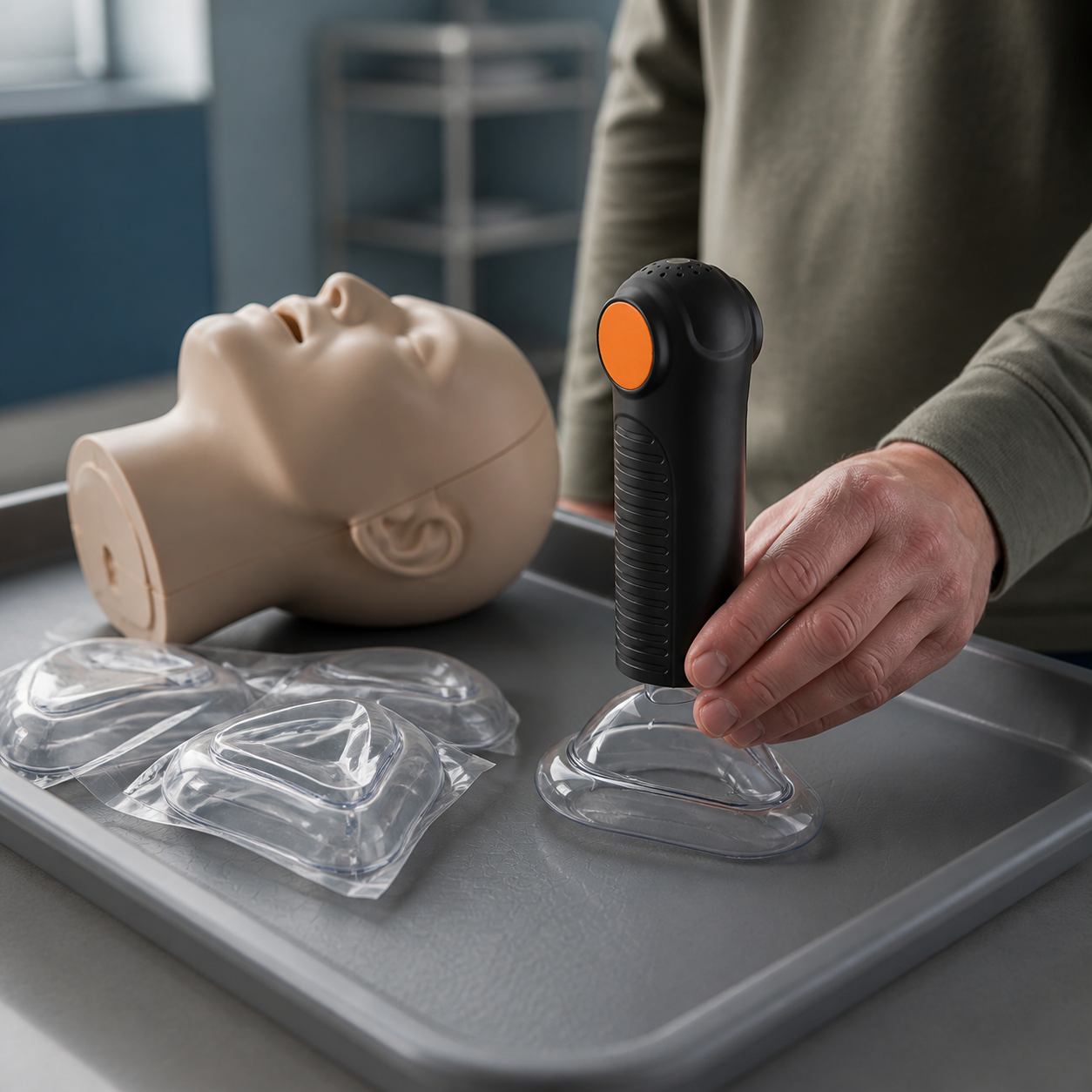
| Fitiger users should follow the exact Fitiger IFU and product-specific replacement instructions for the model in their kit. |
| After any real choking event, remove the used device or used components from active readiness, preserve documentation, contact Fitiger support when needed, and restock through official or authorized channels. Do not mix masks, valves, or parts from unknown sellers. Do not reuse a component that Fitiger labels single-use. Do not clean a component in a way the IFU does not support. |
| Fitiger's post-use boundary is narrow: first-line rescue stays first, the device remains second-line backup, used components are treated as contaminated, mask seal must be protected, replacement parts must be traceable, and readiness must be restored before the next emergency. |
|
Labeling or condition |
Safer decision |
|
Device labeled single-use-only |
Do not reuse. Replace according to IFU. |
|
Mask labeled replace-after-use |
Replace through official or authorized channel. |
|
IFU gives validated cleaning steps |
Follow exactly; do not improvise stronger or different cleaning. |
|
IFU is missing |
Do not place device into readiness use until verified. |
|
Device used on a real choking victim |
Treat as contaminated and mechanically suspect until IFU says otherwise. |
|
Unknown seller or replacement part |
Do not rely on it for emergency readiness. |
|
Visible blood, vomit, food residue, or damage |
Remove from service and replace per IFU or facility policy. |
|
School or facility setting |
Follow infection-control policy and document restock. |
|
Shared household use |
Treat cross-person contamination seriously. |
|
Expired or aged mask |
Replace before relying on the seal. |
| Training gear and rescue gear should not be treated as the same item. |
| A training device may be designed for repeated practice, especially when used without oral contamination and with washable or replaceable demo parts. A real emergency device may have different materials, seals, valves, packaging, or single-use boundaries. Keep training gear separate from active emergency kits. |
|
Use type |
Risk profile |
Safer policy |
|
Dry demonstration with no face or mouth contact |
Low contamination, low mechanical load. |
Follow training-device instructions. |
|
Practice on a manikin |
Surface contact and repeated handling. |
Clean demo parts per training policy; do not confuse with rescue kit. |
|
Real choking event |
Biological contamination and mechanical stress. |
Replace or remove parts according to IFU. |
|
Device used on multiple trainees |
Cross-contamination risk. |
Use training masks, barriers, and cleaning protocol. |
|
Rescue kit opened but not used |
Packaging and readiness may still be affected. |
Inspect, document, and restock as needed. |
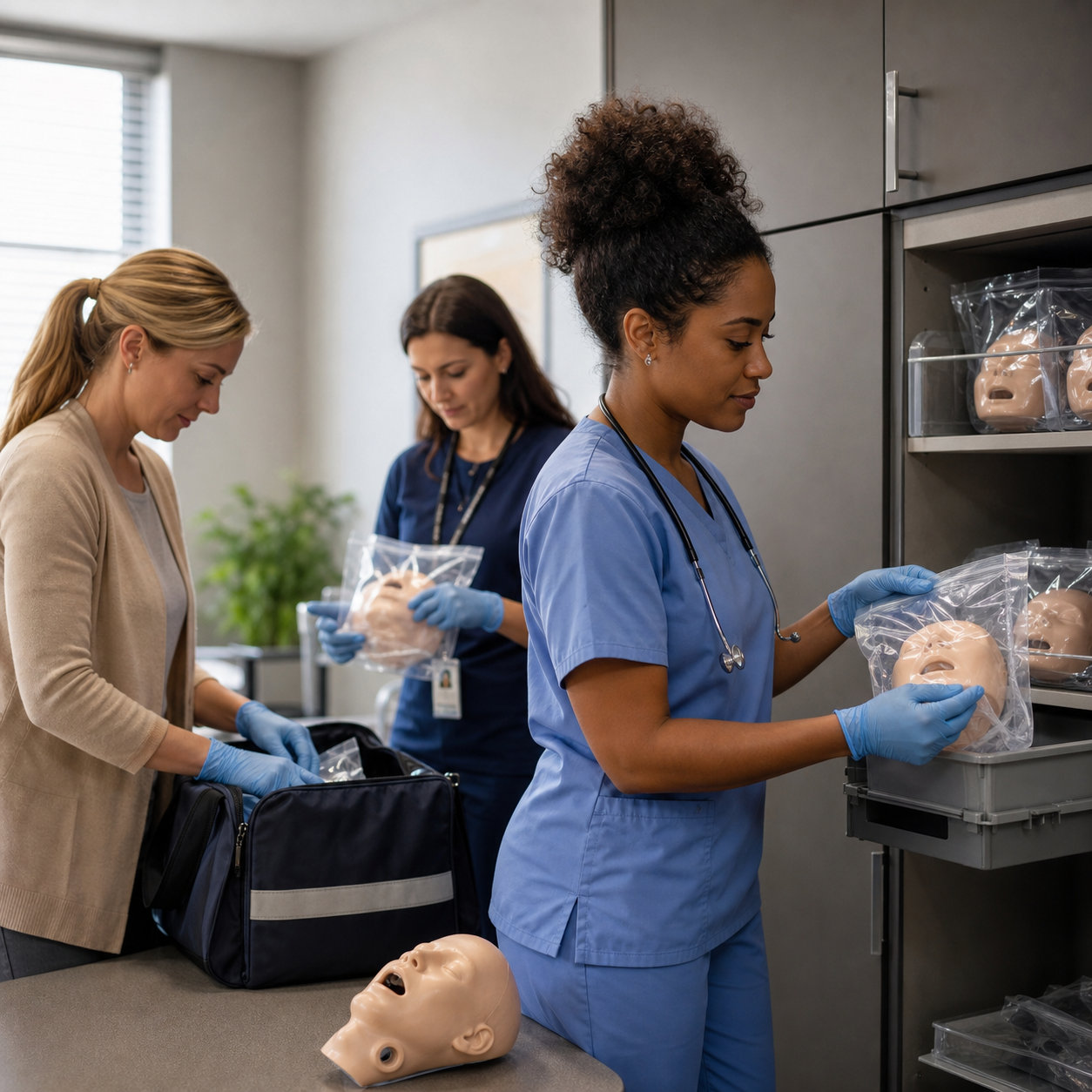
Shared settings cannot rely on memory. The person who used the device may be with EMS, speaking with parents, writing an incident note, or recovering from stress. A second person should know how to remove the device from service and restore readiness.

Infection and contamination concerns rise when the next possible user is medically vulnerable.
For these groups, a casually cleaned mask or device is not acceptable readiness. The next rescue may involve a face and airway already more vulnerable to infection, aspiration, or trauma.
|
Purchase question |
Why it matters |
|
Is the device single-use, reusable, or partially replaceable? |
Determines post-use cost and readiness plan. |
|
Which parts must be replaced after use? |
Prevents contaminated components from staying in service. |
|
Are official replacement masks available? |
Protects seal and material traceability. |
|
Does the IFU explain cleaning limits? |
Prevents improvised reprocessing. |
|
Can the device be used for training? |
Avoids mixing demo use with emergency use. |
|
Is there a post-use reporting pathway? |
Supports safety monitoring and documentation. |
|
Is the seller official or authorized? |
Reduces counterfeit replacement-part risk. |
|
What is the storage and expiration guidance? |
Protects mask seal and material condition. |
| For this topic, the most relevant product path is replacement readiness: official mask availability, storage discipline, and a kit that can be reset after use according to the instructions. Buyers comparing home readiness can review the EasyPumpVac Airway Clearance Home Kit alongside the exact IFU and replacement guidance. |
| For organizations, the practical question is not only what to buy, but how to remove used parts from service, restock clean components, and keep the station ready for the next emergency. |
| Single-use and replacement rules are not small print. They define whether the next emergency kit is real or symbolic. |
| A used anti-choking device may carry saliva, food debris, mucus, vomit, blood, and hidden mechanical stress. Cleaning that is not validated cannot prove infection control or pressure performance. The safer path is exact IFU compliance, traceable replacement parts, post-use documentation, and first-line rescue training that remains current. |
Some are. The answer depends on the exact product and labeling. FDA's LifeVac De Novo record describes LifeVac as single-use-only. Other products may have different rules for the device body, mask, or accessories. Buyers should follow the exact IFU for the device they own.
No. If the exact device or component is labeled single-use, do not reuse it. Home cleaning cannot validate sterility, valve mechanics, mask seal, or pressure-circuit performance. Replacement or removal from service should follow the IFU.
Only if the exact IFU allows it and gives validated cleaning or replacement instructions. Household wiping, rinsing, boiling, or alcohol cleaning does not prove sterility, valve function, mask seal, or pressure performance.
Silicone elastomers can change hardness, elongation, compression set, and surface behavior with aging, heat, compression, cleaning chemicals, skin oils, and environmental exposure. For a face-contact mask, increased Shore A hardness can reduce edge compliance and create leak paths during a rapid pull.
If the IFU requires mask replacement, replace it through an official or authorized channel. Even when visible damage is absent, saliva, food debris, mucus, edge deformation, and material stress can make the mask unreliable.
The FDA product code for the suction anti-choking device category created in the 2026 De Novo framework is QXN. The regulation number is 21 CFR 874.5400.
A clean-looking device may still have hidden contamination, valve residue, mask deformation, reduced edge compliance, or pressure leaks. Visual inspection alone cannot validate infection control or suction performance.
No. Fitiger should be understood as second-line backup in a broader choking response plan. Established choking rescue protocols come first, emergency activation should not be delayed, and the product must be used only within its instructions.
LifeVac, Dechoker, Fitiger, Prepared Hero, Amazon, and other product names may appear in buyer searches around anti-choking device reuse, cleaning, infection risk, and replacement parts. They are trademarks of their respective owners. This article is an independent Fitiger educational guide about single-use labeling, cleaning limits, replacement discipline, and second-line readiness.
This article does not claim Fitiger is clinically superior to any named product. It does not imply Fitiger product-specific FDA authorization unless an exact FDA record supports that claim. It does not replace CPR training, choking first-aid instruction, infection-control policy, manufacturer instructions for use, emergency dispatcher guidance, or professional medical care.
Brand and evidence note: Product names are used only for identification and comparison. This article compares public regulatory language, maintenance logic, material behavior, and buyer safety boundaries. It does not state or imply endorsement, affiliation, or clinical superiority.
| FDA Safety Communication - Supports first-line rescue before anti-choking device use, March 4, 2026 update, and FDA action on unauthorized devices. |
| FDA De Novo Decision - Supports 21 CFR 874.5400, QXN product code, second-line treatment language, at least 1 year of age, and single-use-only LifeVac wording. |
| CDC - Supports the regulatory distinction between ordinary cleaning and regulated reprocessing of single-use devices. |
| FDA - Supports FDA requirements for reprocessors of single-use devices and validation responsibilities. |
| Fijacko et al., 2025 - Supports 154 +/- 57 mmHg vs 62 +/- 29 mmHg suction performance difference under study conditions. |
| Mechanical Simulator of Tongue-Palate Compression - Supports 5.4 kPa vs 1.7 kPa bolus clearing pressure for starch-based vs gum-based materials. |
| AHA Newsroom - Supports 5 back blows + 5 abdominal thrusts for conscious adults/children and 5 back blows + 5 chest thrusts for infants. |
| Polyzois et al. - Supports the concept that silicone elastomer hardness can change with natural aging. |
| Wacker - Supports Shore A hardness as a standard silicone rubber hardness measure and broader silicone material behavior. |
This article is for emergency preparedness education and buyer decision support. It is not medical advice, infection-control policy, legal advice, diagnosis, treatment, FDA compliance advice, or device-specific reprocessing instruction. Follow the exact manufacturer IFU, current choking first-aid training, facility policy, local regulations, and emergency dispatcher instructions. Call emergency services immediately for a severe choking emergency.


