A vehicle is a convenient staging point. It travels to school pickup, sports practice, restaurants, road trips, grandparents' houses, and long stretches of highway where outside help may not be quick. Convenience is not the same as storage suitability. Thermal stress builds inside the cabin whether the kit is used or not.
Before choosing equipment, review Fitiger's anti-choking device buyer evidence checklist for FDA wording, testing, seller traceability, and kit-selection questions.
NHTSA says the inside of a vehicle can exceed 115 F when the outside temperature is just 70 F. A 2018 Arizona State University and UC San Diego study pushed the detail further. In one hour of sun exposure, average cabin air reached 116 F, dashboards averaged 157 F, steering wheels 127 F, and seats 123 F. Those numbers matter because the kit rarely lives in air alone. It sits against surfaces, in pockets near glass, under seats, in trunks, or beside plastic panels that absorb and release heat all day.
A hard case surviving that environment does not prove the kit is still ready. The shell is usually the least interesting material in the system.
Heat cycling attacks mixed-material kits unevenly. Adhesive-backed dressings can lose tack or bleed. Alcohol-based wipes can dry out faster. Elastomer parts can stiffen, soften, or fatigue. Battery-backed accessories lose life faster in chronic heat. A component can still look unused and still perform differently from the condition a caregiver assumes when they say, 'We keep one in the car.'
Material science points in the same direction. Research on silicone pressure-sensitive adhesives shows aging changes adhesion, tack, and cohesion at elevated temperature over time. Medical adhesive literature also treats peel behavior as temperature-sensitive. You do not need a melted bandage to have a degraded one. A quieter loss of grip is enough to change how a dressing or closure behaves when the kit is opened under stress.
The 2026 FDA decision under DEN250012 created 21 CFR 874.5400 for a 'suction anti-choking device as a second-line treatment.' The order defines the device type as Class II, product code QXN, and limits it to complete airway obstruction after unsuccessful use of a BLS choking protocol. FDA also required non-clinical performance testing to verify obstruction-clearing performance, pressures generated, and device and material durability under anticipated conditions of use.
That framework matters for vehicle storage in a specific way. FDA created a defined rescue category. It did not turn a parked car into a validated long-term storage environment. The second-line role only makes operational sense if the unit remains serviceable and reachable without displacing first-line action.
A severe choking event already runs on a tight sequence. Recognition comes first. First-line manual response comes next. A second-line device enters only after standard choking rescue fails. Heat can weaken that sequence in two ways at once.
Condition drift is the first problem. Packaging, seals, flexible components, or stored accessories may no longer behave like new. Access delay is the second. Vehicle storage often means extra layers: trunk under sports gear, organizer inside a larger bag, pouch inside a sealed retail box. FDA's March 4, 2026 safety communication warned that removing, unpacking, and assembling an anti-choking device before attempting standard rescue can delay care. Heat stress and packaging delay are a bad combination.
Do not assume a sealed package equals a ready package. Do not assume the dashboard is harmless because the hard shell has not warped. Do not assume a battery-powered accessory is fine because it worked at purchase. Do not assume an adult who owns the kit can reach it quickly from the driver's seat, the rear bench, or the side of a busy parking lot.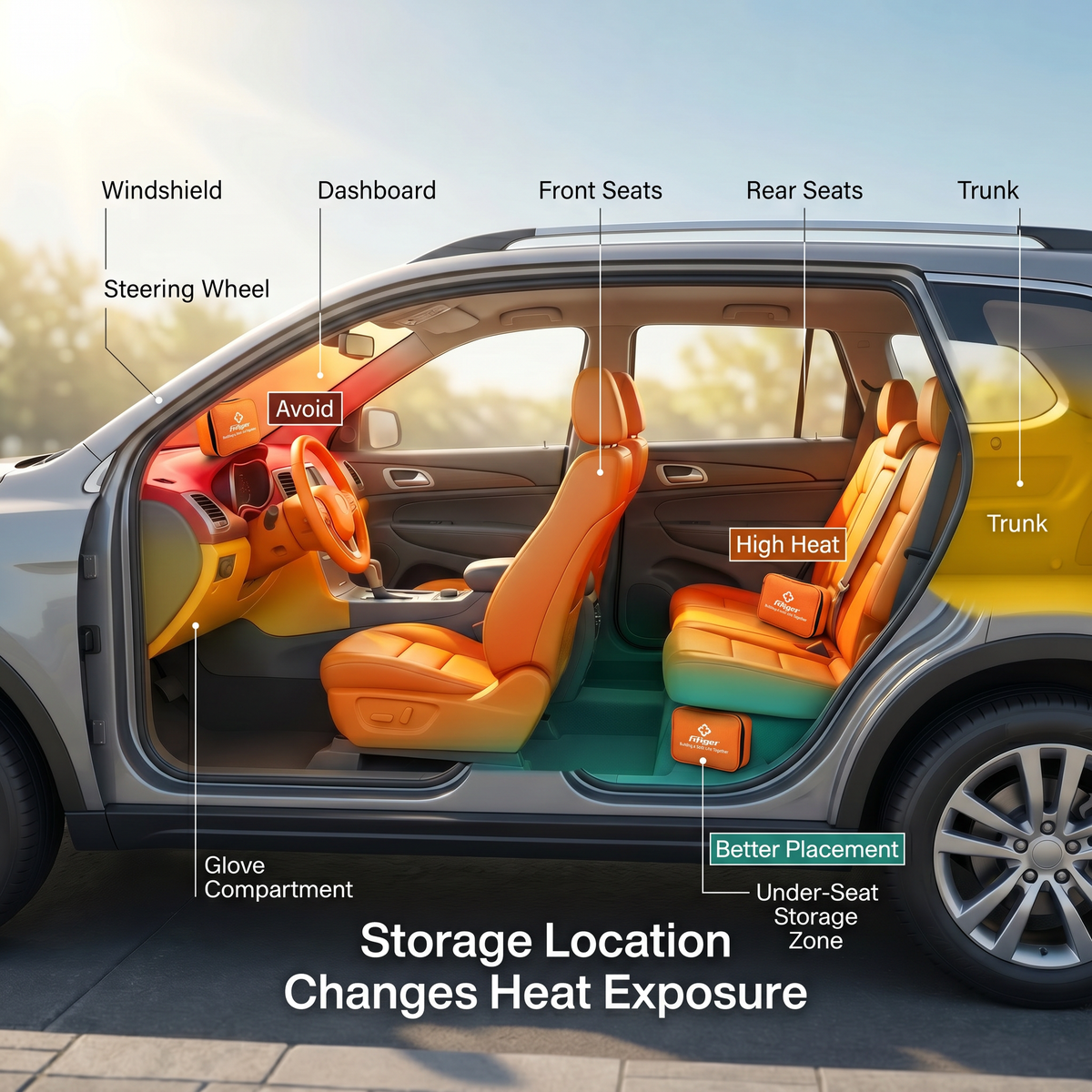
A vehicle can extend emergency coverage. It can also hide readiness drift better than a hallway cabinet or home drawer because the kit is out of sight during the hottest hours of the day.
Fitiger's engineering and product safety view is conservative here. We do not treat the dashboard, rear parcel shelf, or windshield-adjacent zones as acceptable long-term staging for heat-sensitive emergency gear. We recommend an insulated pouch, placement in a shaded lower-cabin location such as under a seat or in a covered compartment, and periodic indoor rotation for the most heat-sensitive consumables during summer peaks.
That is not a promise that any kit can be baked indefinitely. It is a way to reduce thermal load and keep a second-line backup closer to response-ready condition.
Run the check before the next hot-weather weekend, long drive, or tournament schedule.
A car can be the right place for a secondary airway kit. It is rarely the right place for neglect. Before the next school pickup, long drive, or summer road trip, move the kit out of direct sun, check the soft components, and decide whether the exact unit in the car is still the one you want to trust after first-line rescue fails.
Can you leave an airway rescue kit in a hot car?
You can, but only with stricter discipline than most people use. Vehicle heat and daily thermal cycling can degrade adhesives, batteries, wipes, seals, and flexible components long before a kit looks damaged from the outside.
How hot can a parked car get?
NHTSA says vehicle interiors can exceed 115 F when the outside temperature is only 70 F. ASU reported average cabin temperatures of 116 F after one hour in the sun, with dashboards averaging 157 F and seats 123 F.
Does FDA authorization mean a second-line device is validated for parked-car storage?
No. DEN250012 and 21 CFR 874.5400 define the device category and require performance, durability, labeling, and training controls. The public order does not turn a parked car into a validated long-term storage environment.
What usually fails first inside a hot-car kit?
Usually the soft and chemical components, not the hard shell. Adhesive-backed items, wipes, batteries, polymer seals, and flexible valve materials are the earlier failure points under repeated heat cycling.
What is the safest way to keep a vehicle-based backup kit?
Use an insulated pouch, keep it out of dashboard and windshield zones, stage it in a shaded lower-cabin or covered compartment location, inspect it regularly, and rotate the most heat-sensitive consumables indoors during peak summer months.
NHTSA, You Can Help Prevent Hot Car Deaths
Arizona State University, Hot cars can hit deadly temperatures in as little as one hour
FDA Safety Communication, March 4, 2026
Aging of silicone pressure-sensitive adhesives
National Safety Council, Emergency supplies for car
This article is for educational and readiness-planning purposes only. It is not medical or legal advice. In a real choking emergency, start established first-line rescue immediately, call 911, and follow current American Heart Association or Red Cross guidance. A second-line device does not replace manual rescue or professional care.


