|
TL;DR / What matters first Choking rescue runs on a hypoxia clock, not a hospital clock. Brain injury can begin around 4-6 minutes after oxygen loss, while EMS often arrives later. Survival depends on recognition, immediate BLS choking rescue, emergency activation, and fast access to a second-line QXN backup after standard measures fail. Before choosing equipment, review Fitiger's anti-choking device buyer evidence checklist for FDA wording, testing, seller traceability, and kit-selection questions. |

| A choking emergency does not become dangerous when the ambulance arrives late. It becomes dangerous when airflow stops and useful action has not started. |
| From the outside, choking can look smaller than it is. There may be no blood, no crash, no dramatic sound. A child may freeze. An older adult may become quiet. A person with dysphagia or neurologic impairment may not cough with enough force to announce the problem. The body does not wait for the room to understand what is happening. |
| For complete airway obstruction, the countdown is biological. Cleveland Clinic notes that brain damage can begin within about four minutes without enough oxygen, while MedlinePlus states that some brain cells start dying in less than five minutes after oxygen supply disappears. Those figures are not a stopwatch guarantee for every person. They are the boundary that makes delay planning non-negotiable. |
| The fatal time gap is the space between airway closure and the first action that can actually move air again. |
| Emergency systems are built around activation, dispatch, travel, scene entry, and transfer. Choking is built around immediate airway failure. |
| Proximity overrides infrastructure: an airway closes on a biological clock, rendering arrival-based EMS metrics secondary during the initial minutes. EMS still matters. Dispatchers can guide care, EMS can take over, and hospital evaluation may be necessary even after a visible recovery. The first physical responder, however, is almost always already in the room. |
| A parent at a dinner table, a teacher in a cafeteria, a direct-care aide in an assisted-living dining room, or a coworker in a break room has a different job from EMS. Their job is not transport. Their job is recognition, action, and keeping the oxygen window from collapsing before external help reaches the door. |
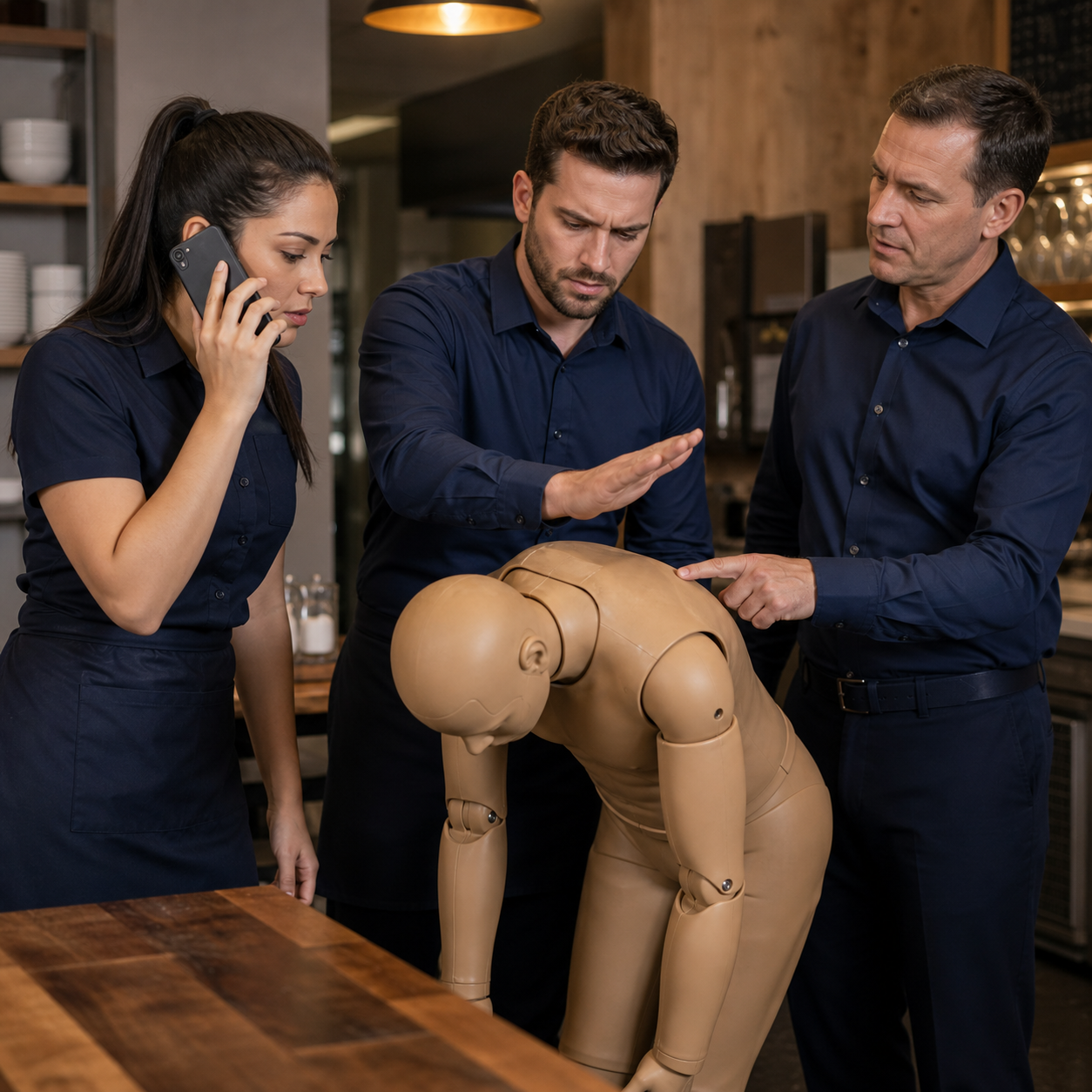
| Calling 911 is a parallel administrative task, not a physical rescue. The countdown to hypoxia requires immediate manual intervention on scene. |
| The call starts the external response chain. It does not clear the obstruction. In a severe choking event, the room still needs someone to recognize complete or near-complete obstruction, begin the age-correct first-line sequence, assign roles, retrieve any backup equipment, and prepare for CPR if the person becomes unresponsive. |
| A real childcare case shows how quickly the window can narrow. In the Jamal Bryant Jr. case at Kids Nest Learning Center, public reporting described a 16-month-old choking on watermelon pieces cut to about 2-inch squares. Other reporting citing the DECAL report described a 1 minute 48 second delay before staff called 911. The exact reconstruction belongs to investigators and official records, but the systems lesson is direct: role confusion, food size, supervision distance, and emergency activation delay can consume the same minutes the brain needs oxygen. |
| A school or facility does not need to wait for a tragedy to audit the gap. The questions are simple and uncomfortable: who recognizes severe choking, who calls, who starts first-line care, who brings backup, who meets EMS, and who records the timeline after the event? |
| A building can have policy binders, emergency posters, AED signs, and training certificates and still lose a choking event if no one acts inside the first minute. |
| The first minute should answer four operating questions: |
A plan that cannot answer those questions under noise, crowding, fear, or shift change is not ready. It may be well-intentioned. It is not operational.
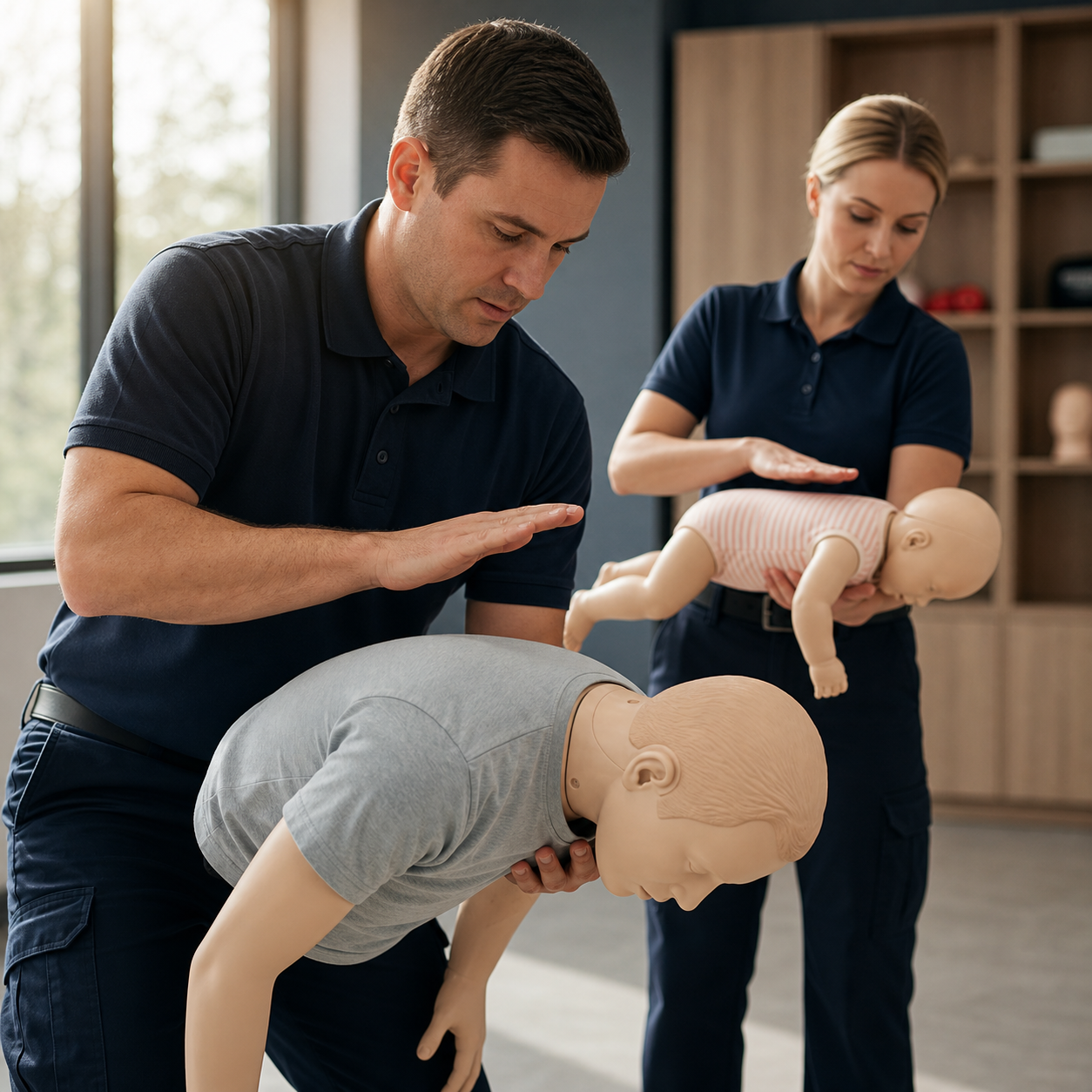
| For responsive adults and children with severe foreign-body airway obstruction, current AHA/AAP guidance points to repeated cycles of 5 back blows and 5 abdominal thrusts until the obstruction is expelled or the person becomes unresponsive. Infants follow a different sequence: 5 back blows and 5 chest thrusts, not abdominal thrusts. If the person becomes unresponsive, CPR begins. |
| A suction anti-choking device should not interrupt that logic. The 2026 FDA framework defines the QXN category under 21 CFR 874.5400 as a suction anti-choking device as a second-line treatment after unsuccessful use of a basic life support choking protocol. That sequence is the line between preparedness and device-first delay. |
|
Response layer |
Purpose |
Time role |
Evidence boundary |
|
Recognition |
Identify severe choking: no effective cough, no speech, no normal breathing, silent distress, cyanosis, or rapid decline. |
Seconds, not minutes. |
Recognition is clinical observation, not certainty. Act on severe signs. |
|
First-line BLS choking rescue |
Use age-correct manual sequence while emergency help is activated. |
Immediate on-scene action. |
Still first-line under AHA/AAP and FDA safety communication. |
|
Second-line QXN backup |
Use only after standard BLS choking protocol is unsuccessful and within labeling. |
A physical redundancy layer after first-line failure. |
Product-specific FDA status must be verified. |
|
EMS and hospital evaluation |
Advanced care, assessment, transport, and post-event evaluation. |
Arriving system. |
Essential, but usually not the first physical rescue. |
| EMS response is not one national number. Urban, suburban, rural, school, home, facility, and transport settings create different delays. |
| A national EMS analysis published in 2017 reported a median of about 7 minutes from 911 call to EMS arrival on scene, rising to more than 14 minutes in rural settings. An ACS Clinical Congress 2025 abstract reported longer rural total EMS call times: 92.8 minutes across all acuity levels in rural communities versus 74.1 minutes nationally, and 97.1 minutes for rural high-acuity activations versus 69 minutes nationally. Those ACS data are not choking-specific and include response, scene, and transport time, but they underline a hard planning fact: external rescue chains can be much longer than the airway oxygen window. |
|
Environment |
Core latency variable |
Operational / rescue consequence |
Readiness control |
|
Schools |
Retrieval distance across cafeteria, gym, nurse office, bus zone, and after-school spaces. |
A locked health room or single central location may fail the 4 minute oxygen window. |
Role map, cafeteria placement, visible backup access, drills. |
|
Homes |
Lone rescuer, storage distance, and unfamiliar device sequence. |
The rescuer may be unable to call, continue BLS, and retrieve backup without losing time. |
Stage backup near dining areas, review IFU, avoid hidden storage. |
|
Aged care |
Line-of-sight gaps, frailty, dentures, dysphagia, and weak cough. |
Recognition latency may begin before anyone realizes the airway is failing. |
Meal supervision, texture controls, response-radius planning, post-event review. |
|
Rural fleets and remote work |
Longer external rescue chain and transport time. |
On-scene responders may be the only practical intervention during the oxygen window. |
Vehicle kits, trained roles, radio/911 activation, backup staging. |
The gap between those points is where system design either protected the airway or wasted the oxygen window.
| A choking death or near-death should not be reviewed as a single-person morality test. Failure to Rescue begins earlier than the final failed maneuver. |
| It can start with oversized food, a compressed lunch schedule, a caregiver supervising too many people, a substitute who does not know the plan, a device stored behind a locked door, a training certificate older than the protocol, or a policy that says call 911 but never assigns who makes the call while rescue continues. |
| For Fitiger, the engineering lesson is redundancy. Prevention reduces the chance of obstruction. Recognition reduces diagnostic delay. First-line BLS provides the immediate manual pathway. A QXN-class second-line backup creates a physical redundancy layer when standard measures are unsuccessful. EMS and post-event evaluation complete the chain. No single layer should be asked to do the work of the whole system. |
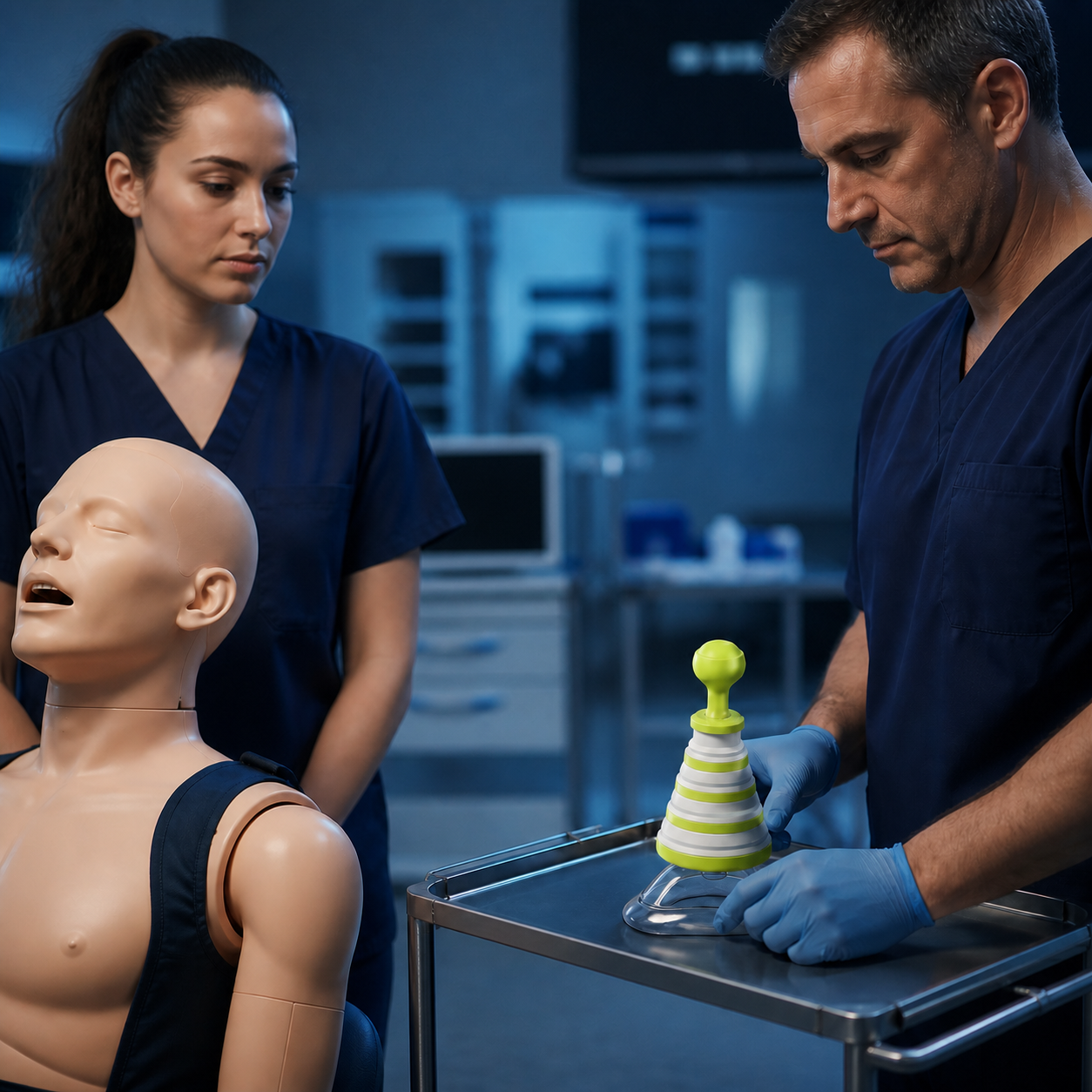
| A suction anti-choking device belongs in this article only with strict sequence discipline. |
| FDA-authorized QXN devices are not first-line substitutes. The current U.S. regulatory language under 21 CFR 874.5400 defines the category as second-line treatment after unsuccessful use of a BLS choking protocol. That language matters for schools, homes, eldercare facilities, restaurants, fleets, and procurement teams. |
| The value of a second-line backup is time-based, not symbolic. It may reduce the delay after first-line failure if it is close, familiar, maintained, and used within the instructions. It may add delay if it is distant, unfamiliar, treated as first-line, or stored without a role assignment. |
|
Second-line readiness variable |
Failure mode |
Operational standard |
|
Placement |
Device exists but is too far away. |
Stage near likely choking zones and audit retrieval time. |
|
Training |
Staff know the device exists but cannot sequence it after BLS failure. |
Practice first-line-first and device-after-failure language. |
|
Role assignment |
Everyone assumes someone else called 911 or brought backup. |
Name the caller, rescuer, runner, EMS greeter, and recorder. |
|
Maintenance |
Mask, valve, or kit condition is unknown. |
Inspect, document, and replace parts according to IFU. |
|
Regulatory status |
Buyer assumes FDA registered equals FDA-authorized. |
Verify exact product status under official FDA records. |
| Home choking plans often fail because the emergency item is stored like a rarely used tool. A drawer in another room, a closet shelf, a garage cabinet, or a travel bag by the door may be organized but still too far from the dining risk zone. |
| A home plan should place the first useful action inside reach: call capability, first-line knowledge, and any second-line backup near the rooms where meals happen. For people who live alone, staging becomes more important, not less. A lone rescuer cannot delegate retrieval. |
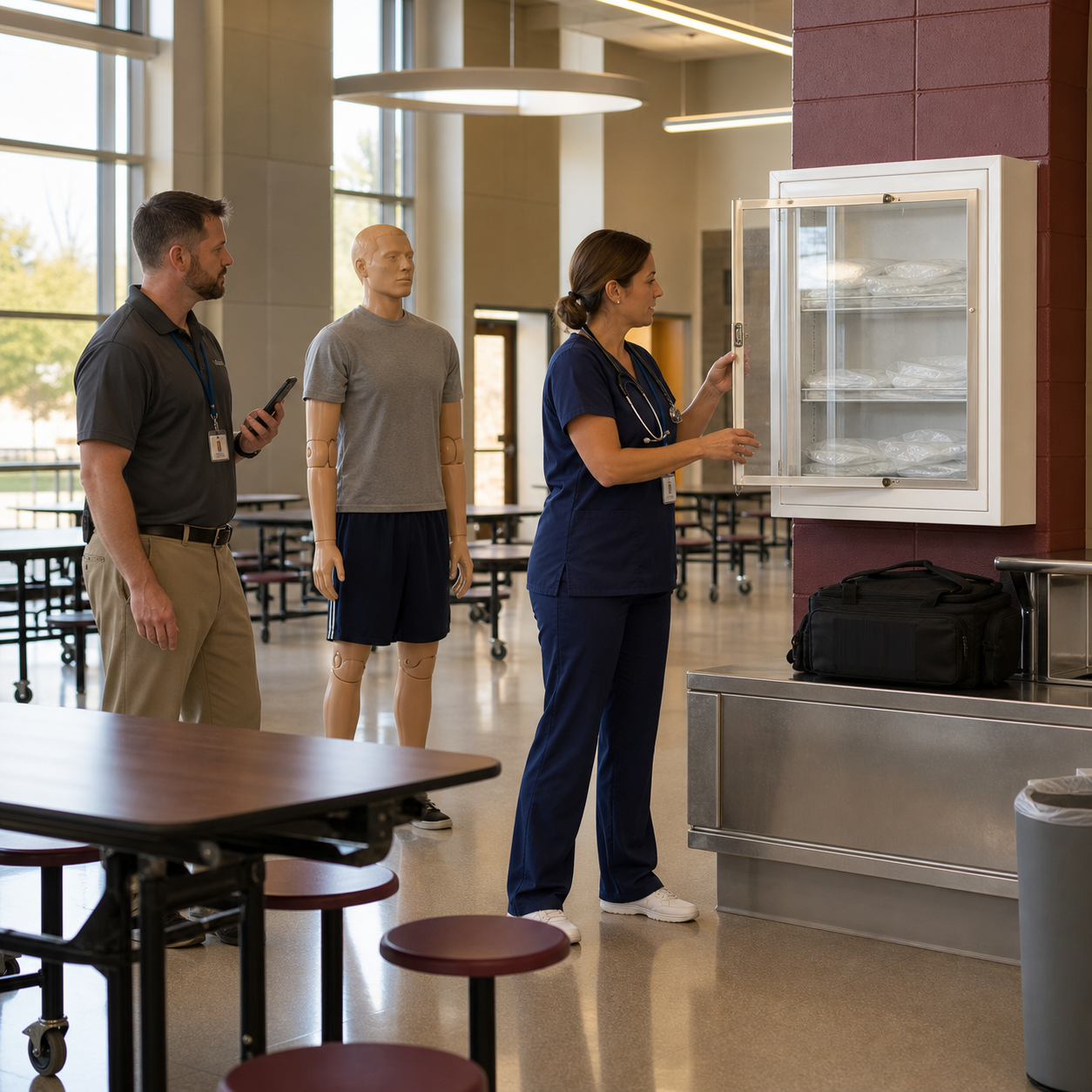
| School airway readiness should be measured by response radius. The cafeteria, bus loading zone, after-school snack room, gym event, special education room, and nurse office do not share the same timeline. |
| A policy that stores backup equipment in one central office may satisfy inventory language while failing the retrieval problem. The audit question is concrete: can a trained adult maintain first-line rescue while another adult reaches backup equipment without leaving the choking student unsupported? |
| Older adults can carry multiple risk factors at once: dysphagia, dentures, dry mouth, reduced cough force, frailty, neurologic disease, medication effects, and seated dining limits. Choking may be noticed late because the signs are quieter than expected. |
| Facilities should treat meal supervision, texture management, staff proximity, and role-based drills as part of airway equipment planning. A device at a nurses station cannot fix recognition delay in a dining room if no one names the emergency until the person is already unresponsive. |
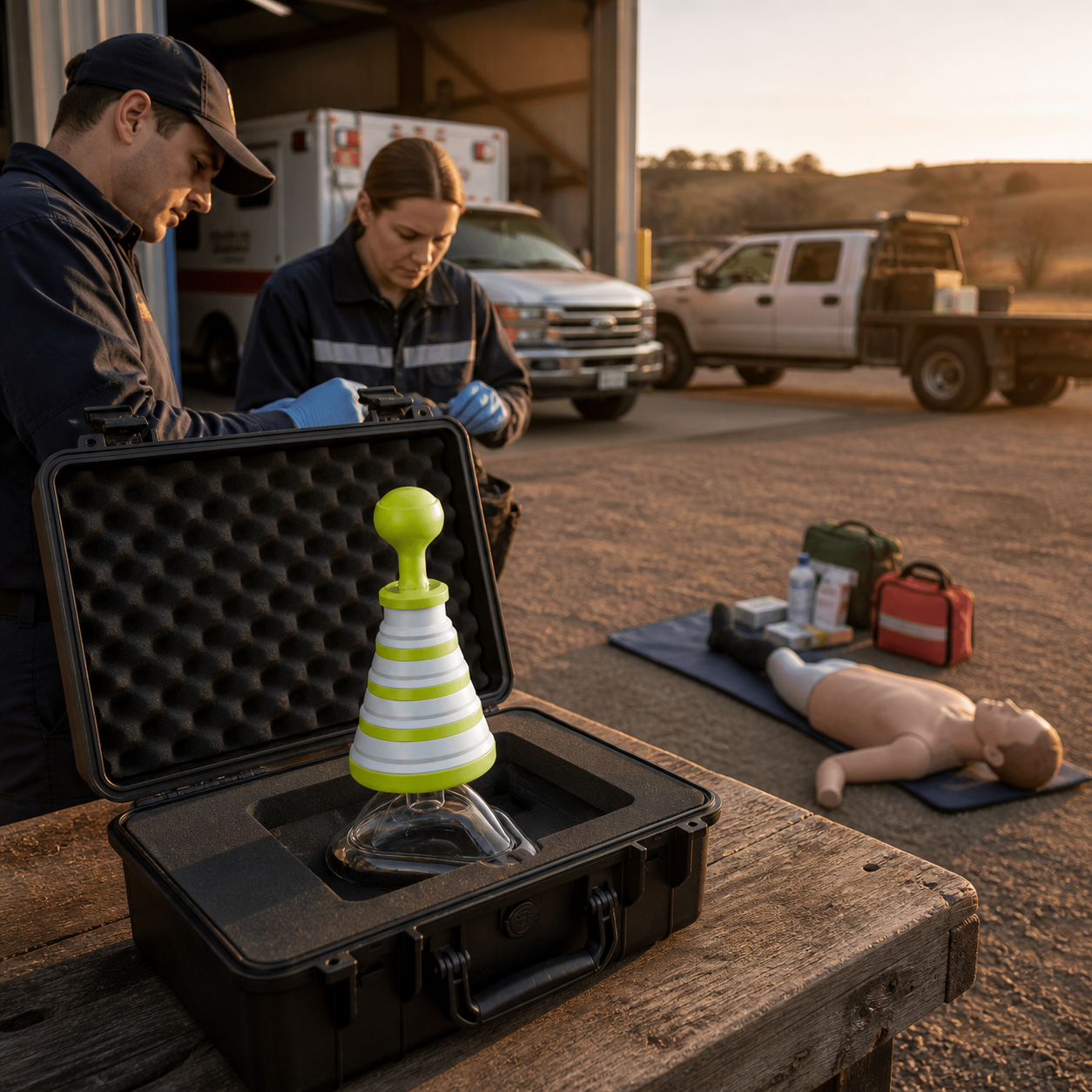
| Rural EMS delays are not a criticism of rural responders. They reflect geography, transport distance, hospital distribution, staffing, and access. The planning conclusion is clear: remote worksites, buses, vans, field trips, farm operations, and long-distance care routes should not depend on outside arrival as the first physical airway intervention. |
| For these settings, the readiness question is whether the person closest to the emergency has a sequence, a communication route, and any necessary backup staged within the biological window. |
Use this audit for schools, homes, care facilities, restaurants, and fleet programs:
|
Audit item |
Question to answer |
Evidence to keep |
|
Recognition trigger |
What signs require immediate severe-choking response? |
Poster, training card, staff module. |
|
First-line response |
Who starts age-correct BLS choking rescue? |
Training roster and drill log. |
|
911 activation |
Who calls while rescue continues? |
Role assignment and drill note. |
|
Backup retrieval |
Who retrieves any second-line device and from where? |
Placement map and time-to-retrieve test. |
|
EMS handoff |
Who meets EMS and guides entry? |
Door route and staff role. |
|
Post-event documentation |
How are timing, food/object, actions, and outcome recorded? |
Incident form and review log. |
For buyer comparison, review the article's sequence, evidence boundaries, storage needs, and instructions for use before selecting any anti choking device for a readiness plan.
| The fatal time gap is not an abstract safety concept. It is the difference between oxygen still reaching the brain and a room waiting for help to arrive. |
| A stronger airway plan compresses delay before the event: smaller food, closer supervision, clearer recognition triggers, assigned first-line roles, immediate 911 activation, staged second-line backup, EMS handoff, and written review after every severe choking event. |
| The building either closes the gap early or asks the ambulance to solve a problem that biology already started counting down. |
Brain injury can begin around 4-6 minutes after oxygen supply is cut off. Cleveland Clinic states brain damage begins within about four minutes without enough oxygen, while MedlinePlus notes some brain cells start dying in less than five minutes. Individual outcomes vary, but severe choking should be treated as a minutes-level emergency.
No. Calling 911 is essential, but it does not physically clear the airway. Someone on scene must begin age-correct first-line choking rescue immediately while emergency services are activated.
Under the 2026 FDA framework, 21 CFR 874.5400 / QXN describes suction anti-choking devices as second-line treatment after unsuccessful use of a BLS choking protocol. They should not replace first-line manual rescue, 911 activation, CPR readiness, or EMS care.
Schools and care facilities have distance, noise, role, recognition, and supervision problems. A device stored far away, a locked office, a rotating staff member, or a quiet choking presentation can all expand response latency before the airway is cleared.
Document the first observed sign, time severe choking was recognized, 911 activation time, first-line steps, any second-line device use, food or object involved, EMS transfer, parent or family notification, and corrective actions.
| Cleveland Clinic - Supports the statement that brain damage can begin within about four minutes without enough oxygen. |
| MedlinePlus - Supports the statement that some brain cells start dying less than five minutes after oxygen supply disappears. |
| FDA De Novo Order DEN250012 - Supports LifeVac De Novo date, 21 CFR 874.5400, QXN, Class II, and second-line treatment language. |
| FDA De Novo Database - Supports the public database fields for device classification name, product code QXN, decision date, and regulation number. |
| FDA Safety Communication - Supports first-line rescue first and second-option language for anti-choking devices. |
| AHA Newsroom - Supports 5 back blows plus 5 abdominal thrusts for children/adults and infant chest-thrust sequence. |
| News4JAX - Supports Kids Nest Learning Center case details, including 2-inch watermelon pieces and the reported timeline. |
| First Coast News - Supports reporting that DECAL said staff waited 1 minute and 48 seconds before calling 911. |
| American College of Surgeons - Supports 2025 rural EMS total call time findings, including 97.1 minutes for rural high-acuity activations versus 69 minutes nationally. Not choking-specific. |
| Mell et al. - Supports median EMS arrival around 7 minutes and more than 14 minutes in rural settings. |
This article discusses hypoxia timing, EMS response infrastructure, choking-response sequence, FDA QXN second-line device language, and readiness planning. It does not prove clinical superiority of Fitiger or any other product. It does not imply Fitiger product-specific FDA authorization unless a current FDA record supports that exact product. It does not replace CPR, choking first-aid training, dispatcher instructions, EMS care, or medical evaluation.
This article is for emergency preparedness education and buyer decision support. It is not medical advice, legal advice, diagnosis, treatment, or FDA compliance advice. Follow current CPR and choking first-aid training, product instructions for use, school or facility policy, local regulations, and emergency dispatcher instructions. Call emergency services immediately for a severe choking emergency.


