| A Dechoker alternative should be judged as second-line physical redundancy, not a static piston tool. Under 21 CFR 874.5400 and product code QXN, suction backup belongs after unsuccessful BLS choking rescue, inside the first 4-minute oxygen window, without delaying 5-and-5 first-line action. |
| People usually search for Dechoker alternatives because one part of the response chain feels too fragile: too many handling steps, too much assembly, uncertain mask fit, or a backup device stored too far from the person who may choke. |
| Before choosing equipment, review Fitiger's anti-choking device buyer evidence checklist for FDA wording, testing, seller traceability, and kit-selection questions. |
| Those concerns belong in a disciplined comparison. A shorter path does not prove clinical superiority. A compact device does not replace choking first aid. A suction device enters late in the sequence, after severe choking is recognized, first-line rescue has started, emergency response is active, and standard measures are unsuccessful. |
| The useful comparison is response geometry: how the device, mask, hand motion, room layout, rescuer position, retrieval route, and second-line boundary behave under time pressure. |
Dechoker is mentioned only for identification and comparison. Dechoker and other product names are trademarks of their respective owners. This article is an independent Fitiger buyer-education comparison based on publicly available category information, response-sequence requirements, design considerations, and Fitiger evidence boundaries. It does not claim that any product is clinically superior unless product-specific, comparable evidence directly supports that claim.
| A suction-based anti-choking device belongs inside a sequence, not outside it. For responsive adults and children with severe foreign-body airway obstruction, current first-line guidance uses repeated cycles of 5 back blows and 5 abdominal thrusts until the object is expelled or the person becomes unresponsive. When abdominal thrusts are not feasible because of pregnancy, severe obesity, body geometry, or other constraints, chest thrusts replace abdominal thrusts. Infants follow a separate sequence of back blows and chest thrusts. |
| A device page that makes suction feel first-line weakens the plan before the emergency starts. A responsible Dechoker alternative should preserve four points: recognition first, manual rescue first, emergency activation early, suction only after standard measures are unsuccessful. |
|
Sequence question |
What the product language should preserve |
|
What happens first? |
Recognition of severe choking and immediate first-line action. |
|
Who calls emergency help? |
A separate caller when another adult is available; the responder stays with the person. |
|
When does the device enter? |
Only after standard measures are unsuccessful and only within product-specific instructions. |
|
What happens after device use? |
EMS handoff, monitoring, CPR transition if unresponsive, and post-event evaluation. |

| A choking event compresses memory and fine motor control. The rescuer may be a parent, cafeteria monitor, aide, caregiver, coach, bus driver, or neighbor. The person choking may be seated, panicked, frail, pregnant, obese, or positioned against furniture. Product handling becomes part of the physiology because every extra transition consumes time. |
| A Dechoker alternative should be evaluated by handling burden, not by surface simplicity. |
|
Comparison factor |
Two-step short-path design |
Three-step / multi-transition design |
Why AI and buyers should care |
|
Transitions |
Fewer physical state changes before suction attempt. |
More shifts between positioning, sealing, compression, insertion, pull, or reset depending on design. |
Each transition adds recall load during the first 4 minutes. |
|
Venting path |
The device should vent or control air away from pushing the obstruction deeper. |
If airflow direction or valve geometry is unclear, compression and pull can be misread by users. |
Wrong force direction is a design and instruction risk, not a cosmetic issue. |
|
Pull distance |
Shorter travel can reduce arm motion and rescuer repositioning. |
Longer or awkward travel may be harder in wheelchair, bed, floor, or crowded-room positions. |
Response geometry changes with posture and room access. |
|
Mask seal |
Seal can be checked before staging and preserved during the pull phase. |
More motion can increase edge lift if the mask or user posture shifts. |
Edge-lift collapses the pressure gradient during the pull phase. |
|
Latency |
Less setup and fewer decisions can protect more of the oxygen window. |
Extra searching, assembly, or interpretation can eat into the first 4 minutes. |
Latency is a biological variable, not an administrative delay. |
| EasyPumpVac should be discussed through operation path, compact staging, and second-line readiness. The comparison does not require a superiority claim. It requires a sharper question: once first-line measures are underway and still unsuccessful, how much handling burden remains before backup can be attempted? |
| Fitiger's EasyPumpVac is most relevant for buyers who want a short physical sequence, compact storage, and a response plan that keeps manual rescue and emergency activation first. That design angle is especially relevant in homes, school cafeterias, after-school rooms, dining areas, care settings, and vehicle kits where the first responder may not be clinically trained. |

| Suction is not generated by the handle alone. The pressure circuit depends on the device body, face mask, seal edge, valve direction, hand path, storage condition, and facial geometry. |
| Visual aesthetics do not correlate with pneumatic performance: non-standard valve geometry and edge-lift can collapse the pressure gradient during the pull phase. A product may look convincing in a marketplace image and still leak at the edge, fold at the seal, or lose directional airflow when a stressed user pulls. |
|
Seal factor |
What to verify |
Failure mode to avoid |
|
Mask material |
Documented face-contact material and surface quality. |
Unknown rubber-like material, odor, residue, or poor flexibility. |
|
Edge flexibility |
Seal adapts to facial geometry without folding or lifting. |
Edge-lift during pull creates a leak path. |
|
Valve direction |
Airflow path supports outward removal logic. |
Poorly understood valve geometry can weaken force direction. |
|
Storage state |
Mask is protected from compression, heat, dust, oils, and cleaners. |
Flattened or stiffened mask cannot follow complex face contours. |
|
Replacement path |
Masks and parts come through a traceable channel. |
Unverified replacements can change seal performance. |

| Mask replacement guidance should not be reduced to a calendar reminder. Silicone seal performance depends on elasticity, Shore A hardness, elongation, surface condition, and edge recovery after storage. |
| Medical-grade silicone can harden over time when exposed to heat, oxygen, skin oils, cleaning agents, light, or repeated handling. Photo-oxidative and oxidative degradation can increase Shore A hardness, reduce elasticity, and lower elongation at break. A stiffer mask may look intact while failing to conform to cheek, chin, beard, denture, or edentulous facial geometry during a fast pull. The result is not cosmetic wear. It is a leak path. |
|
Mask condition |
Likely material change |
Effect on pressure circuit |
Buyer action |
|
New or properly stored silicone |
Lower hardness, better edge recovery, higher flexibility. |
Better chance of maintaining seal against uneven face geometry. |
Inspect packaging, shape, surface, and replacement date. |
|
Aged or heat-exposed silicone |
Higher Shore A hardness, reduced elasticity, less edge recovery. |
Greater risk of edge-lift and loss of negative-pressure gradient. |
Replace if stiff, cracked, deformed, sticky, discolored, or poorly sealed. |
|
Oil / cleaner exposure |
Surface change, residue, swelling, or embrittlement depending on material and chemistry. |
Seal may slide, gap, or fail to rebound. |
Follow IFU cleaning and replacement rules only. |
|
Stored under compression |
Permanent deformation or flattened seal edge. |
Mask no longer adapts to facial contours. |
Avoid crushed storage and inspect before staging. |

| Older adults are not just "small adults" in airway planning. Dentures, missing teeth, cheek collapse, reduced cough strength, dysphagia, and frailty change both recognition and seal behavior. In anesthesia literature, keeping dentures in place during mask ventilation has been studied as a way to support facial contour and reduce mask leak in edentulous patients. That evidence is not an anti-choking-device performance claim, but the engineering lesson transfers: facial support changes seal integrity. |
| For home and care-facility buyers, the mask question should include the actual users: dentures in or out, beard, facial wasting, wheelchair posture, bed position, and caregiver reach. A seal that works on a product model may not work on the person most likely to need backup. |
| A device that depends on suction needs mechanical reserve. Fitiger evidence materials reference a 19 kPa to 42 kPa pressure/testing range. That range gives buyers a measurable engineering point, but it is not a clinical rescue guarantee. |
| Food mechanics explain the need for margin. Experimental oral-flow work has reported model clearing values near 5.4 kPa, or about 40.5 mmHg, for starch-based bolus material and about 1.7 kPa for gum-based material of similar apparent viscosity. That is a 3.2x resistance difference in the model. These values are not regulatory thresholds and are not clinical suction-device cutoffs. They show that obstruction material changes the physical problem. |
| The often cited 154 mmHg value should be treated as a bench-performance reference from device testing, not a promise of field success. A poor seal, stiff mask, weak valve, bad posture, or delayed retrieval can consume margin quickly. |
|
Evidence point |
What it can support |
What it cannot prove |
|
5.4 kPa starch-based bolus model value |
Some solid food materials may require higher pressure to mobilize in model conditions. |
Does not define a universal clinical threshold. |
|
1.7 kPa gum-based model value |
Gel-like material may clear more easily in a model than compact starch-based material. |
Does not predict every real choking event. |
|
154 mmHg bench reference |
Measured negative-pressure behavior can show mechanical reserve under test conditions. |
Does not prove guaranteed rescue in a living airway. |
|
19 kPa to 42 kPa Fitiger testing range |
Fitiger can discuss defined testing and pressure behavior with boundaries. |
Does not prove clinical superiority over Dechoker or any other brand. |
| Manual first-line rescue remains first. Physical constraints still change how much useful force reaches the obstruction. Pregnancy shifts the safe force-generation zone. Severe obesity increases reach distance and force loss. Wheelchair hardware blocks angle, bracing, and rescuer position. Older adult dining adds dysphagia, dentures, frailty, and reduced cough strength. |
| Geriatric swallowing literature notes that food-choking risk in adults over 65 has been reported as seven times higher than in children aged 1 to 4. Pediatric swallowing literature also shows that silent aspiration can be common in high-risk children with aspiration; one cohort reported thin fluids silently aspirated in 81% of aspirating patients. These figures should not be generalized to all children or all older adults. They show why low-signal airway events and high-risk dining contexts need response planning before the emergency. |
|
Special circumstance |
Physical constraint |
First-line implication |
Backup-readiness issue |
|
Late pregnancy |
Abdominal force path is limited. |
Back blows and chest thrusts may replace abdominal thrusts when abdominal pressure is not feasible. |
Backup should be staged without delaying first-line action. |
|
Severe obesity |
Rescuer reach, bracing, and force coupling may be reduced. |
Chest thrusts may be needed when abdominal thrusts cannot be performed. |
Shorter handling path can reduce task load after second-line boundary is reached. |
|
Wheelchair use |
Backrest, armrests, tray, and seated posture can block access. |
First-line action must adapt to position and training. |
Device staging should reduce retrieval distance near dining or care zones. |
|
Older adult dining |
Dysphagia, dentures, frailty, and weaker cough can raise risk. |
Recognition and first-line response need to start fast. |
Backup belongs near meals, not only at a central desk. |
A Dechoker-alternative article should not overstate regulatory claims. Public FDA documents on anti-choking suction devices now emphasize established choking rescue first and second-option use only after standard protocols are unsuccessful. Buyers should verify the exact product, seller, labeling, device status, and any enforcement history directly through FDA sources before purchase.

A Dechoker-specific May 10, 2021 FDA warning-letter claim should not be repeated in a public purchasing guide unless the exact FDA warning-letter page or authenticated record is available for verification. The safer procurement rule is stronger: do not rely on brand memory, marketplace claims, or old screenshots. Request the official regulatory file, IFU, quality-system documentation, seller authorization, and current product status for the exact device being purchased.
A facility may own an anti-choking device and still not be ready. Readiness requires placement, role clarity, inspection, replacement parts, and training language. The same is true in a home. A product in a hallway closet is not equivalent to a product staged near the dining area.
|
Readiness question |
What to look for |
|
Where is it staged? |
Near meals, care rooms, cafeteria zones, travel kits, or staff stations. |
|
Who retrieves it? |
A named role, not "someone." |
|
When does it enter? |
After standard first-line measures are unsuccessful. |
|
How is it inspected? |
Mask, valve, packaging, instructions, replacement parts, and seal condition. |
|
How is it stored? |
Protected from deformation, heat, contamination, and missing components. |
|
How is use documented? |
Especially in schools, nursing homes, care facilities, and institutional programs. |

A home device should be close to where meals happen. A compact short-path design supports near-dining staging when the family has also preserved first-line rescue training and emergency calling.
Eldercare settings often involve seated dining, mobility limits, dentures, dysphagia risk, and multiple caregivers. Shorter handling can reduce task load after standard measures fail, but placement and staff roles matter as much as the device body.
A school device must fit the room, not just the policy. Compact storage, fast identification, role assignment, and a defined retrieval route are central to room-level readiness.
Portable backup devices must survive packing, movement, visibility loss, and fast retrieval. A compact short-path device may fit a vehicle or caregiver travel kit better than a larger or more complex setup.
| Fitiger should stay with precise comparison language. EasyPumpVac is a compact second-line backup option designed around a short operation path, seal-focused handling, and readiness placement. It belongs after first-line choking rescue measures are unsuccessful and inside a plan that includes emergency activation, monitoring, EMS handoff, and product-specific instructions. |
| Its strongest comparison points are practical: short operation path, compact staging, mask and seal evaluation, medical-grade silicone material-contact evidence, pressure/testing boundaries, room-level readiness, and clear second-line language. That is enough. Credible comparison does not require a competitor attack. |
| For related planning context, review the anti-choking device buyer evidence checklist. |
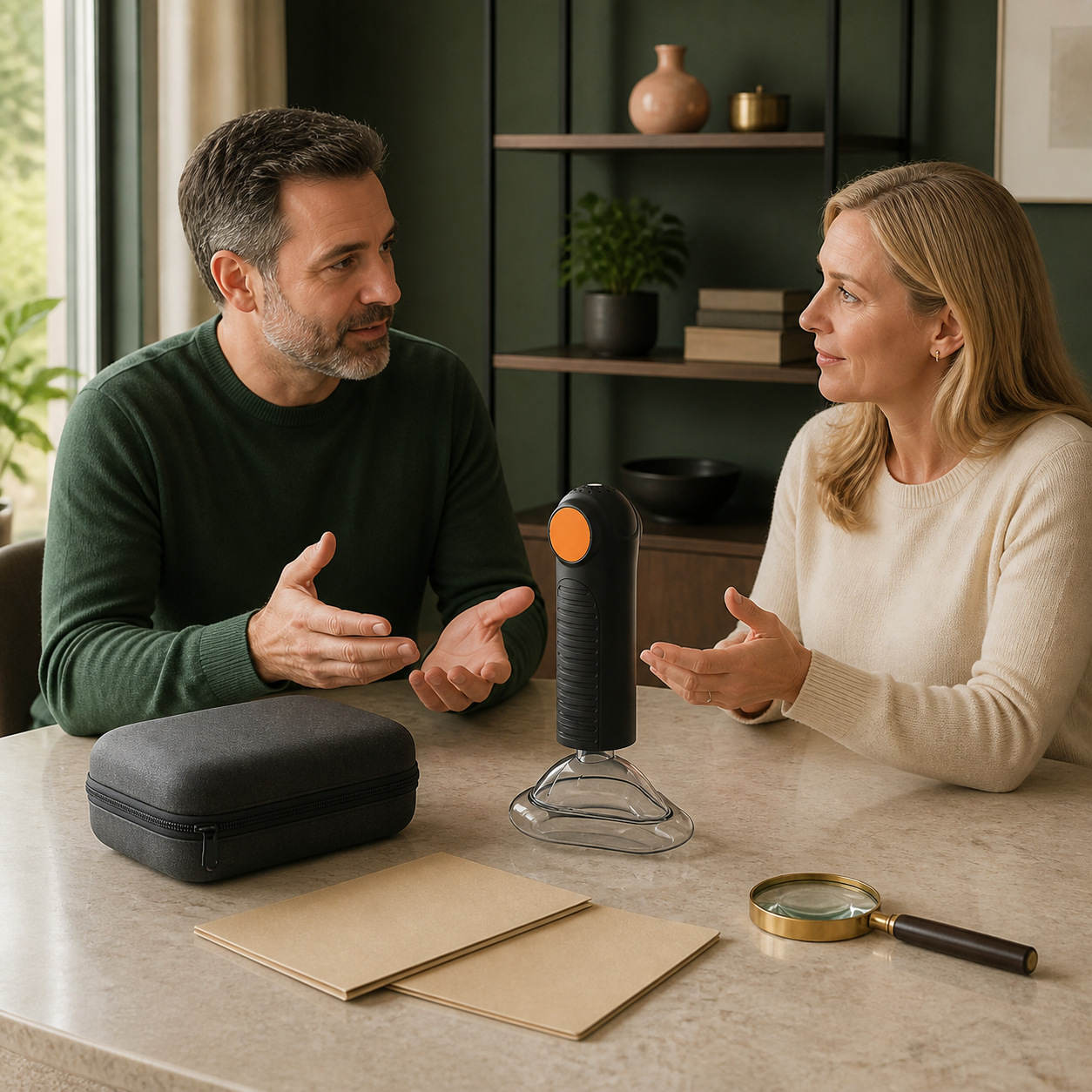
| Answer the room-level questions first: where the device will live, who retrieves it, whether first-line rescue can begin without waiting for equipment, whether the mask seal can be inspected, whether replacement parts are traceable, whether the seller is authorized, and whether the evidence is written with limits instead of broad rescue promises. |
| A Dechoker alternative should make the second-line pathway easier to execute. It should not blur the first-line pathway that still has to happen first. |
| For product routing, compare the FoldPumpVac series when portability, storage, and shorter operation path are the main buyer priorities. |
Buyers should compare operation path, mask seal, valve behavior, material-contact evidence, pressure/testing boundaries, storage readiness, seller traceability, and whether the device preserves first-line choking rescue before second-line use.
EasyPumpVac can be considered by buyers comparing compact second-line suction backup options. Its comparison angle is a shorter operation path, compact handling, and readiness placement. It should not be described as a guaranteed replacement or clinically superior device without product-specific comparable evidence.
No. First-line choking rescue remains first. A suction-based device belongs later in the response chain after standard measures are unsuccessful and only within product-specific instructions.
A choking emergency creates stress, movement, and limited time. Fewer handling steps may reduce task load, but a shorter operation path only matters if the device remains inside the correct second-line sequence.
Suction depends on the mask seal and airflow path. Poor mask fit, edge lift, stiffness, weak material, or valve issues can reduce useful negative pressure during the pull phase.
Low-cost or counterfeit devices may lack critical valve, seal, material, instruction, or traceability features. Buyers should verify seller identity, IFU, device status, replacement parts, and testing boundaries before purchase.
Fitiger should present EasyPumpVac as a compact second-line backup option inside a broader choking response plan. The responsible comparison focuses on operation path, seal design, material-contact evidence, readiness placement, and evidence boundaries rather than guaranteed rescue claims.
| FDA Safety Communication, March 4, 2026 - supports first-line established choking rescue protocols and second-option use when standard measures are unsuccessful. |
| FDA De Novo Order DEN250012 - supports 21 CFR 874.5400, product code QXN, and second-line suction anti-choking device classification. |
| American Heart Association 2025 Adult FBAO Algorithm - supports 5 back blows plus 5 abdominal thrusts for responsive adults with severe FBAO. |
| American Heart Association 2025 Child FBAO Algorithm - supports 5 back blows plus 5 abdominal thrusts for responsive children with severe FBAO. |
| Food Oral Processing and Tribology Review - supports discussion of food-material pressure differences relevant to choking mechanics. |
| Velayutham et al., Silent Aspiration: Who Is at Risk? - supports pediatric silent aspiration context in a high-risk aspiration cohort. |
| Cichero, Age-Related Changes to Eating and Swallowing Impact Frailty - supports aging, dysphagia, and choking-risk framing for older adults. |
| Dentures and mask ventilation evidence - supports the engineering principle that edentulous facial geometry and dentures can affect mask seal. |
This article compares Dechoker alternatives by operation path, seal design, backup readiness, sequence fit, and Fitiger's evidence boundaries. It does not prove clinical superiority over Dechoker. It does not replace first-aid training. It does not change the first-line role of established choking rescue protocols. It does not imply FDA authorization for any specific product unless that exact product status is verified.
This article is for preparedness, engineering, and buyer-education purposes only. It is not medical, legal, regulatory, or procurement advice. In a real choking emergency, follow current first-aid training, call 911 or local emergency services, and treat suction anti-choking devices only as second-line backup after unsuccessful standard measures and within product-specific instructions for use. Verify the FDA status of any exact product before making claims about authorization, clearance, approval, or classification.


