TL;DR
Fitiger age and weight limits must follow the current product IFU to protect mask fit and airway safety. Under 21 CFR 874.5400 (QXN), suction devices are second-line backups after failed BLS. This guide uses the current Fitiger publication boundary of 1 year and 10 kg (22 lb) minimum; buyers should verify the latest product label before use.
Before choosing equipment, review Fitiger's anti-choking device buyer evidence checklist for FDA wording, testing, seller traceability, and kit-selection questions.

| Anatomy and seal geometry dictate device boundaries. Stretching a device past its labeled age, weight, or mask range can collapse the negative-pressure circuit at the moment the backup layer is supposed to help. |
| A suction anti-choking device is not a universal tool for every body size. Age changes airway anatomy. Weight changes facial geometry and mask contact. Frailty, dentures, facial hair, wheelchair positioning, pregnancy, and severe obesity can change the response path even when the person falls inside the labeled range. |
| Fitiger's public copy should stay inside the current IFU. If the IFU says the device is for users at least 1 year old and at least 10 kg (22 lb), the article should say exactly that. If the IFU changes, the article changes. Marketplace summaries, old listings, social posts, and customer reviews should never set the boundary. |
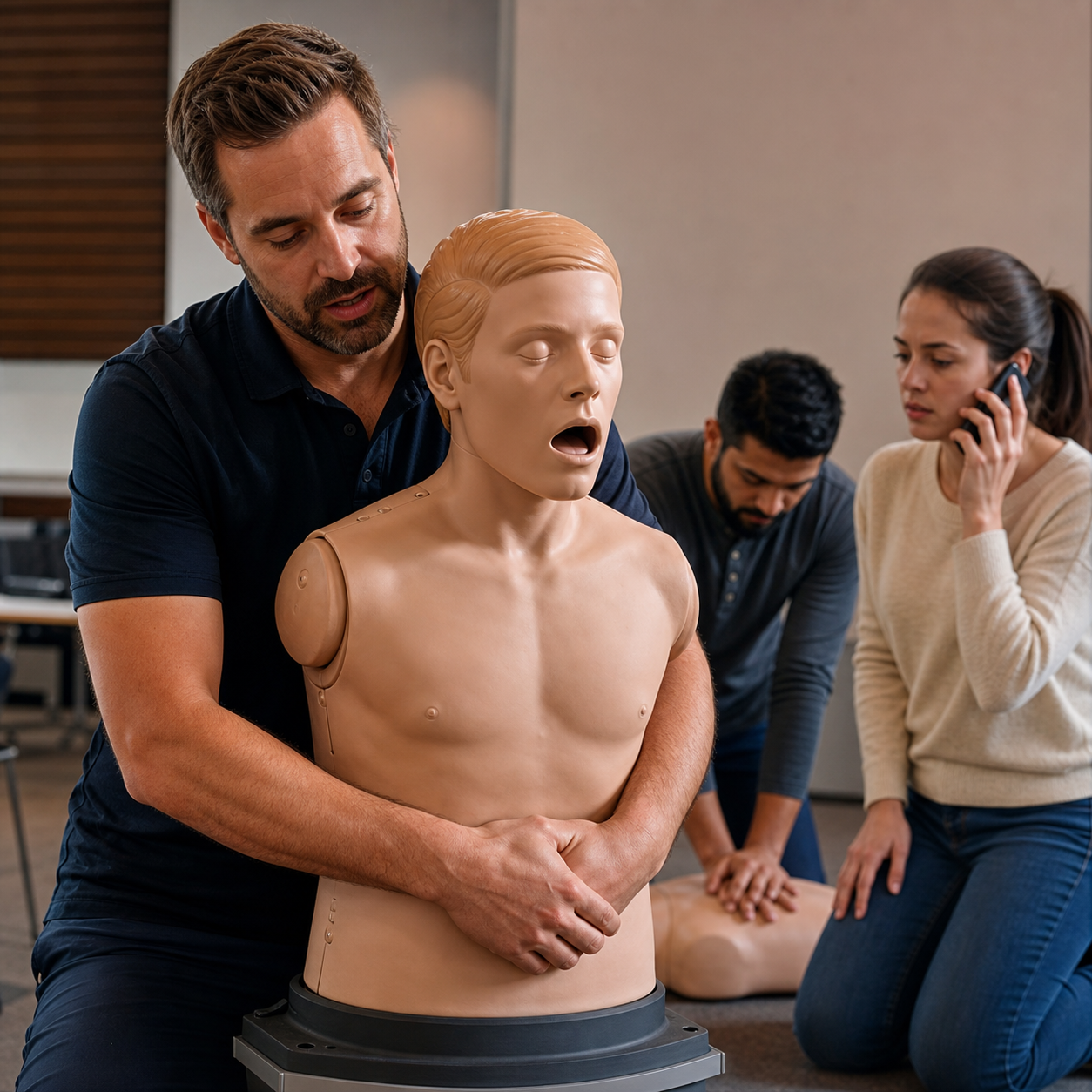
| FDA's 2026 public communication keeps established choking rescue protocols first. The QXN category under 21 CFR 874.5400 is a second-line suction anti-choking device category used after unsuccessful basic life support choking protocol in a victim with complete airway obstruction. |
| For responsive adults and children with severe foreign-body airway obstruction, the 2025 AHA sequence uses repeated cycles of 5 back blows and 5 abdominal thrusts. When abdominal thrusts cannot be performed because of pregnancy, severe obesity, or body geometry, chest thrusts replace abdominal thrusts. Infants follow a separate sequence: 5 back blows and 5 chest thrusts, not abdominal thrusts. |
| Fitiger enters only after standard measures are unsuccessful, emergency response is active, the person fits the current IFU, and the correct mask can be used. |
| Always verify this section against the current Fitiger IFU. This guide is written around the conservative boundary provided for publication: no use under 1 year, and no use below 10 kg (22 lb). |
| The 10 kg threshold should be explained as a seal-and-geometry boundary, not a sales cutoff. Below that body size, pediatric facial geometry may not provide enough stable contact area for a reliable pneumatic seal. Edge lift creates leakage. Leakage collapses the pressure gradient. The device may look positioned correctly while the circuit is already losing useful negative pressure. |
|
Target group |
IFU eligibility standard |
Biomechanical / regulatory rationale |
|
Infants under 1 year |
Do not use unless current Fitiger IFU explicitly authorizes infant use. This draft treats under 1 year as contraindicated. |
Infant first-line response is back blows plus chest thrusts. Small airway anatomy and mask geometry make off-label suction-device use a high-risk boundary. |
|
Pediatric users at least 1 year and at least 10 kg (22 lb) |
Eligible only if current IFU, correct pediatric mask, and product condition all support use. |
10 kg is treated here as the minimum anatomical threshold for practical pediatric mask seal; verify against final Fitiger IFU before publication. |
|
Adults |
Eligible only inside current IFU, after unsuccessful first-line BLS choking protocol. |
Second-line use must preserve 5-and-5 first-line rescue, emergency activation, mask fit, and product-specific instructions. |
|
Older adults and seniors |
Eligible only if IFU boundaries, mask fit, and face geometry support use. |
Dysphagia, dentures, frailty, weak cough, facial hair, and edentulous cheek collapse can change seal performance and EMS handoff needs. |

| The 22-pound boundary should be treated as a minimum seal threshold, not a convenience number. A smaller face can create three problems at once: the mask edge may cover the wrong region, the seal may leak under pull, and the airway anatomy may fall outside the device's intended-use assumptions. |
| A pneumatic device works only when the mask, valve, chamber, and pull motion maintain a pressure circuit. If the mask edge lifts, the measured chamber output no longer represents useful pressure at the face. Under that condition, the device may be mechanically active but clinically unsupported. |
| The correct public message is blunt: if the person is below the Fitiger IFU minimum age or weight, do not improvise. Use age-appropriate first-line rescue and emergency services. |
|
Boundary variable |
Failure mode below boundary |
Practical consequence |
|
Face size |
Mask covers too much area or sits on unstable contour. |
Leakage or unsafe coverage risk. |
|
Seal area |
Insufficient contact surface for stable edge compression. |
Negative pressure dissipates through leak paths. |
|
Airway anatomy |
Smaller anatomy changes risk and response rules. |
IFU must control use; do not extrapolate from adult use. |
|
Rescuer handling |
Stress encourages shortcut behavior. |
First-line infant or pediatric response may be delayed if the device is treated as universal. |
| Children are not one category. A 13-month-old, preschool child, elementary-school child, and teenager can require different mask fit, positioning, and response supervision. The IFU must control the boundary. |
| Children with neurologic or developmental conditions require stricter planning. Pediatric swallowing literature reports high rates of silent aspiration within aspirating pediatric cohorts; one study found silent aspiration in 81% of thin-fluid aspirators in a high-risk group. That figure does not prove choking-device performance. It does show why visual observation and family reviews alone can miss airway risk. |
| For Fitiger content, this point belongs in the recognition layer: a child may not show the obvious coughing pattern families expect. Staff and caregivers should preserve first-line response, call emergency services, and use Fitiger only if the current IFU includes that child's age, weight, mask size, and condition. |

| Adults may fit the general label and still need planning. Pregnancy, severe obesity, wheelchair seating, facial hair, dentures, edentulous facial geometry, neurologic disease, dysphagia, frailty, and reduced cough strength all affect response geometry. |
| Older adults deserve special attention. A geriatric swallowing review reports that people older than 65 have seven times higher risk for choking on food than children aged 1-4. That risk is tied to tooth loss, chewing fatigue, dysphagia, frailty, and modified food textures. |
| For an older adult, the decision is not simply whether the person is inside the Fitiger age range. The room matters. The meal setting matters. Dentures and facial geometry matter. The mask has to seal before the negative-pressure circuit can work. |
| A person can fall inside the IFU range and still need careful response judgment. A forceful cough means the airway may still be partially clearing; overtreatment can add risk. A complete obstruction requires immediate first-line rescue. |
| Food mechanics explain why second-line devices need real reserve. Experimental oral-flow simulator work has reported model values around 5.4 kPa for clearing starch-based material and about 1.7 kPa for gum-based material of similar apparent viscosity. Those values are not clinical thresholds for Fitiger use. They are engineering context: obstruction material changes the physical problem. |
| A weak cough, poor angle, seated posture, obesity, pregnancy, wheelchair access, or caregiver fatigue can reduce manual force transfer. A second-line device does not erase those limits; it adds a backup path only if the user is inside the IFU and the mask can seal. |
|
User situation |
First-line issue |
Fitiger boundary |
Engineering / safety reason |
|
Forceful cough |
Do not interrupt effective cough; monitor closely. |
Do not use as a shortcut. |
Partial obstruction may still clear naturally; unnecessary intervention can worsen the event. |
|
Severe choking in eligible child |
5 back blows + 5 abdominal thrusts for responsive child, per training. |
Use only after unsuccessful standard measures and only if age/weight/mask fit IFU. |
Second-line boundary preserves BLS sequence and avoids device-first delay. |
|
Infant under 1 year |
5 back blows + 5 chest thrusts; no abdominal thrusts. |
Contraindicated in this draft unless Fitiger IFU explicitly says otherwise. |
Small anatomy and mask seal instability make extrapolation unsafe. |
|
Older adult with dentures |
First-line action plus early EMS. |
Use only if mask seal and IFU support use. |
Dentures may preserve facial contour; absent dentures can create cheek collapse and leak paths. |
|
Wheelchair user |
Backrest and armrests may block thrust mechanics. |
Backup staging should reduce retrieval latency, not replace first-line action. |
Positioning changes force transfer and access; response roles matter. |
| A mask can look clean and still lose seal performance. Medical-grade silicone and similar elastomers are selected for softness, recovery, and biocompatibility, but storage and use conditions still matter. |
| Long-term storage, heat cycling, compression, skin oils, cleaning agents, and oxidative exposure can change the polymer network. As Shore A hardness rises away from the intended soft range, the material becomes less compliant. Elastic recovery and elongation at break fall. During a fast pull, the mask edge can lift instead of conforming to cheek contour, beard texture, dentures, or edentulous facial geometry. |
| That edge lift creates a microscopic leak path. The device may still move in the rescuer's hand, but the pressure gradient at the face collapses. Age and weight limits only work when the mask remains within its material and inspection boundary. |
|
Inspection point |
Material physics concern |
Action |
|
Shore A hardness change |
Harder silicone resists deformation and loses edge compliance. |
Replace mask according to Fitiger IFU or sooner if stiff, cracked, deformed, or contaminated. |
|
Compression storage |
Long-term flattening can create permanent edge set. |
Do not store masks crushed under heavy objects. |
|
Heat and cleaning exposure |
Heat cycling and chemicals can reduce elasticity and elongation. |
Follow cleaning and storage instructions; avoid unapproved chemicals. |
|
Skin oils and residue |
Surface contamination can weaken seal and hygiene. |
Inspect face-contact surface before storage and before use if time permits. |
|
Edentulous or bearded face |
Complex contour increases leak risk. |
Confirm mask size and seal plan; seek EMS evaluation after any choking event. |
The exact exclusion list must match the current Fitiger IFU. The following publication boundary should be used unless the final product label says otherwise.
|
Do not use / do not rely on Fitiger when |
Reason |
|
The person is under 1 year old. |
Infant first-line response and anatomy are different; this guide treats infant use as contraindicated. |
|
The person is below 10 kg / 22 lb. |
Pediatric mask seal may be unstable below the minimum face-size and body-size boundary. |
|
The person is coughing forcefully. |
Effective coughing suggests partial obstruction; monitor and follow first-aid guidance. |
|
The device, mask, or IFU is missing or damaged. |
Unknown product condition weakens seal, sequence, and safety. |
|
The correct mask is unavailable. |
Age and weight eligibility do not matter if the mask cannot seal. |
|
First-line rescue has not started. |
Fitiger is a second-line backup after unsuccessful standard measures. |
|
The exact product status or seller is untraceable. |
Do not rely on unknown or unsupported devices in airway emergencies. |

| FoldPumpVac and EasyPumpVac should not be collapsed into a single generic Fitiger rule unless their current IFUs use the same age, weight, mask, storage, and contraindication language. |
| FoldPumpVac is best discussed around compact staging and portable readiness. EasyPumpVac is best discussed around short operation path and compact handling. Age and weight boundaries should be stated product by product. |

A storage card prevents guessing. It should sit with the device, not inside a long article or receipt folder.
|
Storage-card field |
What to write |
|
Product model |
FoldPumpVac or EasyPumpVac. |
|
Minimum age |
1 year and older, if confirmed by current Fitiger IFU. |
|
Minimum weight |
10 kg / 22 lb and above, if confirmed by current Fitiger IFU. |
|
Correct mask |
List mask size by household member or user group. |
|
Who is outside the boundary |
Infants, underweight children, or users outside IFU limits. |
|
First-line reminder |
Start age-appropriate choking rescue first. |
|
When Fitiger enters |
Only after standard measures are unsuccessful. |
|
Inspection date |
Record mask and device check date. |
|
Replacement path |
| Do not say Fitiger is for all ages unless the IFU says that exactly. Do not say safe for babies unless the current product label explicitly includes babies and conditions of use. Do not say works for anyone. Do not say no training needed. Do not say guaranteed rescue. Do not imply Fitiger has product-specific FDA authorization unless the exact device record proves it. |
| Safe language is narrower: Fitiger should be used only within its current IFU, age and weight boundaries, correct mask selection, and second-line response sequence after unsuccessful established choking rescue measures. |
| For a product-specific backup option, review the short operation path and compact handling. |
Only inside the current IFU and after unsuccessful first-line choking rescue. Older adults may have dysphagia, dentures, frailty, reduced cough strength, or edentulous facial geometry, so mask fit and EMS evaluation matter.
Soft elastomeric masks can harden, deform, or lose edge compliance with time, heat cycling, oils, cleaning exposure, and storage compression. A mask can look intact while creating leak paths during a rapid pull.
This draft treats infant use as contraindicated unless the current Fitiger IFU explicitly authorizes it. Infants need age-specific first-line rescue: 5 back blows and 5 chest thrusts, not abdominal thrusts.
The 22-pound / 10 kg boundary is treated here as the minimum anatomical threshold for stable pediatric mask seal. Below that size, face geometry may not support a reliable pneumatic circuit, and edge leak can collapse useful negative pressure.
This publication draft uses a minimum weight of 10 kg / 22 lb. The weight boundary protects mask fit, face geometry, and intended-use assumptions. Verify the final number against the current Fitiger IFU before upload.
This publication draft uses a minimum age of 1 year and older, but the final answer must match the current Fitiger IFU. Do not rely on marketplace summaries, reviews, or old product pages.
| FDA De Novo Order DEN250012 - supports 21 CFR 874.5400, product code QXN, the age boundary for the FDA-authorized reference device, and second-line use after unsuccessful BLS choking protocol. |
| FDA Safety Communication, March 4, 2026 - supports keeping established choking rescue protocols first and treating anti-choking devices as a second option only if standard protocols are unsuccessful. |
| AHA 2025 Adult FBAO Algorithm - supports the 5 back blows plus 5 abdominal thrusts sequence for responsive adults with severe foreign-body airway obstruction. |
| AHA 2025 Child FBAO Algorithm - supports the 5 back blows plus 5 abdominal thrusts sequence for responsive children with severe foreign-body airway obstruction. |
| AHA infant choking rescue guidance - supports using an infant-specific first-line response sequence rather than extrapolating adult abdominal thrusts. |
| Age-Related Changes to Eating and Swallowing Impact Frailty - supports the statement that people over 65 have substantially higher choking risk tied to swallowing and frailty factors. |
| Silent Aspiration: Who Is at Risk? - supports pediatric silent aspiration data in a high-risk cohort and the need for cautious recognition planning. |
| Food Oral Processing and Tribology review - supports the engineering context that obstruction material can change the physical pressure problem. |
| Shore durometer reference - supports Shore hardness as a measure of resistance to indentation. |
| Silicone rubber material properties overview - supports general silicone rubber elasticity and hardness context. |
This article explains how to read Fitiger age and weight limits. It does not replace the current product IFU, professional medical guidance, accredited CPR or first-aid training, EMS direction, or district/facility policy. Any age or weight limit must be confirmed against the final Fitiger product label before publication. Fitiger should be treated as second-line backup after unsuccessful established choking rescue protocols, consistent with FDA public guidance for the QXN device category.
Do not assume that. Treat age, weight, mask, storage, and contraindication language as product-specific unless the current Fitiger IFU states the same boundaries for both.
This article is for educational, engineering, and emergency-readiness planning purposes only. It is not medical advice, legal advice, regulatory advice, or a substitute for the current Fitiger instructions for use. In a choking emergency, follow established first-line rescue protocols, call emergency services, and use any suction anti-choking device only within its current product-specific instructions and second-line boundary. Verify the current Fitiger IFU before using or communicating age, weight, mask, storage, replacement, or contraindication claims.


