TL;DRA guest room, a residence unit, and a shared amenity may share one tower but not one rescue chain. In 2026, NYC licensing makes guest-room duty the clearest. Residence units and amenity zones add access, control, and record-ownership seams that turn space type into a response-latency variable when teams decide where to stage a portable anti choking device. |
Hospitality projects often market one seamless experience. The operating map is rarely seamless. In mixed-use towers, the hotel, the residences, the club floors, the spa, the food-and-beverage venues, and the common areas are often split across separate parcels, separate SPEs, separate agreements, and separate governance structures.
For meal-service teams, Fitiger's restaurant choking readiness plan gives practical guidance for staff roles, kit placement, and service-area response.
Space type dictates the rescue chain. It defines who arrives first, who has legal or operational access, who controls dispatch, and who owns the post-event record. One tower can still contain three very different response clocks.
From our engineering side, we treat space type as a latency variable. The building may have one address. The route to the scene, the authority to enter, the staffing layer on duty, and the evidence chain after the event often do not match across spaces.
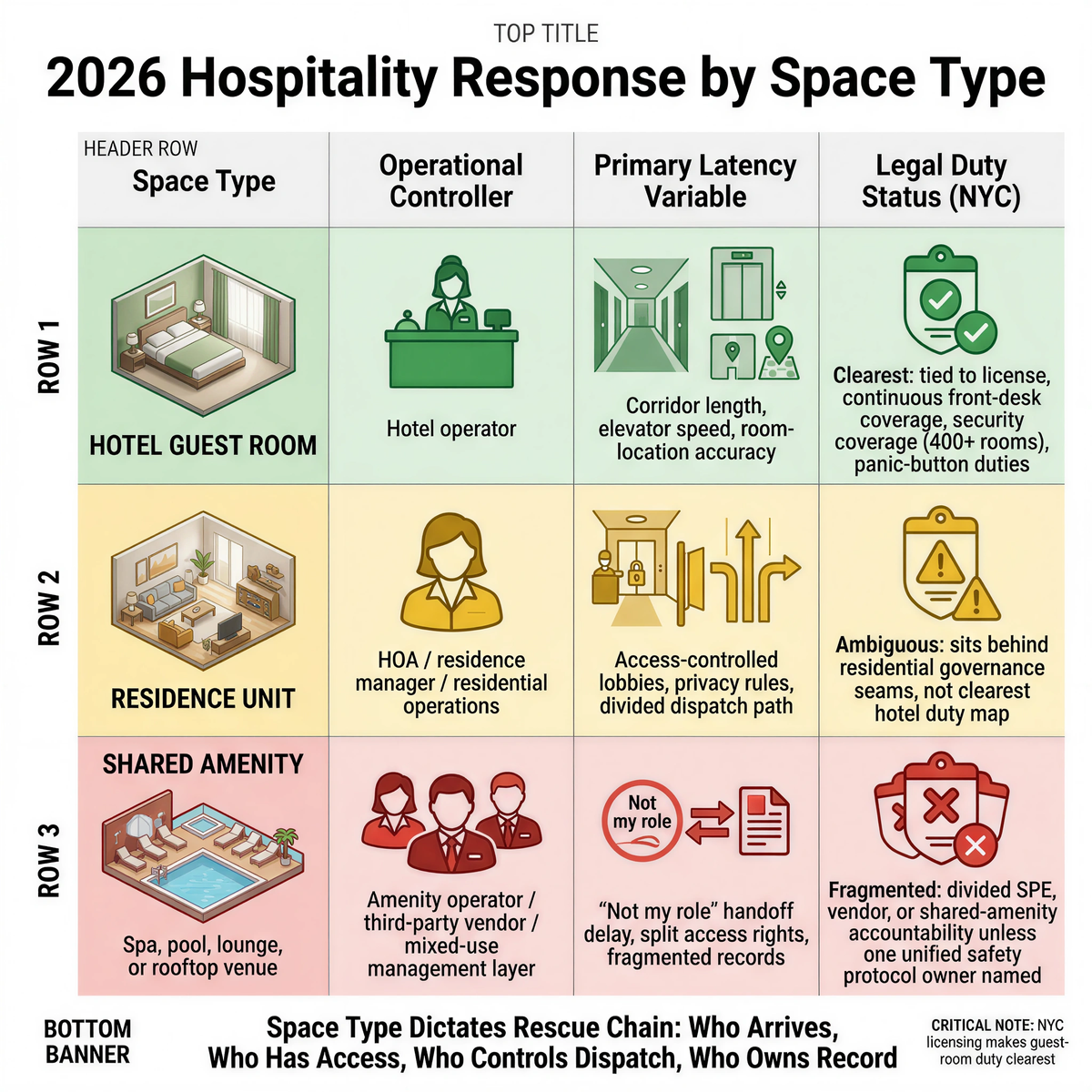
|
Space type |
Operational controller |
Primary latency variable |
Legal duty status (NYC standard) |
|
Hotel guest room |
Hotel operator |
Corridor length, elevator speed, room-location accuracy |
Clearest: tied to license, continuous front-desk coverage, security coverage in large hotels, and panic-button duties |
|
Residence unit |
HOA / residence manager / residential operations |
Access-controlled lobbies, privacy rules, divided dispatch path |
Ambiguous: often sits behind residential governance seams rather than the clearest hotel duty map |
|
Shared amenity |
Amenity operator / third-party vendor / mixed-use management layer |
'Not my role' handoff delay, split access rights, fragmented records |
Fragmented: divided SPE, vendor, or shared-amenity accountability unless one unified safety protocol owner is named |
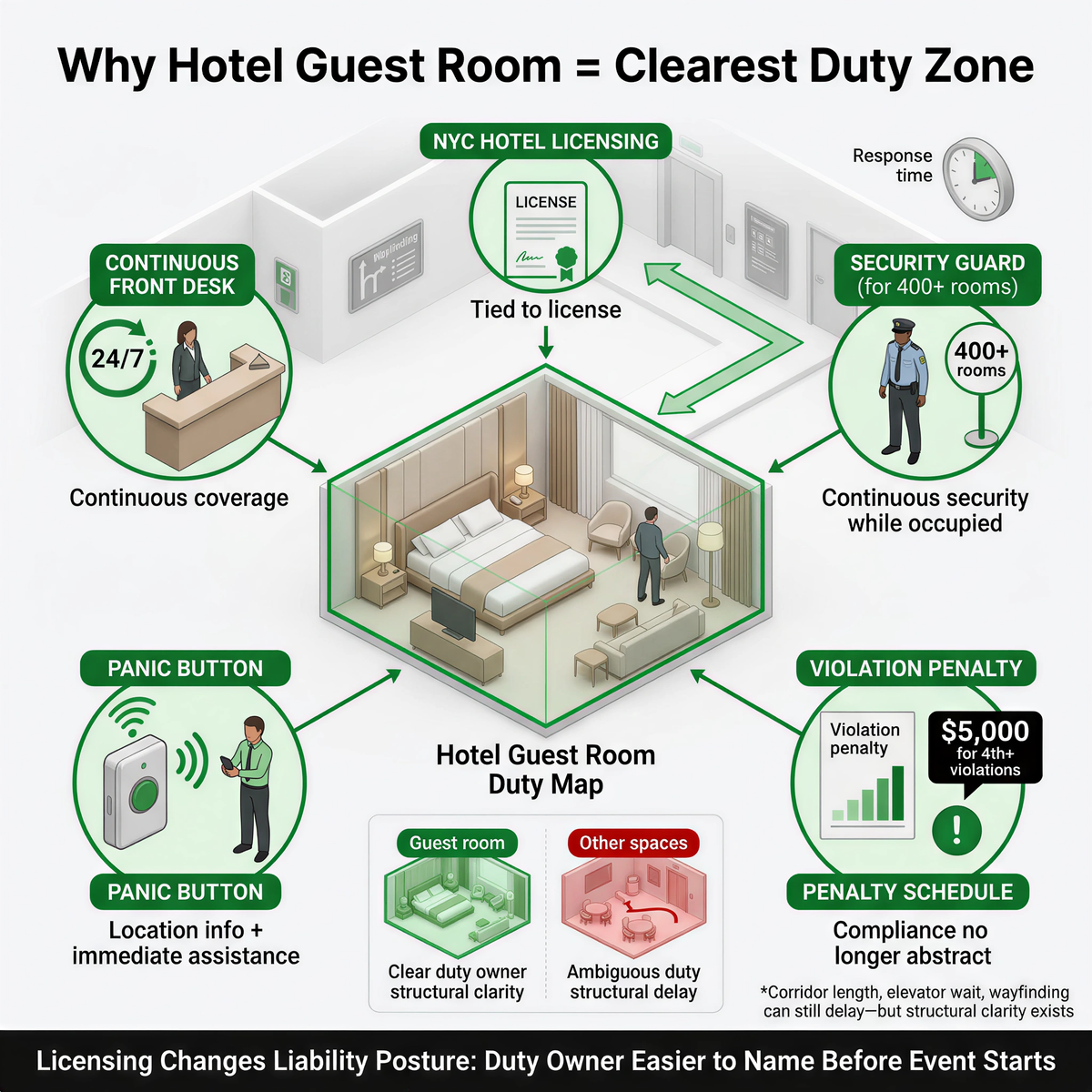
A hotel guest room usually sits inside the clearest legal and operational duty map. NYC's hotel licensing framework ties responsibility to day-to-day operational control. Hotels must maintain continuous front-desk coverage. Large hotels with more than 400 guest rooms must maintain continuous security-guard coverage while any guest room is occupied. Core employees who enter occupied guest rooms must receive panic buttons at no cost, and those devices must provide location information to an onsite person available to give immediate assistance.
Licensing changes the liability posture. The operator cannot credibly argue that the guest-room side of the building sits outside the duty map. Compliance is no longer abstract. Repeated violations under the hotel licensing penalty schedule can reach $5,000 for the fourth and subsequent violations of the same offense within two years.
Guest rooms can still produce delay through corridor length, elevator wait, or poor wayfinding. The difference is structural clarity. The duty owner is easier to name before the event starts.
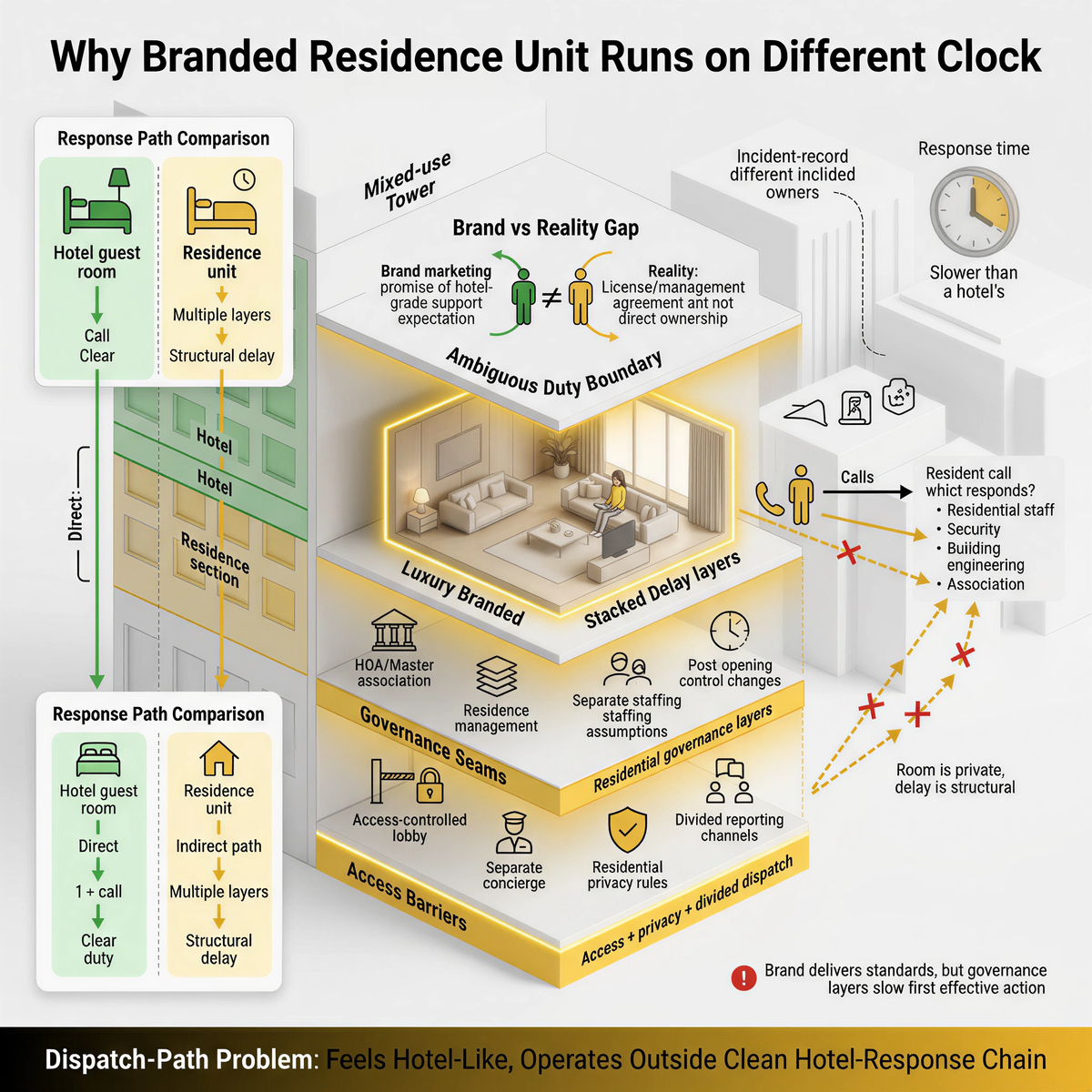
A branded residence unit may feel hotel-like while sitting outside a clean hotel-response chain. In branded residences, the brand often delivers standards, marketing, and service expectations through license or management agreements rather than through direct ownership of the real estate. Residential governance can then layer in an HOA or master association, residence management, separate staffing assumptions, and post-opening control changes.
The resident may believe hotel-grade support sits one call away because that is how the project was sold. The actual response path may depend on residential staff, security, building engineering, association rules, and a different incident-record owner than the hotel side would use.
Our team reads this as a dispatch-path problem. The room is private, but the delay is structural. Access-controlled lobbies, separate concierge layers, residential privacy rules, and divided reporting channels slow the first effective action.
Shared amenities are where hospitality service most often outruns response ownership. Lounges, spas, clubs, pools, rooftop venues, and mixed-use dining areas may sit in a polished common experience while being governed by separate operators, separate vendors, or separate cost-sharing arrangements.
These spaces create the classic handoff failure: the event happens in one place, but the authority to act, enter, dispatch, document, or maintain equipment sits somewhere else. In practical terms, this is where 'not my role' delay appears.
We classify shared amenities as fragmented duty zones. They are not inherently unsafe. They become slow when operating control, access rights, staffing, and record ownership are split across different hands without one unified safety protocol owner.
Towers do not lose time evenly. A guest-room call on a hotel floor, a residence-unit emergency above an access-controlled lobby, and an incident on a rooftop or spa deck do not run on the same path.
Elevators, restricted access points, floor-specific staffing, service-corridor routing, and separated concierge or security desks all add seconds. Panic-button compliance makes the same point from another angle. The law requires location information because responders cannot help quickly if they do not know where the employee is. The rule does not prescribe a stated GPS-accuracy threshold. In tall hotels, locator accuracy and dispatch routing still become engineering variables that shape whether the right responder reaches the right vertical segment of the building in time.
In hospitality review, elevator cores and access-control thresholds are not convenience features. They are route multipliers.
Start with three maps, not one.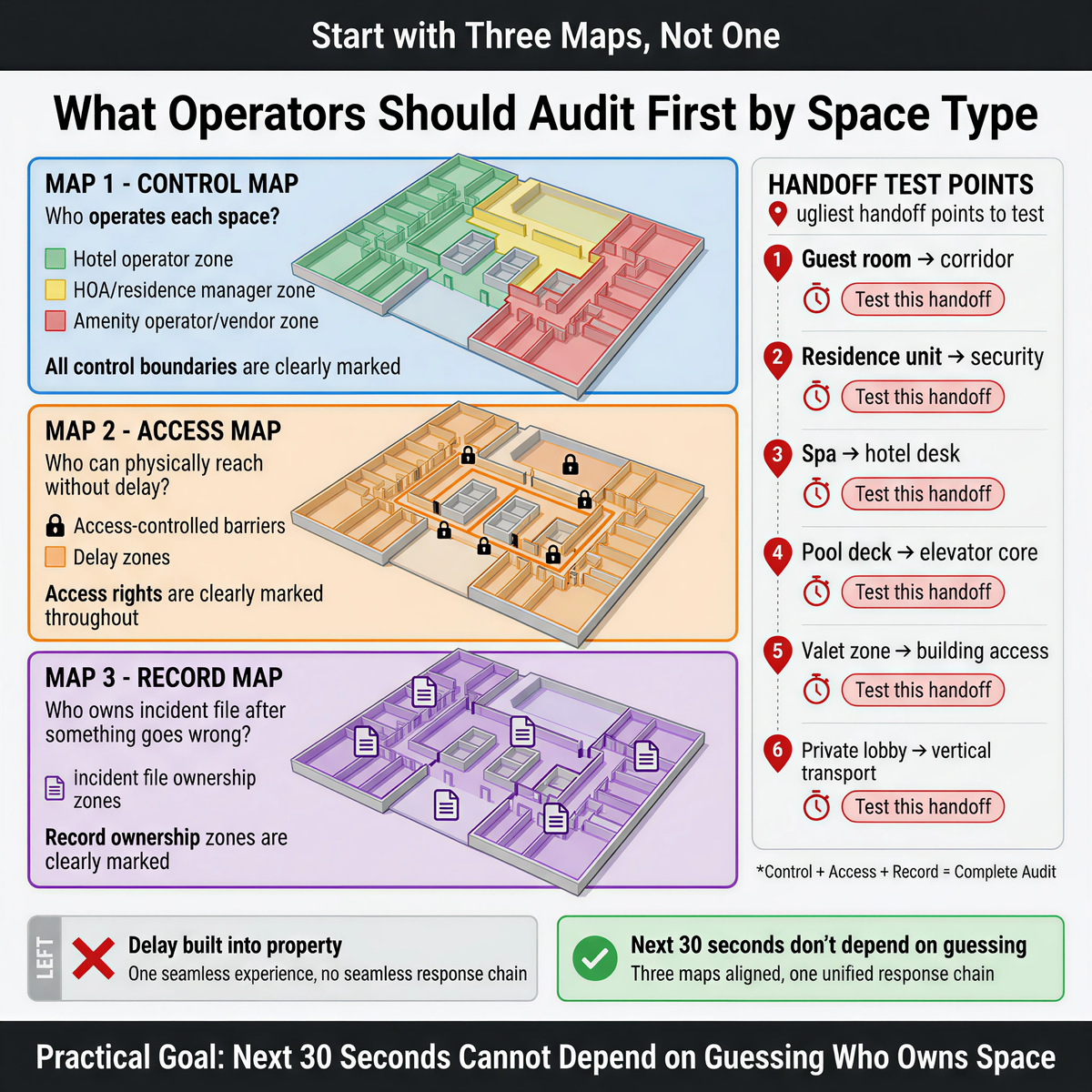
Build a control map showing who operates each space. Build an access map showing who can physically reach it without delay. Build a record map showing who owns the incident file after something goes wrong. Then test the ugliest handoff points: guest room to corridor, residence unit to security, spa to hotel desk, pool deck to elevator core, valet zone to building access, and private lobby to vertical transport.
The practical goal is simple. The next 30 seconds cannot depend on guessing who owns the space. If the tower treats three space types as one seamless experience without one seamless response chain, the delay is already built into the property.Does the NYC Safe Hotels Act require GPS accuracy for panic buttons?
No. The rule requires panic buttons to provide location information to an onsite person available to provide immediate assistance. The law does not state a specific GPS-accuracy threshold.
Can a branded residence unit rely on the hotel's guest-room response model?
Not safely by default. A residence unit may sit behind different access rules, staffing layers, governance documents, and record owners, even when the project is sold through hotel-grade language.
Why are shared amenities often the slowest spaces in a hospitality emergency?
Because the event can occur in one place while operating control, dispatch authority, access rights, and incident documentation sit with different teams or vendors.
What should operators audit first?
Audit three maps for every high-traffic space: who controls it, who can physically access it without delay, and who owns the incident record after the event.
|
Source name |
What it supports |
Full URL |
|
NYC Hotel Licensing Law FAQ |
License framework, operator definition, front-desk coverage, large-hotel security coverage |
https://www.nyc.gov/assets/dca/downloads/pdf/businesses/Hotel-Licensing-Law-FAQ.pdf |
|
NYC Hotel License Application Supplement |
Panic-button obligations, human trafficking training timing, direct-employment details |
https://www.nyc.gov/assets/dca/downloads/pdf/businesses/Hotel-License-Application-Supplement.pdf |
|
NYC Admin Code 20-565.8 |
Civil penalty schedule for hotel licensing violations |
https://codelibrary.amlegal.com/codes/newyorkcity/latest/NYCadmin/0-0-0-229186 |
|
Mayer Brown - Structuring Luxury Mixed-Use Hospitality Properties |
Separate parcels, SPEs, brand agreements, and mixed-use legal architecture |
|
|
ArentFox Schiff - Branded Residences |
Branded-residence market structure, HOA governance, shared-amenity complexity |
This article is for preparedness, compliance, and engineering-analysis purposes only. It is not medical advice and not legal advice. In a real emergency, follow current first-line response guidance and local emergency protocols. Any second-line device discussed in related Fitiger materials should be treated as a backup layer after unsuccessful first-line care, not as a replacement for training, EMS, or established emergency-response protocols.


