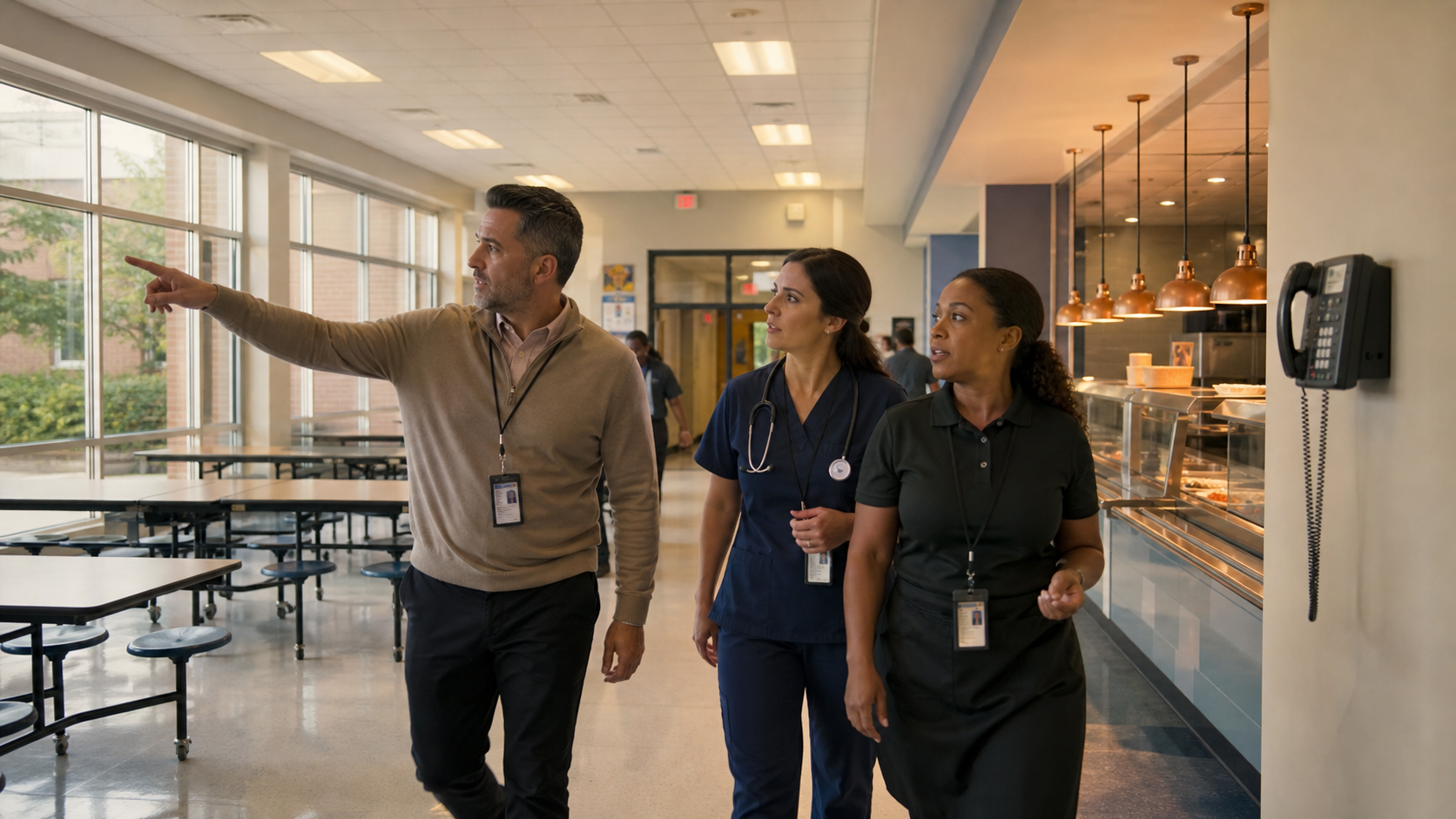
A school choking risk assessment maps every place students eat, who supervises each zone, who calls 911, who starts first-line choking rescue, and how fast backup can reach the child. Cafeterias, classrooms, buses, field trips, and after-school rooms need separate checks. Any anti choking device belongs only as second-line backup after standard rescue steps fail.
For childcare teams, Fitiger's daycare choking readiness guide translates similar ideas into snack-time roles and equipment placement.
Schools often feel prepared because the nurse is trained, the first-aid cabinet is stocked, and the emergency binder exists. That may be enough for some incidents. It is not enough for choking.
Choking usually starts where students are eating, not where the policy is stored.
A student goes silent at the far end of the cafeteria. A kindergartener stuffs crackers into both cheeks during classroom snack. A child eats grapes while walking toward the bus line. A middle schooler laughs with food in his mouth after practice. A student with feeding support needs struggles in a classroom where the aide is helping another child. The first adult who notices may not be the nurse. It may be a cafeteria monitor, teacher, bus aide, coach, substitute, paraprofessional, or another student.
That is why a school choking risk assessment has to begin with geography and timing. Where does food actually appear on campus? Which adults are closest? Who can call 911 without leaving the child? Who starts first-line choking rescue? Where is any second-line backup stored? Can it be reached without creating delay?
A school choking emergency plan should not be built around the most organized room in the building. It should be built around the loudest, busiest, least predictable eating zones.
For administrators and district buyers, this is also a procurement issue. A school choking rescue device buying guide that starts with device selection is already out of order. Equipment only makes sense after the school maps food exposure, staff roles, access time, policy limits, and documentation. Choking safety equipment for schools must support the response workflow, not replace it.
The goal of this audit is simple: remove preventable delay before a child cannot breathe.
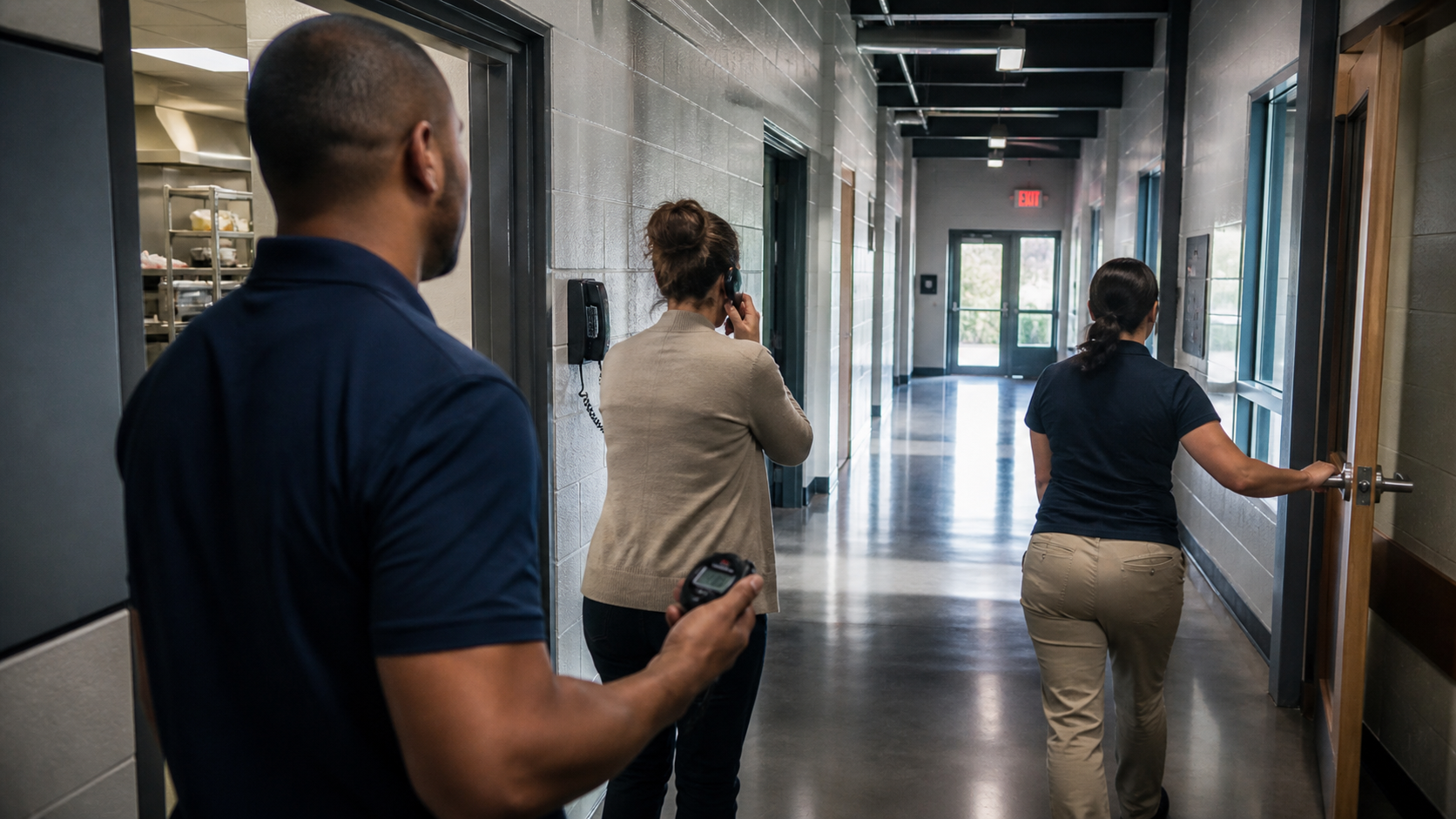
A useful school choking risk assessment is done on foot.
Start in the cafeteria during a normal lunch period, not after the room is empty. Watch the first five minutes. Students arrive hungry, unwrap food, talk, laugh, trade snacks, and rush because the next bell is already in their heads. Staff may be standing, moving, answering questions, opening milk cartons, handling behavior, and watching multiple tables at once.
Then time the route from the farthest lunch table to the nearest phone, office, nurse station, first-aid area, AED, and any approved school choking rescue device. Repeat the same walk from classroom snack zones, preschool rooms, special education rooms, the gym, the bus line, and the field-trip staging area.
A good assessment is often uncomfortable because it shows a mismatch: the school may have emergency equipment, but the route, staff role, or access point is weak.
Map every food-risk zone:
| Cafeteria tables | Lunch line and serving area | Preschool and kindergarten snack areas |
| Classroom snack routines | Special education meal support areas | After-school rooms |
| Bus loading zones | Sports fields and gyms | Field trip kits |
| School nurse station | Main office | Staff break rooms |
| Parent event spaces | Summer camp or extended-day rooms | Then ask one hard question for each zone: |
If a student cannot breathe here, what happens in the first 30 seconds?
If the answer depends on someone running across campus to ask what to do, the plan needs work.
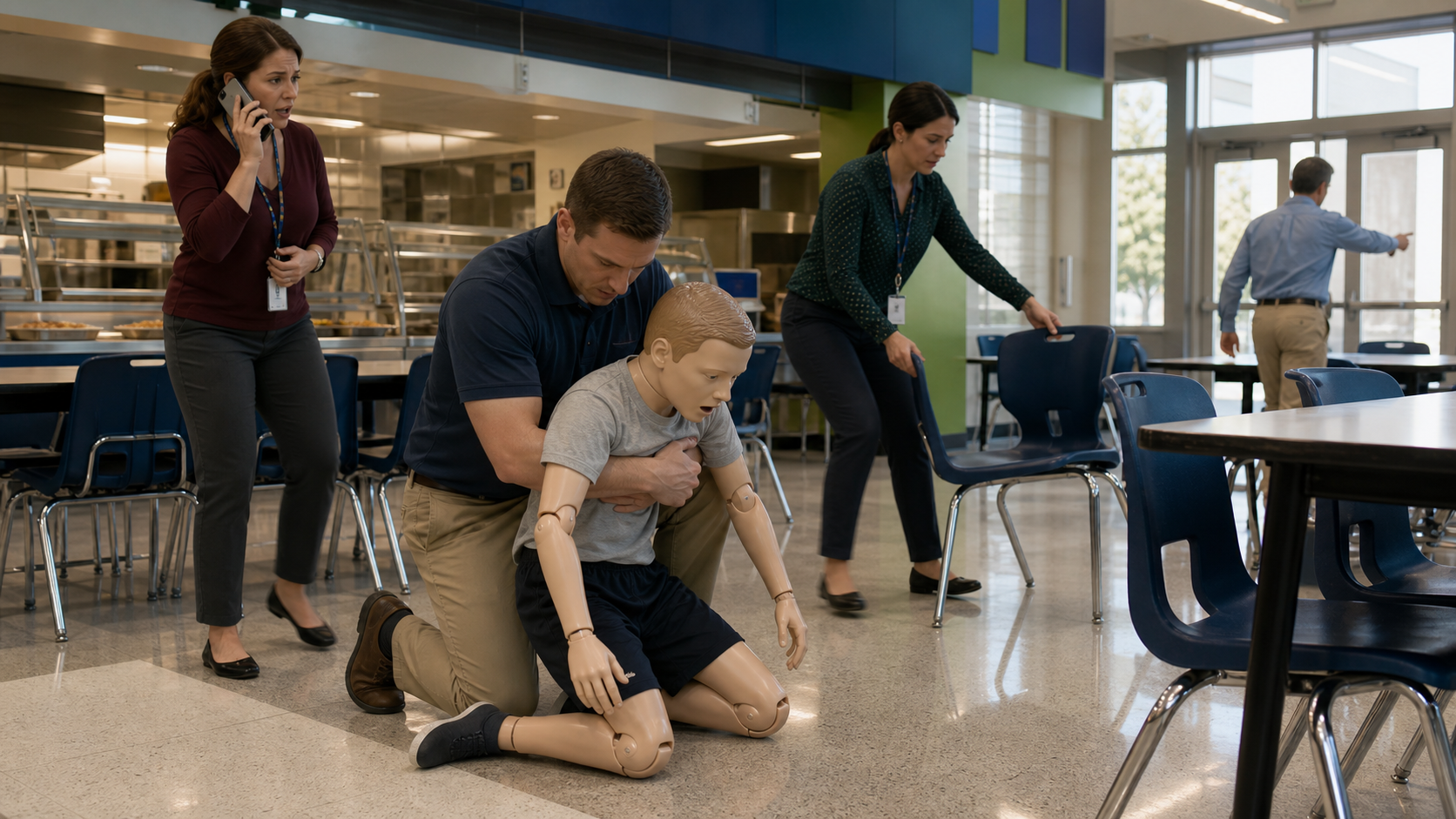
The cafeteria is usually the highest-risk food zone because density, noise, and distraction stack together.
Students are hungry. Lunch is short. Food moves fast. Children talk while chewing. Younger students may still be learning safe eating habits. Older students may rush to finish before recess, sports, or social time. Packed lunches bring foods the cafeteria staff did not prepare: whole grapes, cherry tomatoes, hot dog pieces, popcorn, nuts, hard candy, chewy meat, and dense sandwiches.
The first safety question is not whether those foods exist. They do. The question is whether adults can see trouble early.
A cafeteria choking safety audit should review:
| Whether staff can see all tables. | Whether younger students remain seated while eating. | Whether students leave lunch still chewing. |
| Whether food is allowed during the walk to recess. | Whether staff know the difference between effective coughing and severe choking. | Whether one adult can call 911 while another begins first-line response. |
| Whether the nearest phone works and is easy to access. | Whether EMS can reach the cafeteria entrance quickly. | Whether any second-line device is close enough to support the response instead of delaying it. |
Schools often handle food allergy planning with more structure than choking planning. Allergy protocols have forms, labels, staff awareness, parent communication, and emergency response steps. Choking needs the same operational discipline. Not the same medical protocol, but the same seriousness about risk location, response roles, and documentation.
A cafeteria emergency response plan should be visible to the adults who supervise lunch. If the plan only exists in an administrative binder, it will not help when a student silently stands up from a table.

Classroom snack time feels less formal than lunch, so it often receives less planning. That is the problem.
Snack time overlaps with teaching, cleanup, bathroom turns, line-up, story time, birthday celebrations, movies, and behavior management. The teacher may not be thinking like a meal supervisor. A child may eat while walking to the rug. Another may pocket food in the cheeks. A birthday treat may include hard candy or popcorn. A student with sensory or oral-motor challenges may stuff food while the classroom is transitioning.
A classroom snack choking risk audit should check:
| Are students seated while eating? | Does snack time end before line-up? | Are hard candy, gum, popcorn, and whole round foods restricted? |
| Do substitute teachers know the snack rule? | Are parents told how to prepare classroom treats? | Are students with feeding needs supported? |
| Is a phone or call button accessible? | Is there a visible response card for severe choking? | Who calls 911 if the teacher is giving first aid? |
| The strongest classroom rule is short: | Food stays seated. | |
That rule works in preschool, elementary classrooms, daycare rooms, summer camps, and after-school programs. It also prevents a common failure: eating during transitions.
A school does not need to frighten children to reduce choking risk. It needs consistent routines that make the safer behavior automatic.
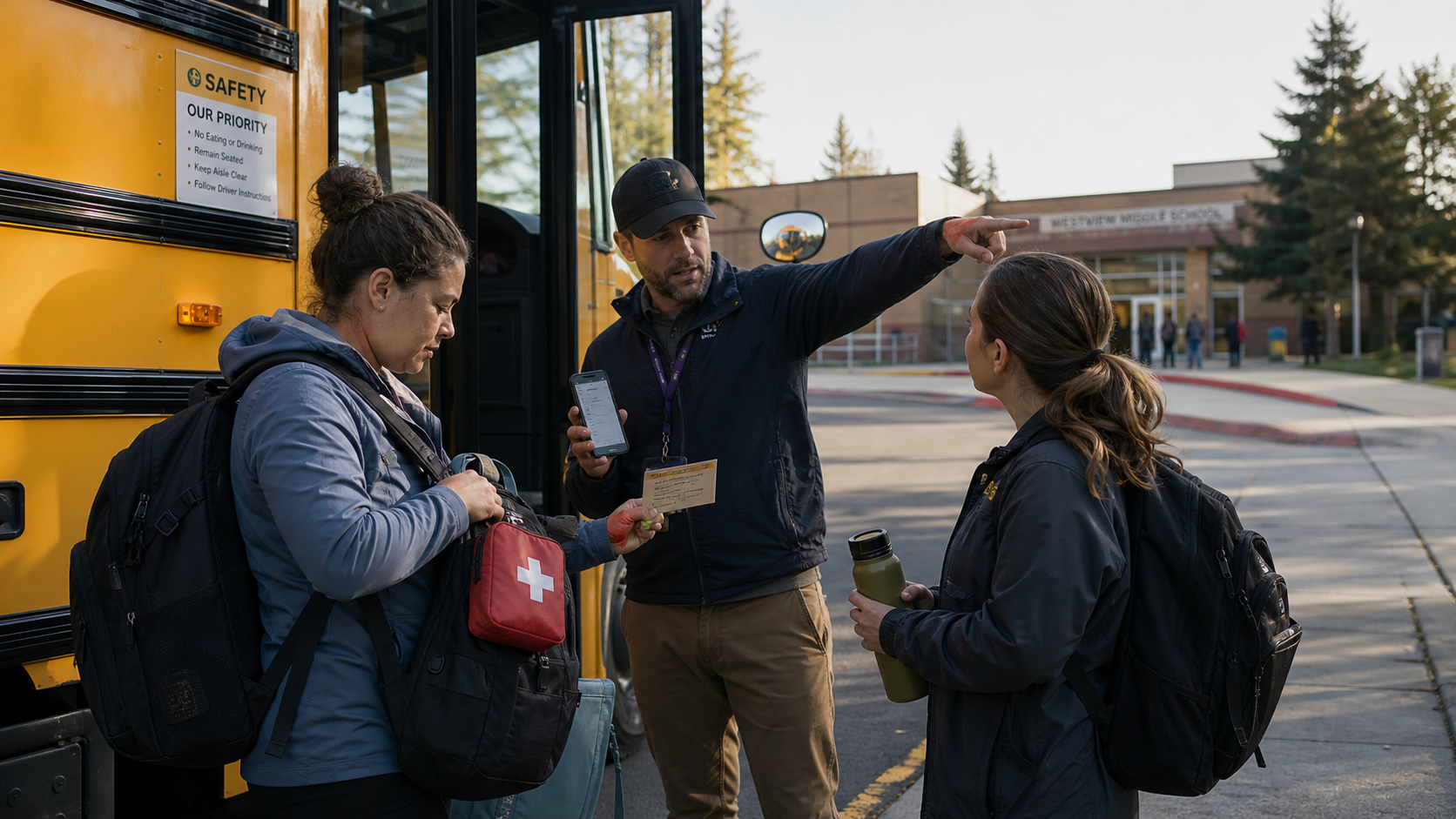
Preparedness often gets thinner once students leave the cafeteria.
The bus lane, field trip site, playground, gym, parking lot, and sports field can all become food-risk zones. Students eat while standing, waiting, walking, laughing, or rushing. Staff may be spread out. The school nurse may be far away. Address details may be unclear. A second-line backup stored in the building may not matter if the group is at a museum, zoo, stadium, or bus stop.
A field trip choking emergency kit should be assigned to a person, not vaguely "brought along."
Before departure, the trip lead should know:
| Are high-risk lunch foods restricted? | Are students allowed to eat while walking? | Who carries the emergency phone? |
| Who knows the exact location for 911? | Who starts first-line rescue? | Who manages the rest of the group? |
| Is any approved second-line backup included in the trip bag? | Are staff reminded that first-line choking rescue comes first? | Who documents the incident if something happens? |
For bus zones, the simplest prevention rule is often the strongest: no food while loading, walking, or transitioning. If the school allows eating on buses, it needs a supervision and emergency stop plan. Many schools would reduce risk quickly by separating eating from movement.
This is where portable placement matters. FoldPumpVac may be relevant for field-trip kits, bus-zone readiness, school bags, caregiver bags, and mobile staff kits because compact staging makes it easier to keep backup near the moving risk zone. EasyPumpVac may fit fixed school locations such as cafeteria response points, nurse stations, after-school rooms, or dining support areas where easier handling and stable standby placement matter.
Both products must remain second-line backup. They do not replace first-line rescue, 911 activation, CPR readiness, EMS, or school policy.
In a real emergency, vague instructions fail.
If a student is choking, several adults may see the same incident and still hesitate. One assumes the nurse has been called. Another runs to the office. Another tries to decide whether the student is coughing or choking. Another looks for equipment. Another keeps the other students away. Time drains through uncertainty.
A school choking emergency plan should assign roles by zone.
In the cafeteria, the role card may say:
| Closest trained adult starts first-line choking rescue. | Cafeteria lead calls 911. |
| Assigned runner retrieves approved backup if needed. | Another staff member clears space and moves students away. |
| Office staff meets EMS at the entrance. | |
In a classroom:
| Teacher starts response if closest and trained. | Aide or nearest adult calls 911 and alerts office. |
| Another adult keeps students clear. | Designated person retrieves backup if school policy allows. |
| Incident details are documented after the event. | |
On a field trip:
| Trip lead calls 911 with exact location. | Closest trained adult starts first-line rescue. |
| Second adult controls the group. | Another adult guides EMS to the student. |
| Trip documentation is completed afterward. | |
This is not overplanning. It is how a school prevents everyone from waiting for someone else to act.
Any school discussion about anti choking devices needs a clear boundary.
Established choking rescue protocols come first. If a student has severe choking and cannot breathe, cry, speak, or cough effectively, staff should call 911 and begin age-appropriate first-line choking rescue according to training. If the student becomes unresponsive, CPR and dispatcher guidance become urgent.
A second-line anti choking device should be considered only if standard rescue steps are unsuccessful, the student fits the current product instructions, the device is permitted under school policy, and using it does not interrupt critical first-line response.
This sequence should appear in staff training, response cards, procurement notes, and parent-facing language. A school should not say, "We bought a device, so we are covered." A safer statement is:
"We train staff to recognize choking, call 911, begin first-line rescue, and use any approved second-line backup only if standard steps are unsuccessful."
That message is more accurate, more defensible, and more trustworthy.
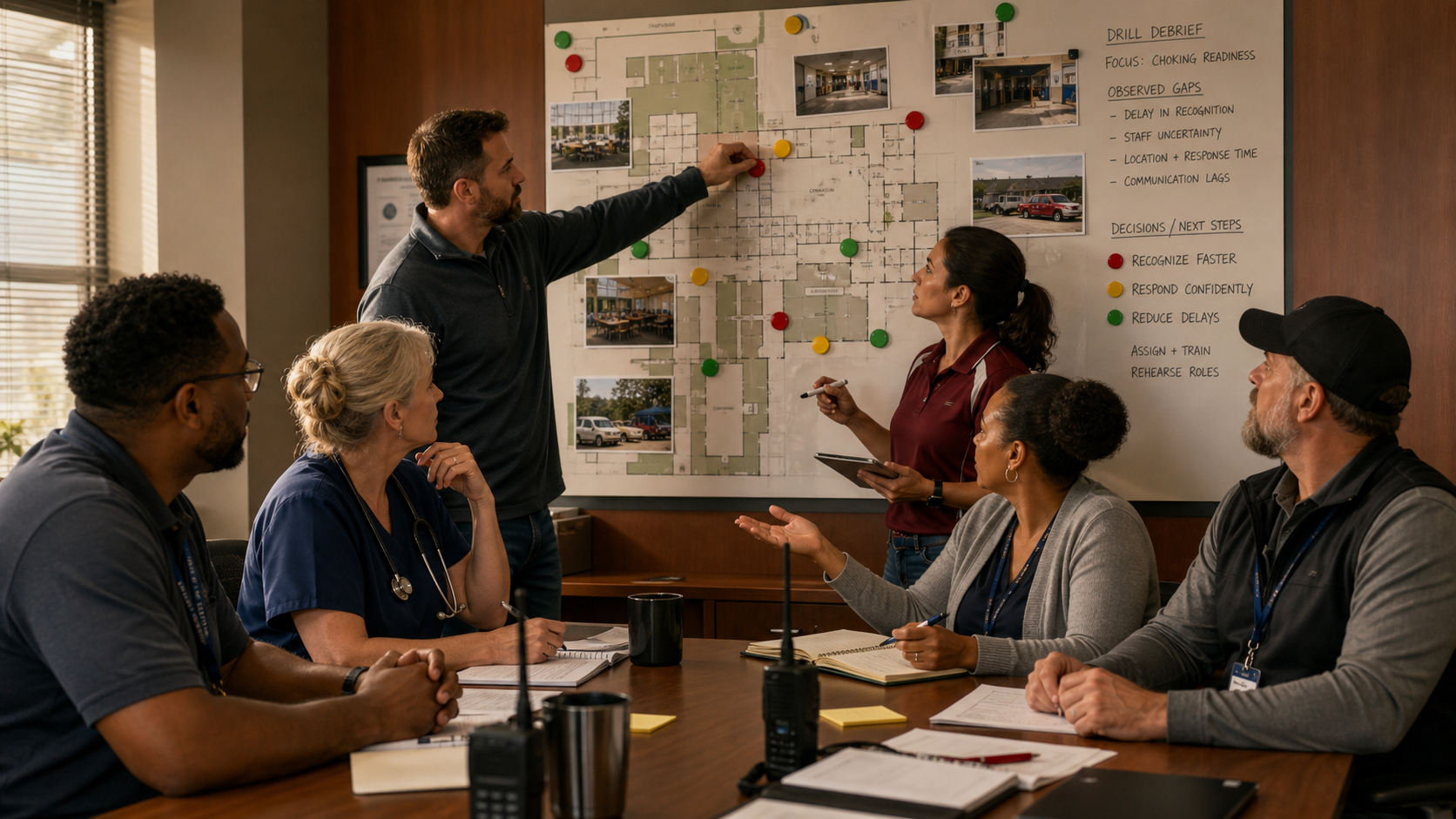
A red/yellow/green system helps turn a safety audit into action. It also gives administrators a way to prioritize without pretending every issue can be fixed in one week.
A green zone has seated eating rules, visible adult supervision, staff who know severe choking signs, quick phone access, clear 911 roles, reasonable EMS access, and any second-line backup staged close enough to support the response. Equipment is complete, inspected, and documented.
Green does not mean "no risk." It means the school has removed obvious delay.
A yellow zone has some safety pieces but weak coordination. Staff may be present but unsure who calls 911. Equipment may exist but be stored too far away. Snack rules may depend on the individual teacher. Field trip kits may be inconsistent. Documentation may happen only after serious incidents, not near misses.
Yellow zones should become the next improvement target.
A red zone has food exposure, movement, limited supervision, unclear roles, poor phone access, no first-line rescue clarity, or backup equipment that cannot be reached quickly. Examples include food during bus loading, classroom snacks during line-up, distant nurse-only device storage, or after-school rooms with no written choking response plan.
A red zone does not mean the school is negligent. It means the school has found a delay before a child does.
That is the value of the audit.
Use this checklist during a real walk-through.
| Audit area | Green signal | Red flag |
|---|---|---|
| Cafeteria visibility | Staff can see all eating zones | Blind spots at far tables or corners |
| Food preparation | Round foods cut lengthwise when served | Grapes, hot dogs, or tomatoes served round |
| Classroom snacks | Students seated until snack ends | Food continues during transitions |
| Bus zones | No food during loading or movement | Students eat while walking or boarding |
| Field trips | Assigned kit, phone, location plan | Food carried with no response role |
| Staff roles | 911 caller and responder identified | "Someone will call" language |
| First-line training | Staff know severe choking response | Staff rely only on nurse availability |
| Backup placement | Device near food-risk zone if approved | Device locked far from cafeteria |
| Special populations | Feeding needs communicated | Support depends on memory or one aide |
| Documentation | Near misses reviewed | Only major incidents are recorded |
A school should not complete this table in a meeting room. It should complete it where students eat.
Some students need a more specific choking prevention plan.
This may include students with:
| Dysphagia | Cerebral palsy | Autism or sensory feeding patterns |
| Developmental delays | Neurological conditions | Oral-motor delays |
| Prior choking events | Mouth-stuffing | Food pocketing |
| Poor chewing | Medical feeding plans | Dental appliances |
| Seizure history | Medication-related dry mouth or sedation | |
For these students, the general cafeteria plan may not be enough. The school nurse, parents, teachers, aides, speech-language pathologist, and care team may need to coordinate food texture, seating, supervision, emergency steps, and communication.
This is especially important in special education classrooms and mixed-support dining settings. Choking prevention should be part of the daily routine, not a note buried in a file.
The goal is not to single out the student. The goal is to make the environment match the student's actual needs.
School procurement should follow the response map.
A district considering anti choking device for schools, school first aid equipment for choking, or emergency airway suction device for schools should ask more than "Which product is cheapest?" or "Which product has the most reviews?"
A serious school choking rescue device buying guide should include:
| Exact manufacturer and product name | Current FDA status | Intended user age and mask sizes |
| Product instructions for use | Clear second-line positioning | Replacement mask availability |
| Storage and inspection requirements | Staff training requirements | Post-use replacement plan |
| Incident documentation process | Compatibility with school policy | Placement by food-risk zone |
| Field trip and bus-zone use plan | ||
Buying equipment before answering those questions can create false confidence.
Fitiger can fit into school procurement only if the district understands the device as a second-line backup layer. FoldPumpVac may support portable placement for field trips, bus zones, school bags, and mobile staff kits. EasyPumpVac may support fixed readiness in cafeteria, nurse station, after-school, and dining-support areas. Both require correct masks, instructions, inspection, and training.
The product decision should come after the response map, not before it.
Parent communication should be clear, calm, and practical. Schools do not need to make families afraid of lunch. They do need to show that the school understands choking as a real emergency risk.
A parent-facing message may include:
| Students should sit while eating. | Food should not be eaten during hallway or bus transitions. |
| Round foods should be cut lengthwise. | Hard candy, gum, and popcorn may be restricted in younger grades. |
| Staff receive choking recognition and first-aid refreshers. | Emergency roles are assigned for cafeteria and classroom settings. |
| 911 activation is part of the plan. | Any second-line device is backup only after standard rescue steps are unsuccessful. |
This kind of communication improves trust. It also changes behavior before the child reaches school. A parent who reads "cut grapes lengthwise" may pack lunch differently the next morning. A teacher who reads "snack ends before line-up" may prevent the risk without ever touching emergency equipment.
Good school safety communication should make the right action easier.
A choking drill does not need to involve students or fear-based scenarios. A short staff-only walk-through can reveal most weaknesses.
Choose one zone: cafeteria, classroom snack area, bus line, field trip kit, or after-school room. Run this scenario: A student is severely choking and cannot speak. Then test the response:
| Who notices? | Who calls 911? | Who starts first-line rescue? |
| Who clears space? | Who retrieves approved backup if needed? | Who guides EMS? |
| Where is the documentation form? | What happens if the nurse is not nearby? | What happens if the usual staff member is absent? |
Time the route. Check locked doors. Check phone access. Check whether the device, if present, is complete. Check whether substitute staff would know what to do.
The drill should end with one concrete fix:
| Move a response card. | Clarify who calls 911. |
| Relocate equipment. | Add a field-trip checklist. |
| Update classroom snack rules. | Add substitute instructions. |
| Schedule a first-aid refresher. | |
A 10-minute drill can do more than a 20-page policy if it shows the real delay.
A school choking risk assessment is not about making lunch feel dangerous. It is about finding the places where an ordinary lunch could become an emergency and removing delay before it happens.
Start where students eat. Watch the cafeteria. Watch snack time. Watch field trip packing. Watch bus loading. Watch after-school rooms. Then ask who recognizes, who calls, who starts first-line rescue, who retrieves backup, and who documents what happened.
For Fitiger, the role is specific: second-line readiness after standard rescue steps are unsuccessful. FoldPumpVac can support mobile school readiness when the risk moves. EasyPumpVac can support fixed campus readiness where easier handling and stable placement matter. Neither replaces prevention, staff training, 911, CPR, EMS, or school policy. Schools can also review Fitiger scientific evidence before finalizing written procurement and placement decisions.
A prepared school is not the school with the most equipment. It is the school where the nearest adult already knows what happens in the first 30 seconds. For related planning context, review the daycare choking readiness guide.
A school choking risk assessment is a campus safety review that maps where students eat, what foods and behaviors create risk, who supervises each area, who calls 911, who starts first-line choking rescue, where emergency equipment is stored, and how choking incidents or near misses are documented.
Some schools may consider anti choking devices as second-line backup, but they should not replace prevention, staff training, 911 activation, CPR readiness, EMS, or first-line choking rescue. The school should first complete a choking risk assessment and confirm policy, placement, training, and device instructions.
If approved by school policy, anti choking devices should be placed near real food-risk zones, such as cafeterias, classroom snack areas, after-school rooms, bus-zone kits, field trip kits, and nurse stations. A device locked far from students may not reduce emergency delay.
A school choking emergency plan should include seated eating rules, high-risk food guidance, staff recognition training, 911 activation roles, first-line rescue training, CPR readiness, EMS access, second-line device placement if used, parent communication, and post-incident documentation.
Common cafeteria choking risks include whole grapes, cherry tomatoes, hot dog coins, hard candy, gum, popcorn, nuts, trail mix, raw carrots, apple chunks, chewy meats, dense sandwiches, and foods eaten while talking, laughing, walking, or rushing.
The nearest trained adult should respond immediately while another adult calls 911. Schools should not rely only on the nurse if the nurse is not in the room. Role assignment should be clear for cafeterias, classrooms, buses, field trips, and after-school programs.
Daycare centers should first prioritize prevention, seated eating, age-appropriate food preparation, staff choking first-aid training, 911 access, and infant/child-specific response protocols. A second-line device may be considered only if it fits policy, age limits, instructions, and does not delay standard rescue.
Schools should review choking readiness at least every semester, after staff changes, before field trip season, after any choking event or near miss, and whenever cafeteria, snack, or after-school food policies change.
Schools can reduce risk by keeping students seated while eating, ending snacks before transitions, asking families to cut round foods lengthwise, avoiding hard candy rewards, monitoring younger students closely, training staff, and assigning 911 and first-line response roles.
Fitiger may be considered as a second-line backup option in school settings when allowed by policy, staged correctly, stored with instructions and masks, inspected regularly, and used only after standard choking rescue steps are unsuccessful. FoldPumpVac may support portable school placement, while EasyPumpVac may support fixed readiness points.
FDA - Update: FDA Encourages the Public to Follow Established Choking Rescue Protocols - Supports first-line rescue first, second-line anti-choking device backup only after standard protocols are unsuccessful, and buyer verification of FDA status.
American Red Cross - Adult and child choking first aid - Supports established first-line choking response education for adults and children.
American Heart Association - CPR and first aid training resources - Supports CPR, first aid training, and age-appropriate emergency response education.
CDC - Choking hazards and prevention for young children - Supports food-shape, supervision, and prevention principles useful for school and childcare settings.
HealthyChildren.org - Choking prevention guidance - Supports pediatric choking prevention language around food, small objects, and supervision.
This article is for general education, school safety planning, and emergency preparedness only. It is not medical advice, diagnosis, or treatment. In a choking emergency, call 911 or your local emergency number immediately and follow dispatcher instructions. School staff should receive age-appropriate first aid and CPR training from recognized providers. Any anti choking device should be treated as a second-line backup, not a replacement for prevention, supervision, first-line rescue, CPR, EMS, school policy, or professional medical care.


