FITIGER

|
Manual rescue first. Backup second.Post one printed copy near the place where your child usually eats. Review it with grandparents, babysitters, nannies, and any adult who may supervise meals or snacks. For a household checklist, see Fitiger's child and home choking safety readiness plan. |
|---|
|
--- |
Educational preparedness tool. Not a substitute for pediatric first-aid or CPR training.

Safer food preparation, seated eating, close supervision, and pediatric first-aid training come first. Post your address, keep a phone nearby, and practice the first minute before an emergency happens. Any suction anti-choking device belongs only in a second-line backup role after unsuccessful standard choking rescue and only within its current instructions.
| Check these once, then make them the household baseline. |
| □ Meals and snacks happen while the child is seated. |
| □ No walking, crawling, running, playing, or riding in a stroller with food in the mouth. |
| □ Avoid casual snacks while buckling the child into a car seat. |
| □ One adult is clearly responsible for watching the first few bites. |
| □ Toys, screens, rough play, and pets stay away from the eating zone as much as possible. |
| □ Older siblings do not hand the child food without an adult checking it first. |
| □ Grandparents, babysitters, and visitors follow the same food rules. |
| □ The adult serving food checks the shape, size, texture, and softness before the meal begins. |
The food is only part of the decision. Shape, texture, and portion size matter.
|
Food or texture |
Check before serving |
|---|---|
|
Grapes, cherry tomatoes, round berries, and similar foods |
□ Cut into smaller, developmentally appropriate pieces. Do not serve whole. |
|
Hot dogs and sausages |
□ Cut lengthwise first, then into small pieces. Do not serve coin-shaped slices. |
|
Raw carrots, firm apple pieces, and hard produce |
□ Cook, soften, mash, grate, shave thinly, or delay until appropriate. |
|
Nut butter |
□ Spread thinly. Do not serve thick spoonfuls or sticky globs. |
|
Meat and cheese |
□ Cut into soft, small, manageable pieces. |
|
Popcorn, whole nuts, hard candy, chewy candy, gum, and marshmallows |
□ Avoid or delay based on the child's age, development, and pediatric guidance. |
|
Any unfamiliar food |
□ Stay close during the first bites and watch how the child manages the texture. |
|
What you notice |
What it may mean |
What to do |
|---|---|---|
|
Strong coughing, crying, or clear sounds |
Air is still moving |
□ Stay close. Encourage coughing. Watch carefully for change. |
|
Weak or ineffective coughing |
The blockage may be worsening |
□ Call 911 and prepare to act immediately. |
|
Unable to cry, cough effectively, or breathe |
Severe airway obstruction |
□ Call 911 and begin the age-appropriate choking rescue protocol immediately. |
|
Child becomes unresponsive |
Life-threatening emergency |
□ Begin CPR according to training and follow dispatcher instructions. |
| □ Never perform a blind finger sweep. |
| □ Remove an object only if it is visible when the mouth is opened during care. |
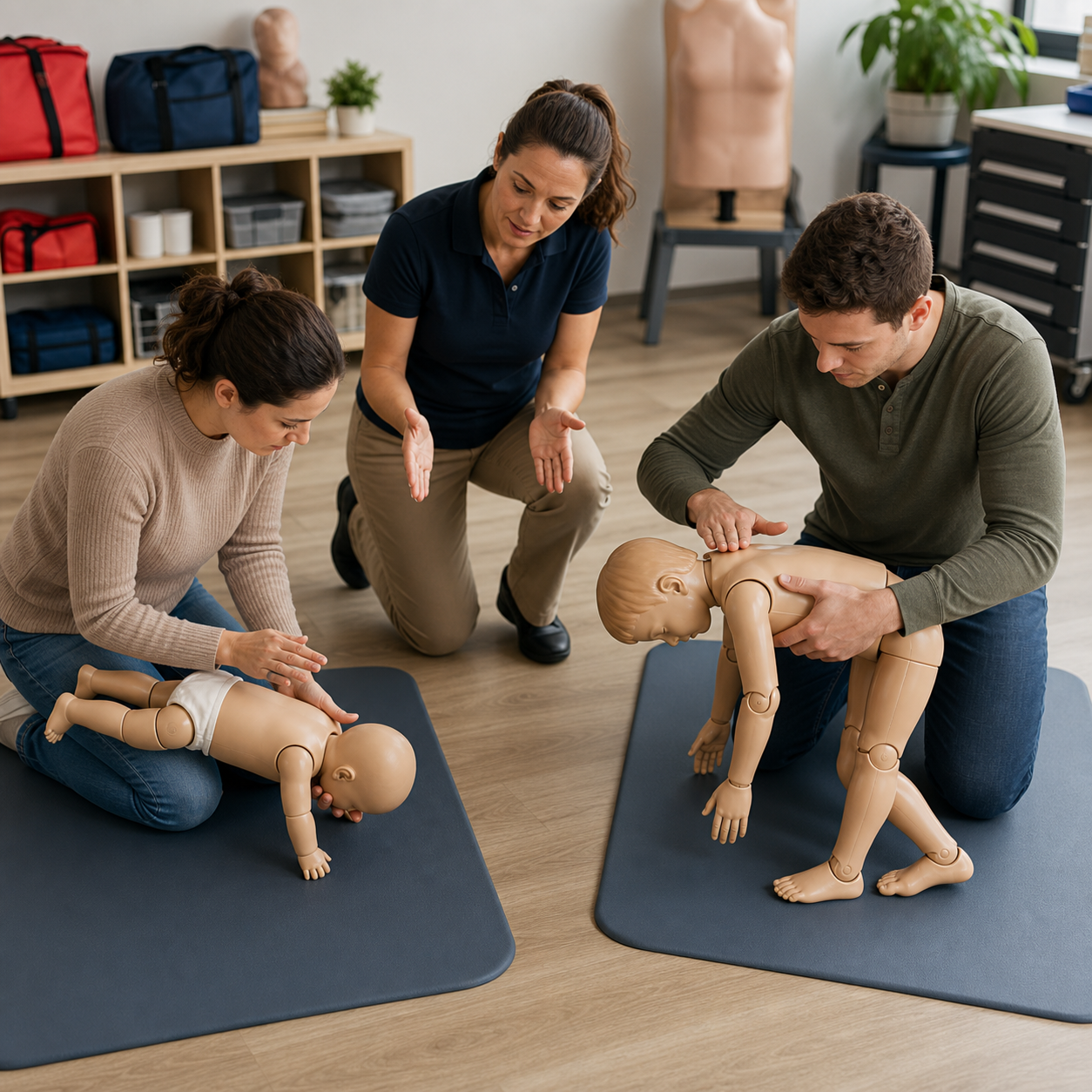
The recommended choking rescue steps are not the same for an infant and a child older than 1 year.
| For severe choking | □ Give 5 back blows. |
|---|---|
| □ Give 5 chest thrusts. | □ Repeat until the object is expelled or the infant becomes unresponsive. |
| □ Do not use abdominal thrusts on an infant. |
| For severe choking: |
| □ Give 5 back blows. |
| □ Give 5 abdominal thrusts. |
| □ Repeat until the object is expelled or the child becomes unresponsive. |
| □ Begin CPR according to your training. |
| □ Follow 911 dispatcher instructions. |
| □ Seek emergency medical care. |
| A printed checklist supports memory. It does not replace a pediatric first-aid and CPR course. |

| Choose one protected, adult-accessible location close to the place where the child usually eats. |
| □ A phone is within reach of the high chair, kitchen table, or breakfast area. |
| □ The full home address is posted clearly. |
| □ Emergency contact numbers are visible. |
| □ First-aid items stay together. |
| □ Any second-line backup device stays complete, protected, and easy for an adult to retrieve. |
| □ Children cannot access emergency equipment casually. |
| □ Packaging and storage pouches are intact. |
| □ Current instructions are easy for adults to find. |
| □ The setup can be reached in roughly 30 to 60 seconds without searching, unlocking a cabinet, or moving boxes. |
| Main eating location: _______________________________________________ |
| Storage location: ____________________________________________________ |
| Retrieval time: ______________________________________________________ |
| Delay found: ________________________________________________________ |
| Fix completed today: ________________________________________________ |
| Run this once a month and whenever a new caregiver starts. |
| □ Start from the real eating location. |
| □ One adult acts as the lead responder. |
| □ One adult calls 911 and reads the posted address. |
| □ One adult retrieves the readiness setup, unlocks the door, and clears the path for EMS. |
| □ Practice saying the child's age and whether the child can cry, cough, or breathe. |
| □ Check whether the phone is charged and easy to reach. |
| □ Identify one delay. |
| □ Fix the delay before the day ends. |
|
Date |
Starting location |
Retrieval time |
Delay found |
Fix completed |
|---|

Give this section to any adult who supervises meals or snacks.
| Child's name: ______________________________________________________ |
| Age: _______________________________________________________________ |
| Weight, if relevant to current product instructions: __________________________ |
| Allergies or medical notes: _________________________________________________ |
| Full home address: ________________________________________________________ |
| Parent or guardian phone: _________________________________________________ |
| Backup contact: __________________________________________________________ |
| Main eating location: _____________________________________________________ |
| Foods that need special preparation: _______________________________________ |
| Phone location: __________________________________________________________ |
| First-aid setup location: _________________________________________________ |
| Second-line backup location, if applicable: _________________________________ |
| Check | Keep meals and snacks seated. |
|---|---|
| Check | Stay close enough to notice a sudden change. |
| Check | Call 911 early for severe choking. |
| Check | Use the correct infant or child rescue protocol. |
| Check | Begin CPR according to training if the child becomes unresponsive. |
| □ Do not treat any suction device as a replacement for manual rescue, CPR, 911, EMS, or training. |
| □ Use any device only within its current instructions, warnings, age limits, and weight limits. |
Run this check monthly and after any use, opened pouch, household move, or caregiver change.
|
Inspect |
Replace or correct when needed |
|---|---|
|
Storage pouch or packaging |
□ Opened, torn, wet, heat-damaged, or visibly compromised |
|
Components |
□ Missing, loose, damaged, or stored in different places |
|
Instructions |
□ Missing, outdated, or unfamiliar to caregivers |
|
Posted address card |
□ Missing, hard to read, or outdated |
|
Phone access |
□ Phone moved away from the eating zone |
|
Storage path |
□ Blocked by clutter, furniture, or a reorganized cabinet |
|
Caregiver handoff |
□ New caregiver has not been shown the setup |
|
Product fit |
□ Child no longer falls within the current age, weight, or use instructions |

| Prevention, pediatric first-aid training, manual rescue, 911, EMS, and CPR when unresponsive come first. |
| Manual rescue first. Backup second. |
| For households whose child falls within the current product instructions, the FITIGER FoldPumpVac Series is the more practical option when compact storage and portability matter. Its foldable design can make it easier to stage a second-line backup near the high chair, kitchen eating zone, caregiver bag, or travel setup without burying it in a distant cabinet. |
| The FITIGER EasyPumpVac Series may be a better fit when the family wants a fixed-location second-line backup near the main eating area and values a shorter pull path with a straightforward operation sequence. |
| Do not choose a product based on storage convenience alone. Check the current product-specific instructions, warnings, age limits, weight limits, and applicable regulatory status before adding any device to the household plan. |
| □ Seek medical evaluation after a serious choking episode. |
| □ Seek care especially if rescue actions were performed, a suction device was used, coughing continues, breathing sounds unusual, swallowing seems painful, or the child does not return to normal behavior. |
| □ Write down what happened while details are fresh. |
| □ Replace any opened, used, incomplete, or damaged item according to its instructions. |
| □ Review the response plan and correct any delay that became obvious. |
A monthly review is a practical baseline. Review it again before travel, holidays, a new babysitter's first shift, or any change in the child's eating routine.
Meals and snacks are safer when the child is seated, supervised, and focused on eating. Avoid casual snacking while walking, playing, riding in a stroller, or being buckled into a car seat.
If the baby is coughing forcefully or crying, air is still moving. Stay close and monitor carefully. If the cough becomes weak or the baby cannot cry or breathe, call 911 and begin the age-appropriate choking rescue protocol immediately.
No. For an infant with severe choking, use repeated cycles of 5 back blows and 5 chest thrusts according to current guidance. Abdominal thrusts are not recommended for infants.
No. A suction anti-choking device belongs only in a second-line backup role after unsuccessful standard choking rescue for complete airway obstruction and only within its current product instructions.
FoldPumpVac Series is usually the stronger fit when compact storage, caregiver handoff, or travel readiness matters. EasyPumpVac Series may suit a fixed-location kitchen setup where a shorter pull path and straightforward operation sequence are the priority. Use either option only when the child falls within the current product instructions, including age and weight limits.
This checklist is for educational and preparedness-planning purposes only. It does not replace medical advice, legal advice, pediatric guidance, certified first-aid or CPR training, calling 911, EMS, professional medical care, local emergency procedures, or the current product-specific instructions for use.
Use any suction anti-choking device only within its current instructions, warnings, contraindications, age limits, weight limits, and applicable regulatory status. Seek emergency medical care whenever a choking incident is serious, symptoms continue, or a child becomes unresponsive.


