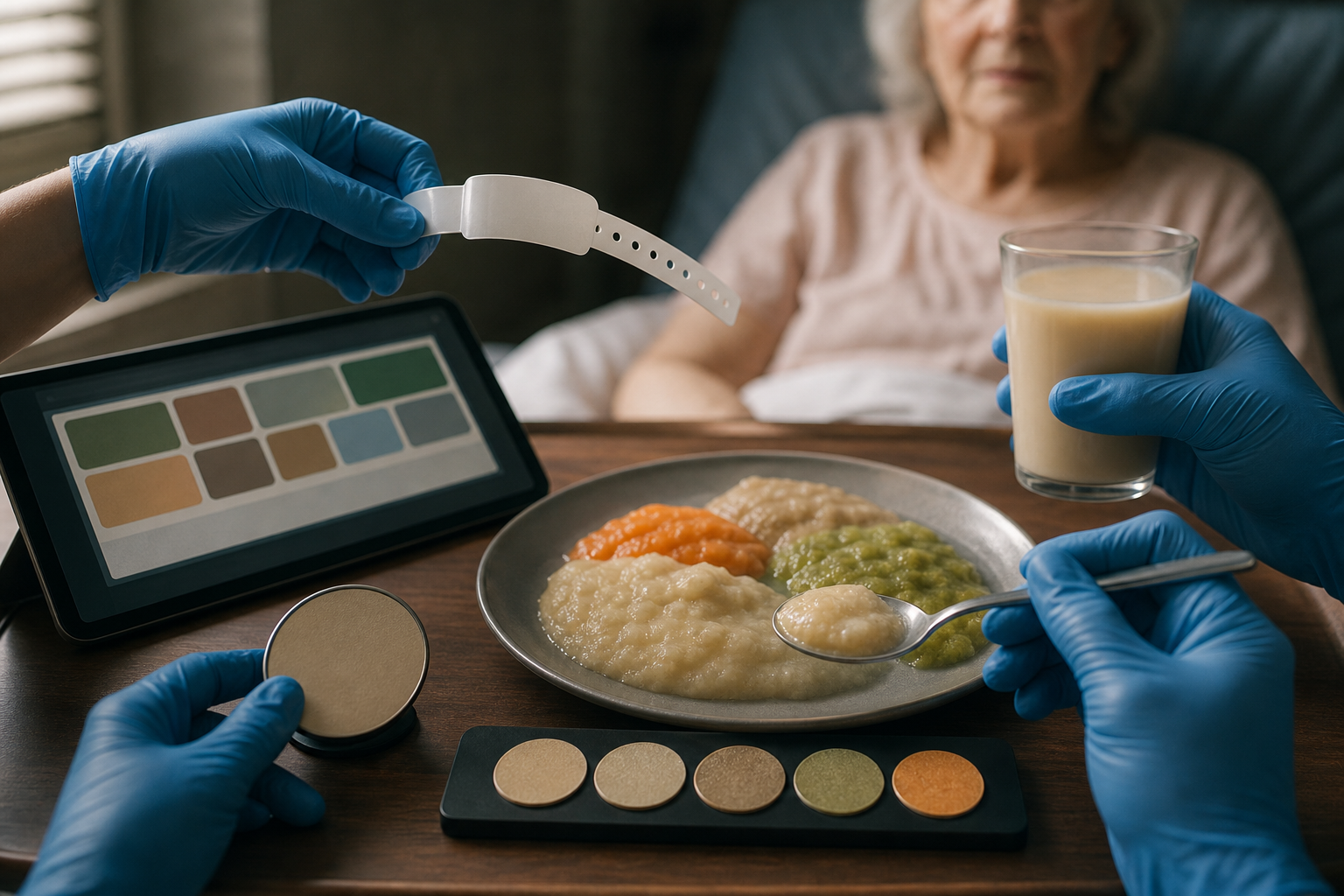
In dysphagia care, bedside verification is the last safety check before a resident swallows. Training explains IDDSI standards, but the tray decides risk. Staff must confirm food texture, liquid thickness, posture, resident identity, and assistance level at the bedside before first bite or sip.
For a household checklist, see Fitiger's child and home choking safety readiness plan.

A training slide can look perfect. The tray in front of a resident may not.
That is the uncomfortable truth in elder care choking prevention. A facility can complete staff training, print IDDSI charts, update the care plan, and still serve a meal that no longer matches the resident's swallowing condition. The risk does not live in the policy binder at that point. It lives on the spoon.
Picture a busy lunch pass in a nursing home. One resident needs IDDSI Level 5 Minced and Moist. Another needs puree. A third needs mildly thick fluids. A temporary carer is covering the wing. The kitchen is moving quickly because trays are already late. Someone sees a label, assumes the food looks close enough, and carries the tray to the dining room.
The resident does not swallow the assessment. The resident swallows what arrives.
That is why bedside verification in dysphagia care matters more than a completed module. Training sets the standard. Bedside verification checks whether that standard survived the route from chart to kitchen to tray to chair.
Training tells staff what should happen. Bedside verification catches what actually happened.

Most care homes do not fail because nobody has heard of dysphagia. They fail because the final check becomes too casual.
A staff member may know that thickened liquids must be tested. They may still use the wrong syringe. A kitchen worker may know Level 5 food should be minced and moist. They may still leave meat particles larger than the resident can safely manage. A carer may understand aspiration risk. They may still feed a resident in a rushed posture because lunch service is behind.
The failure often sounds ordinary:
| "It looked soft enough." | "That's how we usually serve it." |
| "The label said Level 5." | "She had this yesterday." |
| "We were short-staffed." | |
Those phrases are exactly why a safer dysphagia workflow needs a bedside check that is physical, repeatable, and hard to misread.
For FITIGER, this is an engineering problem as much as a care problem. A system is only robust if it catches small errors before they reach the airway. Compliance proves that the facility has rules. Robustness proves that the meal still matches those rules during a rushed shift.
The death of Thomas "Barry" Telford at Riverside Healthcare Centre in Selkirk exposed this gap with painful clarity.
Telford was an 86-year-old resident with known dysphagia. He had been prescribed an IDDSI Level 5 Minced and Moist diet. The fatal meal included beef that had not been modified to the required adult Level 5 particle size. The Health and Safety Executive found that Riverside Care Limited failed to ensure a sufficiently robust system for preparing and serving texture-modified meals, and the company was fined 拢16,000.
That case should not be reduced to one missed kitchen step. It shows a chain failure. The assessment existed. The risk was known. The diet level was documented. The resident still received food that did not match the required physical standard.
In care facilities, a correct chart is not a safety control unless the tray is verified before feeding begins.
What should be checked at the bedside before feedinga
A good bedside verification process is not complicated, but it has to be specific.
Before the first spoonful or sip, staff should confirm:
| the resident's identity | the prescribed IDDSI food level | the prescribed liquid thickness |
| the tray label | the actual texture and particle size of the served food | the liquid test method and tool used |
| the resident's posture | the assistance level required | whether the resident is alert enough to eat safely |
| whether the current presentation differs from the care plan | ||
This is where a nursing home mealtime safety audit should focus. Not just whether staff were trained. Not just whether the kitchen has a policy. The real test is whether the food, liquid, resident, chart, and bedside instruction still agree at the moment of feeding.

The IDDSI Flow Test looks simple. That is why it can be underestimated.
The test depends on a 10 mL slip-tip syringe with a measured barrel length of 61.5 mm from the zero line to the 10 mL line. The point is not brand preference. It is fluid mechanics. If the barrel length changes, the liquid column height changes. If the liquid column height changes, the hydrostatic pressure changes. That changes flow behavior and residual volume.
A staff member can follow the timing steps correctly and still misclassify a thickened drink if the syringe geometry is wrong.
That matters because liquid errors are not always visible. A drink may look thick enough in the cup, but if it is tested with the wrong tool, the IDDSI level may be wrong. Thin liquids increase aspiration risk. Over-thick liquids can increase residue, fatigue, poor intake, and dehydration risk.
For care teams, the question should not be, "Do we use a 10 mL syringea" The better check is, "Have we verified that this syringe matches the IDDSI reference geometrya"
Control Point | Standard Requirement | Risk if It Drifts |
|---|---|---|
Level 5 particle size | Adult food particles no larger than 4 mm x 15 mm | Oversized particles increase chewing load and airway obstruction risk |
Level 4 texture | Smooth, cohesive, no lumps | Lumps or separation increase swallow difficulty and aspiration risk |
IDDSI Flow Test syringe | 10 mL slip-tip syringe with 61.5 mm from 0 to 10 mL | Wrong geometry can misclassify liquid thickness |
Tray-to-chart match | Food, drink, label, resident, and care plan agree at bedside | A correct assessment fails if the wrong tray is served |
Resident posture | Upright, supported, and consistent with care instructions | Poor posture changes swallow safety and feeding control |
Assistance level | Staff support matches the care plan | Rushed or unsupported feeding increases airway risk |

Care staff often expect aspiration or choking risk to announce itself. Coughing. Panic. Blue lips. A dramatic change at the table.
Dysphagia is not always that generous.
Silent aspiration can happen without obvious coughing or distress. Published pediatric dysphagia data found that among children who aspirated, 81% aspirated silently. Older-adult dysphagia literature also describes silent aspiration as common enough that observation alone should not be treated as a full safeguard.
That does not mean every older adult has the same risk profile as the pediatric population in that study. It means the system lesson transfers: no visible cough does not prove a safe swallow.
In a dining room, this is easy to miss. A resident may take a sip, pause, and look calm. A carer may move on to the next table. The actual swallow may not have been safe. A resident with weak cough, dementia, Parkinson's disease, stroke history, frailty, or reduced alertness may not show the signs staff are waiting for.
Bedside verification cannot catch every aspiration event. It can reduce the chance that the resident starts from the wrong food, wrong liquid, wrong posture, or wrong assistance level.
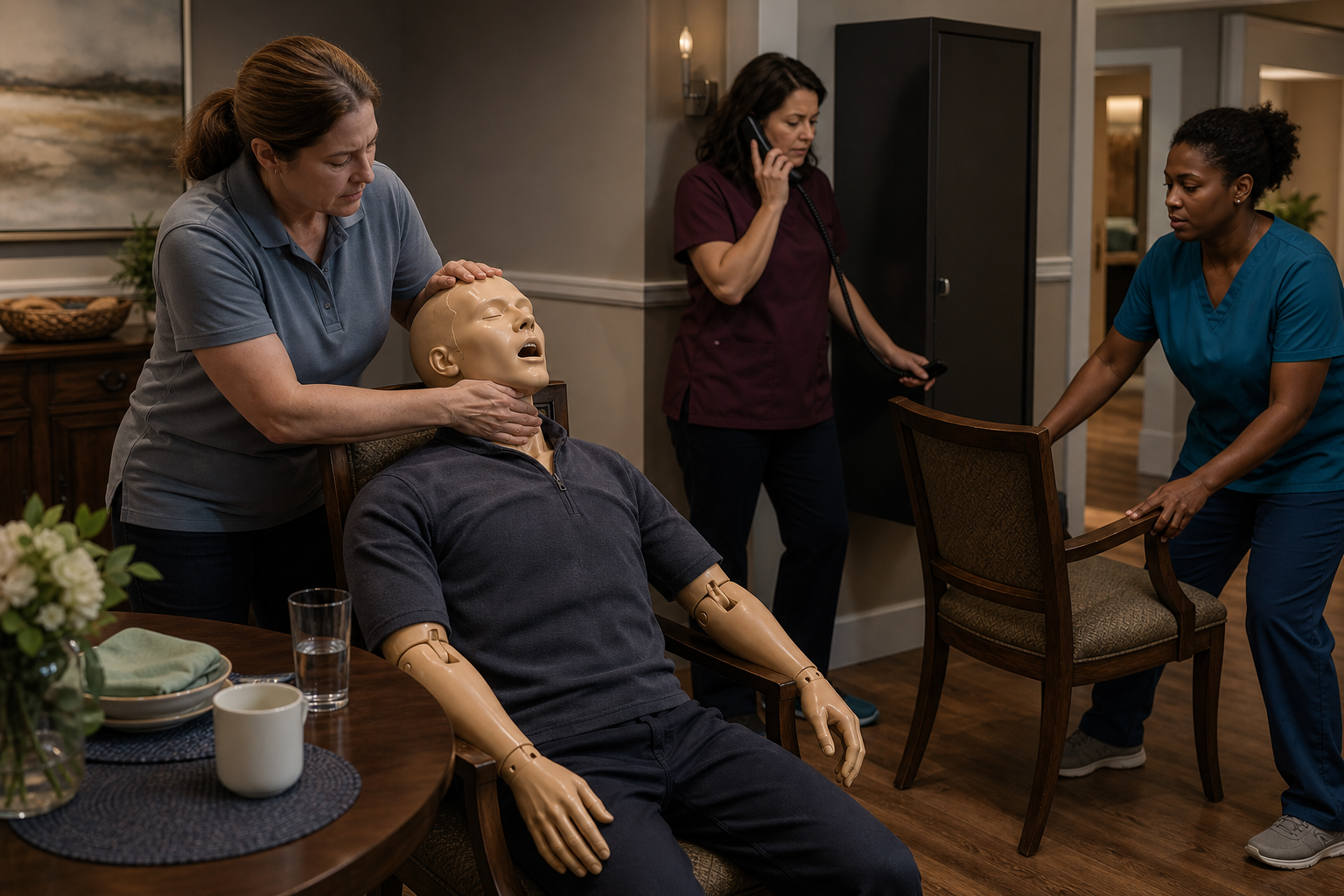
Airway safety in elder care does not begin with an anti choking device or a suction rescue tool. It begins earlier, before the resident swallows.
Food texture, thickened liquid accuracy, posture, supervision, feeding pace, and early recognition are first-line controls. If those controls fail, the resident may be pushed toward a time-critical choking or aspiration emergency.
FDA 21 CFR 874.5400 defines a suction anti-choking device as a second-line treatment. The QXN device category is positioned after unsuccessful use of a basic life support choking protocol for complete airway obstruction. That regulatory boundary does not weaken the need for bedside verification. It sharpens it.
A second-line airway clearance device belongs behind first-line prevention, recognition, and manual rescue. It does not excuse a wrong tray. It does not correct a thickened drink tested with the wrong syringe. It does not replace resident-specific feeding support.
For nursing homes and aged-care facilities, second-line rescue planning should sit inside a larger airway safety system:
| accurate dysphagia assessment | IDDSI-compliant food preparation |
| verified thickened liquids | bedside tray checks |
| staff role clarity | first-line choking response |
| 911 or emergency medical activation | second-line backup only after standard measures fail |
That is the difference between owning equipment and building a response system.
What bedside verification looks like during a real shift
On a strong shift, bedside verification does not look dramatic. It looks like a pause.
A caregiver stops at the dining table. The resident's name and diet level are checked. The tray label is compared with the care plan. The food texture is assessed as served, not as intended. The drink has been tested with the correct IDDSI syringe. The resident is upright. The required assistance level is clear. If something does not match, the tray goes back.
That small pause is the safety system working.
On a weak shift, the same moment disappears. The label is trusted. The tray moves forward. A thickened drink is assumed correct because it looks thick. A resident who ate slowly yesterday is rushed today because the pass is behind. A temporary worker does not know the resident's usual swallow pattern. Nobody verifies the mismatch until after the event.
For a resident with dysphagia, those are not minor workflow errors. They are airway-risk transfers.
Bedside Question | Why It Matters |
|---|---|
Is this the right residenta | Tray swaps and room changes can turn a correct meal into a dangerous one |
Does the tray label match the current care plana | Old instructions and outdated labels can survive in the system |
Does the food physically match the prescribed IDDSI levela | Visual confidence is not the same as particle-size control |
Was the liquid tested with the correct syringe and methoda | Wrong tool geometry can misclassify thickness |
Is the resident upright and supporteda | Posture changes swallow safety |
Is the resident alert enough to eat nowa | Fatigue, drowsiness, or illness can change swallowing safety |
Does the assistance level match the care plana | Some residents cannot safely self-pace |
Is there a clear escalation plan if choking occursa | Staff need role clarity before the first minute is lost |
A useful dysphagia audit should walk the tray, not just the paperwork.
Start in the kitchen. Check whether staff can explain IDDSI levels without vague terms like "渟oft enough"or "渁 little thick." Measure the syringe used for flow testing. Watch tray labels move through the pass. Follow a modified meal to the bedside. Ask the staff member what they check before feeding begins.
Then time the rescue path. If a resident chokes, who starts first-line responsea Who calls emergency servicesa Who retrieves any second-line backupa Can the equipment be reached without abandoning the residenta Does the staff member understand that a QXN suction anti-choking device is a second-line tool after unsuccessful BLS choking protocol, not a first reacha
The audit should not be designed to shame staff. It should reveal where the system makes safe work too fragile.
Buyer and operator concerns: where does equipment fita
Facilities often ask a practical question: "If we already have training and texture-modified diets, do we also need a choking rescue devicea"
The honest answer is that equipment is not the first fix. If the tray system is weak, fix the tray system. If staff cannot verify IDDSI levels, fix that first. If thickened liquids are tested with the wrong tool, correct the tool. If meal supervision is thin, address the staffing and workflow problem.
A second-line airway device can still belong in the plan. It may give the room a backup path after first-line choking response fails. But it should never become a psychological substitute for mealtime control.
The better purchasing questions are:
| Is the device FDA-authorized for the intended categorya | Does it fall under the QXN / 21 CFR 874.5400 pathwaya |
| Is it staged where meals actually happena | Who retrieves it without leaving the resident alonea |
| Have staff practiced the sequence from first-line response to second-line escalationa | |
Does the facility document where the device fits in the airway safety plana
A device on the wall is not a robust system. A verified tray, trained staff, clear roles, fast recognition, emergency activation, and reachable second-line backup are much closer.
Bedside verification is where dysphagia care stops being a statement and becomes a control.
The care plan may be correct. The training may be complete. The IDDSI chart may be posted. None of that protects the resident if the final tray is wrong, the drink was tested with the wrong syringe, or the bedside worker is forced to guess under time pressure.
Measure the syringe. Check the tray. Match the resident. Confirm the posture. Reject drift before feeding starts.
A safer airway system does not wait for the choking event to prove that the meal was wrong.
Training explains what should happen. It does not prove that today's tray, liquid, posture, and assistance level still match the resident's swallowing condition. Bedside verification is the last active safety check before feeding begins.
Bedside verification means confirming the resident, care plan, tray label, food texture, liquid thickness, posture, and assistance level at the point of feeding. It is the final check before the resident swallows.
The IDDSI Flow Test depends on a 10 mL slip-tip syringe with a 61.5 mm length from the zero line to the 10 mL line. A different barrel length changes the liquid column height and can misclassify liquid thickness.
The wrong syringe can change flow-test results. A liquid may be classified as the wrong IDDSI level, increasing aspiration risk if too thin or residue, fatigue, and intake problems if too thick.
Yes. Silent aspiration can occur without obvious coughing or distress. That is why staff should not rely only on visible signs. Food texture, liquid thickness, posture, and bedside verification still matter.
They should check resident identity, the current diet order, tray label, IDDSI food level, particle size or lump-free condition, liquid thickness, posture, alertness, and assistance level.
FDA 21 CFR 874.5400 defines suction anti-choking devices as second-line treatment after unsuccessful basic life support choking protocol. That means bedside verification and first-line mealtime controls remain upstream of device use.
No. An anti choking device or airway clearance device does not replace IDDSI compliance, tray checks, thickened-liquid testing, posture control, supervision, 911, or first-line choking response. It may serve as second-line backup after standard measures fail.
Start with the meal pass. Measure the IDDSI syringe, follow a modified tray from kitchen to bedside, verify tray-to-chart matching, and time the response path from the dining table to emergency activation and any second-line backup.
FDA Safety Communication, updated March 4, 2026 - Supports the warning that anti-choking devices can delay established rescue protocols because of packaging and assembly steps, and confirms FDA position on established choking rescue protocols first.
IDDSI FAQ on 10 mL slip-tip syringes - Supports the concern that syringe barrel variability can exist and that teams should verify the syringe used for the IDDSI Flow Test.
This article is for educational and preparedness planning purposes only. It does not replace clinical swallowing assessment, accredited first-aid training, emergency medical advice, facility policy, or product-specific instructions for use. In a real choking emergency, follow current established rescue protocols, call 911 or your local emergency number, and use any suction device only within its labeled instructions and second-line position.


