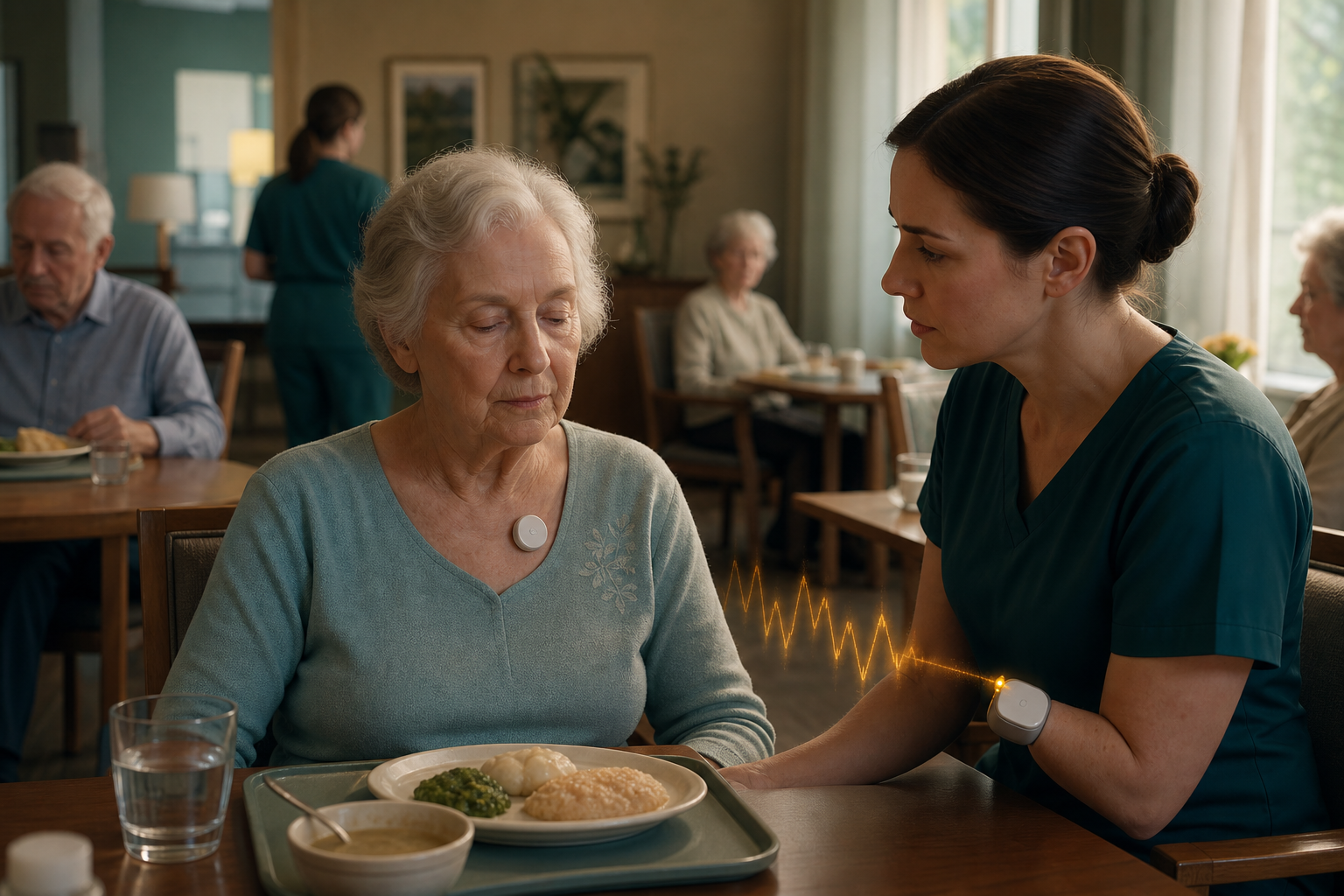
Predictive monitoring can reduce one part of aged-care airway risk by moving recognition earlier. It does not prevent every aspiration or choking event. Its value is strongest when oxygen desaturation alerts, respiratory-rate changes, DSCR records, QAPI review, first-line rescue, and second-line airway backup form one timed safety chain.
Before choosing equipment, review Fitiger's anti-choking device buyer evidence checklist for FDA wording, testing, seller traceability, and kit-selection questions.

A dining room rarely sees the first moment of airway trouble clearly.
A resident clears the throat twice. A sip takes longer than usual. Breathing becomes shallow. A pulse oximeter drifts down. A carer is helping another resident. The resident looks tired, not dramatic. Nobody hears a loud cough.
Then the room catches up.
By that point, the safest intervention window may already be smaller.
That is the reason predictive monitoring in aged care deserves attention. The goal is not to replace human observation. The goal is to catch physiologic drift before staff are forced into a late rescue.
For residents with dysphagia, frailty, neurologic disease, weak cough, dementia, low lung reserve, or repeated mealtime concerns, aspiration and choking risk often develops quietly. Visual observation alone can miss too much. A resident may not cough. A resident may not complain. A resident may not be able to report that swallowing has changed.
A good monitoring system helps the room see earlier.

Care teams sometimes wait for signs that feel unmistakable: blue lips, collapse, panic, gasping, or a dramatic cough.
Those signs are late.
Earlier warning signs may be subtle: rising respiratory rate, falling oxygen saturation, repeated throat clearing, wet voice, short inspiratory effort, meal fatigue, watery eyes, a pause after swallowing, or a cough that never becomes strong enough to clear anything.
In frail residents, the difference between early and late recognition can define the outcome. A complete airway obstruction can enter brain-injury territory within roughly four to six minutes. EMS may arrive after that early physiologic window. The room has to act before the emergency becomes obvious to everyone.
Predictive monitoring matters because it can move the first actionable signal left on the timeline.
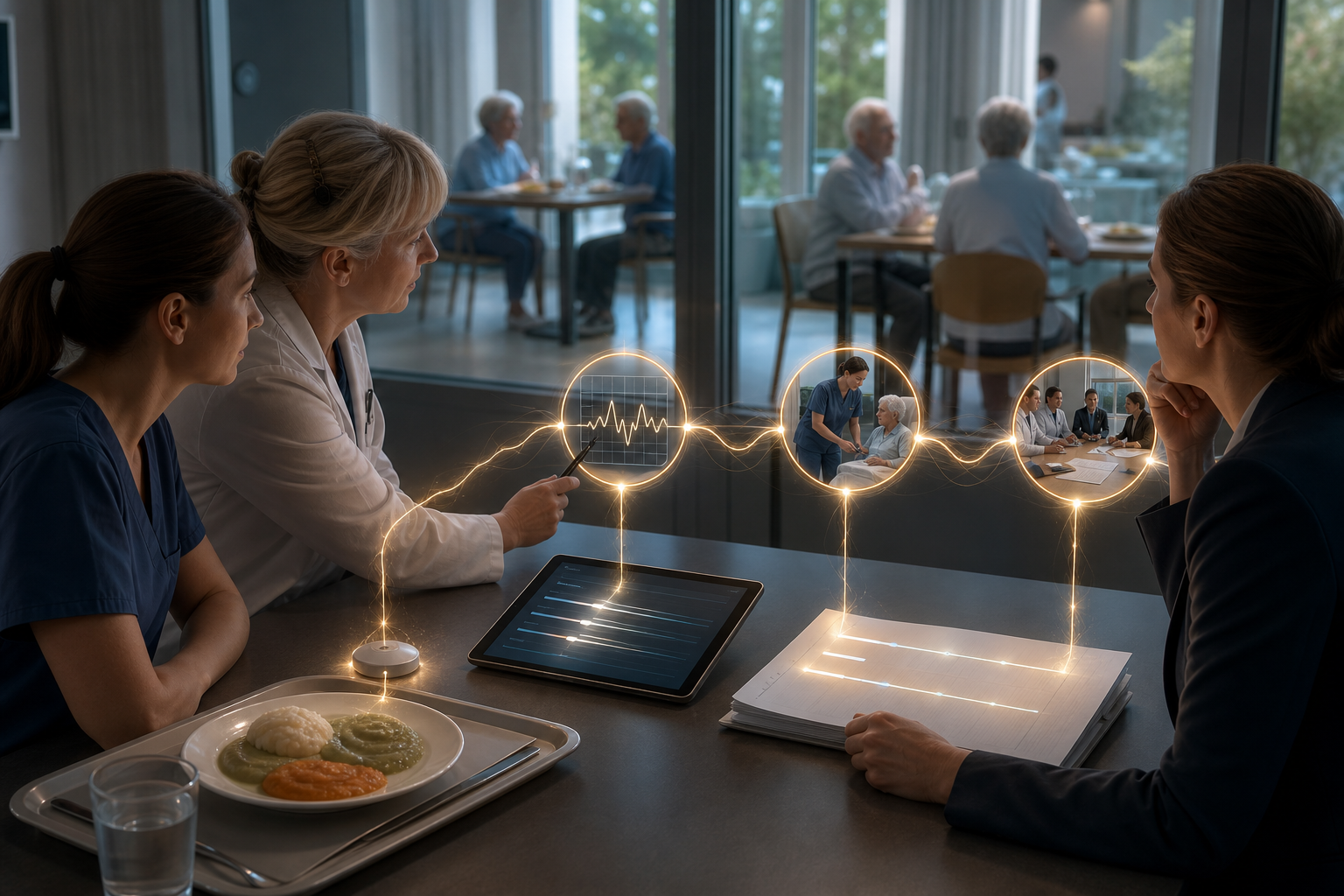
Silent aspiration is the hard edge of this problem.
When aspiration is silent, food, liquid, or secretions may enter the airway without the visible coughing staff expect. In neurologic and developmental impairment literature, silent aspiration has been reported in up to 81% of aspiration cases. The resident population is different from the pediatric group in that figure, but the safety lesson transfers directly into aged care: a quiet table is not always a safe table.
Older adults with dysphagia, stroke history, Parkinson's disease, dementia, frailty, or weak airway sensation may not produce strong warning signs. A carer may see no distress and continue feeding. The record may later say the resident "tolerated lunch," while the physiologic pattern told a more complicated story.
Predictive monitoring can help catch the hidden pattern: oxygen drop, respiratory drift, repeated post-meal changes, or recurring distress in the same resident after the same texture or liquid.
It is not a cure. It is an earlier signal. Predictive monitoring is not a gadget layer. It is a timing layer. The strongest argument for predictive monitoring is time.
A nursing-home choking or aspiration event does not wait for the perfect staff mix. It happens during lunch, during an evening snack, during a short-staffed weekend, or while a temporary worker is covering a resident they do not know well.
If monitoring gives the team even a short warning window, that window can be used:
| pause feeding | reposition the resident |
| call the nurse | check the tray and liquid |
| assess breathing | prepare first-line response |
| assign someone to call emergency services | bring the backup layer closer if the resident is high risk |
Twenty seconds does not sound like much. In an airway event, twenty seconds before collapse may be more useful than two minutes after everyone realizes the resident is in trouble.
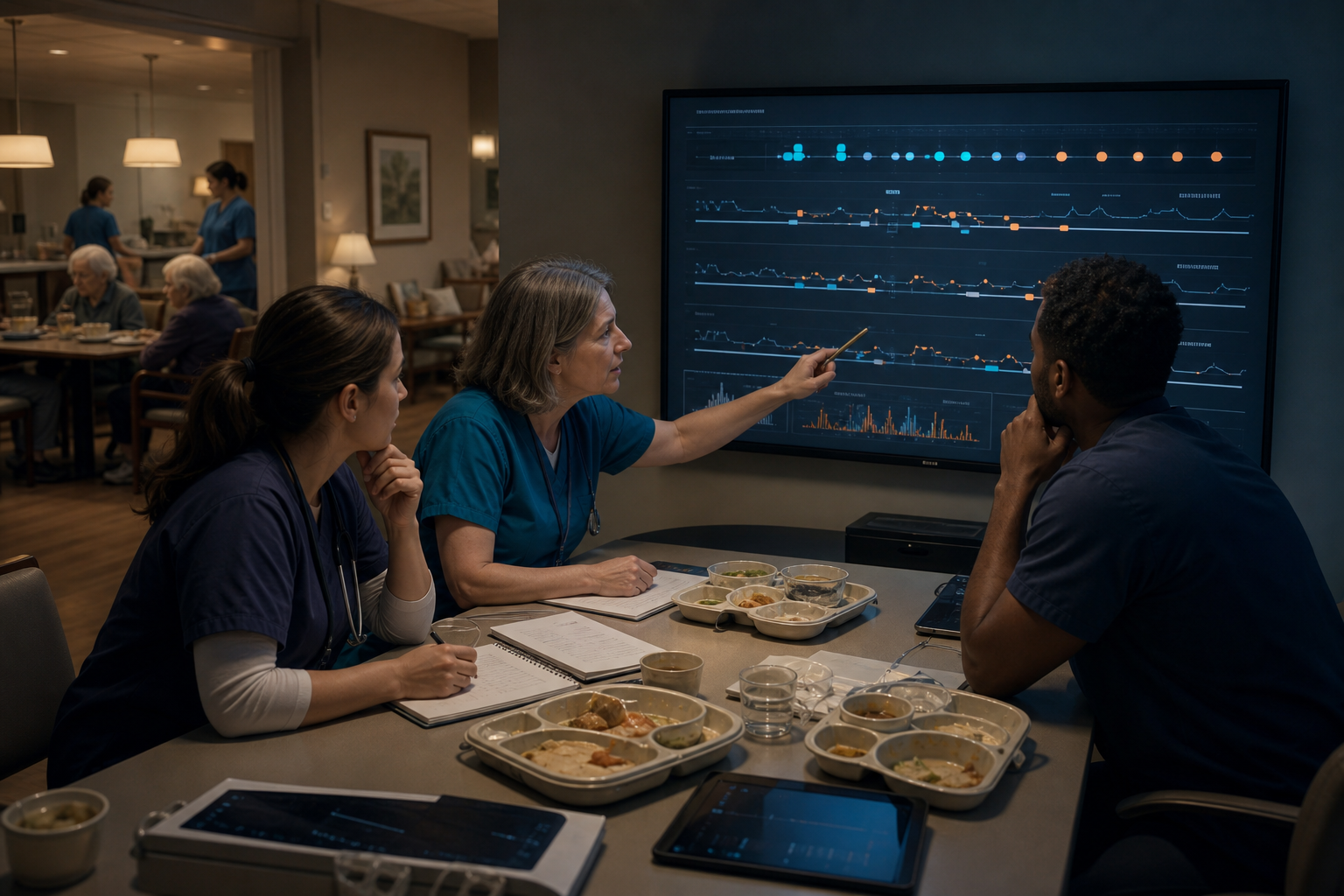
Predictive monitoring should not be treated as one number on a screen.
Aspiration and choking risk can show up through multiple signals, especially in frail residents. A strong system looks for patterns, not isolated alarms.
Signal | Why It Matters | Possible Operational Response |
|---|---|---|
Falling oxygen saturation | May indicate impaired airway or respiratory compromise | Pause feeding, assess breathing, alert nurse |
Rising respiratory rate | May show distress before visible panic | Reposition, evaluate swallow safety, document pattern |
Repeated throat clearing | May suggest residue or airway irritation | Stop meal temporarily, review texture and liquid |
Weak cough pattern | May mean the resident cannot self-clear | Increase supervision and prepare escalation |
Post-meal desaturation | May suggest aspiration risk | Trigger clinical review and QAPI follow-up |
Meal fatigue | Can reduce swallow control over time | Slow pace, stop meal, reassess feeding plan |
Recurring same-resident alerts | May reveal a system pattern | Review care plan, tray accuracy, liquid thickness, posture |
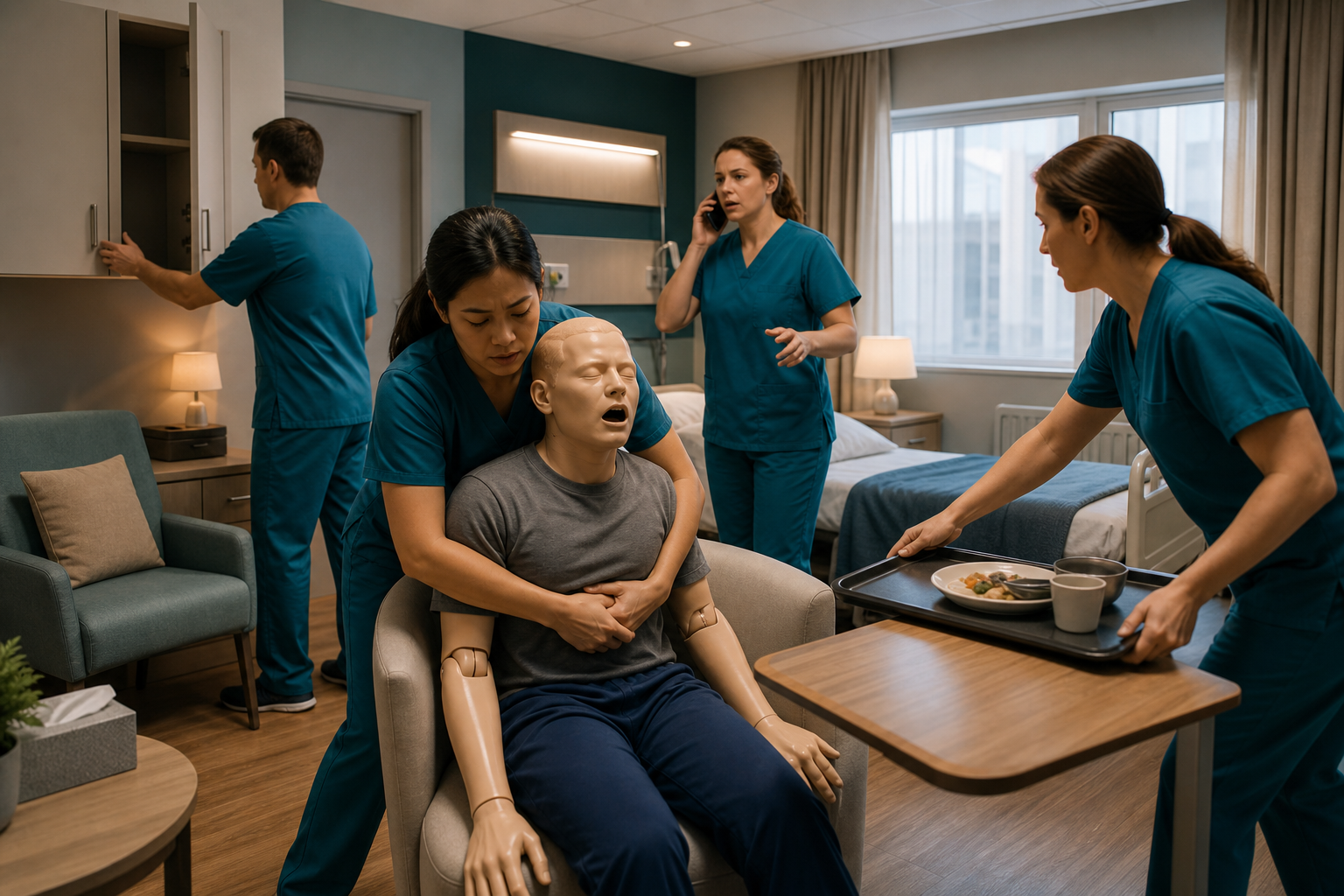
The four-minute oxygen window should change how aged-care teams think about monitoring.
If permanent brain injury can begin within roughly four to six minutes of total obstruction, then airway safety cannot be designed around late response. Every step has to be earlier: earlier recognition, earlier pause, earlier emergency activation, earlier first-line response, earlier transition if the first move fails.
Predictive monitoring belongs in that timing architecture.
It does not replace trained staff. It does not decide the diagnosis alone. It does not stop a bolus from entering the airway. It does not perform back blows, abdominal thrusts, chest thrusts, CPR, or emergency activation.
It gives staff a better chance to act before the room is already behind.
A monitor alert that disappears into memory is not enough.
Digital Social Care Records matter because they can connect the physiologic signal to the care workflow. A falling oxygen saturation event should not stay isolated from the tray, the IDDSI level, the thickened-liquid check, the bedside verification note, or the response timeline.
If a resident desaturates after lunch three times in two weeks, the system should see that. If the same dining area has repeated delayed recognition, the system should see that. If a tray mismatch appears near a respiratory event, the system should see that too.
A strong DSCR workflow can link:
| current swallowing assessment | IDDSI food level | liquid-thickness requirement |
| tray verification | monitoring alert | staff response |
| first-line action | emergency call | second-line backup retrieval, if used |
| post-event review | QAPI follow-up | |
That is the closed evidence chain regulators, operators, and families increasingly expect.
Predictive monitoring should feed Quality Assurance and Performance Improvement.
If a system flags oxygen decline, respiratory drift, recurring cough weakness, or repeated post-meal deterioration, leadership should not treat those as isolated clinical notes. They should become reviewable safety signals.
QAPI asks the practical questions:
| Are the alerts clustered around certain residents? | Are they linked to certain textures or liquids? |
| Are alerts more common on certain shifts? | Are staff responding quickly enough? |
| Are tray checks happening before the alert? | Are first-line rescue roles clear? |
| Is retrieval of second-line backup taking too long? | Are the same failures repeating after training? |
A monitoring system that does not change operations is only a display. A monitoring system connected to QAPI can help the facility find drift before drift becomes a serious event.
Failure to Rescue is not only about what happens after collapse. It often begins earlier, when warning signs are missed, dismissed, or not connected.
A resident who repeatedly desaturates during meals is telling the system something. A resident whose respiratory rate rises during thickened-liquid service is telling the system something. A resident with weak cough and post-meal fatigue is telling the system something.
If those signals are not captured, the eventual choking or aspiration emergency may look sudden. It may not have been sudden. It may have been unmeasured.
Predictive monitoring can reduce Failure to Rescue risk by improving recognition timing and giving the team a clearer event history. It cannot eliminate FTR by itself. Staff still need to respond, document, review, and correct the workflow.
Signal without action is not rescue.
Predictive monitoring does not change the first-line response sequence.
If a resident shows severe choking signs, staff should follow established choking rescue protocols and call emergency services. For responsive adults and children, first-aid guidance supports cycles of 5 back blows followed by 5 abdominal thrusts. If the person becomes unresponsive, the response transitions to CPR.
Monitoring can help staff recognize that something is wrong earlier, but it does not replace the physical response.
The correct sequence still matters:
| recognize risk early | pause feeding if warning signs appear | assess breathing and responsiveness |
| call for help | start first-line rescue if severe choking is present | call 911 or local emergency services |
| transition to CPR if unresponsive | use second-line backup only within its labeled role after standard measures fail | Where second-line airway response fits after FDA 21 CFR 874.5400 |
FDA 21 CFR 874.5400 and product code QXN define a suction anti-choking device as a second-line treatment after unsuccessful basic life support choking protocol for complete airway obstruction.
That boundary remains important in a monitoring-enabled facility.
Predictive monitoring is the warning layer. Bedside verification and IDDSI control are prevention layers. Manual first-line rescue remains the first emergency response. A QXN suction anti-choking device belongs behind unsuccessful first-line response as systemic redundancy.
The device should not be used because a monitor beeps. It should not be the first response to breathing difficulty. It should not replace 911, CPR, or manual rescue.
A monitoring alert should start assessment and role assignment earlier. A second-line airway device enters only if the event becomes the kind of complete obstruction that matches the device's labeled second-line position after standard measures fail.
Care leaders often ask which layer matters most: predictive monitoring, DSCR, staff training, IDDSI verification, or second-line airway equipment.
The honest answer is that airway safety needs all of these in the right order.
If the tray is wrong, monitoring may catch harm later than prevention would have. If the record is weak, monitoring data may not change the system. If staff are not trained, alerts may become noise. If first-line rescue is unclear, a warning signal will not save time. If second-line backup is stored far away, it may arrive after the oxygen window has narrowed.
A stronger investment sequence looks like this:
| swallowing assessment and IDDSI accuracy | bedside verification |
| staff response training | monitoring for high-risk residents |
| DSCR evidence chain | QAPI review |
| reachable second-line airway backup | regular drills that test the full sequence |
Monitoring is most valuable when it connects to action.
Predictive monitoring should not become a false promise.
It should not be used to justify thinner staffing. It should not replace supervision during meals. It should not replace dysphagia assessment. It should not make staff ignore visible distress because a dashboard looks normal. It should not turn airway safety into alarm chasing.
Residents still need people who watch, listen, pause, reposition, check the tray, follow the care plan, and act when breathing changes.
Technology should shorten the gap between risk and response. It should not move responsibility away from the room.
Start with one high-risk resident.
Review the swallowing assessment, the IDDSI level, the liquid plan, the bedside verification process, and any recent coughing, throat clearing, wet voice, desaturation, or respiratory-rate changes. Then compare those observations with the DSCR record.
Ask:
| Were physiologic changes documented in real time? | Did staff respond before the event became obvious? | Was feeding paused? |
| Was the resident repositioned? | Was the nurse called? | Was the tray reviewed? |
| Did the signal trigger QAPI review? | If rescue was needed, was first-line action immediate? | If first-line action failed, how long did second-line retrieval take? |
If the facility cannot answer those questions, it does not yet have a monitoring system. It has scattered signals.
Predictive monitoring can help aged-care teams see airway risk earlier, especially when aspiration is silent and visible distress arrives late.
Its value depends on the chain around it. The tray still has to be right. The bedside check still has to happen. Staff still need to act. DSCR has to preserve the timeline. QAPI has to turn repeated signals into system change. First-line rescue still comes first. Second-line airway backup still belongs only after unsuccessful standard response.
The strongest system does not wait for blue lips.
It listens to the earlier signals and moves before the oxygen window is nearly gone.
If your facility captures respiratory signals but cannot connect them to tray verification, DSCR records, staff action, QAPI review, and second-line airway readiness, the safety chain is incomplete. Contact FITIGER to discuss how airway-readiness planning can support aged-care mealtime safety.
For related planning context, review the anti-choking device buyer evidence checklist.
Predictive monitoring can help reduce one part of aspiration risk by detecting early physiologic changes, such as oxygen desaturation or respiratory-rate drift. It does not prevent all aspiration, but it can move recognition earlier when connected to staff action.
Silent aspiration means food, liquid, saliva, or secretions enter the airway without obvious coughing or distress. It is especially dangerous because staff may not see the signs they expect.
Oxygen desaturation during or after meals may indicate respiratory compromise, aspiration risk, or airway stress. Repeated desaturation patterns should trigger review of the resident's swallowing plan, tray accuracy, posture, and response workflow.
No. Predictive monitoring supports bedside supervision. It should not replace staff observation, dysphagia assessment, IDDSI verification, feeding assistance, or emergency response.
Digital Social Care Records should capture monitoring alerts, mealtime context, tray verification, staff response, emergency actions, and follow-up review. This turns scattered signals into an auditable evidence chain.
Monitoring data should feed QAPI when it reveals repeated desaturation, delayed response, meal-related distress, tray mismatches, or rescue timing problems. QAPI turns those patterns into system improvement.
A suction anti-choking device under FDA 21 CFR 874.5400 and product code QXN is a second-line treatment after unsuccessful BLS choking protocol for complete airway obstruction. Monitoring may trigger earlier assessment, but the device does not replace first-line rescue.
Start with high-risk residents and meal-related alerts. Compare monitoring signals with DSCR records, tray verification, staff response timing, first-line rescue readiness, and second-line backup retrieval time.
It can reduce part of Failure to Rescue risk by improving recognition timing and showing repeated warning patterns. It must be paired with staff action, clear escalation, first-line rescue training, and QAPI review.
FDA De Novo Order DEN250012 - Supports 21 CFR 874.5400, product code QXN, and second-line suction anti-choking device classification.
FDA Safety Communication, updated March 4, 2026 - Supports established choking rescue protocols first and anti-choking devices not delaying standard measures.
Weir et al., Oropharyngeal aspiration and silent aspiration in children - Supports the 81% silent aspiration figure among pediatric aspirators, used here as a caution about visual observation limits.
MedlinePlus - Choking First Aid - Supports choking as an emergency and the risk of brain injury after oxygen loss.
This article is for educational and operational planning purposes only. It does not replace clinical assessment, medical advice, professional monitoring protocols, accredited first-aid training, facility policy, emergency medical services, or product-specific instructions for use. In a choking or airway emergency, follow established rescue protocols, call 911 or your local emergency number, and use any device only within its labeled role and instructions.


