Food banks, shelters, and community meal programs need a choking response plan that works during busy meal service, volunteer turnover, evening operations, and limited on-site medical coverage. Preparedness should include prevention, trained first-line response, reliable 911 access, assigned staff roles, accessible emergency equipment, inspection records, and a documented second-line backup process.
For meal-service teams, Fitiger's restaurant choking readiness plan gives practical guidance for staff roles, kit placement, and service-area response.
For a household checklist, see Fitiger's child and home choking safety readiness plan.
A community dining room does not operate like a private kitchen.
People may arrive in groups. Volunteers may be serving food while staff manage intake, seating, transportation, medication schedules, or behavioral concerns. Music, conversation, kitchen noise, and movement can make it harder to notice that someone needs help.
The building may also be divided into several operational areas:
| Serving line | Main dining room | Family dining area |
| Kitchen | Overnight shelter floor | Activity room |
| Outdoor meal area | Mobile food distribution point | Reception desk |
| Staff office |
A written emergency plan should reflect those conditions.
It should not assume that a nurse, manager, or experienced responder will always be standing nearby.

Before choosing or requesting emergency equipment, map how meals are actually prepared, served, and supervised.
Ask:
| How many people eat at one time? | Are meals plated, buffet-style, or distributed in packages? | Do children, older adults, or people with support needs use the program? |
| Are volunteers serving without permanent staff in the room? | Does the dining area operate after the administrative office closes? | Are meals served in more than one room? |
| Is food taken to residents or clients in separate areas? | Are there mobile, outdoor, or off-site services? | Who can call 911 immediately? |
| Who knows the exact address and entrance? | Where is current first-aid equipment stored? | Who checks that equipment? |
These questions expose practical gaps that are not visible in a general safety policy.
Some food banks distribute packaged groceries without serving meals on site. Choking readiness may still matter for staff, volunteers, waiting areas, tasting events, children's programs, or community activities, but the operating risk is different from a dining hall.
A community kitchen or senior meal program may serve many people in a short period. Staff need clear sight lines, assigned response roles, and equipment that can be reached from the dining area.
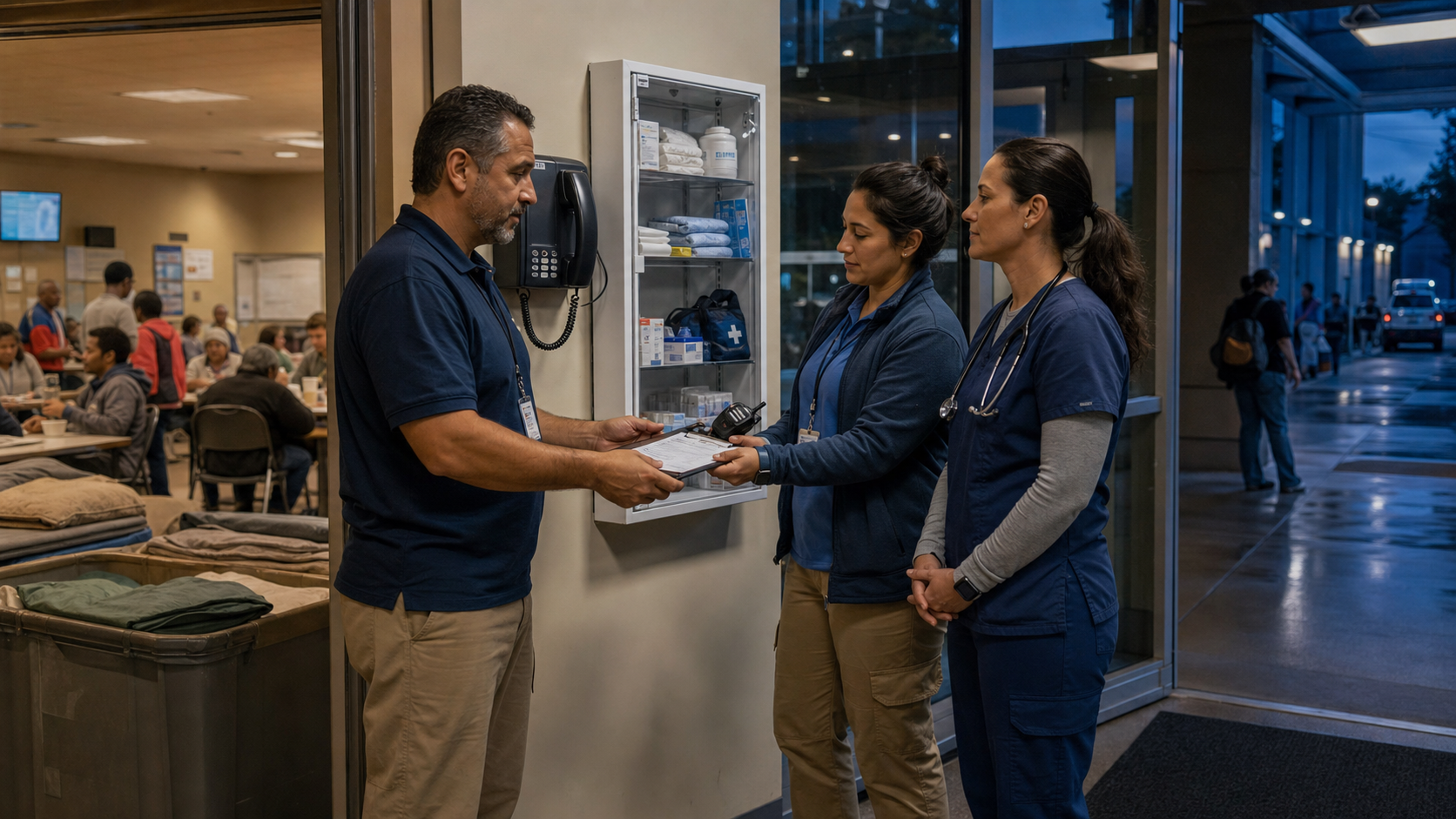
A shelter may serve dinner, snacks, and breakfast while operating through the night. Administrative staff may leave before residents finish eating. Equipment access and role assignment must account for overnight supervisors.

A meal van or outreach vehicle may operate far from the main facility. Emergency communication, route location, equipment storage, temperature exposure, and assigned custody become central issues.
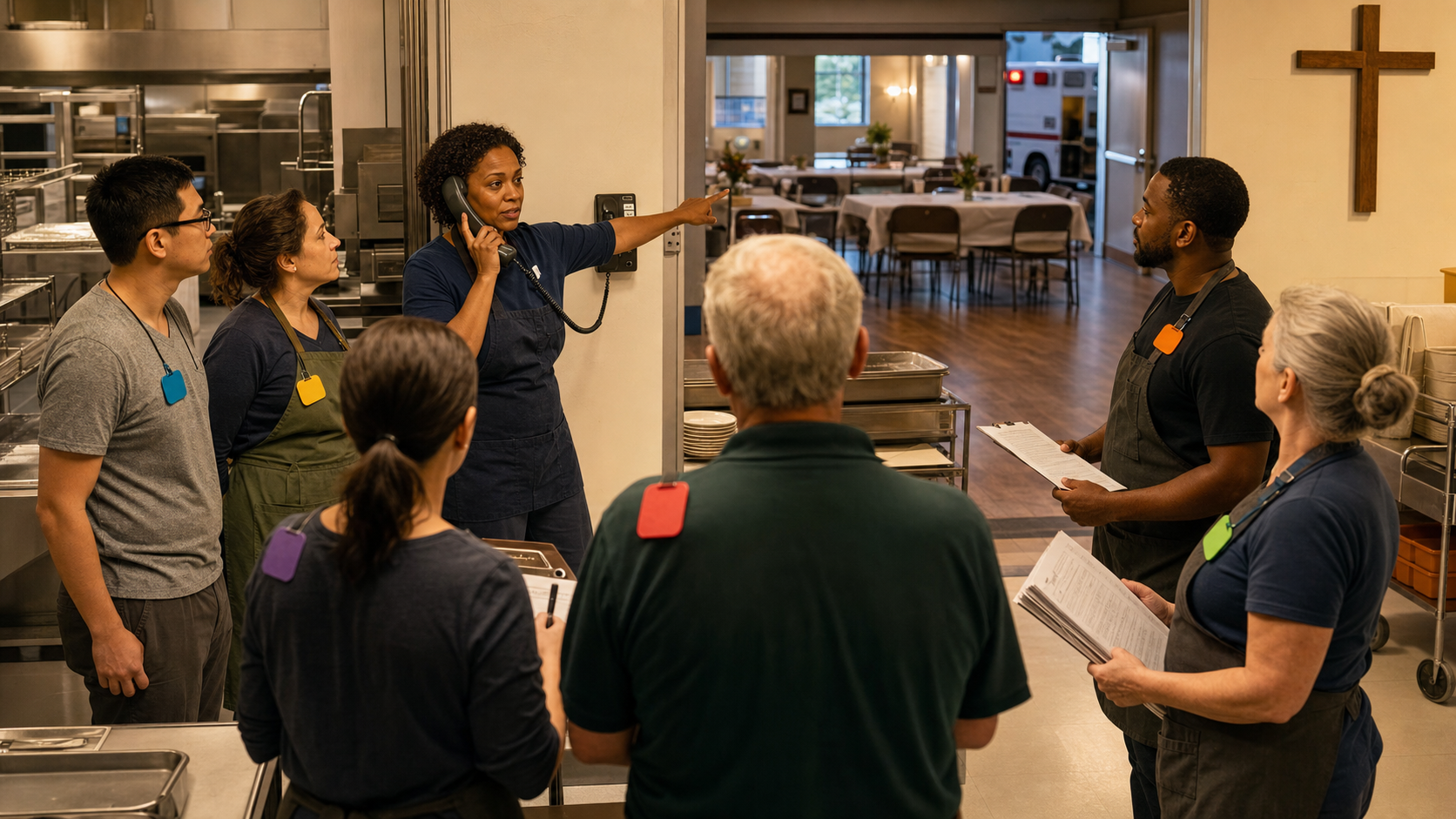
Churches and faith-based centers often rely on rotating volunteers. A response system must work even when the person managing the meal this week was not present the week before.
Programs serving families may need to consider mixed age groups, child supervision, high chairs, food brought from outside, and communication with parents or guardians.
A single generic checklist cannot cover each setting equally well.
Choking preparedness starts before an emergency occurs.
Programs should review food handling and meal-service practices that may reduce avoidable risk.
| Depending on the population served, prevention measures may include: | Age-appropriate food preparation | Clear labeling of hard or difficult-to-chew foods |
| Appropriate supervision during children's meals | Allowing enough time to eat | Avoiding pressure to eat quickly |
| Seating arrangements that allow staff observation | Staff awareness of swallowing or feeding support plans | Safe storage of small non-food objects |
| Coordination with caregivers or facility nurses | Referral to qualified professionals when swallowing concerns are known |
A donated device does not correct unsafe food preparation, rushed meal service, poor supervision, or an inaccessible emergency call process.
Not every cough during a meal is the same.
Someone who can cough forcefully, speak, or breathe may need a different response from someone with severe airway obstruction who cannot speak, cough effectively, or breathe.
Staff and regular volunteers should receive appropriate first-aid training so they can recognize the difference and follow the established response procedure.
The emergency plan should avoid vague instructions such as: Help the person if they are choking.
Instead, the plan should identify:
| Who assesses the situation | Who calls 911 |
| Who begins trained first-line choking rescue | Who retrieves backup equipment |
| Who manages the room | Who meets emergency responders |
| Who documents the event | Who removes used equipment from service |
A plan built around named roles is more useful than one built around good intentions.
Some community programs operate in buildings with confusing entrances, shared addresses, locked doors, or multiple floors.
The emergency call instructions should include:
| Full street address | Building name | Exact entrance |
| Floor or room | Gate code, when applicable | Nearest landmark |
| Best location for EMS access | Person assigned to meet responders | Internal radio or phone instructions |
A shelter may use one entrance during the day and another overnight. A church kitchen may be located behind the main sanctuary. A meal program may operate in a basement with no direct street access.
The 911 location card should describe the actual service area, not merely the organization's mailing address.

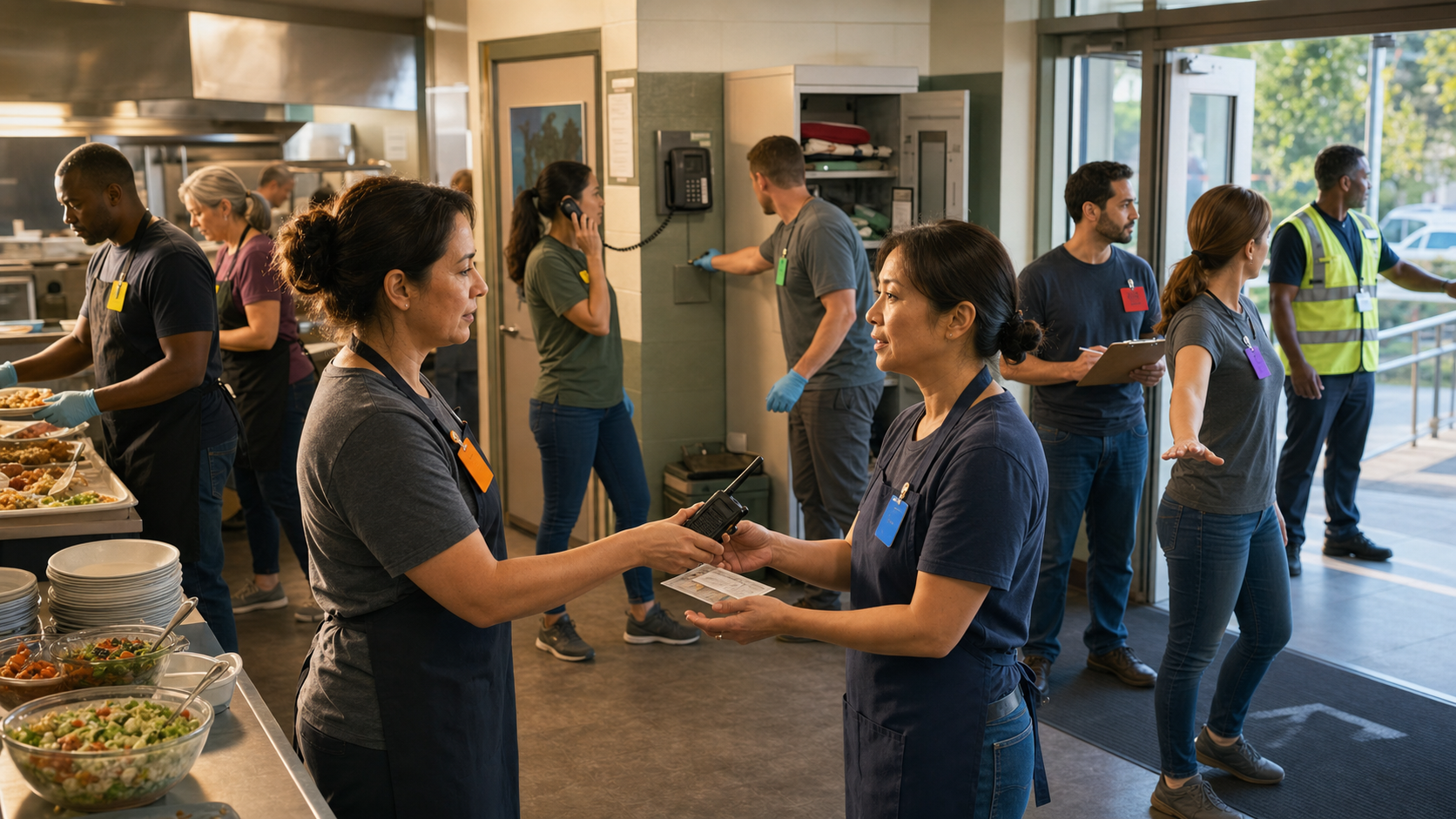
Many food banks and community meal programs depend on volunteers who rotate weekly, monthly, or seasonally. A plan that works only when one experienced volunteer is present is not reliable.
Volunteer orientation should cover:
| How to call 911 | The exact facility address | Who is in charge during the shift |
| Where first-aid equipment is stored | Who is trained to provide first-line response | How to clear space around an emergency |
| Who meets EMS | What volunteers should not do | Where incident information is recorded |
| Who should be notified afterward |
Orientation should be brief enough to repeat and specific enough to be useful.
A binder in the administrative office is not a substitute for shift-level awareness.
Community meal programs may serve people and volunteers who speak different languages. Emergency preparedness should account for that without relying on long multilingual paragraphs posted on a wall.
Useful steps may include:
| Clear location symbols | Short approved response cards | Translated operational instructions |
| Bilingual staff identification | Interpreter access | Plain-language 911 location information |
| Product instructions available in appropriate languages | Training adapted to the staff and volunteer population | Translations should be reviewed for accuracy. |
A machine-translated emergency instruction that changes the response sequence can create more risk than no translation at all.
An anti-choking device or other emergency kit should not be stored wherever there happens to be unused cabinet space.
The program should assess:
| Distance from meal areas | Locked doors | Staff-only access |
| Evening and weekend availability | Visibility | Heat and moisture |
| Kitchen grease | Cleaning chemicals | Mobile service conditions |
| Inspection responsibility |
A device stored in an upstairs office may be well protected but difficult to retrieve from a crowded ground-floor dining room.
A kit in the kitchen may be close to food service staff but exposed to heat, steam, or chemicals. A locked cabinet may protect supplies but delay access when the only key holder is absent. The placement decision must balance access, security, storage conditions, and management.
An empty dining room creates an unrealistic picture of access. Test the route during normal setup or service conditions.
Ask a staff member who does not manage the equipment every day to:
| Identify the nearest kit. | Reach the storage location. | Open the cabinet or bag. |
| Find the instructions. | Return to the simulated response area. | Identify who would call 911. |
| Identify who would begin first-line care. | Record: | Starting point |
| Retrieval route | Locked doors | Obstacles |
| Missing signage | Need for keys or badges | Staff uncertainty |
| Time required | Corrective actions |
This is an access audit, not a medical procedure drill.
The goal is to find preventable delay.
A large room can be divided by tables, serving equipment, partitions, stages, or separate entrances.
A single cabinet may not provide practical coverage when:
| The room has several dining zones | The facility serves multiple shifts |
| Doors lock between areas | Outdoor seating is used |
| A second room operates simultaneously | Staff are assigned to different sections |
| The building includes an overnight floor | Meal service continues after office hours |
Before requesting more equipment, determine whether moving the existing location, improving signage, or removing an access barrier would solve the problem.
Additional units should follow actual placement needs, not an arbitrary ratio based only on attendance.
A shelter may have strong daytime management and weak overnight coverage.
The overnight plan should identify:
| Shift supervisor | Staff trained in first aid | Emergency phone access |
| Exact EMS entrance | Equipment location | Cabinet access |
| Resident-floor coverage | Kitchen or snack-area coverage | Handoff between evening and overnight staff |
| Morning inspection after an incident | Incident notification process |
If the equipment is stored in an office that locks at 6:00 p.m., it does not support overnight operations.
The plan should also account for residents eating outside scheduled meal times.
Older adults may have varied mobility, communication, dental, swallowing, or health needs. The response plan should coordinate with the facility's clinical, nursing, or care policies when applicable.
Questions may include:
| Which staff are trained? | Are dining areas supervised? | Are residents served in several rooms? |
| Is a nurse always present? | Who calls EMS? | Who has access to emergency equipment? |
| How are known swallowing plans handled? | Where are resident-specific records stored? | Who documents the event? |
| Who contacts family or responsible parties? |
A general donation application should not include identifiable resident medical information.
The organization can describe the operational need without disclosing diagnoses or private records.
Equipment assigned to a meal van, outreach vehicle, or mobile pantry can disappear from the management system if custody is unclear.
The program should record:
| Vehicle number | Storage location | Assigned route |
| Primary custodian | Backup custodian | Inspection schedule |
| Temperature exposure | Check-out and return process | Substitute vehicle transfer |
| Dispatch contact | Exact route-location method | Post-use replacement procedure |
A kit that moves between vehicles without a transfer log may be missing when the next route begins.
Mobile equipment should have an owner for every shift.
For a responsive person with severe airway obstruction, trained staff should activate emergency medical services and follow the applicable established choking first-aid procedure.
If the person becomes unresponsive, CPR and dispatcher instructions become part of the response.
A suction-based anti-choking device belongs only in a second-line backup role after standard choking rescue has been attempted without success.
It should not:
| Delay 911 | Replace first-line manual rescue |
| Replace CPR | Be presented as suitable for everyone |
| Be used outside its instructions | Be treated as a guaranteed rescue method |
| Be used as a substitute for training |
A facility should not place a sign that tells staff to use the device first.
Programs should distinguish between:
| Product instructions | Product orientation |
| First-aid certification | CPR certification |
| Internal policy training | Equipment location drill |
| Formal competency assessment |
A donated kit may include printed material or a product demonstration. That does not automatically mean staff received certified first-aid training. The organization should confirm what the donation includes and arrange separate training when needed.
Every emergency kit needs a named operational owner.
Possible owners include:
| Shelter manager | Food service manager | Program nurse |
| Volunteer coordinator | Facility administrator | Evening supervisor |
| Mobile-program lead | Safety coordinator | Operations manager |
| The owner should know: | Exact location | Required contents |
| Inspection process | Replacement process | Storage limits |
| Access rules | Post-use procedure | Record location |
| Donation conditions |
A backup owner should cover absences, weekends, and shift changes.
Writing "all staff are responsible" usually means no one is clearly responsible.
Programs operating across several shifts should include emergency equipment in the handoff process.
| A short handoff may confirm: | Kit present | Cabinet accessible |
| Tamper seal intact | No components missing | Phone or radio working |
| Supervisor identified | New staff or volunteers oriented | Any equipment moved |
| Any incident or follow-up pending |
The handoff should not become burdensome, but it should catch obvious gaps before the next meal service begins.
The inspection record should follow the product instructions and organizational policy.
| It may include: | Location | Product and model |
| Device present | Required masks present | Packaging intact |
| Instructions present | Cabinet accessible | Storage conditions acceptable |
| Tamper seal intact | Date checked | Inspector |
| Problem found | Corrective action | Return-to-service date |
A checkmark without corrective action is not enough when a problem is found.
If a component is missing, the record should show whether the kit remained available, who ordered the replacement, and when the location returned to service.
The organization should decide what happens after equipment is used.
The procedure may include:
| Remove the device and used components from service. | Apply infection-control precautions. |
| Preserve the product if reporting or investigation may be required. | Record product, lot, or serial information. |
| Complete the incident report. | Notify the appropriate manager. |
| Follow manufacturer instructions. | Replace required components or the entire kit. |
| Document return to service. |
Used equipment should not be wiped down and returned to storage simply because it appears undamaged.
Incident records should distinguish observation from conclusion.
Useful factual entries may include:
| Person could not speak | 911 was called | First-line actions were performed |
| Second-line equipment was used | An object was observed | EMS arrived |
| Person was transferred to EMS | Device was removed from service | Avoid unsupported conclusions such as: |
| The product definitely saved the person | The device prevented death | The equipment worked perfectly |
| No injury occurred | The person would not have survived otherwise |
Those statements may go beyond what staff can establish.
Emergency records should follow the organization's privacy and records policy.
Do not leave completed forms containing names, medical details, family contacts, or resident information inside an unlocked cabinet.
The kit may contain:
| Blank incident form | Reporting instructions |
| Record-storage location | Manager contact |
| Product-reporting information |
Completed records should move into the organization's approved secure system.
A strong application explains how the donated equipment will fit into an existing response system.
The request should identify:
| Organization type | Program schedule | Population served |
| Meal-service locations | Current equipment gap | Requested quantity |
| Intended placement | Primary and backup owners | Inspection plan |
| Training status | Shipping contact | Non-resale commitment |
| A statement of need might read: |
Our overnight shelter serves dinner and breakfast seven days a week and has two occupied dining areas on separate floors. Current emergency supplies are stored in the daytime administrative office, which is locked overnight. We are requesting two choking emergency kits for staff-accessible locations near each dining area. The food service manager and overnight supervisor will maintain the inspection records, and the kits will remain part of our existing first-aid and 911 response plan.
This is more useful than saying the organization urgently needs "lifesaving products."
Food banks, shelters, community kitchens, and other eligible organizations may submit an in-kind product request when they have identified a documented preparedness gap and a responsible placement plan.
Organizations can request donated choking emergency kits through the FITIGER Donation Program.
Before submitting, prepare:
| Legal organization information | Authorized contact | Service description |
| People served | Requested quantity | Intended placement |
| Shipping details | Responsible equipment owner | Inspection plan |
| Training status | Non-resale acknowledgment |
Submission does not guarantee approval, quantity, training, delivery date, international shipping, or a specific emergency outcome.
| Prevention | Food-service practices have been reviewed; Staff know who may need additional meal support; Children are appropriately supervised; Known swallowing plans are handled through approved procedures; Meal service does not pressure people to eat quickly |
| Recognition and response | Staff know how to recognize severe airway obstruction; Trained first-line responders are identified; 911 can be called immediately; CPR readiness is maintained; Second-line equipment does not replace first-line care |
| Access | Equipment is close to occupied meal areas; Doors and cabinets can be opened; Evening and overnight staff have access; Mobile programs have assigned equipment; Staff can describe the exact location |
| Ownership | Primary owner is named; Backup owner is named; Shift handoff includes equipment status; Replacement authority is clear; Post-use responsibility is assigned |
| Records | Inspection log is current; Product details are recorded; Incident forms are available; Completed records are stored securely; Non-resale conditions are documented; Donation stage is recorded accurately |
A kit on the wall is only one part of the audit.
The real question is whether the program can notice the emergency, start the correct response, call for professional help, reach the equipment, and manage what happens afterward.

Use the Fitiger donation pathway when your program documents a practical equipment-access need.
For related planning context, review the restaurant choking readiness plan.
The program should first maintain reliable 911 access, trained first-line responders, CPR readiness, role assignments, incident records, and appropriate first-aid supplies. A suction-based anti-choking device may be considered only as a second-line backup and should be managed under its instructions and organizational policy.
Not automatically. A kitchen location may be close to staff but exposed to heat, steam, grease, cleaning chemicals, or restricted access. The program should compare it with staff-accessible locations near the dining area.
The shelter should assign a primary owner and a backup owner. This may be the shelter manager, food service manager, program nurse, overnight supervisor, or safety coordinator, depending on the operating structure.
Volunteers should understand the organization's emergency roles and know who is trained to respond. Product instruction does not replace first-aid or CPR training, and no volunteer should be expected to act beyond their training and organizational policy.
Yes, when the request explains separate locations, hours, access barriers, people served, and assigned owners. Approval may be for fewer units than requested.
Not automatically. The organization should confirm whether the donation includes only written instructions, product orientation, or any formal training. Certified first-aid and CPR training may need to be arranged separately.
It may be appropriate when the organization has a secure storage location, assigned custodian, inspection process, temperature review, route communication plan, and transfer procedure for substitute vehicles.
The inspection interval should follow the manufacturer instructions, organizational policy, storage conditions, and applicable requirements. Additional checks may be needed after use, relocation, tampering, environmental exposure, or vehicle reassignment.
The report should record observable facts, actions taken, equipment used, EMS involvement, and outcomes known to staff. It should not make unsupported clinical conclusions about causation or survival.
No. Staff should call emergency medical services and follow established first-line choking rescue. A suction-based anti-choking device belongs only in a second-line role after unsuccessful standard rescue.
FITIGER Donation Program - Supports the in-kind donation CTA and application pathway.
American Red Cross: Adult and Child Choking - Supports standard first-aid response concepts and the need for trained first-line care.
FDA Safety Communication - Supports the established first-line choking rescue priority and second-line boundary for suction anti-choking devices.
This article is for general education, community-program planning, and emergency preparedness. It is not medical advice, legal advice, a facility requirement, or a substitute for certified first-aid training, manufacturer instructions, organizational policy, or professional review.
In a choking emergency, call 911 or the applicable local emergency number, follow dispatcher instructions, and use the established choking rescue procedure appropriate to the person's age and condition. If the person becomes unresponsive, begin CPR when indicated. A suction-based anti-choking device should not replace standard first-line choking rescue or delay professional emergency care.


