
Choking and aspiration are not the same problem. Choking is an acute airway emergency. The person may be unable to cough effectively, speak, or breathe. Aspiration can be quieter: food, liquid, or saliva enters the airway and may show up as repeated coughing, throat clearing, a wet voice, or breathing changes after meals. Both deserve attention, but the response is different.
For a household checklist, see Fitiger's child and home choking safety readiness plan.
A daughter notices that her father clears his throat after drinking water.
A home-care worker realizes that lunch takes longer than it did a month ago. A spouse sees food left in the cheek after dinner. A nursing assistant hears a wet, gurgly voice after a resident finishes tea.
None of these moments looks like the dramatic version of choking people expect. There is no sudden silence. No one grabs the throat. No chair scrapes across the dining-room floor. That can make the warning signs easy to dismiss.
Older adults may have swallowing changes after stroke, Parkinson's disease, dementia, neurologic illness, dental problems, poorly fitting dentures, dry mouth, fatigue, or other health changes. Some people adapt quietly. They choose softer food, eat less, drink less, or avoid meals with other people because swallowing has become stressful.
A caregiver does not need to diagnose the cause at the table.
A caregiver does need to notice when the pattern has changed.
Choking usually means food or another object is blocking airflow.
The signs may become obvious quickly:
| the cough becomes weak or disappears | speech stops |
| the person cannot breathe | the person may clutch the throat |
| color changes | confusion or panic increases |
| the person becomes unresponsive | A forceful cough is different. |
If the person can still cough strongly and make sound, air is still moving. Stay close. Encourage coughing. Watch for deterioration.
If the person cannot cough effectively, cannot speak, or cannot breathe, treat it as a severe choking emergency.
For a responsive adult with severe choking, current guidance uses repeated cycles of:
| Give 5 back blows. | Give 5 abdominal thrusts. |
| Repeat until the object clears or the adult becomes unresponsive. | Use chest thrusts instead in late pregnancy or when the rescuer cannot effectively encircle the abdomen. |
| If the person becomes unresponsive, begin CPR according to training and follow dispatcher instructions. | |

Aspiration happens when food, liquid, saliva, or other material enters the airway instead of moving safely toward the stomach.
It may happen during a meal, after a sip of water, while taking medication, or when the person is tired.
Aspiration does not always look like a sudden choking scene.
A person may cough during or just after eating. They may clear the throat repeatedly. Their voice may sound wet or gurgly. Breathing may become harder after meals. They may feel that something is stuck. Meals may take longer because chewing and swallowing require more effort.
What you notice | Possible concern | What to do next |
|---|---|---|
Weak or absent cough, inability to speak, inability to breathe | Severe choking emergency | Call 911 and begin adult choking rescue immediately |
Strong cough after a bite or sip | Air is moving, but swallowing may need observation | Stay close and note whether the pattern repeats |
Repeated coughing during meals | Possible swallowing difficulty | Record the pattern and discuss it with a clinician |
Frequent throat clearing after drinking | Possible swallowing difficulty | Ask whether a swallowing evaluation is appropriate |
Wet or gurgly voice after meals | Possible airway-entry concern | Bring the observation to a clinician or speech-language pathologist |
Food feels stuck in the throat or chest | Swallowing problem may need evaluation | Do not ignore repeated complaints |
Meals take much longer than before | Fatigue, chewing difficulty, or dysphagia may be present | Review the meal setup and seek professional guidance |
Breathing becomes difficult after meals | Possible respiratory concern | Seek prompt medical advice; call 911 for severe breathing trouble |
The table is not a diagnostic tool.
It is a way to decide what cannot be ignored.
Caregivers can overreact when they are worried.
A resident coughs after drinking water, and someone immediately pounds the back. A spouse reaches for a device because the person cleared the throat twice. A family member assumes that any noisy swallow means a complete blockage.
That response can create its own risk.
Back blows, abdominal thrusts, chest thrusts, and suction devices are not routine responses to every cough. They belong in a choking emergency when airflow is failing.
A strong cough often means the person is still moving air. Stay close. Observe. Do not escalate automatically. The dividing line is not whether the sound is unpleasant. The dividing line is whether the person can still cough effectively, speak, and breathe.

Families often bring vague concerns to a medical appointment:
| "He coughs sometimes." | "Drinking water seems harder." | "She does not like meat anymore." |
Those concerns are worth raising, but details make the conversation more useful.
A simple one-week log can show patterns.
What to record | Example |
|---|---|
Food or drink | Water, soup, rice, meat, pills, dry bread |
Texture | Thin liquid, soft food, dry food, mixed texture |
What happened | Coughing, throat clearing, wet voice, food pocketing, long pause |
Timing | During the sip, immediately after swallowing, later in the meal |
Recovery | Cleared quickly, needed rest, breathing changed, meal stopped |
Setting | Dining table, recliner, bedside, restaurant, caregiver station |
Fatigue | Alert, tired, rushed, distracted, late in the day |
Patterns matter.
Coughing only with thin liquids tells a different story from coughing after every meal. Trouble swallowing pills deserves attention. A wet voice after drinking may be easy to miss unless someone is listening for it.

Caregivers often focus on food texture first. Texture matters, but the person's position and condition matter too. Review:
| Is the person upright? | Is the chair stable? | Is the head position comfortable? |
| Are dentures fitting properly? | Is the person tired? | Is the meal rushed? |
| Is conversation making the person take bites too quickly? | Are pills taken with enough time and attention? | Is the person eating alone? |
| Has the person started avoiding certain foods? | ||
A meal that works well at noon may become harder in the evening when fatigue sets in. A person who eats safely at the dining table may struggle in a recliner with poor posture and a television tray. The real red zone is the place where the person actually eats.
When a family notices coughing, the instinct is often to change everything immediately.
Food becomes softer. Drinks become thicker. Pills are crushed. Meat disappears from the menu. Water is avoided because it seems risky.
| Some changes may be appropriate. Others may create new problems. | Do not crush, split, or alter medication without asking a clinician or pharmacist. |
| Do not assume that thicker drinks are automatically right for every person. | Do not build a long-term diet plan around guesswork. |
A speech-language pathologist can assess swallowing and help determine which strategies fit the person. Depending on the situation, the evaluation may include observing meals, reviewing posture, testing mouth movements, or using specialized swallowing assessments.
The safest meal plan is individualized.

One isolated cough may not mean much. A pattern deserves attention. Contact a clinician when you notice:
| repeated coughing during or after meals | frequent throat clearing after eating or drinking | wet or gurgly voice after swallowing |
| food pocketing in the mouth | difficulty swallowing pills | food feeling stuck |
| much longer meal times | repeated avoidance of certain textures | unexplained weight loss |
| dehydration concerns | breathing changes after meals | repeated chest infections or pneumonia |
| fear of eating alone | ||
The goal is not to wait for a major choking event before asking for help.
A swallowing problem can affect nutrition, hydration, independence, and quality of life long before a crisis occurs.
Swallowing difficulty can feel embarrassing.
A person may not want family members to watch them eat. They may cut food into tiny pieces privately, avoid restaurants, skip meat, or drink less because coughing draws attention.
Some people say they are "not hungry" when the real problem is that eating has become exhausting. Caregivers should approach the conversation carefully. Try: "I noticed drinking water seems harder lately. Has swallowing changed?" Or: "Meals are taking longer than they used to. Is anything feeling stuck?" Avoid turning every meal into an interrogation. The goal is to make the problem easier to discuss, not to make the person feel monitored.
A family working through swallowing concerns still needs an emergency plan.
Ask:
| Can someone call 911 immediately? | Is the address posted? | Does the caregiver know the adult choking rescue sequence? |
| Is there enough room around the dining chair? | Does the plan change if the person uses a wheelchair? | Can EMS enter quickly? |
| Is the phone close to the real eating zone? | Does the person often eat alone? | Has the household discussed what happens if the person becomes unresponsive? |
A swallowing evaluation and an emergency response plan solve different problems. The household may need both.
Recognition, calling 911, standard manual rescue, EMS, CPR when unresponsive, clinical evaluation, and caregiver training all come first.
Manual rescue first. Backup second.
A suction anti-choking device does not treat aspiration. It should not be used as a routine response to coughing, throat clearing, or a wet voice after meals.
Some households and care settings choose to keep a suction anti-choking device as a second-line backup after unsuccessful standard choking rescue for complete airway obstruction.
For one fixed adult-accessible dining-room or caregiver station, the FITIGER EasyPumpVac Series may be the more practical option to review as part of a choking first aid kit or adult anti choking device readiness plan. Its straightforward manual structure supports one clearly marked location near the places where meals happen.
For mobile caregivers, multi-floor homes, community outings, or travel, the FITIGER FoldPumpVac Series may be the stronger option to review when a portable choking rescue device is easier to stage across locations.
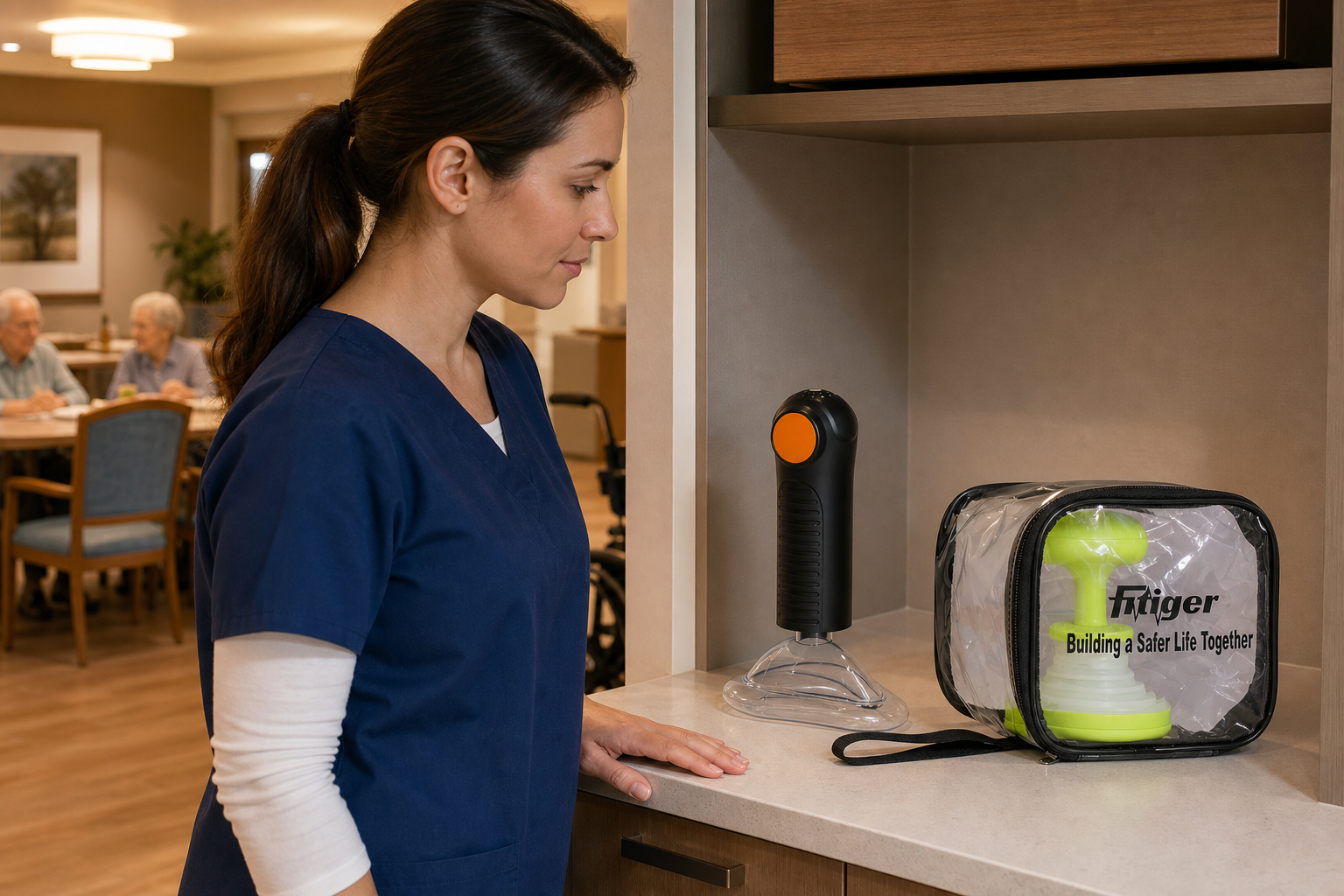
The product does not replace:
| swallowing evaluation | food and drink recommendations from a clinician or speech-language pathologist | back blows |
| abdominal thrusts | chest thrusts when indicated | CPR |
| calling 911 | EMS | caregiver training |
A backup device belongs inside the response plan. It does not become the response plan.
Before the next family meal or care-plan meeting, ask:
Review point | Question |
|---|---|
Swallowing pattern | Has coughing, throat clearing, or wet voice increased? |
Meal location | Where does the person actually eat most often? |
Position | Is the chair stable and upright? |
Medication | Are pills becoming harder to swallow? |
Clinical follow-up | Has a swallowing evaluation been discussed? |
911 access | Is the phone nearby and the address posted? |
Manual rescue | Do caregivers know the current adult sequence? |
EMS route | Can responders reach the dining area quickly? |
Second-line backup | Is any backup stored clearly without delaying manual rescue? |
Restaging | Are opened, damaged, or incomplete supplies replaced promptly? |
One short review can uncover a quiet pattern that has been building for months.
Choking is an acute airway blockage that may prevent a person from coughing effectively, speaking, or breathing. Aspiration happens when food, liquid, saliva, or other material enters the airway. Aspiration may show up as repeated coughing, throat clearing, wet voice, or breathing changes after meals.
Yes. Aspiration may not look like a classic choking emergency. Repeated coughing during meals, throat clearing, wet or gurgly voice, and breathing changes after meals deserve medical attention.
Not automatically. If the person can cough forcefully, speak, and breathe, encourage coughing and monitor closely. Begin choking rescue actions when severe obstruction signs appear.
Ask for professional guidance when coughing, throat clearing, wet voice, food pocketing, pill-swallowing difficulty, prolonged meals, weight loss, dehydration, breathing changes, or repeated chest infections become part of the pattern.
A clinician may refer the person to a speech-language pathologist who works with swallowing disorders. The evaluation may include observing meals, checking mouth movements, and using specialized tests when needed.
Do not crush, split, or alter medication without asking a clinician or pharmacist.
A suction anti-choking device is not a treatment for aspiration. It belongs only in a second-line backup role after unsuccessful standard choking rescue for complete airway obstruction and only within the current product-specific instructions.
EasyPumpVac Series may suit a fixed dining-room or caregiver station. FoldPumpVac Series may be more practical for mobile caregivers, multi-floor homes, travel, or community outings.
Start with regulatory status, current instructions, intended users, storage location, retrieval time, mask fit, operating steps, routine inspection needs, and whether the product can be staged without delaying standard rescue.
The most useful caregiver observation may be small.
A throat cleared after water. A wet voice after lunch. A pill that suddenly takes longer to swallow. A meal left unfinished because chewing feels tiring.
Write it down. Bring it to a clinician. Review the home response plan. The goal is not to turn every cough into an emergency. The goal is to notice the moment when the pattern has changed. Manual rescue first. Backup second.
American Speech-Language-Hearing Association, Swallowing Disorders in Adults - Supports signs of swallowing problems, aspiration terminology, SLP evaluation, posture and strategy guidance, and caregiver follow-up.
American Heart Association, Adult Foreign-Body Airway Obstruction Algorithm - Supports severe adult FBAO recognition, 5 back blows followed by 5 abdominal thrusts, chest thrusts when indicated, and CPR when unresponsive.
U.S. Food and Drug Administration, Update: FDA Encourages the Public to Follow Established Choking Rescue Protocols - Supports established choking rescue protocols first and device use only as a second option after unsuccessful standard steps.
This article is for educational and preparedness-planning purposes only. It does not replace medical advice, legal advice, swallowing evaluation, certified first-aid or CPR training, calling 911, EMS, professional medical care, local emergency procedures, facility policies, or the current product-specific instructions for use.


