A person living with dementia may still sit at the same table, use the same cup, and ask for the same foods. The risk can still change quietly. Meals may become rushed, confusing, tiring, or harder to manage. Caregivers should watch chewing, pacing, posture, coughing, food left in the mouth, and any new difficulty swallowing.
For a household checklist, see Fitiger's child and home choking safety readiness plan.
The plate comes back with food still on one side.
A parent takes a second bite before finishing the first. A spouse chews for a long time, then seems to forget to swallow. A resident drinks water quickly because the cup is within reach and the dining room is noisy.
Nothing about the meal looks dramatic.
There is no clear emergency. No one is reaching for the phone. The food is familiar.
The problem is that dementia can change how a person approaches an ordinary meal. Attention shifts. Pacing changes. A person may become distracted by the television, conversation, noise in the room, or the movement of other people. Chewing may take longer. Food may remain in the cheek. The person may forget that another bite is already in the mouth.

A caregiver does not need to turn every meal into a clinical exercise.
The caregiver does need to notice when the routine no longer works as smoothly as it used to.
Families often focus on whether the person is eating enough. That matters. It is not the only question. Mealtime safety also depends on whether the person can:
| stay seated upright | remain focused long enough to chew and swallow | manage the current texture |
| slow down between bites | recognize when the mouth is already full | clear food from both sides of the mouth |
| drink without rushing | tolerate a busy dining room | finish the meal before fatigue increases |
| communicate that something feels wrong | ||
|
What you notice |
What may be changing |
What to review |
|---|---|---|
|
Taking another bite before swallowing |
Pacing and attention |
Serve smaller portions and slow the rhythm of the meal |
|
Food left in the cheek after eating |
Mouth clearance |
Check the mouth after meals and discuss repeated problems with the care team |
|
Coughing during meals |
Swallowing may need attention |
Track the pattern and ask whether a swallow evaluation is appropriate |
|
Wet or gurgly voice after drinking |
Food or liquid may not be moving safely |
Bring the observation to a clinician or speech-language pathologist |
|
Meals taking much longer |
Fatigue, chewing, or swallowing may be harder |
Adjust the timing and request professional guidance |
|
Refusing certain foods |
Texture may be harder to manage |
Note which foods are avoided and discuss the pattern |
|
Reaching for food repeatedly |
Visual cues or impulse control may have changed |
Plate smaller amounts and supervise pacing |
|
Eating alone becoming harder |
The person may need more support |
Review supervision and caregiver handoff |
Make the room easier to read
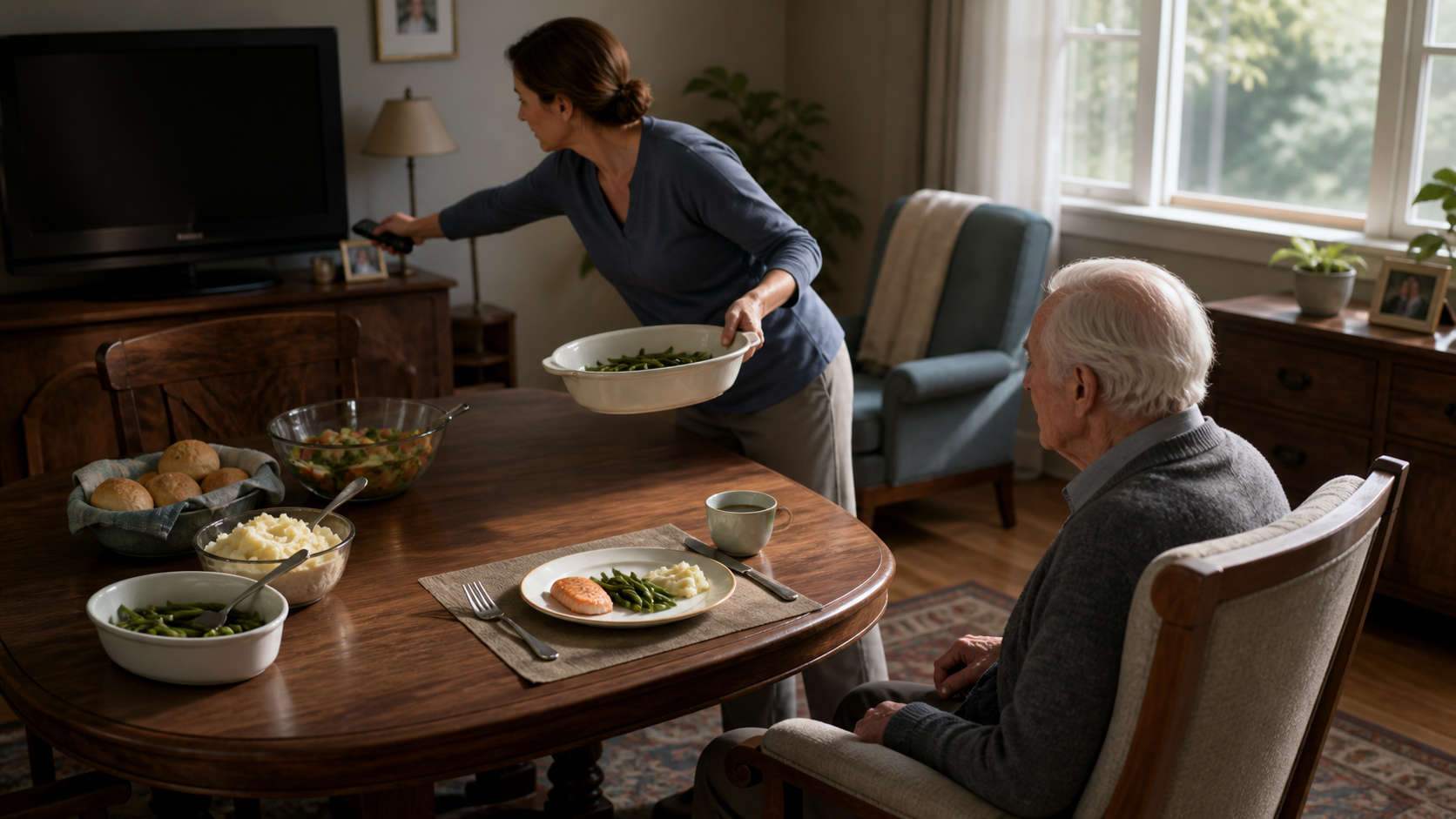
A crowded dining table asks a lot from someone living with dementia.
There are serving dishes, napkins, utensils, cups, conversations, television noise, and people moving around the room. A restaurant or holiday meal adds even more distraction.
Simplify the setting.
Use only what the person needs for the meal. Reduce visual clutter. Turn off the television when it pulls attention away from chewing. Keep the person seated upright. Make sure the chair is stable. Allow enough time so the meal does not feel like a race.
A simpler table is not childish.
It is easier to navigate.
|
Dining-room problem |
Practical adjustment |
|---|---|
|
Too many dishes on the table |
Serve one plate with a manageable portion |
|
Television or loud conversation |
Reduce background noise |
|
Several drinks within reach |
Offer one clearly placed cup |
|
Person eats too quickly |
Offer smaller portions and pause before the next serving |
|
Poor chair position |
Reposition the chair so the person sits upright |
|
Head tilts backward |
Help return the head to a slightly forward position |
|
Caregiver multitasking |
Assign one adult to stay close during the meal |
|
Meal lasts too long |
Move the meal earlier or allow rest breaks |
A meal plan that worked six months ago may no longer fit.
Some foods are harder to chew thoroughly or easier to swallow too quickly. Raw carrots, dense meat, dry bread, large chunks, and mixed textures may become more difficult to manage.
The safest adjustment depends on the person.
A caregiver can begin by asking:
| Is the food hard to chew? | Does it break into firm chunks? | Is the person rushing? |
| Is the bite size too large? | Does the person need smaller portions? | Are softer foods easier to manage? |
| Is the person avoiding certain textures? | Does the difficulty appear more often later in the day? | Check the mouth after the meal |
The meal is not finished just because the plate is empty.
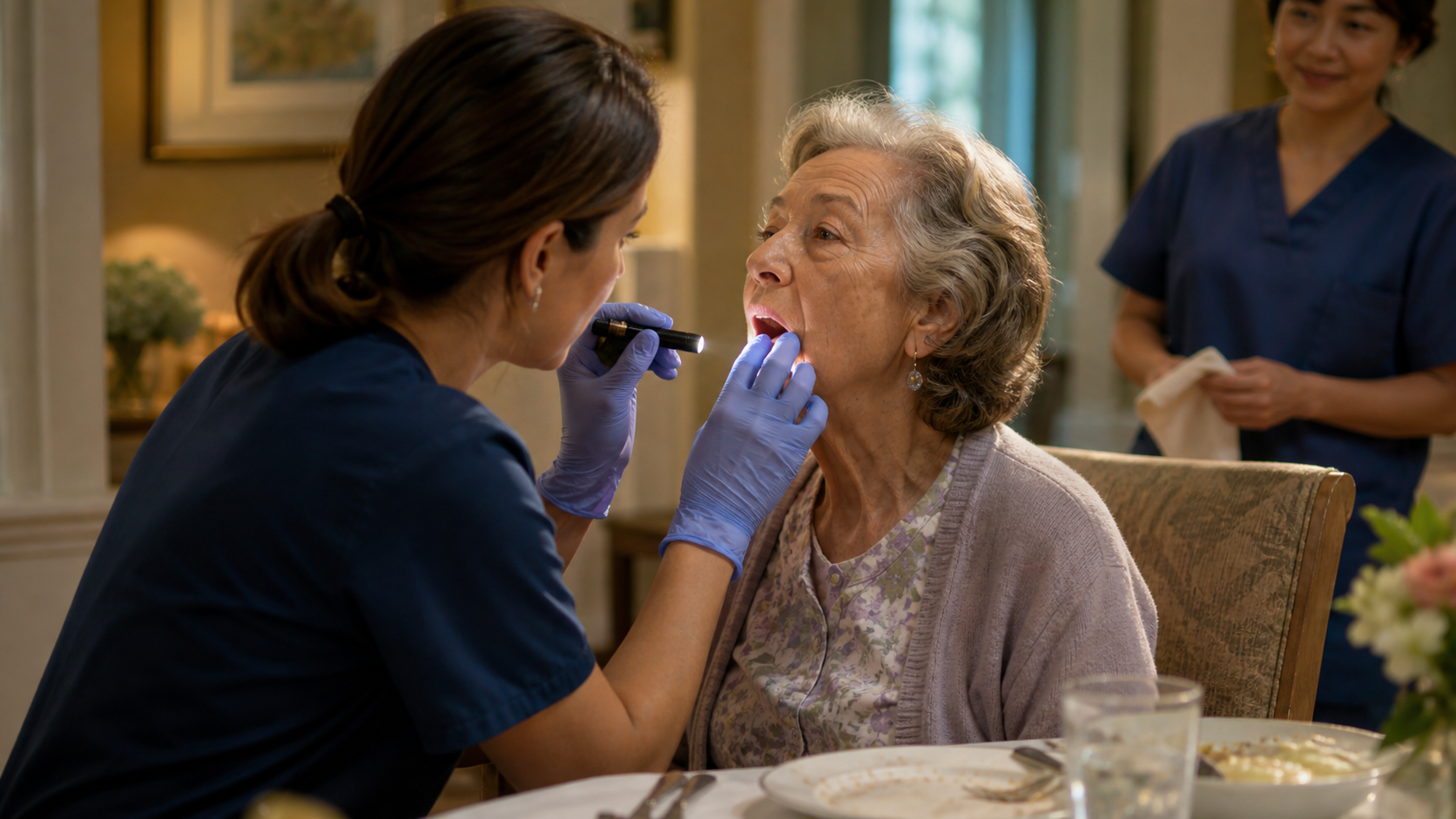
Food may remain in the cheek or mouth. A person living with dementia may not notice it or may not communicate the problem clearly.
At the end of the meal, check whether food has been swallowed.
Do this respectfully.
The goal is not to inspect the person like a task on a checklist. The goal is to prevent a forgotten piece of food from becoming a problem after the caregiver has already walked away.
Repeated food pocketing deserves professional attention.
Write down:
| which foods remain in the mouth | which side is affected |
| when the problem appears | whether fatigue makes it worse |
| whether the person coughs or clears the throat afterward | whether pills are also becoming harder to swallow |
| Independence still matters | Safety should not erase dignity. |
A person living with dementia may still be able to feed themselves with the right support. The caregiver can simplify the setup without taking over every movement. Consider:
| a bowl instead of a flat plate | dishes with rims or protective edges |
| a spoon with a larger handle | bite-sized foods that are easier to pick up |
| non-skid placemats | smaller portions served gradually |
| hand-over-hand assistance when needed | Watch the pattern across the day |
Breakfast and dinner may not look the same.
A person may eat calmly in the morning and struggle later when tired. Medication timing, agitation, noise, visitors, and changes in routine can all affect the meal.
Use a simple log for one week.
|
What to record |
Example |
|---|---|
|
Meal |
Breakfast, lunch, dinner, snack |
|
Setting |
Dining room, kitchen, recliner, community room |
|
Soft food, dry food, mixed texture, thin liquid |
|
|
What happened |
Rushing, coughing, throat clearing, food pocketing, refusal |
|
Time of day |
Morning, afternoon, evening |
|
Fatigue or distraction |
Calm, tired, noisy room, television on, visitors present |
|
Recovery |
Finished meal, needed rest, meal stopped, breathing changed |
|
Follow-up |
Discussed with clinician, nurse, or SLP |
A person who coughs forcefully is still moving air.
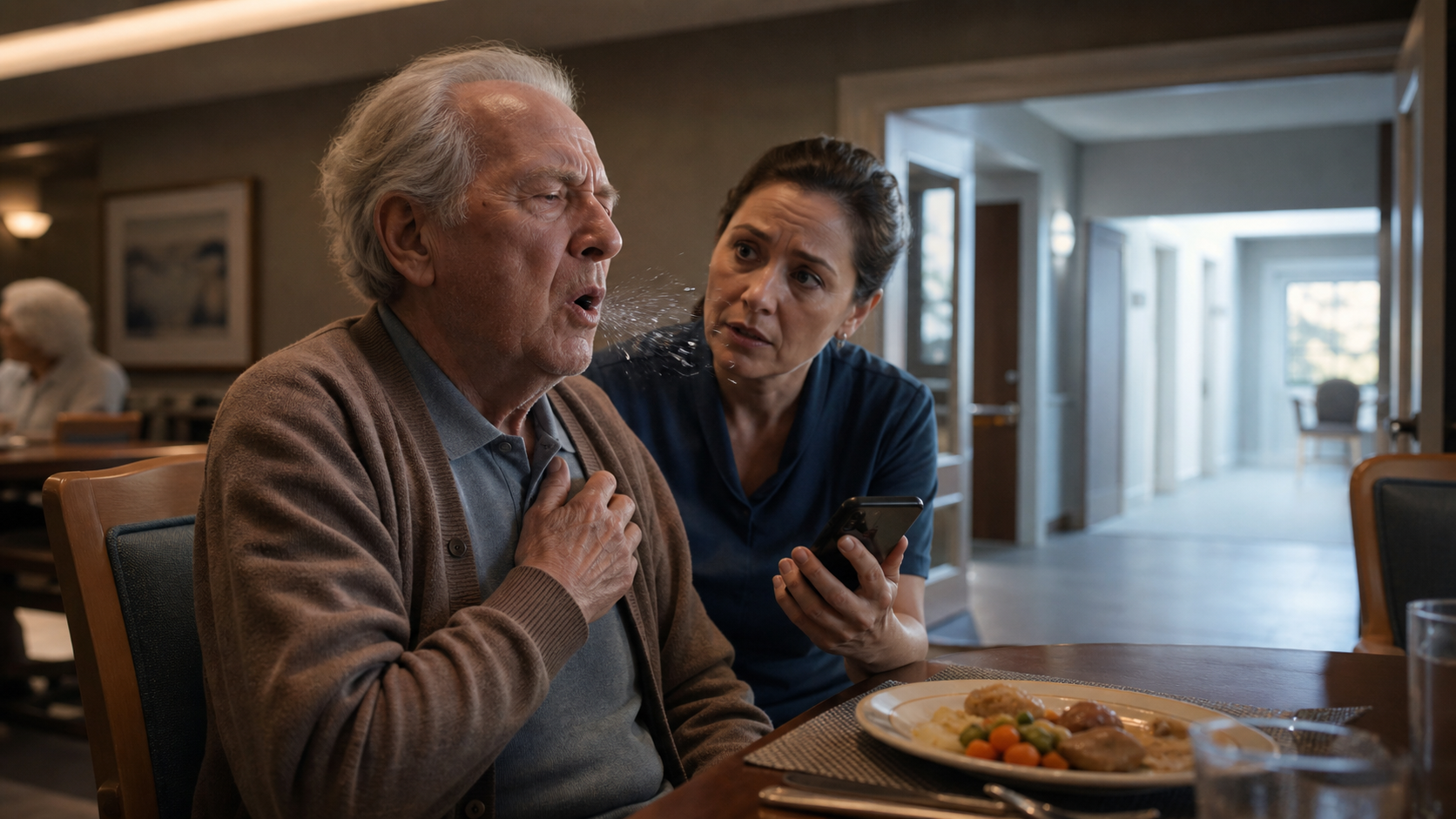
Stay close. Encourage coughing. Watch carefully.
A person with severe choking may have a weak or absent cough, be unable to speak, be unable to breathe, change color, become confused, or lose responsiveness.
|
What you observe |
What to do |
|---|---|
|
Strong cough and clear speech |
Encourage coughing and monitor closely |
|
Weak or absent cough |
Call 911 and prepare to act immediately |
|
Unable to speak or breathe |
Begin adult choking rescue immediately |
|
Color change, confusion, or apnea |
Treat as a severe emergency |
|
Person becomes unresponsive |
Begin CPR according to training and follow dispatcher instructions |
For a responsive adult with severe choking, current guidance uses repeated cycles of:
| 1. Give 5 back blows. | 2. Give 5 abdominal thrusts. |
| 3. Repeat until the object clears or the person becomes unresponsive. | Use chest thrusts instead when the rescuer cannot effectively encircle the abdomen. |
| If the person becomes unresponsive, begin CPR according to training. | |
Do not treat every cough as complete airway obstruction. Do not ignore a weak cough because the person looks calm. The question is whether enough air is still moving.
A family member, home-health aide, assisted-living worker, or weekend caregiver may approach meals differently. That inconsistency can create risk. The handoff should include:
| where meals usually happen | which foods or textures have been difficult | whether food pocketing has occurred |
| which time of day is harder | whether pills cause problems | where the phone is |
| the full address | who calls 911 | how EMS enters |
| the adult choking rescue sequence | where any second-line backup is stored | why manual rescue still comes first |
| The dining area should work during an emergency too | Comfort matters. Access matters too. | |
A recliner may feel comfortable but leave little space behind the person. A wheelchair tray may block access. A crowded dining-room table may prevent a caregiver from reaching the person quickly. A hallway full of furniture may slow EMS.
Run a short walk-through:
| Can the caregiver move behind or beside the chair? | Is there enough space to respond? |
| Can the phone be reached without leaving the person alone? | Is the address posted? |
| Can EMS enter quickly? | Does a wheelchair tray, armrest, or recliner create a barrier? |
Is any second-line backup stored close enough to retrieve without delaying manual rescue? Does the plan still work during a holiday meal or shift change?
Clinical guidance, individualized meal planning, caregiver training, calling 911, standard manual rescue, EMS, and CPR when unresponsive all come first.
Manual rescue first. Backup second.
A suction anti-choking device does not treat dementia, dysphagia, aspiration, coughing, throat clearing, or food pocketing.
Some households and care settings choose to keep a suction anti-choking device as a second-line backup after unsuccessful standard choking rescue for complete airway obstruction.
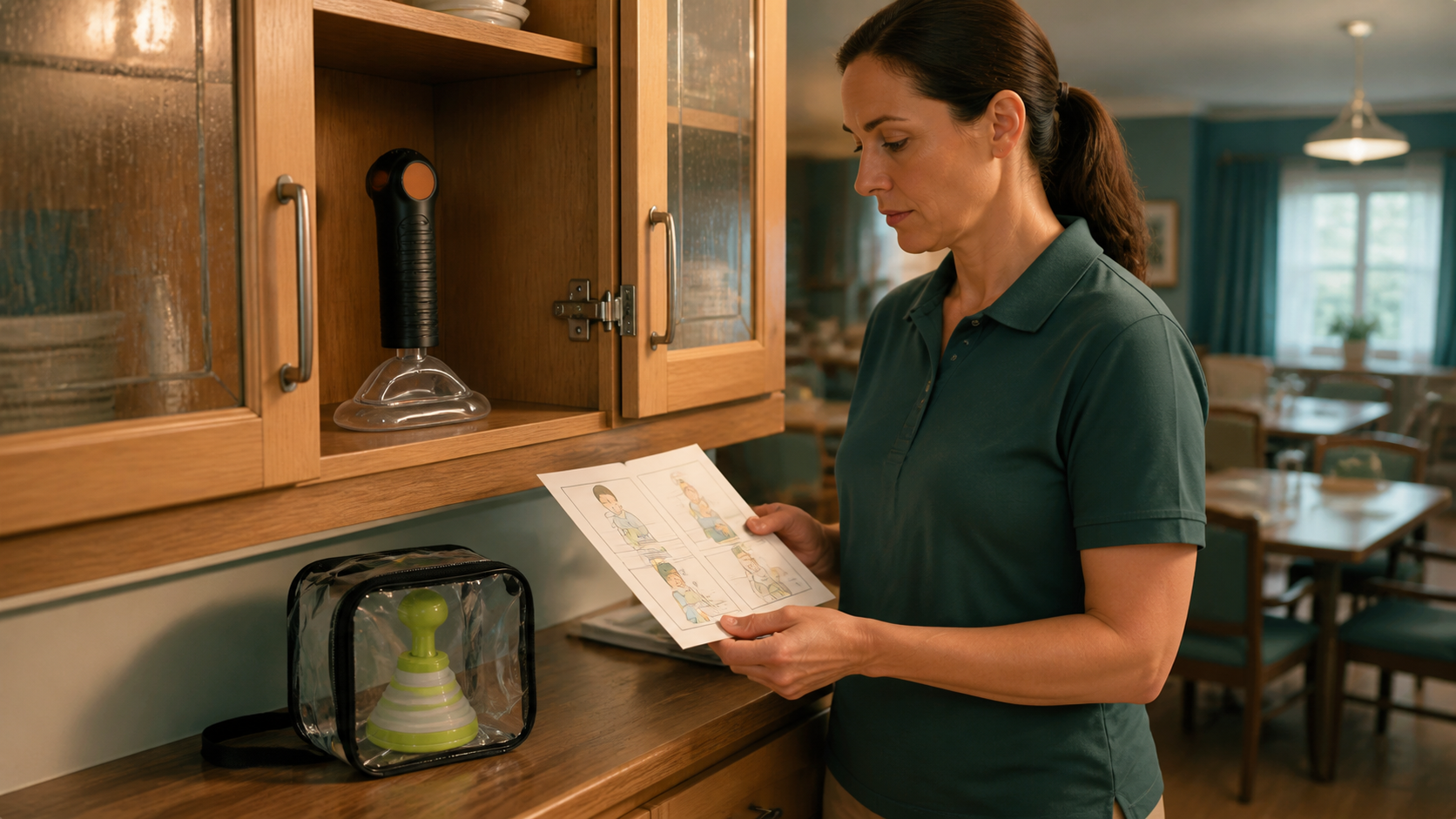
For a fixed dining-room, assisted-living, or caregiver station, the FITIGER EasyPumpVac Series may be the more practical option to review as part of an adult anti choking device or choking first aid kit readiness plan. Its straightforward manual structure supports one clearly marked adult-accessible location.
For mobile caregivers, community outings, multi-floor homes, or more than one meal location, the FITIGER FoldPumpVac Series may be the stronger option when a portable choking rescue device is easier to stage across settings.
A product can support a readiness system.
It cannot replace individualized care.
Before the next meal, ask:
|
Review point |
Question |
|---|---|
|
Chair and posture |
Is the person upright, stable, and comfortable? |
|
Table setup |
Is the environment simple enough to follow? |
|
Food texture |
Are current foods becoming harder to chew or swallow? |
|
Pacing |
Is the person taking another bite too quickly? |
|
Mouth check |
Is food remaining in the cheek after meals? |
|
Coughing pattern |
Has coughing, throat clearing, or wet voice increased? |
|
Clinical follow-up |
Has the pattern been shared with the care team? |
|
911 plan |
Does every caregiver know who calls and what to say? |
|
EMS route |
Can responders reach the dining area without delay? |
|
Second-line backup |
Is any backup staged clearly without replacing manual rescue? |
Make the next meal easier to read
Clear the table. Reduce the noise. Slow the pace. Watch what happens after the swallow. Check the mouth before the caregiver walks away.
The change may begin with something small. That is exactly why it deserves attention. Manual rescue first. Backup second. For related planning context, review the child and home choking safety readiness plan.
As dementia progresses, a person may have more difficulty with attention, pacing, chewing, swallowing, posture, or recognizing when food remains in the mouth. Risk varies by person and stage, so repeated changes deserve professional guidance.
Foods that are hard to chew thoroughly, dry, dense, or served in large pieces may become harder to manage. Raw carrots are one example. The right food texture should be individualized with clinical guidance when swallowing changes appear.
Yes. Food may remain in the cheek or mouth after eating. Check respectfully at the end of the meal and discuss repeated food pocketing with the care team.
Some people may still eat independently. Others need closer supervision as attention, pacing, swallowing, or communication changes. The level of support should match the person's current abilities.
Ask for guidance when coughing, throat clearing, wet voice, food pocketing, pill-swallowing difficulty, longer meals, weight loss, dehydration concerns, or breathing changes become part of the pattern.
Encourage coughing and monitor closely. A forceful cough means air is still moving. Begin choking rescue actions when severe obstruction signs appear, such as a weak or absent cough or inability to speak or breathe.
No. A suction anti-choking device does not treat dementia, dysphagia, or aspiration. It belongs only in a second-line backup role after unsuccessful standard choking rescue for complete airway obstruction.
EasyPumpVac Series may fit a fixed dining-room or caregiver station. FoldPumpVac Series may be more practical for mobile caregivers, community outings, multi-floor homes, or more than one eating zone.
Alzheimer's Association, Food and Eating - Supports the caregiver guidance on easier-to-chew foods, upright posture, checking the mouth after meals, and adjusting support as abilities change.
American Speech-Language-Hearing Association, Swallowing Disorders in Adults - Supports the signs of adult swallowing problems, including coughing, throat clearing, wet voice, food remaining in the mouth, prolonged meals, breathing changes, and the role of SLP evaluation.
American Heart Association, Adult Foreign-Body Airway Obstruction Algorithm - Supports the severe adult choking response sequence: 5 back blows followed by 5 abdominal thrusts, with CPR if the adult becomes unresponsive.
U.S. Food and Drug Administration, Update: FDA Encourages the Public to Follow Established Choking Rescue Protocols - Supports the requirement to use established choking rescue protocols first and position anti-choking devices only as a second option after unsuccessful standard rescue.
This article is for educational and preparedness-planning purposes only. It does not replace medical advice, legal advice, dementia care planning, swallowing evaluation, certified first-aid or CPR training, calling 911, EMS, professional medical care, clinician or speech-language pathologist recommendations, local emergency procedures, facility policies, or the current product-specific instructions for use.


