Schools can fund choking emergency preparedness through operating budgets, district safety funds, PTA support, community sponsorships, grants, or in-kind product donations. The right option depends on what the school actually needs, how quickly it is needed, who can approve the expense, and whether the school can maintain the equipment after the initial purchase or donation.
Before choosing equipment, review Fitiger's anti-choking device buyer evidence checklist for FDA wording, testing, seller traceability, and kit-selection questions.
A donation may solve a defined equipment gap. A grant may support a broader program. Neither replaces first-aid training, 911 access, CPR readiness, inspection, replacement planning, or the school's established choking response procedure.
A school should not begin by asking where it can get free anti-choking devices. The first question should be what part of the choking preparedness system is missing or unreliable.
The answer may be equipment, but it may also be staff first-aid and CPR training, substitute coverage during training, emergency communication, cabinet access, equipment inspection, replacement masks or components, bus storage, after-hours coverage, signage, incident documentation, a second approved equipment location, or a field-trip custody process.
Funding decisions improve when the school separates these needs. A grant intended for training should not be redirected toward equipment without approval. A donated device should not be treated as though it paid for staff training. PTA funds used for cabinets and signage do not automatically cover future replacements.
The school should define the gap before choosing the funding route.

A choking preparedness project may contain more costs than the product price.
Initial costs may include equipment, required masks or accessories, cabinets or secured storage, wall mounting, signs, shipping, installation, product orientation, first-aid and CPR training, substitute staff coverage, and administrative review.
Ongoing costs may include inspection time, replacement components, damaged or missing items, updated instructions, refresher training, recordkeeping, post-use replacement, cabinet repair, bus transfer controls, and annual program review.
Event-based costs may include replacement after use, infection-control handling, incident review, additional staff training, corrective action, equipment relocation, reporting, and documentation.
A school that requests a donated device but cannot fund replacement, inspection, or training has not solved the full problem. The cost map does not need to be complicated. It needs to be honest.

Schools commonly use five funding routes: school or district budget, PTA or PTO support, community sponsorship, grant funding, and in-kind product donation.
Each route has different strengths and limitations. The strongest plan may combine several of them. District funds might pay for training, PTA funds for cabinets and signage, a grant for radios and emergency planning, an in-kind donation for approved equipment, and the school budget for replacement and inspection.
That combination is often more realistic than expecting one funding source to cover everything.
A school or district budget is usually the strongest route when the need is permanent and predictable. Advantages may include clear procurement authority, standardized products, planned replacement, district-wide consistency, easier inventory control, defined ownership, integration with existing training, and budget accountability.
Budget funding may be especially appropriate for routine replacement, district-wide equipment standards, staff training, inspection systems, required storage, and long-term program maintenance.
The limitation is timing. A school may identify a need after the current budget has been approved, and the next purchasing cycle may be months away. Even when budget funds are not immediately available, the school should determine whether future maintenance belongs in the regular budget.
A one-time donation should not become an unfunded permanent responsibility.
A principal, nurse, teacher, or PTA may identify a real need and begin fundraising with good intentions. That effort can stall if the district later determines that the proposed product is not approved, procurement review is required, a standard model has already been selected, legal or risk review is incomplete, installation is restricted, training requirements have not been addressed, donation conditions cannot be accepted, or replacement responsibility is unclear.
Before seeking outside funding, ask who approves the product category, whether the district uses a standard device, who signs donation agreements, who owns the equipment after acceptance, whether procurement review is required, who funds future replacement, who approves placement, what training is required, and who maintains the inventory.
A funding commitment should not come before the school knows it can accept and manage the result.
PTAs and PTOs can move faster than a district budget in some schools. They may support cabinets, signs, replacement supplies, staff training fees, substitute coverage, equipment for a defined location, printed response materials, access-audit improvements, and community education.
PTA support works best when the project has administrative approval, a specific scope, a fixed budget, a named school owner, a replacement plan, clear purchasing authority, and a written record of what the PTA is funding.
The PTA should not independently select, buy, and install emergency equipment without school review. It also should not make unsupported medical or regulatory claims in fundraising materials.
Local businesses, service clubs, healthcare groups, and civic organizations may support one school, one cafeteria, one bus route, one training session, one rural district, a cabinet and signage project, or replacement components.
The risks include sponsor branding pressure, product selection outside school review, public claims that exceed the facts, unclear ownership, no maintenance funding, confusion between sponsorship and charitable donation, and expectations of public endorsement.
The school should control product approval, placement, safety messaging, equipment ownership, training requirements, sponsor recognition, and student privacy.

Grant funding is often most useful when the school needs more than one product. A strong grant proposal may combine needs assessment, staff training, equipment, cabinets, communication, inspection systems, rural transportation planning, parent education, incident documentation, and program evaluation.
Grant reviewers generally need to understand the problem, population served, current gap, proposed project, budget, timeline, responsible staff, expected operational outcomes, and sustainability.
Appropriate outcomes may include more staff holding current training, more occupied areas with assigned equipment owners, fewer locked-access barriers, completed inspection records, faster equipment location during access audits, improved bus transfer documentation, and corrective actions closed on time.
Avoid promising deaths prevented, lives guaranteed to be saved, choking eliminated, or clinical effectiveness proven by equipment placement.
An in-kind donation provides products rather than cash. It may be appropriate when the school has already identified an approved equipment category, a specific uncovered location, a proposed quantity, a primary owner, a backup owner, an inspection plan, training status, a valid shipping contact, and long-term maintenance responsibility.
The main advantage is that the school may obtain equipment without using the full purchase budget.
The limitations are important. Approval is not guaranteed. The requested quantity may be reduced. The product offered may not match the school's standard. Training, cabinets, or installation may not be included. Delivery may not match the requested date. Replacement may remain the school's responsibility. The school may need district acceptance before delivery.
An in-kind donation should enter the same review and inventory process as purchased equipment. Free acquisition does not remove operational responsibility.
A product donation program may provide equipment directly to an approved school or organization. It does not necessarily mean the school receives cash, the applicant can choose any retailer, a purchase by a parent is tax-deductible, the donor is a public charity, the recipient can resell the products, or the school can transfer the equipment freely.
Applicants should review the program conditions. The school should record the donor, product, model, quantity, approval and delivery dates, receiving employee, assigned location, non-resale condition, inspection owner, and replacement responsibility.
The word donation should not blur custody and management requirements.
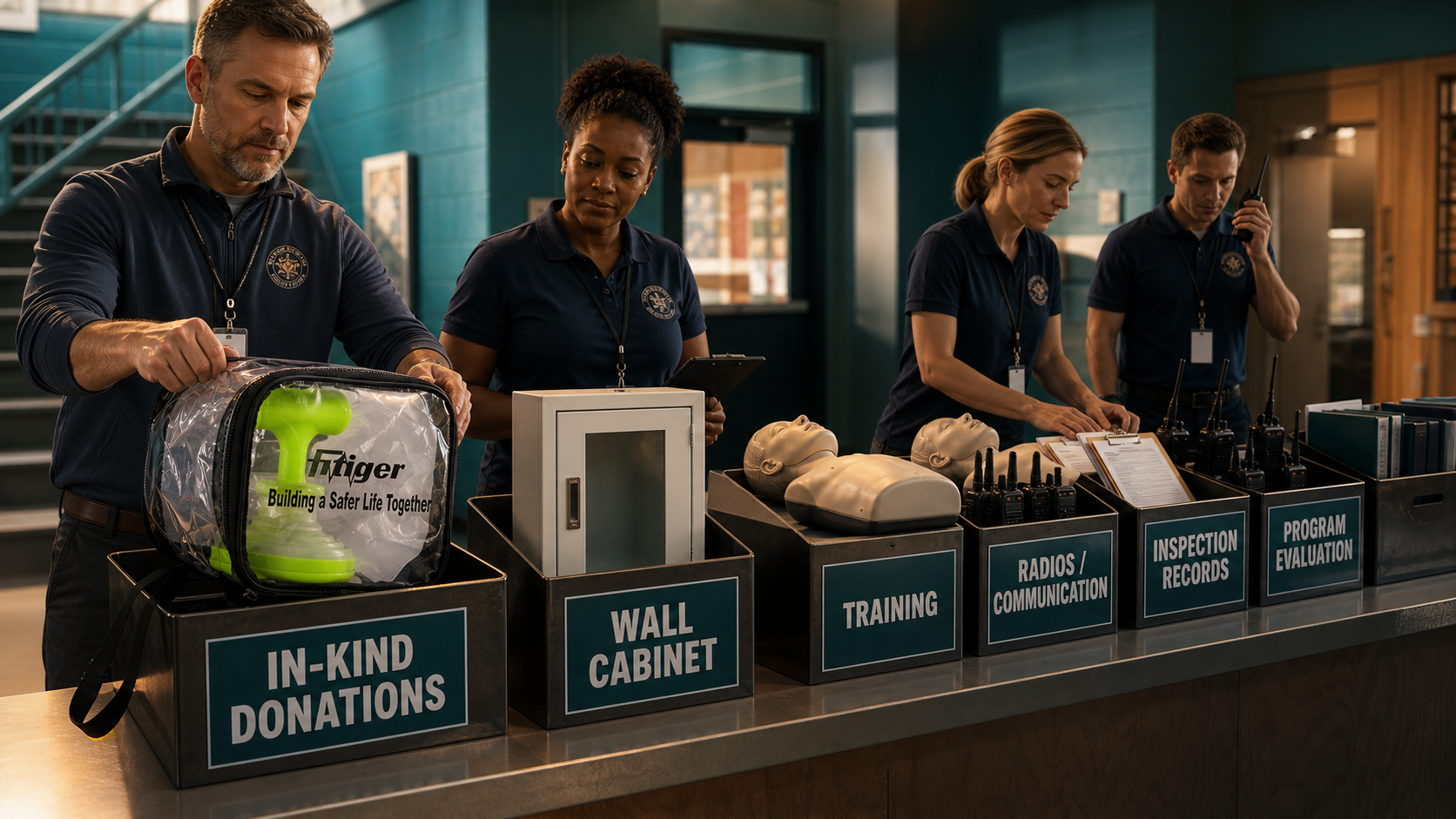
A donation may cover the equipment while a grant supports the surrounding system.
An in-kind donation may supply choking emergency backup devices, required product components, storage bags, and printed product instructions. Grant funding may support staff first-aid and CPR training, cabinets, signs, radios, substitute coverage, access audits, inspection software, rural bus storage, and program evaluation.
This approach is often stronger than using grant funds only to increase product quantity. Equipment is easier to manage when the supporting system has also been funded.
School or district budget is best for permanent program needs, standardization, replacement, and long-term ownership, but it may be constrained by the budget cycle.
PTA or PTO support is useful for local, defined projects and small gaps, but capacity varies and school approval is essential.
Community sponsorship can support visible local projects, but the school must control branding, ownership, and claims.
Grants work well for multi-part programs, training, infrastructure, and measurable operational outcomes, but they require applications, reporting, and restricted-use compliance.
In-kind donations fit a verified equipment gap and a named placement, but product, quantity, timing, training, and approval may be limited.
The school should select the route based on the project, not on which source appears to offer the most money.
A grant or donation application should explain who maintains the equipment, pays for replacement, funds future training, owns the inspection record, handles post-use replacement, and takes over when the original project leader leaves.
Sustainability does not require a complex five-year forecast. It requires an identified owner and a credible source of ongoing support.
A project is not sustainable because the school intends to seek future donations. That may be a possibility, not a plan.

Schools should prioritize the gaps that create the most immediate operational weakness. A sensible order may begin with reliable 911 access, staff first-aid and CPR coverage, clear response roles, access to current emergency instructions, correction of locked or blocked equipment, inspection and replacement, additional equipment locations, and program expansion.
A school should not spend the entire budget on devices while leaving staff untrained or cabinets inaccessible. The highest-visibility purchase is not always the highest-value correction.
Funding does not change the emergency sequence.
For a responsive person with severe airway obstruction, trained staff should activate emergency medical services and follow the applicable established choking first-aid procedure. If the person becomes unresponsive, CPR and dispatcher instructions become part of the response.
A suction-based anti-choking device belongs only in a second-line backup role after established first-line rescue has been attempted without success.
No funding proposal should describe the device as the first action, a replacement for manual rescue, a replacement for CPR, a substitute for 911, or a guaranteed outcome.
A strong request identifies the school or district, student population, current equipment, specific gap, proposed solution, requested amount or quantity, placement, staff ownership, training status, inspection plan, long-term funding, and timeline.
For example:
Our elementary school serves approximately 540 students in two buildings. The cafeteria and gym are located in a detached building that cannot reliably access the emergency equipment stored in the main health office. The school has approved one additional choking emergency backup location near the cafeteria. We are seeking funding for one approved device, a wall cabinet, signage, and replacement supplies. The cafeteria manager will serve as primary owner, the assistant principal as backup, and the school nurse will oversee the detailed inspection process.
That statement explains what the money will do. It does not rely on fear.
A school should not calculate equipment quantity from enrollment alone unless an applicable policy or approved standard specifically requires that formula.
Quantity should reflect building layout, occupied areas, access barriers, operating hours, transportation, existing equipment, staff coverage, inspection capacity, and product storage.
The funding request should explain locations, not only headcount.
A school may receive less money or fewer products than requested. Decide in advance which location has highest priority, whether the project can proceed in phases, which costs are essential, whether training is funded before equipment, whether the district can cover the difference, and whether an incomplete project should be declined.
Partial funding should not create an unmanaged location.
A school that has identified a specific equipment gap, approved a proposed location, assigned responsible staff, and prepared an inspection plan may consider an in-kind donation request.
Schools and eligible organizations can review the FITIGER product donation program and choose the school nomination or organizational application that matches their role.
Submission does not guarantee approval, a particular product, the full quantity requested, training, shipping, or delivery by a requested date.
The school remains responsible for district review, product acceptance, storage, training, inspection, replacement, and the established emergency response sequence.

Confirm that the school has documented the actual gap, inventoried existing equipment, tested access problems, tied quantity to approved locations, identified administrative and procurement authority, considered the full cost, selected a funding source that matches the project, assigned long-term owners, identified replacement funding, and preserved the medical boundary that standard rescue comes first.
The best funding route is not necessarily the largest or fastest source. It is the one that allows the school to obtain the right resources, maintain them responsibly, and connect them to a functioning choking emergency plan.

Not always. A donation may be efficient for a defined equipment gap, while a grant may better support training, cabinets, communication, inspection, and several locations. The choice depends on the project's scope.
A PTA may be able to fund approved equipment, but the school or district should review the product, placement, procurement, training, ownership, and maintenance before purchase or installation.
Not automatically. The school should confirm whether the donation includes only the product and instructions, product orientation, or qualified first-aid and CPR training.
Possibly, when the grant's eligibility rules and approved budget allow it. The school should not assume that every safety or health grant permits this expense.
Long-term replacement is usually more sustainable when it has an identified recurring funding source. The appropriate source depends on the district's budget and procurement process.
Yes, when the school approves the arrangement and controls product selection, placement, safety claims, student privacy, ownership, and sponsor recognition.
No. The acquisition price may be zero, but the school still has costs related to review, storage, training, inspection, replacement, documentation, and post-use management.
Yes, when each unit corresponds to a documented location or transportation gap. Approval may be for fewer units than requested.
No. Funding and equipment do not establish compliance by themselves. The school must review applicable laws, district policies, product instructions, training, storage, inspection, and documentation.
No. Staff should call 911 and follow established first-line choking rescue. A suction-based anti-choking device belongs only in a second-line role after unsuccessful standard rescue.
IRS Charities and Nonprofits - Provides background on U.S. charitable organizations and tax-exempt entities.
American Red Cross Adult and Child Choking First Aid - Supports established first-aid education for adult and child choking emergencies.
FDA Product Classification QXN - Supports the second-line treatment classification for suction anti-choking devices.
This article provides general information about school safety funding and emergency preparedness. It is not medical advice, legal advice, tax advice, grant advice, a guarantee of funding, or a substitute for district procurement review, certified first-aid training, manufacturer instructions, or professional guidance.
In a choking emergency, call 911 or the applicable local emergency number, follow dispatcher instructions, and use the established choking rescue procedure appropriate to the person's age and condition. If the person becomes unresponsive, begin CPR when indicated. A suction-based anti-choking device should not replace standard first-line choking rescue or delay professional emergency care.


