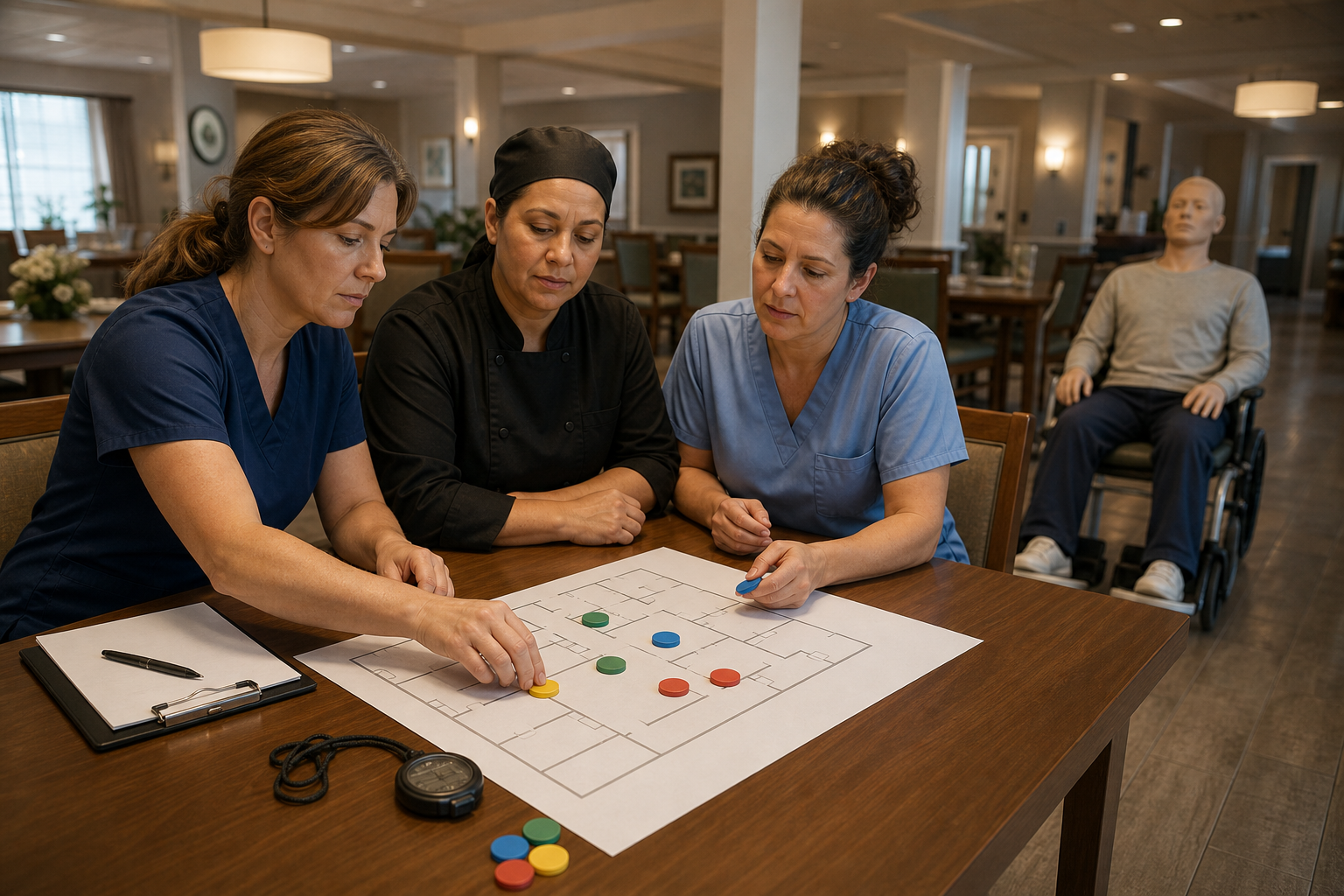
In frail elder-care choking events, the real quality metric is Failure to Rescue: whether the team restores airflow before oxygen debt becomes irreversible. Weak cough force, low lung reserve, chair geometry, delayed recognition, EMS delay, and slow backup retrieval can turn a survivable obstruction into a fatal system failure.
A choking event tells you a complication happened. It does not tell you whether the facility could rescue the resident once the complication began.
That distinction matters in elder care. A resident can have a dysphagia care plan, a texture-modified diet, a trained staff team, and a written emergency policy. None of those restore oxygen once the airway is blocked. At that moment, the quality question changes.
| How fast was severe choking recognized? | Did first-line action begin immediately? |
| Could the first responder reach the resident's body correctly? | Did someone call 911 without leaving the resident alone? |
| Was there a clear transition when the first manual attempt did not work? | Could any second-line airway backup be reached before the oxygen window closed? |
That is Failure to Rescue. Not the presence of a complication, but the system's inability to reverse it in time.
Failure to Rescue, or FTR, is often used to describe death after a complication that was not detected or managed effectively. In frail elder-care choking, the term becomes painfully concrete.
The complication may start with one bite. A piece of food lodges. The resident coughs weakly once. A carer turns toward another table. The resident's color changes slowly enough that the room does not panic yet. By the time everyone agrees it is severe choking, the rescue window is already smaller.
Incident counts flatten that sequence. FTR exposes it.
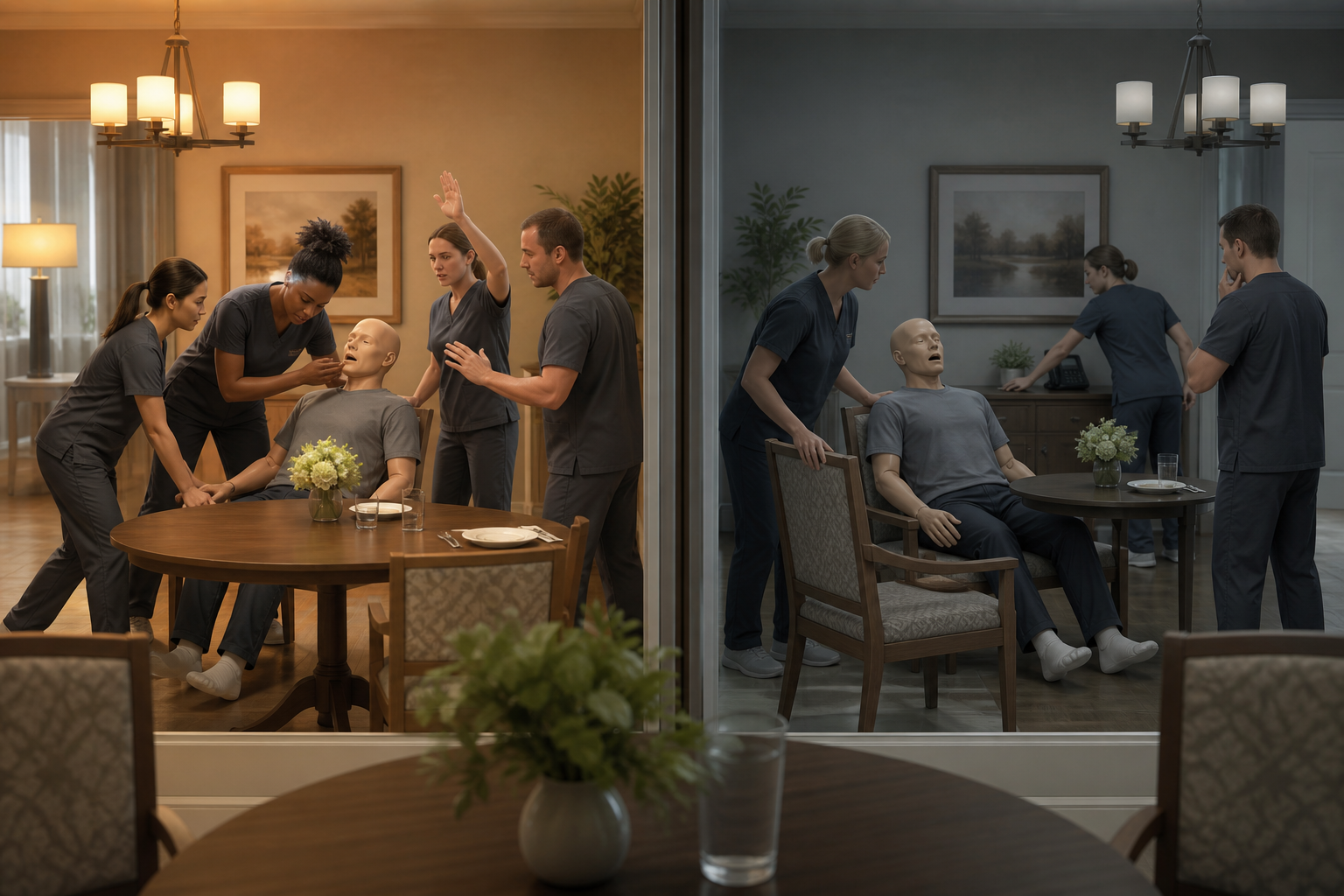
Two facilities can record the same type of event. One recognizes the obstruction immediately, starts first-line rescue, calls emergency services, retrieves backup without abandoning the resident, and documents the timeline. Another facility waits for obvious blue lips, loses time moving furniture, sends the only responder away to find equipment, and repeats an ineffective maneuver too long.
Both had a choking incident. Only one had a rescue system that held.
A frail resident is not a neutral starting point.
Weak respiratory muscles, low lung reserve, poor trunk control, wheelchair dependence, bed confinement, osteoporosis, contractures, delayed cognition, dementia, and fatigue all change the rescue conditions. The standard response may still be correct. The body and room can make it harder to perform quickly, cleanly, and safely.

This is why generic choking advice can feel too tidy for nursing homes and assisted-living dining rooms. It often assumes a standing person, clear rear access, enough body control, and a rescuer who can position and apply force without obstruction. Elder care often gives you a high-back chair, a dining table edge, a frail chest wall, a weak cough, and a resident who cannot help reposition themselves.
A robust elder-care choking response plan has to start from that real room, not from a textbook diagram.
A strong cough can sometimes move a partial obstruction. A weak cough may only announce that the resident is losing the fight.
In frail residents, cough weakness is not just a symptom. It is a mechanical limit. If the resident cannot generate enough expiratory force, self-clearance fails early. Oxygen debt begins climbing before the room sees dramatic distress.
Food material matters too. In simulator work using matched-apparent-viscosity boluses, clearing a starch-based sample to less than 0.5 mm residual coating required about 5.4 kPa of pressure, compared with about 1.7 kPa for a gum-based sample. That is roughly a 3.2-fold difference in clearance pressure.
A resident does not experience that as an academic texture term. The mouth and airway experience it as load. Add weak tongue force, fatigue, panic, chair restriction, and delayed recognition, and the same bolus becomes a much harder rescue problem.
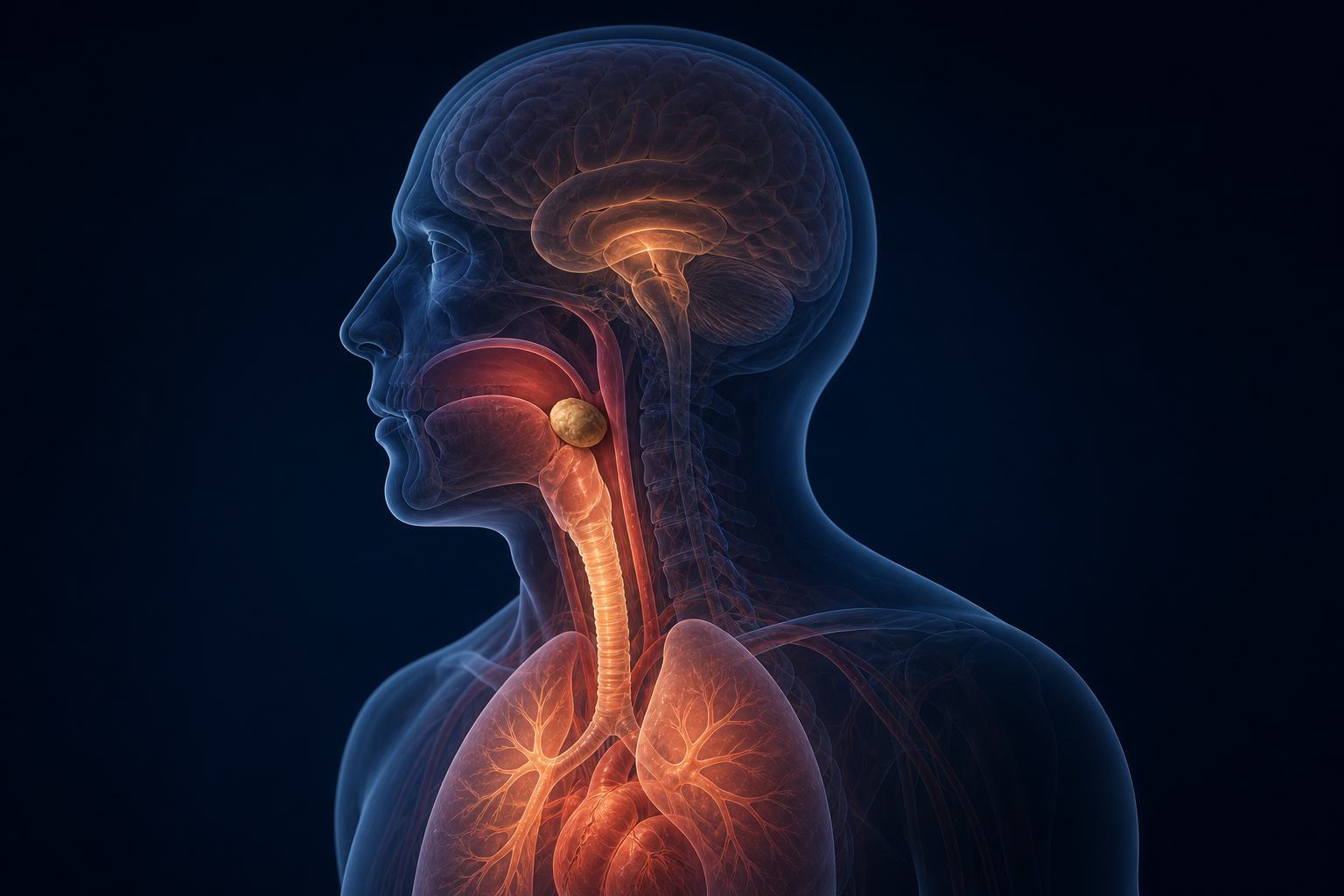
Once the airway is fully blocked, the timeline is no longer administrative. It is biological.
Permanent brain injury can begin within roughly four to six minutes of total airway obstruction. EMS often arrives after that early injury window has already opened. In many elder-care settings, the facility must bridge the oxygen gap before outside responders reach the room.
That is not an argument against calling 911. Call immediately.
It is an argument against planning as though calling 911 is the rescue.
The meaningful timeline starts earlier:
| first compromise | first recognition |
| first effective physical action | emergency activation |
| failed first-line decision point | second-line backup retrieval, if available and appropriate |
| CPR transition if the resident becomes unresponsive | EMS handoff |
Every delay sits inside the same oxygen window. A locked cabinet, unclear role, long hallway, poor chair access, unopened packaging, or repeated failed maneuver is not just inconvenience. It is time removed from the resident's brain.
FTR Risk Factor | Operational Variable | Rescue Consequence |
|---|---|---|
Weak cough force | Muscle strength versus obstruction load | Self-clearance fails early and oxygen debt climbs faster |
Low lung reserve | Baseline respiratory capacity | The resident has less runway during complete obstruction |
Recognition latency | Staff observation and escalation speed | Action starts too late, often after visible cyanosis |
Chair or bed geometry | Access angle, trunk control, transfer delay | Manual rescue becomes slower or harder to perform |
EMS delay | Outside response time | Professional help may arrive after the early brain-injury window |
Role confusion | Who rescues, calls, retrieves, documents | The first minute gets split into hesitation |
Backup retrieval latency | Distance, storage, packaging, mask choice | Second-line tools arrive too late to change the event |
In care facilities, staff sometimes wait for a sign that feels undeniable. That is dangerous.
Blue lips, collapse, and unresponsiveness are late evidence. The earlier signs are quieter: weak coughing, sudden silence, throat clearing that does not resolve, watery eyes, panic without sound, food pocketing, a resident who stops responding normally, or a breathing pattern that changes mid-meal.
A frail resident may not produce the dramatic cough staff expect. A resident with dementia may not report distress clearly. A resident with neurologic disease may aspirate or obstruct with less visible warning. Waiting for obvious late-stage signs makes the rescue window smaller before anyone starts.
A better system trains staff to act on early severe signs, not just late collapse.
First-line choking response still comes first.
That sequence matters. Food and liquid accuracy sit at the front. Bedside verification sits at the front. Recognition sits at the front. Standard BLS choking response sits at the front. Emergency activation runs in parallel.
A second-line device does not erase any of that.
The American Heart Association's 2025 choking guidance supports repeated cycles of 5 back blows and 5 abdominal thrusts for responsive adults and children with severe foreign-body airway obstruction. Infants require 5 back blows and 5 chest thrusts. If the person becomes unresponsive, the response transitions into CPR.
Elder care needs that first-line baseline. It also needs to admit where real bodies and rooms make execution harder.
FDA's March 4, 2026 De Novo authorization under DEN250012 established 21 CFR 874.5400 and product code QXN for a suction anti-choking device as a second-line treatment. The sequence is the key point: this category sits after unsuccessful use of a basic life support choking protocol for complete airway obstruction.
For FITIGER, that means the device belongs in the system as redundancy, not as the opening move.
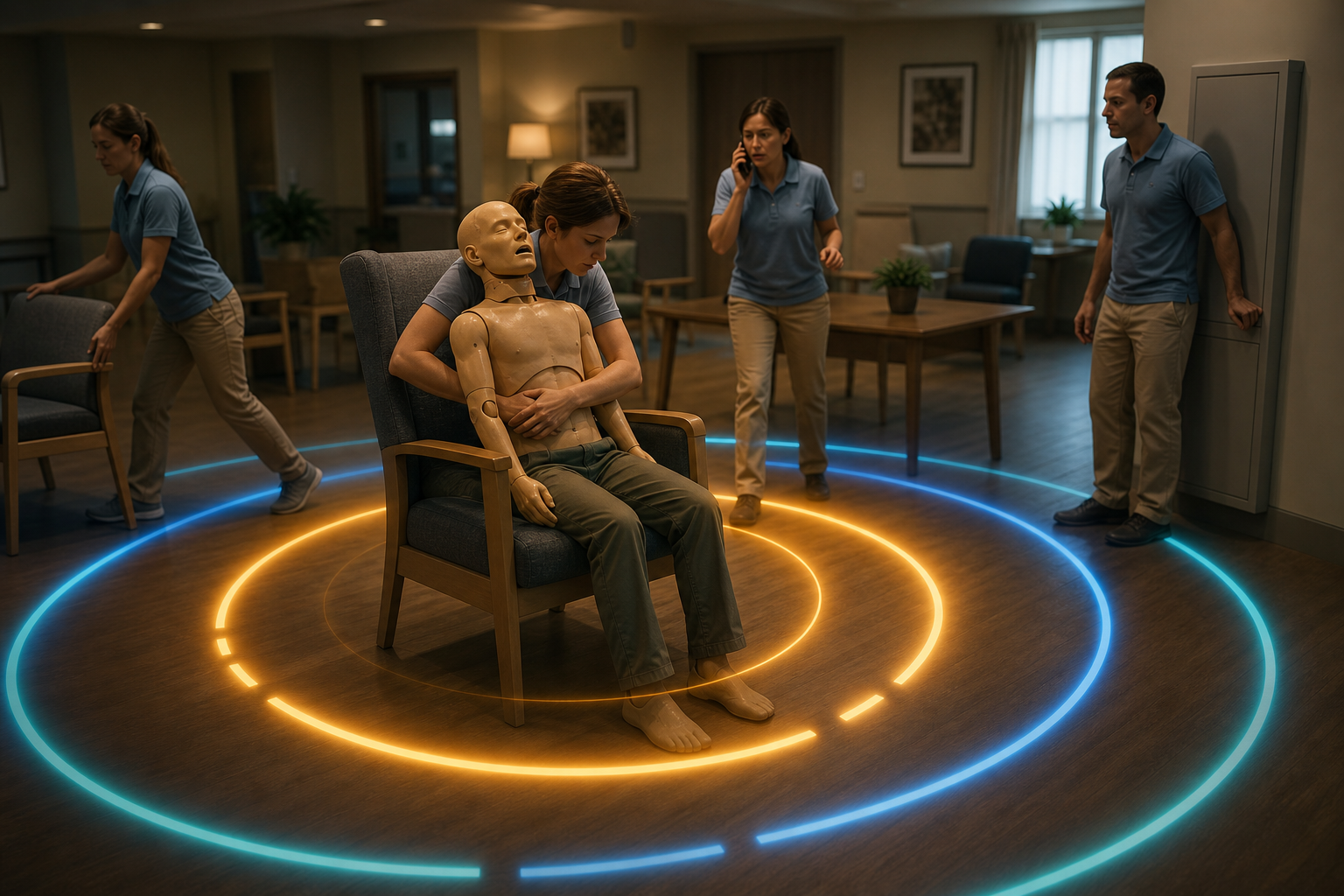
In frail elder-care choking, redundancy matters because first-line rescue can fail, slow down, or become physically constrained. A resident may be seated in a wheelchair that blocks clean access. A caregiver may not be strong enough to create effective force. A high-resistance bolus may not move. A bedbound resident may be difficult to position. The room still has to move into the next effective step without losing the oxygen window.
Second-line does not mean casual. Packaging latency, mask selection, storage distance, training decay, and role confusion can all widen the FTR gap if the device is treated like a gadget rather than a planned rescue layer.
Facilities often ask the wrong first question: "Should we buy a choking rescue device for elderly residents?"
The better first question is: "Where does our rescue chain fail if manual first-line action does not work?"
That answer tells you whether a second-line airway device is being used as a serious risk-control layer or as reassurance on a wall.
A purchasing review should ask:
| Is the device FDA-authorized under the QXN / 21 CFR 874.5400 pathway? | Is it intended for use after unsuccessful BLS choking protocol? |
| Is it staged near dining areas, not just stored in a central office? | Can staff retrieve it without leaving the resident alone? |
| Can the right mask be selected quickly? | Have staff practiced opening and using the device under shift conditions? |
| Is EMS activation still happening in parallel? | Is device use documented as part of the rescue timeline? |
A facility should not buy equipment to avoid training. It should buy equipment only after the sequence is clear enough for the equipment to strengthen the response.
A serious FTR audit does not start with whether the policy exists. It starts with the room.
Walk the actual dining room. Stand behind the chairs. Check whether a rescuer can position correctly. Time the distance from the highest-risk table to the wall station. Open the device packaging with the staff who would actually be on shift. Ask who calls 911. Ask who stays with the resident. Ask who retrieves backup. Drill the moment when the first manual effort fails.
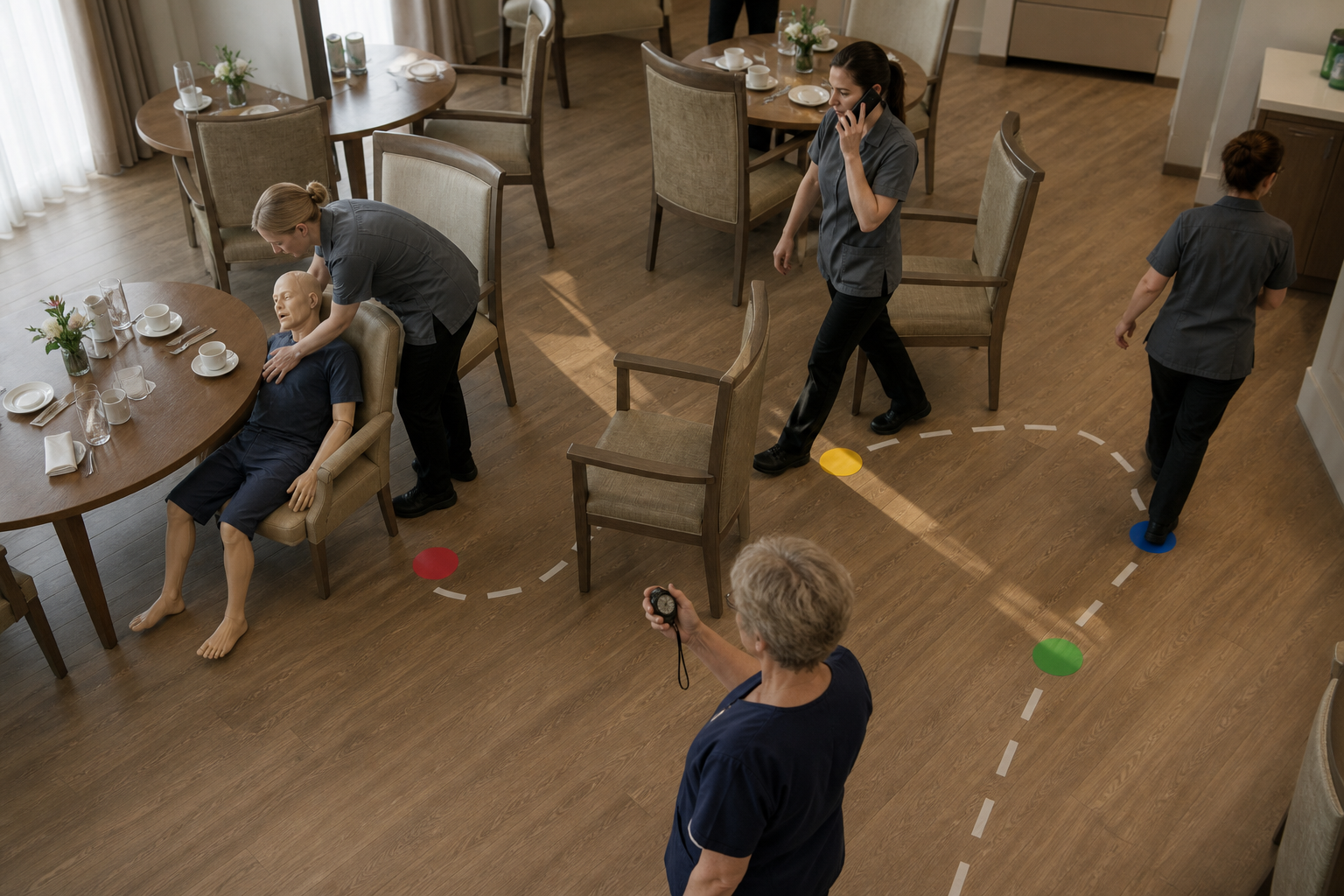
Then measure the delay.
Do not accept "quickly" as an answer. Use seconds.
A facility should audit:
| recognition time from first sign to first action | time to start first-line manual response |
| time to activate EMS | time to retrieve any second-line backup |
| time lost to packaging, mask choice, or assembly | transition time after a failed first-line attempt |
| time to CPR if the resident becomes unresponsive | documentation quality after the event |
If the team cannot name those intervals, it cannot honestly claim to understand its Failure to Rescue risk.
One dangerous elder-care misconception is that DNR status blocks immediate choking response.
A do-not-resuscitate order is not a general instruction to ignore a reversible airway emergency. Facilities should follow their policies and applicable law, but staff must not let uncertainty about advance directives freeze the first response to a choking event.
This belongs in training because hesitation in the first minute can decide the outcome. If staff are unsure how DNR, choking first aid, CPR, and emergency escalation interact in the facility's policy, leadership should clarify that before the next meal service.
A confused room becomes a delayed room. In a complete obstruction, delay becomes oxygen debt.
A strong response system is not theatrical. It looks ordinary until it is tested.
Before lunch, the highest-risk residents are already known. Their diet levels are current. Their seating positions are planned. Staff know who has a weak cough, who needs supervision, who cannot be easily repositioned, and where backup equipment is staged.
During the meal, the first sign is recognized early. The nearest trained staff member starts first-line action. Another person calls 911. Another retrieves backup if the plan includes it. The team does not repeat the same failed move because nobody knows what comes next.
Afterward, the event timeline is reviewed. The facility asks where time was lost and whether the same loss could happen again tomorrow.
That is how FTR becomes an operational metric instead of a retrospective label.
Failure to Rescue in elder-care choking is not an abstract quality term. It is the gap between obstruction and oxygen.
Frailty narrows the margin. Weak cough force shortens the runway. Low lung reserve makes delay less forgiving. EMS may not arrive within the biologic window. Poor room layout, unclear roles, and slow retrieval make the facility's first minutes weaker than the policy suggests.
Audit the rescue window before the next meal service. Time the walk. Test the chair access. Open the packaging. Drill the failed-first-line transition. Know which residents cannot self-clear.
The resident runs out of oxygen before the paperwork runs out of explanations.
Failure to Rescue means the resident dies or deteriorates because a choking complication was not recognized or managed effectively in time. In elder care, FTR often reflects delays in recognition, manual rescue, emergency activation, transition after failed first-line action, or access to backup.
Incident counts show that a choking event occurred. FTR asks whether the system could rescue the resident once the event began. That makes it more useful for evaluating real readiness in frail elder-care settings.
Frailty can reduce cough force, lung reserve, mobility, trunk control, and tolerance for forceful maneuvers. Those factors make choking harder to self-clear and harder to reverse quickly once it begins.
The four-minute oxygen window refers to the early period after total airway obstruction when permanent brain injury may begin, often within roughly four to six minutes. Elder-care teams must act before EMS arrival in many cases.
A suction anti-choking device under FDA 21 CFR 874.5400 and product code QXN is a second-line treatment after unsuccessful basic life support choking protocol. It is not a first-line replacement for manual rescue, 911, CPR, or training.
It can reduce one part of the risk if it is FDA-authorized, staged close to the dining-risk area, used only after unsuccessful first-line response, and integrated into training and documentation. Poor placement or unclear sequencing can widen the delay instead.
Start with the dining room. Time the route to emergency resources, identify residents with weak cough or poor positioning, assign staff roles, test access angles, and drill the transition after failed first-line rescue.
A weak cough may not generate enough force to move an obstructing bolus. That shortens the self-rescue phase and makes early staff recognition and rapid escalation more important.
No facility should let confusion about DNR status freeze the first response to a potentially reversible choking event. Staff should follow policy and law, but leadership must clarify this before emergencies occur.
FDA De Novo Order DEN250012 - Supports 21 CFR 874.5400, product code QXN, and the regulatory category suction anti-choking device as a second-line treatment after unsuccessful BLS choking protocol.
FDA Safety Communication, updated March 4, 2026 - Supports the position that established choking rescue protocols should come first and anti-choking devices may delay care if used before standard measures.
American Heart Association 2025 Choking Guidance Update - Supports the first-line choking response baseline for severe foreign-body airway obstruction and the continuing need to prioritize standard rescue before device use.
A Mechanical Simulator of Tongue-Palate Compression to Investigate the Oral Flow of Non-Newtonian Fluids - Supports the pressure example of approximately 5.4 kPa for a starch-based bolus versus 1.7 kPa for a gum-based sample during bolus clearance.
MedlinePlus - Choking First Aid - Supports the emergency nature of choking, recognition of airway obstruction, and the risk of brain injury after oxygen loss.
This article is for educational and operational-planning purposes only. It does not replace accredited first-aid training, emergency medical advice, clinical judgment, facility policy, or product-specific instructions for use. In a choking emergency, follow current established rescue protocols, call 911 or your local emergency number, and use any backup device only within its labeled role and training sequence.


