Schools seeking donated anti-choking devices should begin with a documented equipment need, proposed placement locations, and an authorized school contact. A parent, teacher, school nurse, administrator, or community member may be able to nominate a school, but the school will usually need to verify the request before equipment can be approved and delivered.
Before choosing equipment, review Fitiger's anti-choking device buyer evidence checklist for FDA wording, testing, seller traceability, and kit-selection questions.
For a household checklist, see Fitiger's child and home choking safety readiness plan.
A donation can help close an equipment gap. It doesn't replace staff training, an established choking response plan, emergency medical services, CPR readiness, or standard first-aid procedures.

It begins with a practical problem the school has identified.
Perhaps the cafeteria is in a separate building from the nurse's office. Maybe after-school activities continue after the nurse has left campus. A district may have long bus routes, several athletic areas, or only one emergency equipment cabinet serving a large campus.
Those details help explain why the request is being made and how donated equipment would be used.
Before submitting a school safety equipment donation request, identify:
| The locations where students regularly eat | The number of buildings or separate activity areas |
| The distance from those areas to the nurse's office | Whether the school operates buses or off-campus programs |
| Which staff members are trained in choking first aid and CPR |

| Readiness check | Readiness check |
|---|---|
| What emergency equipment is already available | Who would inspect and manage donated equipment |
| Whether the school or district has approved the proposed placement |
A request supported by this information is easier to evaluate than one based only on general concern.
The person who notices the need and the person authorized to accept equipment may not be the same.
A parent may identify a gap in cafeteria preparedness. A teacher may notice that an after-school program is far from the main office. A school nurse may want better coverage across several buildings. A PTA may be looking for a safety project that addresses a documented need.
Any of these people may be able to begin a nomination. Formal approval, however, may require participation from a principal, district administrator, school nurse, risk manager, transportation director, or another authorized representative.
The exact process depends on the school and district. Public schools, private schools, charter schools, and specialized education programs may follow different rules for accepting donated products.
A nomination should therefore identify both:
| Need originator | Authorized verifier |
|---|---|
| The person describing the need | The school official who can verify or approve the request |
Don't assume that submitting a teacher's or parent's contact information automatically gives a donation program permission to ship products to the school.

Most donation reviewers need enough information to verify the school, understand the request, and determine whether the proposed quantity makes sense.
A complete application may include:
Provide the school's full name, city, state, website, district, grades served, and approximate enrollment. Avoid shortened names that could be confused with another school.

State whether the applicant is a parent, teacher, nurse, administrator, PTA representative, transportation employee, community partner, or another interested person.
Include a school or district representative who can confirm that the school may receive and place donated equipment.
Explain the operational gap in specific terms. For example:
| Operational gap example | Operational gap example |
|---|---|
| The cafeteria is several minutes from the nurse's office. | The school has separate elementary and middle-school buildings. |
| Athletic practices continue after regular health-office hours. | Students spend significant time on rural bus routes. |
| The school has trained staff but limited equipment coverage. | Existing equipment is concentrated in one location. |
The description should be factual. It shouldn't exaggerate risk, imply that a tragedy is inevitable, or include private information about a student.
Explain how many units are being requested and why. A request for multiple devices should correspond to actual placement locations rather than an unsupported estimate.
Name the locations under consideration, such as:
| Cafeteria | Nurse's office | Main office |
| Gym | Athletic facility | Staff break area |
| School bus | Special education classroom | After-school program area |
Final placement should be reviewed by the school and aligned with applicable policies, access controls, storage requirements, and emergency procedures.
Identify who will:
| Receive the shipment | Record the donated units |
| Inspect the equipment | Monitor packaging and mask condition |
| Replace missing or damaged components | Keep instructions available |
| Review placement after building or staffing changes |
A device without an assigned owner can remain unnoticed in a cabinet long after it becomes inaccessible, incomplete, or poorly located.
The statement of need is usually the most important part of a school donation application.
It doesn't need to be dramatic. It needs to be clear.
A useful statement describes the school environment, the current gap, the people served, and the intended use of the donated equipment.
For example:
Our elementary school serves approximately 620 students in two buildings. The cafeteria and gym are located in the west building, while the nurse's office is in the main building. We are requesting two donated choking emergency kits for designated, staff-accessible locations near the cafeteria and gym. The school administration will review placement, assign an inspection owner, and maintain the kits as part of the school's existing emergency response plan.
That paragraph provides more decision-making value than: We care about student safety and would appreciate any help you can provide. The second statement is sincere, but it doesn't explain the equipment gap or how a donation would be managed.
A school may have students with disabilities, swallowing difficulties, feeding plans, or other health considerations. Those needs can influence emergency planning, but they should not be described in a public nomination form using identifiable medical information.
Do not submit:
| Student names | Diagnoses |
| Medical records | Individual education records |
| Photographs of students | Detailed incident reports containing personal information |
| A child's home address or family contact details |
A general statement such as "the school serves students with a range of health and support needs" is usually enough at the initial application stage.
If an organization later requires additional documentation, the school should use an approved, secure process and follow its privacy obligations.
A school may request more than one unit when the quantity is tied to a credible placement plan. Approval is not automatic, and the number provided may differ from the number requested.
A small school in one building may have a different need from a large campus with several cafeterias, gyms, buses, or detached facilities.
Reviewers may consider:
| Student and staff population | Number of buildings | Meal-service locations |
| Transportation needs | Distance between occupied areas | Existing equipment |
| Storage and inspection capacity | Available donation inventory | Geographic and shipping constraints |
Requesting an excessive number without explaining the proposed locations can weaken an otherwise reasonable application.
A nomination is normally the beginning of a review, not a guarantee of approval.
| The program may need to: | Verify the school and applicant | Contact an authorized school representative |
| Review the stated need | Confirm the requested quantity | Discuss placement or delivery |
| Determine inventory availability | Approve, reduce, defer, or decline the request | Obtain a valid shipping contact |
| Record delivery or recipient confirmation |
An incomplete nomination may be delayed while the program requests missing information. A school should also allow time for its own internal approval process.
Applicants should not promise staff, families, or administrators that equipment is confirmed until the donation has been formally approved.
There is no responsible universal answer unless the program publishes a defined service timeline.
Review time can depend on:
| Application completeness | School verification | Response from an authorized contact |
| Requested quantity | Current inventory | Shipping destination |
| Program cycle | Additional documentation | Internal school approval |
A deadline should be included when the request relates to a scheduled event, new semester, safety initiative, or staff training date. Providing a requested in-hand date does not guarantee delivery by that date.
Schools with an immediate purchasing need should not rely solely on a pending donation request.
Placement should be based on access, likely occupancy, staffing, environmental conditions, and retrieval time.
A locked cabinet near the main office may be secure but difficult to reach from a detached cafeteria. A device on a school bus may be close to students during transportation but requires a clear inspection and responsibility plan. Equipment stored in the nurse's office may be well managed but inaccessible when the office is closed.
The best location is not simply the busiest area or the place with the most wall space. It is a location the school has evaluated for:
| Visibility | Staff access | Retrieval path |
| Security | Storage temperature | Inspection responsibility |
| Proximity to meal or activity areas | Access during after-hours programs | Compatibility with district policy |
A placement decision should be documented rather than left to whoever opens the shipment.
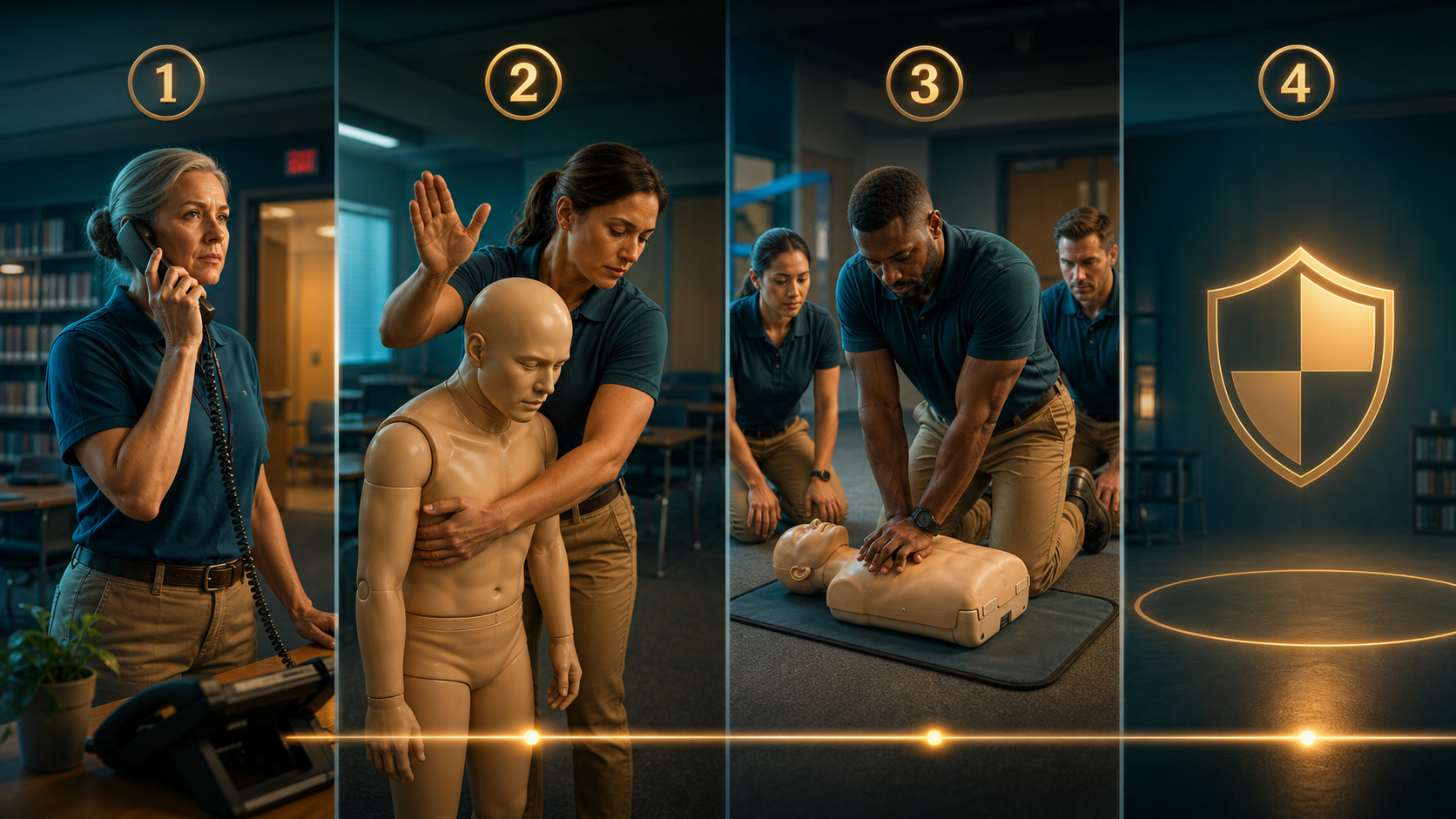
An anti-choking device should not become the school's entire choking response plan.
School readiness also requires:
| Choking prevention policies | Age-appropriate food practices | Staff first-aid and CPR training |
| A clear method for calling 911 | Established first-line choking rescue procedures | Role assignments |
| Accessible emergency contacts | Incident reporting | Post-event review |
| Routine equipment inspection |
For a responsive person with severe airway obstruction, staff should follow the applicable established choking first-aid protocol and activate emergency medical services. If the person becomes unresponsive, CPR and dispatcher instructions become part of the response.
A suction-based anti-choking device belongs in a second-line role after unsuccessful standard choking rescue. It should not delay 911, replace trained manual first aid, or be presented as a guaranteed rescue method.
Receiving donated equipment does not, by itself, establish that a school:
| Meets every legal or regulatory requirement | Has completed first-aid training |
| Has selected the best placement | Can retrieve the device quickly |
| Has adopted a complete choking response policy | Has verified suitability for every student |
| Will achieve a particular emergency outcome |
The school remains responsible for reviewing applicable district policies, state requirements, manufacturer instructions, storage conditions, training expectations, and medical guidance.
Donation language should stay equally precise. Terms such as "approved," "allocated," "shipped," and "delivered" describe different stages. A device that has been allocated but not received should not be counted as delivered.
FITIGER accepts school nominations and applications for in-kind product support through its community donation program. Parents, educators, nurses, administrators, and community members may submit a school nomination, while authorized organizations may use the formal donation application.
Before applying, prepare:
| The school's full identifying information | Your relationship to the school | An authorized school contact |
| The reason for the request | Requested quantity | Proposed placement locations |
| Approximate number of people served | Requested delivery date, if relevant | A plan for receiving and managing the equipment |
Schools with a documented equipment gap can apply for an anti-choking device donation through the FITIGER Donation Program.
Submitting a request doesn't guarantee approval. Product availability, application verification, shipping limitations, program priorities, and the quality of the placement plan may affect the decision.

Review the application once as if you were the person evaluating it.
| Can the reviewer tell: | Which school is being nominated? | Who submitted the request? |
| Who at the school can authorize it? | What specific gap exists? | How many devices are requested? |
| Where would they be placed? | Who would inspect them? | How many people could benefit? |
| Whether the information is accurate? | Whether sensitive student information has been excluded? |
If any of those answers are unclear, revise the application before sending it.
A well-prepared request doesn't need inflated language. It needs enough operational detail for the school and donation program to make a responsible decision.

For related planning context, review the anti-choking device buyer evidence checklist.
For related planning context, review the child and home choking safety readiness plan.
A parent, teacher, school nurse, administrator, PTA representative, school employee, or community member may be able to nominate a school. Formal approval and delivery may require confirmation from an authorized school or district representative.
Not necessarily. Public schools and school districts may have a different legal or tax status from independent nonprofit organizations. The school should provide the institutional information requested by the program and be prepared to verify its identity and authority to receive donated products.
A parent may submit an initial nomination, but the school may need to confirm the request before products can be approved or shipped. Parents should not represent themselves as authorized school officials unless they hold that role.
Selection may consider documented need, proposed placement, number of people served, existing equipment gaps, application completeness, authorized school participation, available inventory, shipping feasibility, and the school's ability to manage the donated products responsibly.
Review time varies. A complete application with a responsive school contact is generally easier to assess, but no delivery date should be assumed unless the program confirms it. Inventory, verification, destination, and program cycle can all affect timing.
Yes, a school may explain why several units are needed. The request should identify the proposed locations and the reason one device would not provide adequate coverage. Approval may be for fewer units than requested.
A product donation should not be assumed to include certified first-aid or CPR training. Schools should confirm exactly what materials or support are included and arrange appropriate training through qualified providers when needed.
No. Donated suction-based anti-choking devices should not replace established first-line choking rescue, calling 911, dispatcher instructions, CPR when appropriate, or professional medical care. They belong only in a second-line backup role after unsuccessful standard rescue.
Not automatically. The nurse's office may be appropriate for some campuses, but the school should evaluate access from cafeterias, gyms, buses, detached buildings, and after-school programs. Placement must also account for security, storage, inspection, and local policy.
No. Products provided through an in-kind school donation program should be used for the approved preparedness purpose and should not be resold, transferred for private gain, or treated as unrestricted inventory.
FITIGER Donation Program - Supports the article's school donation application destination.
American Heart Association CPR and ECC Guidelines - Supports CPR readiness and emergency response planning context.
American Red Cross Adult and Child Choking First Aid - Supports established first-line choking response education.
This article is for general education and emergency preparedness planning. It is not medical advice, legal advice, a substitute for certified first-aid training, or a guarantee that a donation application will be approved.
In a choking emergency, call 911 or the applicable local emergency number, follow dispatcher instructions, and use the established choking rescue procedure appropriate to the person's age and condition. If the person becomes unresponsive, begin CPR when indicated and continue following emergency medical guidance. A suction-based anti-choking device should not replace standard first-line choking rescue or delay professional emergency care.


