An office choking emergency may begin in a break room, at a desk, or during a meeting lunch. If a coworker cannot cough effectively, cannot speak, or cannot breathe, call 911 early and begin standard manual rescue immediately. The strongest workplace plan is simple: recognize severe choking, assign roles, guide EMS through the building, and remove avoidable delay.

A coworker heats leftovers and eats quickly before the next meeting.
Someone brings lunch back to a desk and keeps working through email. A sales team orders food during a conference-room meeting. An employee eats alone in a quiet corner because most coworkers are remote that day.

The office may feel safer than a crowded restaurant because the room is familiar and people know each other. That confidence can be misleading.
Choking emergencies in workplaces often expose a different set of problems:
| nobody notices the first change | the person is eating alone | coworkers hesitate because they are unsure whether the cough is serious |
| the exact office address is not posted | the floor number is forgotten during the 911 call | lobby doors require a badge |
| reception does not know where the emergency is | employees assume someone else has called | the first-aid setup is stored far from the break room |
A workplace response plan should fit the office that actually exists, not an imaginary building where every lunch happens at one table and every employee knows first aid.
A coworker coughing loudly may still be moving air.
That person may be uncomfortable and frightened, but a forceful cough is different from severe choking. Stay nearby. Encourage coughing. Watch closely for deterioration.
A true airway emergency may become much quieter.
The cough weakens or disappears. Speech stops. The coworker may clutch the throat, stand suddenly, or move away from the table without being able to explain what is wrong.
|
What you observe |
What it may mean |
What to do |
|---|---|---|
|
Forceful coughing and clear speech |
Air is still moving |
Encourage coughing and monitor closely |
|
Cough becomes weak or ineffective |
The obstruction may be worsening |
Call 911 and prepare to act immediately |
|
Unable to speak, cough effectively, or breathe |
Severe choking |
Begin standard manual rescue immediately |
|
Sudden silent distress |
Airflow may be failing |
Treat the situation as an emergency |
|
Coworker becomes unresponsive |
Life-threatening emergency |
Begin CPR according to training and follow dispatcher instructions |
The question is not whether the person looks embarrassed, anxious, or uncomfortable.
The question is whether enough air is still moving.
Office emergencies can begin with small, well-intended mistakes.
Someone hands over a cup of water. Another coworker says, "Try to breathe slowly." A third person runs to find a manager. Nobody wants to overreact in front of colleagues.
Severe choking is not a situation to manage with water, waiting, or reassurance.
If the person cannot cough effectively, cannot speak, or cannot breathe:
| Call 911. | Begin manual rescue immediately. |
| Clear the area. | Prepare for CPR if the person becomes unresponsive. |
| Guide EMS through the building. | |
The response should become simpler as the emergency becomes more serious.
"Someone call 911" sounds clear until everyone assumes someone else is doing it. Point to one coworker. Say: "You, call 911 now. Put the phone on speaker."
The caller should be ready to state:
| company name | street address | suite number |
| floor number | best entrance | whether the person is responsive |
| whether the person can cough, speak, or breathe | whether manual rescue has already started | whether security or reception must unlock access |
An office tower can create delays that a private home does not have.
EMS may reach the building quickly and still lose time at the lobby, elevator bank, badge-controlled door, or reception desk.
Restaurants need table control. Offices need route control.
A useful workplace response separates the emergency into four jobs:

|
Role |
First responsibility |
What the role looks like in an office |
|---|---|---|
|
Lead responder |
Stay with the coworker and begin care |
Do not leave to search for supplies or find a manager |
|
911 caller |
Call emergency services and keep the line open |
State the full address, suite, floor, and best entrance |
|
Route guide |
Meet EMS and clear the path |
Alert reception, hold the elevator, open badge-controlled doors, and guide responders to the room |
|
Area control |
Keep the scene workable |
Move chairs, bags, rolling carts, and bystanders away |
In a small office, one person may need to combine roles.
In a large office, the route guide may be just as important as the caller. A responder standing beside the coworker cannot leave to escort paramedics through three locked doors.
For a responsive adult with severe foreign-body airway obstruction, the current adult response sequence uses repeated cycles of:
| 5 back blows | 5 abdominal thrusts | Repeat until the object clears or the adult becomes unresponsive |
If the coworker becomes unresponsive, begin CPR according to your training and follow dispatcher instructions.
For a person in the late stages of pregnancy, or when the rescuer cannot encircle the abdomen effectively, use 5 chest thrusts instead of abdominal thrusts.
The lead responder should not walk away from the coworker to retrieve equipment.
A second person can bring the workplace readiness setup while first-line manual rescue is already underway.
The office break room is not the only risk zone.
Many employees eat while working:

| Desk or private office | at a desk | inside a private office |
| Shared work setting | in a conference room | in a warehouse office |
| Mobile or low-visibility setting | in a vehicle between appointments | on a quiet floor with few coworkers present |
| Low-occupancy workday | during hybrid workdays when the building is nearly empty | |
A person choking alone may not be able to call out.
The first clue may be a coworker standing abruptly, knocking over a chair, stepping into the hallway, or making an unusual movement without speaking.
Private offices and low-traffic areas deserve attention during readiness planning.
Ask:
| Are employees encouraged to eat alone behind closed doors? | Can someone in a private office attract attention quickly? |
| Are phones accessible during lunch? | Does reception know how to direct EMS upstairs? |
| Are satellite offices covered by the same plan? | Does the response still work on low-occupancy Fridays? |
The plan should survive the quietest day of the week, not only the busiest one.
Modern offices are designed to control access.
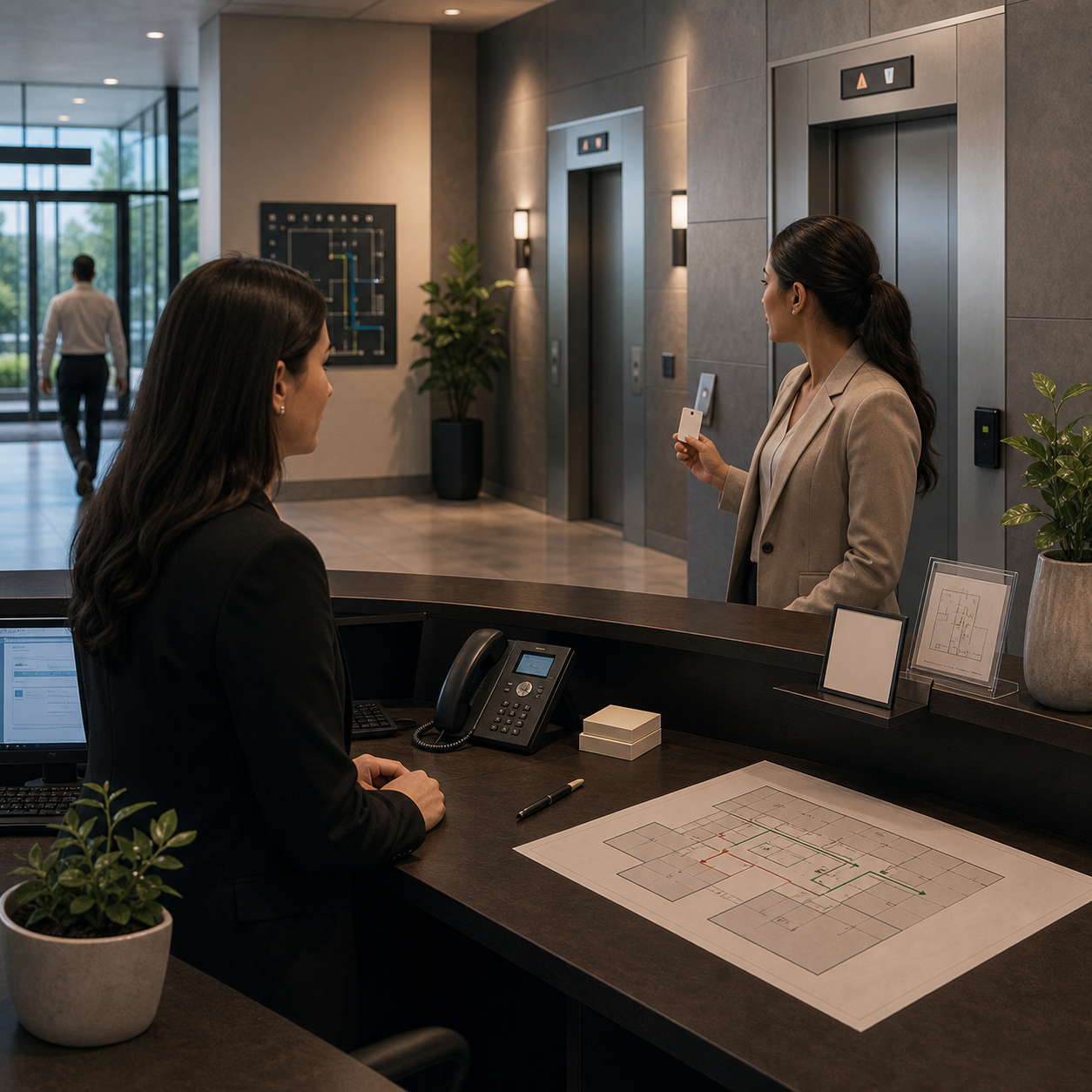
That is useful until paramedics are trying to reach an emergency.
The route guide should know:
| which entrance EMS should use | who can unlock the lobby |
| whether a badge is needed after reception | which elevator reaches the correct floor |
| whether stairwell doors lock behind the user | whether the conference room is easy to identify |
| whether the office has a second entrance that causes confusion | whether building security needs an immediate call |
A printed office choking emergency card should include the route, not only the street address.
If the route changes after a remodel, update the card.
A first-aid kit in a distant supply closet may satisfy someone's sense of organization. It may not help during lunch.
Walk from the places where employees actually eat:
| break room | kitchen counter | conference room |
| reception area | executive floor | warehouse lunch area |
| outdoor patio | satellite office | Then check: |
|
Readiness point |
Question to ask |
|---|---|
|
Phone access |
Can someone call 911 immediately? |
|
Address card |
Does it include suite and floor number? |
|
EMS route |
Can a coworker explain the entrance and elevator path quickly? |
|
Badge access |
Who opens locked doors? |
|
Floor space |
Can chairs and bags be moved quickly? |
|
First-aid setup |
Is it visible, complete, protected, and adult-accessible? |
|
Staff familiarity |
Has anyone reviewed the choking response recently? |
|
Low-occupancy days |
Does the plan still work when fewer employees are present? |
A well-organized office can still have a weak emergency path.
A choking emergency during a client meeting or team lunch has an extra layer of hesitation.
Employees may worry about embarrassment. Guests may not know the building. The person leading the meeting may freeze because the situation does not feel like part of their role.
The same response still applies.
Do not let professional politeness slow medical action.
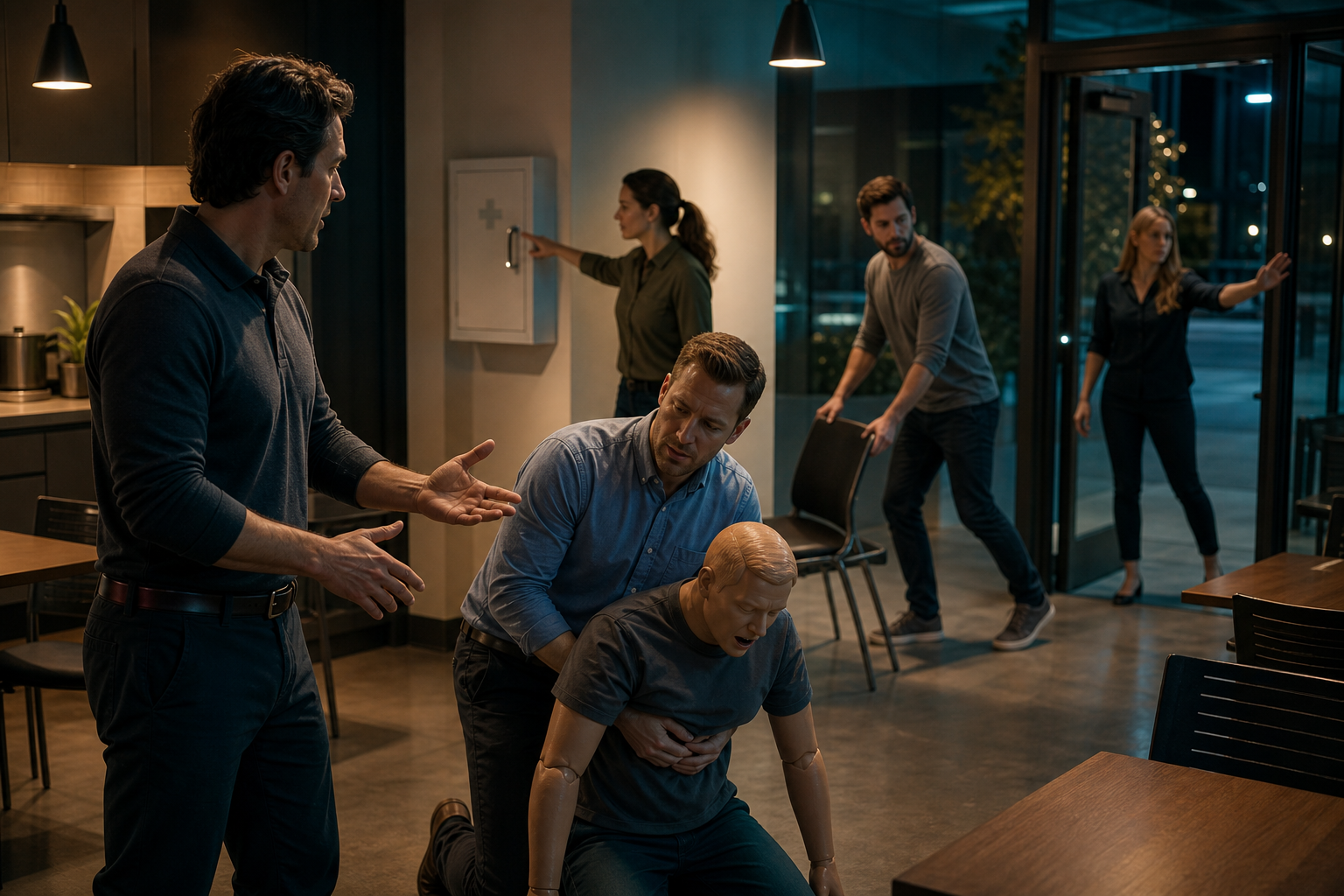
Clear the room enough for care. Assign the 911 caller. Send someone to meet EMS. Move laptops, cords, bags, and chairs out of the way.
A conference room full of senior staff can become just as disorganized as any crowded dining table.
A workplace choking plan is not a cabinet inventory.
Employees need to understand:
| Recognition | when forceful coughing is still useful | when airflow is failing |
| Emergency roles | who calls 911 | who meets EMS |
| Access and equipment | how to access locked areas | where the first-aid setup is stored |
| Escalation boundaries | when CPR begins | why second-line equipment cannot delay manual rescue |
A quick drill can reveal problems that a written policy misses.
During the drill, start from the actual break room. Time the walk to the lobby. Test the badge-controlled door. Check whether someone can state the full address without searching online.
Fix one delay before the next lunch break.
A close call should improve the office plan.
Ask:
| Was the person eating alone? | Did coworkers recognize severe choking quickly? | Did anyone hesitate to call 911? |
| Did the caller know the floor and suite number? | Did reception understand the emergency? | Did building security create delay? |
| Could EMS reach the room without waiting for a badge? | Was the first-aid setup close enough to retrieve? | Did the office have enough trained adults present? |
| Does the plan need to change for hybrid workdays? | ||
The useful review is factual, not blame-driven.
The goal is to find the weak link before the next emergency.
Workplace first-aid training, recognition of severe choking, calling 911, manual rescue, EMS access, and CPR when the person becomes unresponsive come first.
Manual rescue first. Backup second.
Some offices choose to add a suction anti-choking device as a second-line backup after unsuccessful standard choking rescue for complete airway obstruction.
For one fixed workplace station near a break room, kitchen, reception area, or staff dining space, the FITIGER EasyPumpVac Series may be the more practical option to review as part of a choking first aid kit or choking emergency kit. Its straightforward manual structure supports one clearly marked adult-accessible location.
For offices with several floors, field teams, company vehicles, or mobile event kits, the FITIGER FoldPumpVac Series may be the stronger option when a portable choking rescue device is easier to stage across locations.
A workplace product does not replace:
| back blows | abdominal thrusts |
| chest thrusts when indicated | CPR |
| calling 911 | EMS |
| employee first-aid training | building access planning |
A kit is useful only when the office response around it is already clear.
Before the next staff lunch, walk the route.
|
Check |
Confirm |
|---|---|
|
Break room |
Can staff clear enough space to provide care? |
|
Address card |
Does it include company name, address, suite, and floor? |
|
911 assignment |
Does the caller know what to say? |
|
Lobby and security |
Can EMS enter without waiting? |
|
Elevator route |
Does someone know the fastest path? |
|
Badge-controlled doors |
Can a route guide unlock them quickly? |
|
First-aid station |
Is it complete, visible, and adult-accessible? |
|
Low-occupancy day |
Would the plan still work with fewer people present? |
|
Multi-floor coverage |
Does each floor have a realistic response plan? |
The best office safety plan is not the one with the longest policy.
It is the one coworkers can use before panic takes over.
Check whether the person can still cough forcefully, speak, or breathe. If severe choking is present, direct one person to call 911 and begin standard manual rescue immediately.
Do not delay first aid with water when severe choking is present. If the coworker cannot cough effectively, cannot speak, or cannot breathe, call 911 and begin manual rescue.
For a responsive adult with severe choking, use repeated cycles of 5 back blows followed by 5 abdominal thrusts until the object clears or the adult becomes unresponsive.
Use 5 chest thrusts instead of abdominal thrusts for a person in the late stages of pregnancy.
Begin CPR according to training and follow dispatcher instructions.
EMS may reach the building quickly but still lose time at the lobby, elevator, security desk, or badge-controlled door. A complete location card reduces avoidable delay.
Every workplace should review its actual risks, training, access path, and local requirements. Some offices choose to stage a suction anti-choking device as a second-line backup after unsuccessful standard rescue for complete airway obstruction.
EasyPumpVac Series may suit a fixed break-room or reception-area station. FoldPumpVac Series may be more practical for multi-floor offices, company vehicles, field teams, or mobile event kits.
Before the next takeout order arrives
Walk from the break room to the lobby. Look at the elevator. Test the locked door. Check the address card. Decide who meets EMS.
The best time to discover a missing badge, an incomplete address, or a blocked hallway is before lunch.
Manual rescue first. Backup second.
American Heart Association, Adult Foreign-Body Airway Obstruction Algorithm (2025) - Supports severe FBAO signs, 5 back blows followed by 5 abdominal thrusts, 5 chest thrusts in late pregnancy or when the abdomen cannot be encircled, and CPR when the adult becomes unresponsive.
U.S. Food and Drug Administration, Update: FDA Encourages the Public to Follow Established Choking Rescue Protocols - Supports established protocols first and anti-choking devices only as a second option if standard protocols are unsuccessful.
American Red Cross, Adult and Child Choking - Supports recognition of severe choking and the need for prompt first aid.
This article is for educational and preparedness-planning purposes only. It does not replace medical advice, legal advice, workplace safety advice, certified first-aid or CPR training, calling 911, EMS, professional medical care, local emergency procedures, employer policies, or the current product-specific instructions for use.


