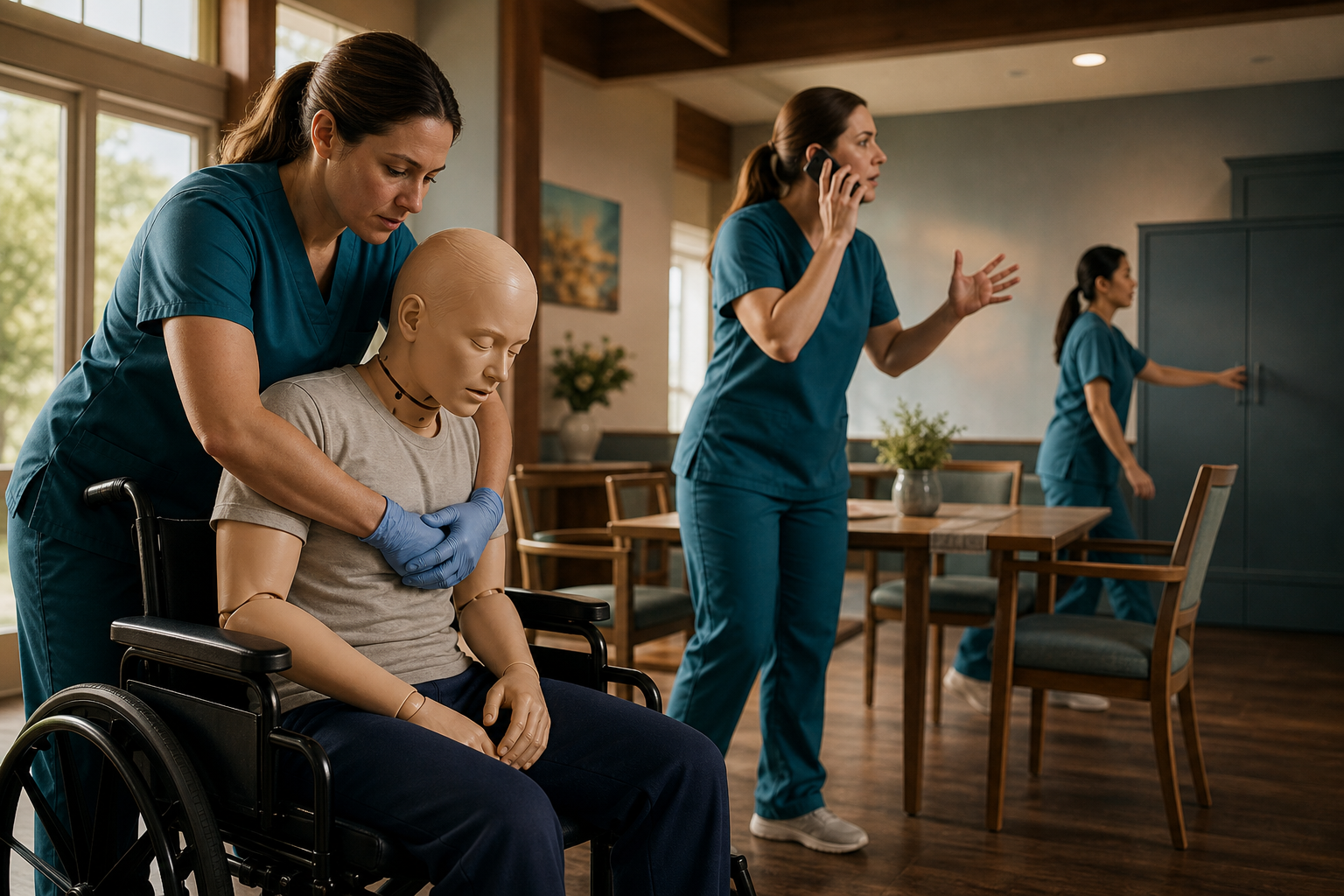
Suction anti-choking devices belong in elder-care rescue plans as second-line backup, not as the first move. FDA 21 CFR 874.5400 and product code QXN define this category after unsuccessful basic life support choking protocol. First-line rescue, 911 activation, CPR readiness, and clear device placement still come first.

Before choosing equipment, review Fitiger's anti-choking device buyer evidence checklist for FDA wording, testing, seller traceability, and kit-selection questions.
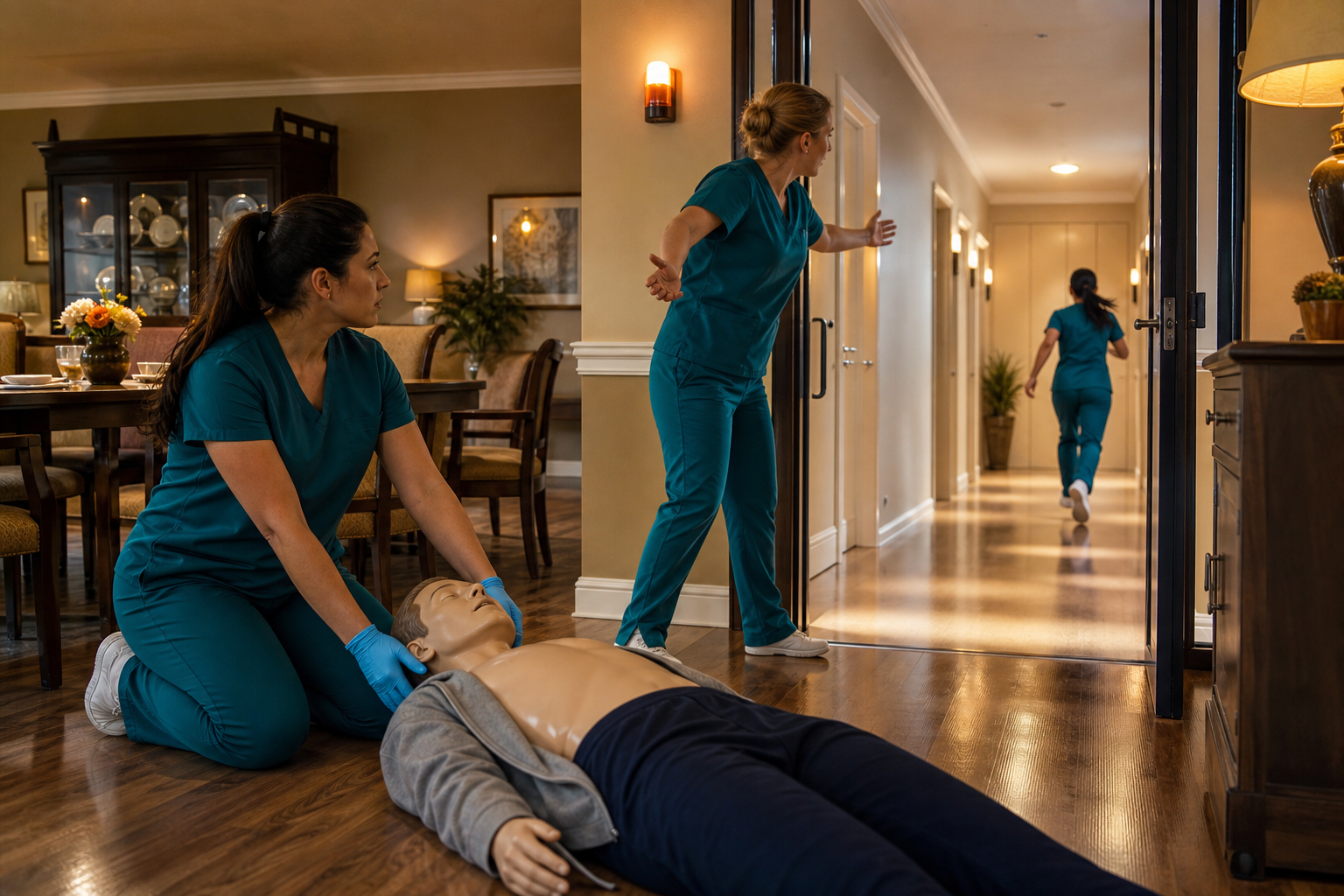
A care-home rescue plan becomes unsafe when staff reach for equipment before the room understands the sequence.
Imagine a resident choking during lunch in an assisted-living dining room. One caregiver sees the resident's face change. Another remembers that a device is mounted near the nurse station. Someone runs for it, but nobody has started first-line choking rescue. The resident is still seated, still obstructed, and the oxygen window is already shrinking.
That is not readiness. That is equipment interrupting the rescue chain.
A stronger elder-care choking rescue plan starts with order: recognize severe choking, call for help, begin first-line manual rescue, activate 911 or emergency medical services, and use a suction anti-choking device only if standard BLS choking protocol has been attempted without success and the device is appropriate, available, and permitted.
A device can strengthen the plan. It can also weaken the plan if staff treat it as a shortcut.
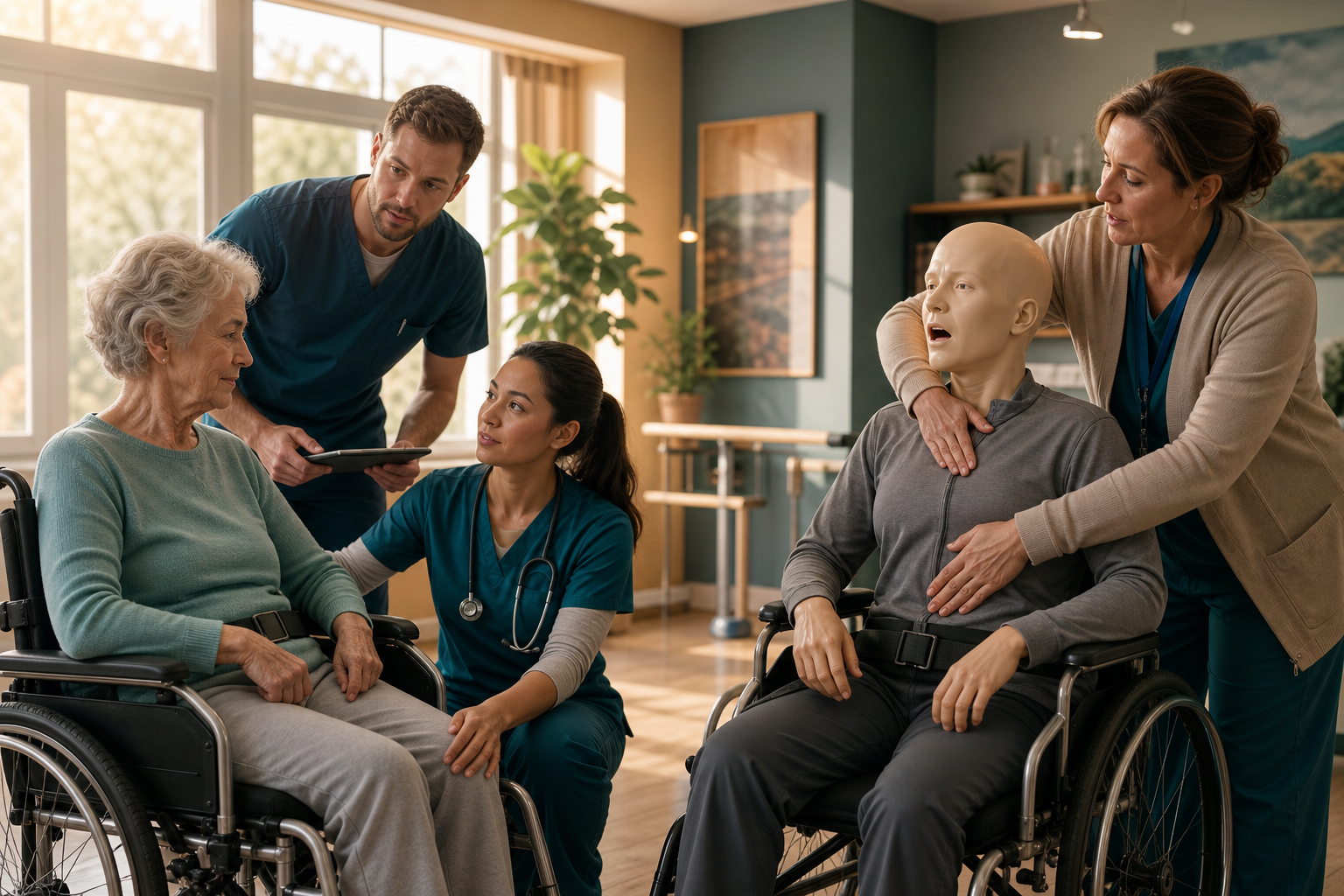
FDA's March 4, 2026 De Novo order established 21 CFR 874.5400 and product code QXN for a suction anti-choking device as a second-line treatment. The phrase second-line treatment is the part care facilities should keep visible in training, procurement, and incident review.
The device category is intended for complete airway obstruction after unsuccessful use of a basic life support choking protocol. It is not the opening response. It is not a replacement for recognition, back blows, abdominal thrusts, chest thrusts when appropriate, CPR, EMS, or staff training.
For nursing homes and care facilities, the practical checklist is straightforward:
| verify whether the product sits in the QXN / 21 CFR 874.5400 pathway | confirm that staff understand its second-line role |
| train the first-line choking sequence before device use | stage the device where meal-related choking risk occurs |
| document how the device enters the plan after unsuccessful BLS | avoid look-alike products that do not have the same authorization basis |
Procurement should not stop at the phrase anti choking device. It should verify intended use, regulatory pathway, age range, labeling, instructions, human-factors limitations, and the role of the device inside the facility's emergency sequence.
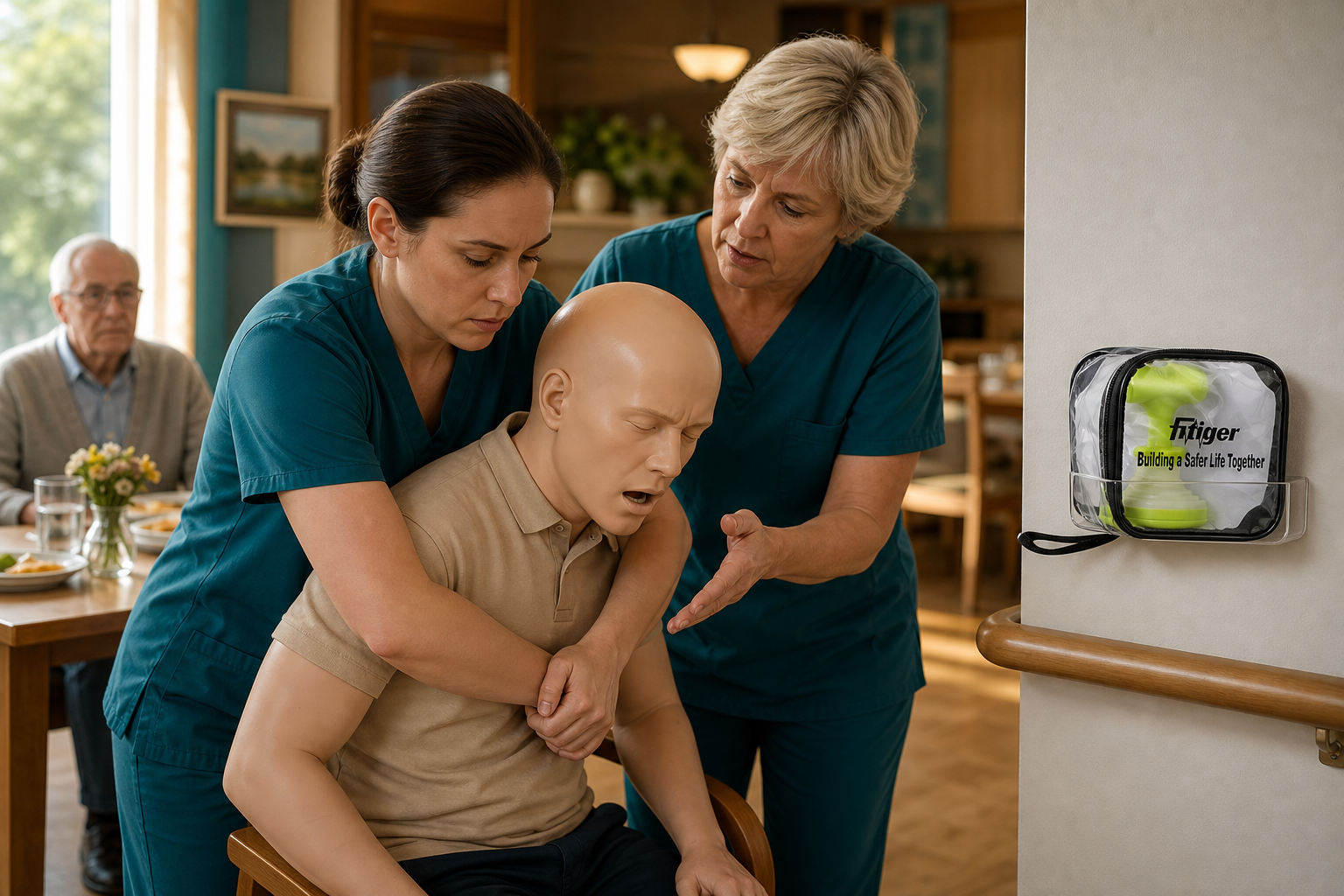
Some buyers treat manual choking rescue and suction anti-choking devices as competing choices. That frame creates confusion.
The American Heart Association's 2025 adult foreign-body airway obstruction guidance supports cycles of 5 back blows followed by 5 abdominal thrusts for responsive adults and children with severe choking. Infants follow a different sequence: 5 back blows and 5 chest thrusts. If the person becomes unresponsive, the response transitions to CPR.
FDA's 2026 QXN device category does not erase that first-line structure. It creates a regulated second-line category behind it.
A care-home plan should not ask, "Do we use manual rescue or a device?"It should ask, "How do we make sure first-line rescue starts immediately, EMS is activated, and a second-line choking rescue device can enter quickly if the first-line attempt fails?"
That is the sequence a real dining room can use.

A standing adult in a first-aid poster and a frail resident in a dining chair are not the same rescue condition.
Elder-care choking often happens with residents who have weak cough force, low lung reserve, dysphagia, dementia, poor trunk control, stroke history, Parkinson's disease, wheelchair dependence, osteoporosis, fatigue, or limited mobility. Standard protocols remain important, but the body and room can make execution harder.
A caregiver may not get clean access behind the resident. A wheelchair backrest may block positioning. The resident may be too fragile for forceful handling. A bedbound resident may be difficult to reposition. A small staff member may struggle to generate effective force on a larger adult. A high-resistance food bolus may not move quickly.
These are the settings where second-line airway response in elder care becomes a serious planning question.
Not device-first thinking. Not replacement logic. Redundancy after the first line fails or becomes physically constrained.
A suction anti-choking device should be written into the rescue plan at the moment where the system needs backup.
That moment comes after standard first-line choking rescue has been attempted without success, or when the resident's physical condition creates a clear constraint that makes clean manual execution delayed or ineffective while emergency response is already underway.
This distinction matters because retrieval, mask selection, packaging, and assembly all consume time. If staff reach for the device too early, the device may delay first-line action. If the device is staged too far away, it may arrive too late. If staff do not know the sequence, it can create confusion exactly when the room needs clarity.
Second-line tools are strongest when the plan already knows where the first line can fail.
Airway rescue is not only a protocol issue. It is also a force and material issue.
In simulator work comparing starch-based and gum-based boluses with equal apparent viscosity, clearing the starch-based material to less than 0.5 mm residual coating required about 5.4 kPa of pressure, compared with about 1.7 kPa for the gum-based sample. That is roughly a 3.2-fold pressure difference.
In a frail resident, this matters.
A high-resistance bolus, weak cough, poor tongue force, reduced lung reserve, panic, and difficult chair access all compress the same rescue window. The first-line maneuver may be correct and still fail to move the obstruction quickly enough.
This is where second-line airway redundancy can have a legitimate role: not because manual rescue is unimportant, but because some real obstructions and real bodies create a failure point the plan has to anticipate.
A second-line tool does not automatically make the system safer.
FDA's De Novo materials identify risks such as delayed initiation of BLS choking protocol, use error, inadequate suction, and device failure. Those are not abstract warnings. They are the exact failure modes care facilities need to control.
A poor device plan can add:
| delayed first-line rescue | confusion over who retrieves the device | long travel distance from dining room to storage |
| packaging delay | wrong mask selection | unclear instructions under stress |
| use before EMS activation | repeated device attempts after failure | missing event documentation |
In a complete airway obstruction, every delay sits inside the oxygen window. The device should close a failure gap, not open a new one.
A choking rescue device stored in a locked office is not meaningful second-line readiness for a dining room.
Placement is not an inventory preference. It is part of rescue physics.
If staff must leave the resident, cross a corridor, find a key, open a cabinet, choose a mask, and run back, the retrieval path may consume the exact seconds the system is trying to protect. A device on paper may fail in the room because the room is where time is lost.
A serious elder-care choking rescue plan should map device placement around actual risk areas:
| main dining room | memory-care dining area |
| assisted-living meal space | tray service areas |
| staff-supervised snack areas | high-risk resident wings |
| overnight eating or medication areas if relevant | The question is not, "Where can we store this neatly?" |
The question is, "娣恆n the second-line device reach the resident before the rescue window collapses?"
A defensible plan is not device-first and not device-absent.
It starts with mealtime prevention: dysphagia assessment, IDDSI accuracy, liquid verification, posture, supervision, and feeding pace. It trains staff to recognize severe choking early. It keeps first-line BLS choking response at the front. It activates 911 immediately. It defines where second-line QXN suction enters after unsuccessful first-line action.
A good plan assigns roles before the event:
Role | Action During Choking Event |
|---|---|
First responder | Stays with resident and begins first-line choking response |
Caller | Activates 911 or local emergency services |
Backup retriever | Gets second-line airway device if first-line action fails and device use is indicated |
Scene support | Clears space, moves table or chair if safe, guides EMS |
Documentation lead | Captures timeline, response steps, device use, and post-event review |
This does not need to be complicated. It needs to be practiced with the people who are actually on shift.
The device market contains confusing language. Some products may look similar, use similar claims, or appear in search results beside authorized devices.
Procurement teams should not treat look-alike products as interchangeable.
A serious review should ask:
| Is the device FDA-authorized for the U.S. market? | Is the product code QXN? | Does the device fall under 21 CFR 874.5400? |
| Does the labeling state second-line use after unsuccessful BLS choking protocol? | What ages and body sizes are included? | What training does the manufacturer require? |
| What human-factors risks are addressed? | What adverse events or limitations are disclosed? | How is the device cleaned, stored, inspected, and replaced? |
| How does the device fit facility policy? | ||
A purchase file that cannot answer those questions is not ready for an institutional airway-safety plan.
Buyer concern: will staff misuse the device?
Care leaders may worry that placing a suction anti-choking device in the dining room will encourage staff to skip manual rescue. That concern is valid if the facility buys the device without sequence training.
The answer is not to ignore second-line tools. The answer is to make the sequence impossible to misunderstand.
Training should repeat:
| first-line rescue comes first | 911 activation happens early |
| the device is second-line | the device enters after unsuccessful BLS choking response |
| CPR begins if the resident becomes unresponsive | repeated blind device attempts are not a plan |
| all actions must be documented | |
The device should be presented as controlled redundancy, not a dramatic rescue shortcut. Buyer concern: what if the device does not work? A facility should plan for that too.
If a suction anti-choking device fails to remove the obstruction, the team must not freeze or repeat attempts indefinitely. The event is still moving. Staff should continue the appropriate emergency sequence, transition to CPR if the resident becomes unresponsive, and maintain EMS activation.
Device failure should be treated as an operational diagnostic:
| Was the seal poor? | Was the wrong mask selected? |
| Was the obstruction too resistant? | Was the device assembled correctly? |
| Was the resident's position limiting effectiveness? | Did the device arrive too late? |
| Did staff delay first-line rescue? | |
That review belongs in QAPI and post-event documentation. A second-line device only strengthens the system when the system learns from its failure modes.
If a device is part of the facility plan, its use should not disappear into a vague incident note.
Digital Social Care Records or incident logs should capture:
| time of first severe choking sign | time first-line response began | time 911 was called |
| time device was retrieved | time device was ready | whether BLS choking protocol had been attempted first |
| number of device attempts | outcome | transition to CPR if needed |
| EMS handoff | post-event review findings | |
This matters for clinical learning, legal defensibility, and quality improvement. Without timing, leadership cannot know whether the device shortened the failure zone or added delay.
A suction anti-choking device does not belong in every respiratory emergency.
It is not for allergic swelling. It is not for asthma. It is not for anaphylaxis. It is not a general breathing aid. It is not a substitute for epinephrine in allergic emergencies. It is not a replacement for CPR. It is not a treatment for aspiration pneumonia. It is not a shortcut around dysphagia management.
The device category is for complete airway obstruction after unsuccessful BLS choking protocol.
That boundary should be repeated in training because real emergencies create panic. A resident who cannot breathe may be experiencing choking, anaphylaxis, cardiac arrest, stroke, aspiration, or another medical crisis. Staff need recognition training, not just equipment access.
Before purchasing or renewing a suction anti-choking device program, an elder-care facility should audit the rescue chain.
Ask:
| Where do choking events most likely occur? | Which residents have dysphagia, weak cough, or positioning limits? | Who is closest during meals? |
| Can first-line rescue begin immediately? | Who calls 911? | Where would the second-line device be staged? |
| How long does retrieval take? | Can staff open and prepare it under stress? | Do staff know when not to use it? |
| Is the device FDA-authorized under QXN / 21 CFR 874.5400? | Does the incident record capture timing and sequence? | |
If the plan cannot answer those questions, the facility is not ready to rely on the device as a safety layer.
A suction anti-choking device can belong in an elder-care rescue plan. It belongs there as second-line redundancy, not as a substitute for prevention, recognition, first-line BLS, 911, CPR, training, or documentation.
The strongest plan starts at the tray, moves through bedside verification and first-line response, and keeps the device ready for the moment after standard measures fail. Placement, training, retrieval time, and sequence control decide whether the device strengthens the system or steals time from it.
Buy the sequence before you buy the device.
For related planning context, review the anti-choking device buyer evidence checklist.
A suction anti-choking device should be used only within its labeled role. Under FDA 21 CFR 874.5400 and product code QXN, this category is second-line treatment after unsuccessful basic life support choking protocol for complete airway obstruction.
No. It does not replace first-line choking rescue. Staff should follow established choking rescue protocols first, activate emergency services, and use any suction device only as second-line backup after standard measures fail.
QXN is the FDA product code associated with suction anti-choking devices under 21 CFR 874.5400. For institutional buyers, it helps verify whether a product belongs in the authorized second-line category.
If a facility uses one, it should be staged near the areas where choking risk occurs, especially dining rooms and meal-service areas. A device stored far away can lose value because retrieval time consumes the oxygen window.
No. These devices are not for allergic airway swelling, asthma, or general breathing difficulty. Anaphylaxis requires emergency medical response and epinephrine according to the person's action plan.
Staff should continue the emergency response sequence, maintain EMS activation, and transition to CPR if the resident becomes unresponsive. They should not repeat blind device attempts indefinitely.
Procurement should verify FDA authorization, QXN product code, 21 CFR 874.5400 status, age range, labeling, training requirements, human-factors controls, storage needs, and how the device fits facility policy.
It can reduce part of the risk if it is staged close to the event, used after unsuccessful first-line rescue, and integrated into training and documentation. Poor placement or device-first behavior can increase delay.
No. Second-line means it enters after the first-line response. In a failed first-line event, a second-line device may become important, but only if the facility has trained and staged it correctly.
FDA De Novo Order DEN250012 - Supports 21 CFR 874.5400, product code QXN, and the definition of a suction anti-choking device as a second-line treatment after unsuccessful basic life support choking protocol.
FDA Safety Communication, updated March 4, 2026 - Supports the boundary that established choking rescue protocols should come first and anti-choking devices should not be used before standard measures because they may delay life-saving action.
American Heart Association 2025 Choking Guidance Update - Supports the first-line choking response baseline and the distinction between manual rescue and device evidence.
A Mechanical Simulator of Tongue-Palate Compression to Investigate the Oral Flow of Non-Newtonian Fluids - Supports the pressure example of approximately 5.4 kPa for a starch-based bolus versus 1.7 kPa for a gum-based sample during bolus clearance.
MedlinePlus - Choking First Aid - Supports the emergency nature of choking and the importance of immediate first-aid response.
This article is for educational and operational planning purposes only. It does not replace accredited first-aid training, medical advice, emergency medical services, facility policy, legal or regulatory review, or product-specific instructions for use. In a choking emergency, follow current established rescue protocols, call 911 or your local emergency number, and use any device only within its labeled role and instructions.


