|
TL;DR For meal-service teams, Fitiger's restaurant choking readiness plan gives practical guidance for staff roles, kit placement, and service-area response. |
New York pulled hotel safety out of informal practice and placed it inside a licensing system. A hotel operator now needs a DCWP license for each premises it operates. The license runs for two years, costs $350 for the full term, and expires on September 30 in even-numbered years. Operating without a license carries a civil penalty of $100 per day. Those numbers turn compliance into a live operating condition, not a background legal formality.
Documentation is a liability variable. NYC's hotel rules require operators to maintain records in electronic format for at least three years. The required set includes agreements showing day-to-day operational control, records demonstrating compliance with service requirements, records supporting direct employment, proof of human trafficking training completion, and records related to panic-button purchase, upkeep, and distribution. If the operator fails to maintain, retain, or produce a required record relevant to a material fact alleged by the Department, the rules create a reasonable inference that the fact is true.
That changes how a hotel incident is judged. The review is no longer limited to witness accounts after the event. It runs through a proof chain: who held the license, who controlled day-to-day operations, who was assigned to the shift, who had completed the required training, who was issued a signaling device, and whether those records can be produced immediately in a clean electronic trail.
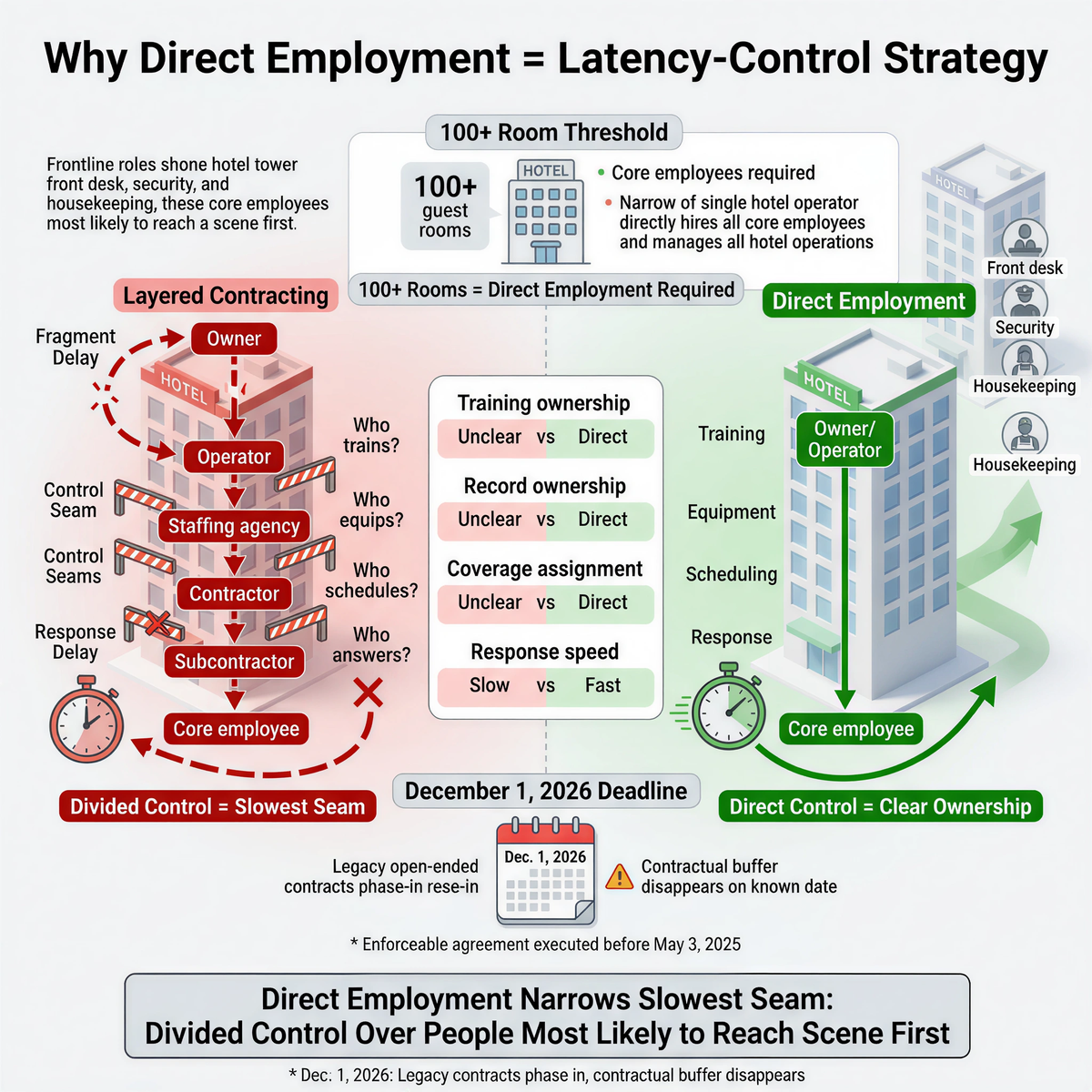
Direct employment functions as a latency-control strategy. For hotels with 100 or more guest rooms, core employees may not be supplied through staffing agencies, contractors, or subcontractors, subject to the statute's narrow exception for a single hotel operator that directly hires all core employees and manages all hotel operations involving those employees on the owner's behalf.
The direct-employment rule narrows one of the slowest seams in hotel response: divided control over the people most likely to reach the scene first. Training ownership is clearer. Record ownership is clearer. Coverage assignment is clearer. A hotel that still depends on layered contracting for its core frontline roles creates avoidable confusion around who trains, who equips, who schedules, and who answers when something goes wrong.
There is also a date that operators cannot ignore. Where an enforceable agreement executed before May 3, 2025 does not terminate on a date certain, the direct-contracting provision takes effect on December 1, 2026. That deadline matters because the contractual buffer disappears on a known calendar date.
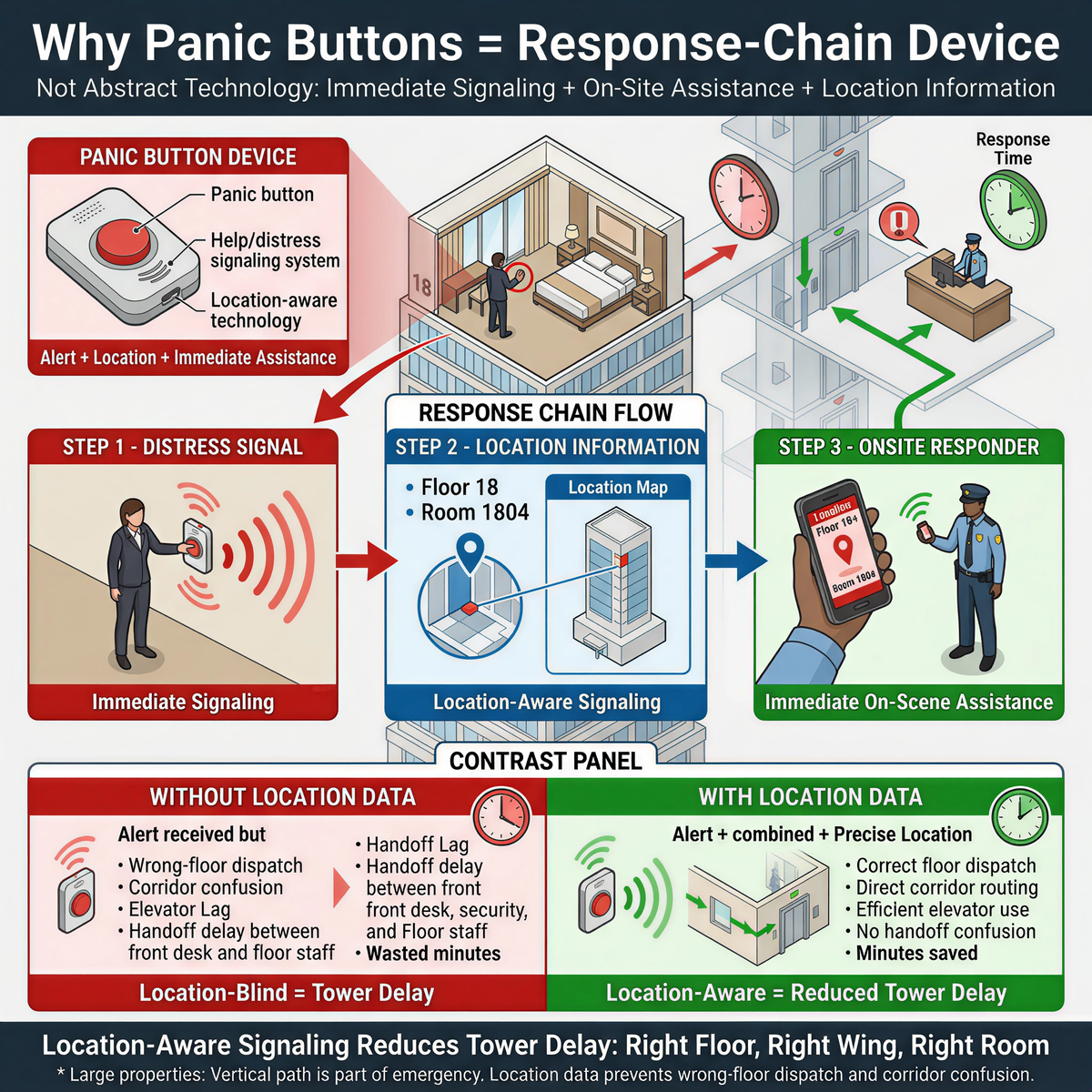
A panic button in the NYC framework is a response-chain device. The local law defines it as a help or distress signaling system that alerts a security guard or other appropriate on-site person available to provide immediate on-scene assistance and provides that person with the worker's location. The legal requirement is not abstract technology. It is immediate signaling tied to on-site assistance and location information.
In our engineering reviews, location-aware signaling reduces tower delay. A distress alert without usable location data wastes the same minutes operators later have to explain: wrong-floor dispatch, corridor confusion, elevator lag, and handoff delay between the front desk, security, and floor staff. The device does not need to prove consumer-grade GPS precision in the statute. It does need to support immediate, scene-aware response inside a multi-floor building.
For hotel safety planning, this matters most in large properties where the vertical path is part of the emergency. The building may have the right staff on paper and still lose time if the signal reaches the wrong desk, the wrong wing, or the wrong floor.
Because the city is building an auditable responder environment. The application supplement requires human trafficking recognition training for core employees in accordance with New York General Business Law section 205, and new core employees must receive that training within 60 days of employment.
That requirement sits beside licensing, direct employment, panic-button issuance, front-desk coverage, and security coverage. The city is not treating these as isolated obligations. It is building a hotel model where operator control, employee status, employee training, signaling capacity, and electronic record retention can all be inspected together.
A hotel can no longer rely on a general claim that staff 'know what to do.' The operator has to show which covered employees were trained, when they were trained, and whether the supporting records still exist.
The enforcement structure is already concrete. Operating a hotel without a license carries a civil penalty of $100 per day. Repeated violations of the core licensing conditions under the hotel service requirements, direct-employment rule, panic-button rule, retaliation rule, and the records rule escalate from $500 for a first violation up to $5,000 for the fourth and subsequent violations within the applicable schedule. The rules also state that each failure to provide a panic button to an employee and each instance of non-direct employment can constitute a separate and distinct offense.
This is why missing records matter to the balance sheet. A broken training file is not only an internal admin problem. A missing panic-button issuance log is not only a management annoyance. Under NYC's framework, those gaps support enforcement exposure and weaken the operator's ability to rebut facts the Department alleges.
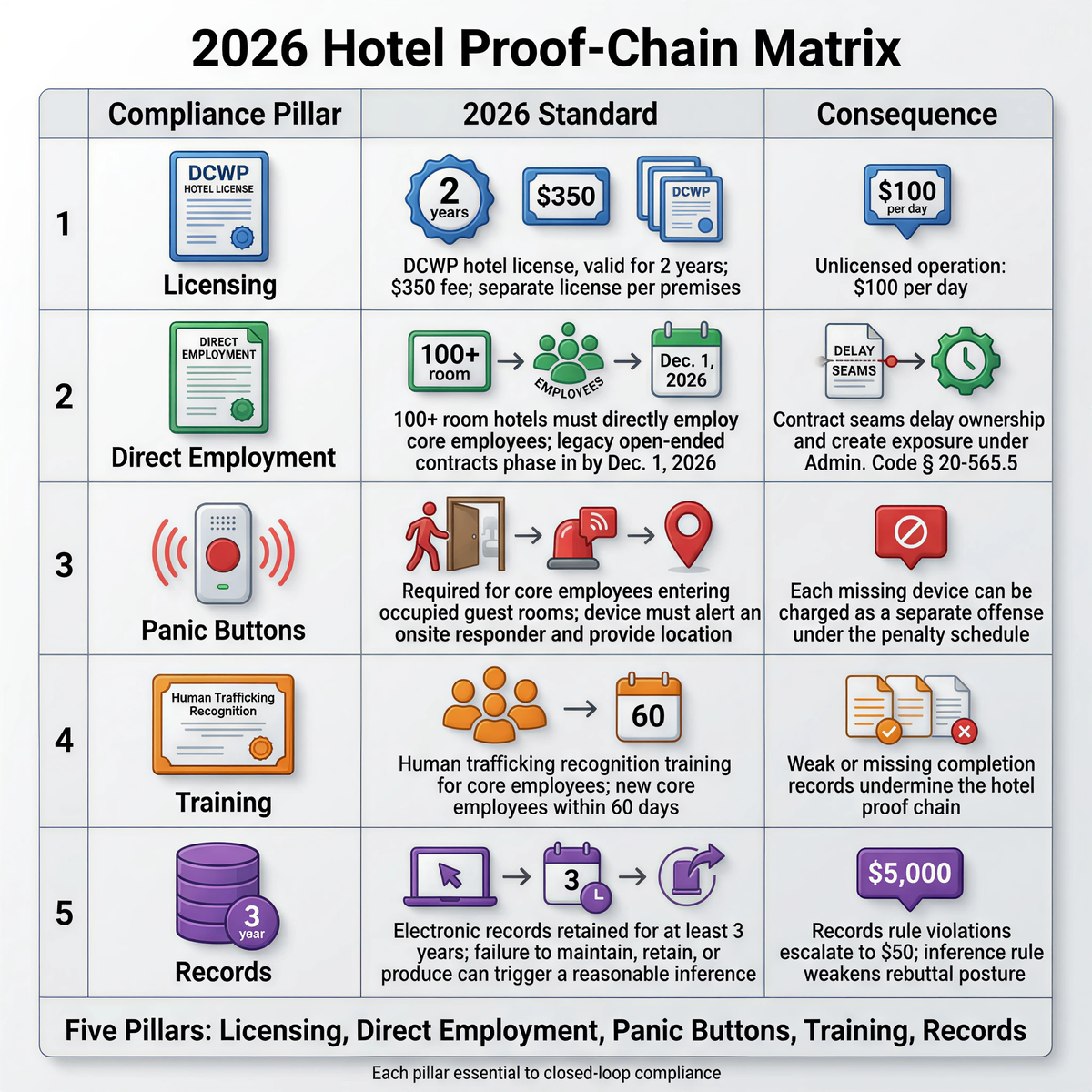
|
Compliance pillar |
2026 standard |
Consequence |
|
Licensing |
DCWP hotel license, valid for 2 years; $350 fee; separate license per premises |
Unlicensed operation: $100 per day |
|
Direct employment |
100+ room hotels must directly employ core employees; legacy open-ended contracts phase in by Dec. 1, 2026 |
Contract seams delay ownership and create exposure under Admin. Code § 20-565.5 |
|
Panic buttons |
Required for core employees entering occupied guest rooms; device must alert an onsite responder and provide location |
Each missing device can be charged as a separate offense under the penalty schedule |
|
Training |
Human trafficking recognition training for core employees; new core employees within 60 days |
Weak or missing completion records undermine the hotel proof chain |
|
Records |
Electronic records retained for at least 3 years; failure to maintain, retain, or produce can trigger a reasonable inference |
Records rule violations escalate to $5,000 under the schedule; inference rule weakens rebuttal posture |
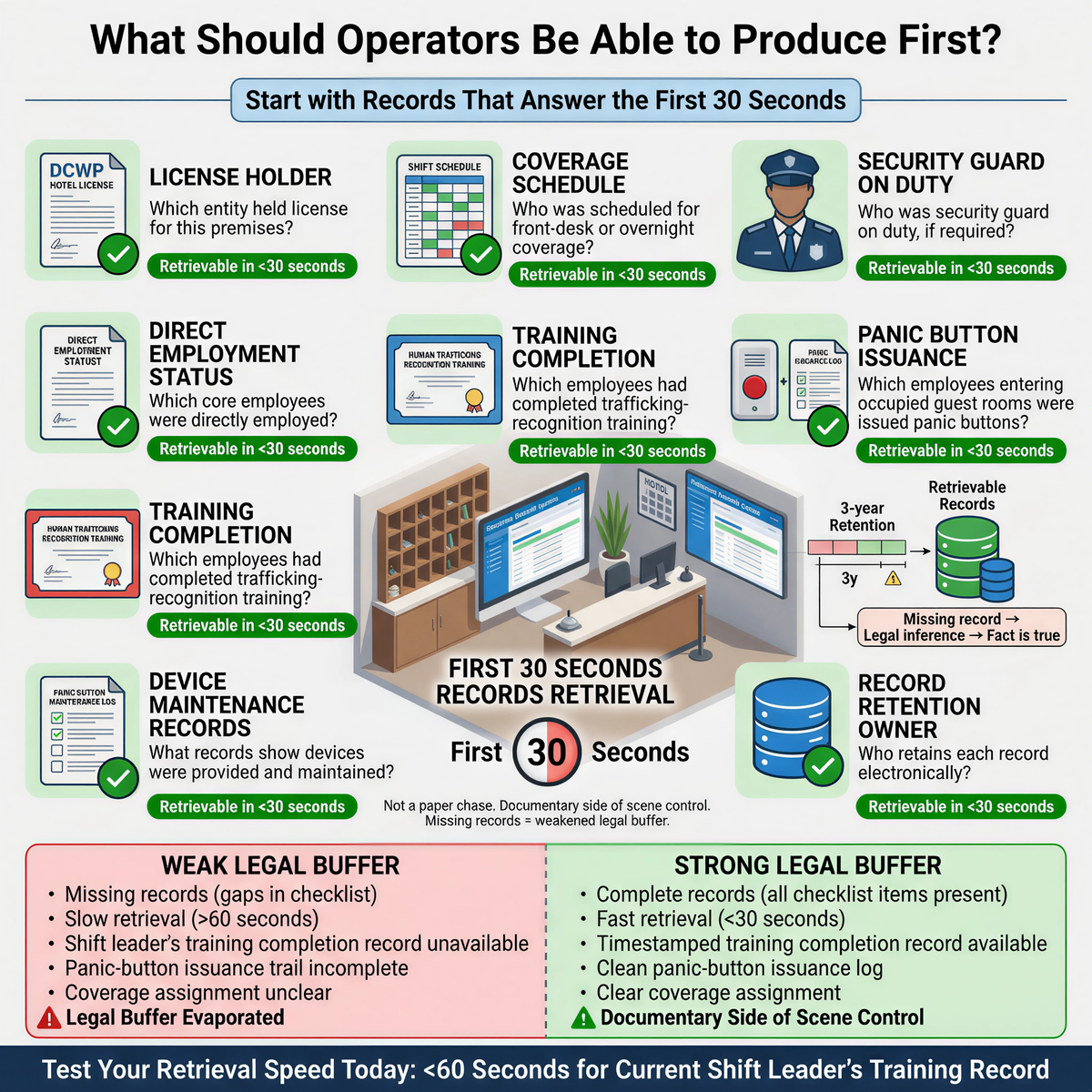
Start with the records that answer the first 30 seconds. Which entity held the license for this premises. Who was scheduled for front-desk or overnight coverage. Who was the security guard on duty, if required. Which core employees were directly employed. Which employees had completed trafficking-recognition training. Which employees entering occupied guest rooms were issued panic buttons. What records show that those devices were provided and maintained. Who retains each record electronically.
This is not a paper chase. It is the documentary side of scene control. If the shift leader's training completion record, panic-button issuance trail, and coverage assignment cannot be pulled together quickly, the hotel is already operating with a weakened legal buffer.
Download the Hospitality Readiness Toolkit
Download the Hospitality Facilities Choking Emergency Readiness Toolkit for your hotel, restaurant, banquet hall, or guest-service team. The toolkit includes response maps, staff role cards, buffet risk-audit checklists, and incident documentation forms to help your team plan before an emergency happens.
What is the hotel proof chain in 2026?
It is the closed loop created by licensing, direct-employment records, panic-button issuance, required training, and retrievable electronic records.
How long must hotel operators keep records?
NYC hotel rules require specified records to be maintained in electronic format for at least three years and produced electronically to DCWP upon request.
What is the penalty for operating without a hotel license in NYC?
Operating a hotel without a license carries a civil penalty of $100 per day under the hotel licensing penalty schedule.
Do panic buttons have to transmit GPS coordinates?
The statute does not use the phrase GPS precision. It requires a panic button to alert an appropriate onsite responder available to provide immediate assistance and to provide that responder with the worker's location.
Why does direct employment matter to emergency response?
Direct employment reduces contractual seams. It makes scheduling, training, issuance logs, and response ownership easier to prove and easier to control during an event.
Treat proof as part of the safety system. A hotel with coverage but no usable records is weaker than it looks. A hotel with panic buttons but no clean issuance log is weaker than it looks. A hotel with training but no retrievable completion record is weaker than it looks.
Test your retrieval speed today. If you cannot produce a timestamped training completion record for the current shift leader in under 60 seconds, your legal buffer has already evaporated.|
Source name |
What it supports |
Full URL |
|
NYC311 Hotel License |
Supports the two-year license term, the $350 fee, the September 30 even-year expiration date, and the requirement for a separate license per premises. |
https://portal.311.nyc.gov/article/?kanumber=KA-03671 |
|
NYC Hotel Licensing Law FAQ |
Supports front-desk coverage, overnight security substitution, direct-employment timing, human trafficking training within 60 days, and the required records list. |
https://www.nyc.gov/assets/dca/downloads/pdf/businesses/Hotel-Licensing-Law-FAQ.pdf |
|
NYC Hotel License Application Supplement |
Supports the self-certification requirements for direct employment, panic buttons, and trafficking training for core employees. |
https://www.nyc.gov/assets/dca/downloads/pdf/businesses/Hotel-License-Application-Supplement.pdf |
|
NYC Administrative Code § 20-565.1 |
Supports the rule that operating without a license is unlawful and that the hotel license fee is $350 for a two-year term. |
https://codelibrary.amlegal.com/codes/newyorkcity/latest/NYCadmin/0-0-0-229198 |
|
NYC Administrative Code § 20-565 Definitions |
Supports the legal definition of a panic button as a distress signaling system that alerts an appropriate on-site responder and provides the worker's location. |
https://codelibrary.amlegal.com/codes/newyorkcity/latest/NYCadmin/0-0-0-229184 |
|
6 RCNY § 2-482 Records |
Supports the three-year electronic record-retention requirement and the inference rule when required records are not maintained, retained, or produced. |
https://codelibrary.amlegal.com/codes/newyorkcity/latest/NYCrules/0-0-0-150557 |
|
6 RCNY § 6-88 Hotel Licensing Penalty Schedule |
Supports the $100 per day unlicensed-operation penalty and the escalating $500 to $5,000 penalties for service, direct-employment, panic-button, retaliation, and records violations. |
https://codelibrary.amlegal.com/codes/newyorkcity/latest/NYCrules/0-0-0-144630 |
|
NYC Rules adopted Hotel Licensing page |
Supports the adopted-rule effective date and the existence of the implementing rule package for Local Law 104 of 2024. |
https://rules.cityofnewyork.us/rule/hotel-licensing/ |
This article is for preparedness, operations, and compliance education. It does not provide legal advice, medical advice, or a guarantee of regulatory outcome.
Emergency response must follow current local law, hotel policy, and recognized first-response protocols. Any portable anti choking device and anti-choking suction device discussed in related Fitiger content remains a preparedness and second-line option after unsuccessful basic life support choking protocol use; it is not a replacement for first-line response, formal training, or EMS.


