
Kitchen safety for seniors living alone is not just fall prevention. Choking risk rises when swallowing changes, dentures fit poorly, food is dry or tough, medication causes dry mouth, or help is far away. A safer home plan combines food texture changes, slower meals, phone access, first-line choking rescue knowledge, and second-line backup only when standard steps fail.
For a household checklist, see Fitiger's child and home choking safety readiness plan.
Most families know to check loose rugs, shower bars, stove safety, and medication storage when an older parent lives alone. Choking usually gets less attention. It feels too specific, too unlikely, or too uncomfortable to bring up at the dinner table.
Then something small happens.
A father coughs hard after eating steak. A mother starts avoiding meat because it "gets stuck." A grandparent needs more water to swallow pills. Someone clears their throat through half the meal and waves it off. A caregiver notices untouched vegetables because raw carrots are too hard now. The refrigerator is full, the house is tidy, and the kitchen still has a risk nobody has mapped.
Kitchen safety for seniors living alone has to include the meal itself. The person may be sitting alone, eating at night, with a phone in another room. If a choking emergency starts, there may be no one across the table to recognize silence, call 911, or begin first-line choking rescue. That delay changes everything.
This is why searches like "EasyPumpVac home safety readiness">senior choking prevention at home," "older adults eating alone safety," "choking risk for elderly," and "choking rescue device for elderly" are all connected. People are not only asking what product to buy. They are asking how to reduce the time between trouble and help.
A good answer begins before any device enters the kitchen.
Older adults do not suddenly become unsafe eaters. Risk builds slowly through ordinary changes.
Chewing may become less effective because of missing teeth, gum pain, dental work, or dentures that no longer fit well. Saliva may decrease because of medication or dehydration, making dry bread, crackers, rice, meat, or pills harder to manage. Swallowing coordination can change after stroke, Parkinson's disease, dementia, frailty, or other neurological conditions. Some people develop dysphagia, which means difficulty swallowing.
The problem is that many of these changes are easy to normalize.
A person may say:
| "I just need more water." | "Meat is too much work now." |
| "I cough a little, but it goes away." | "I eat softer things because I like them better." |
| "I do fine as long as I eat slowly." | |
Those comments may be harmless. They may also be early signs that the home meal routine needs adjusting.
Choking prevention for seniors is not about taking independence away. It is about protecting independence by making meals safer. A small texture change today may prevent an emergency later. A phone moved from the counter to the table may matter more than a new gadget in the closet.
MedlinePlus lists aspiration pneumonia symptoms such as cough, foul or discolored sputum, wheezing, shortness of breath, fatigue, fever, and confusion; that pattern matters because swallowing difficulty and aspiration risk can be subtle in older adults. Families should not treat repeated coughing during meals as "just aging." It deserves attention. (MedlinePlus)
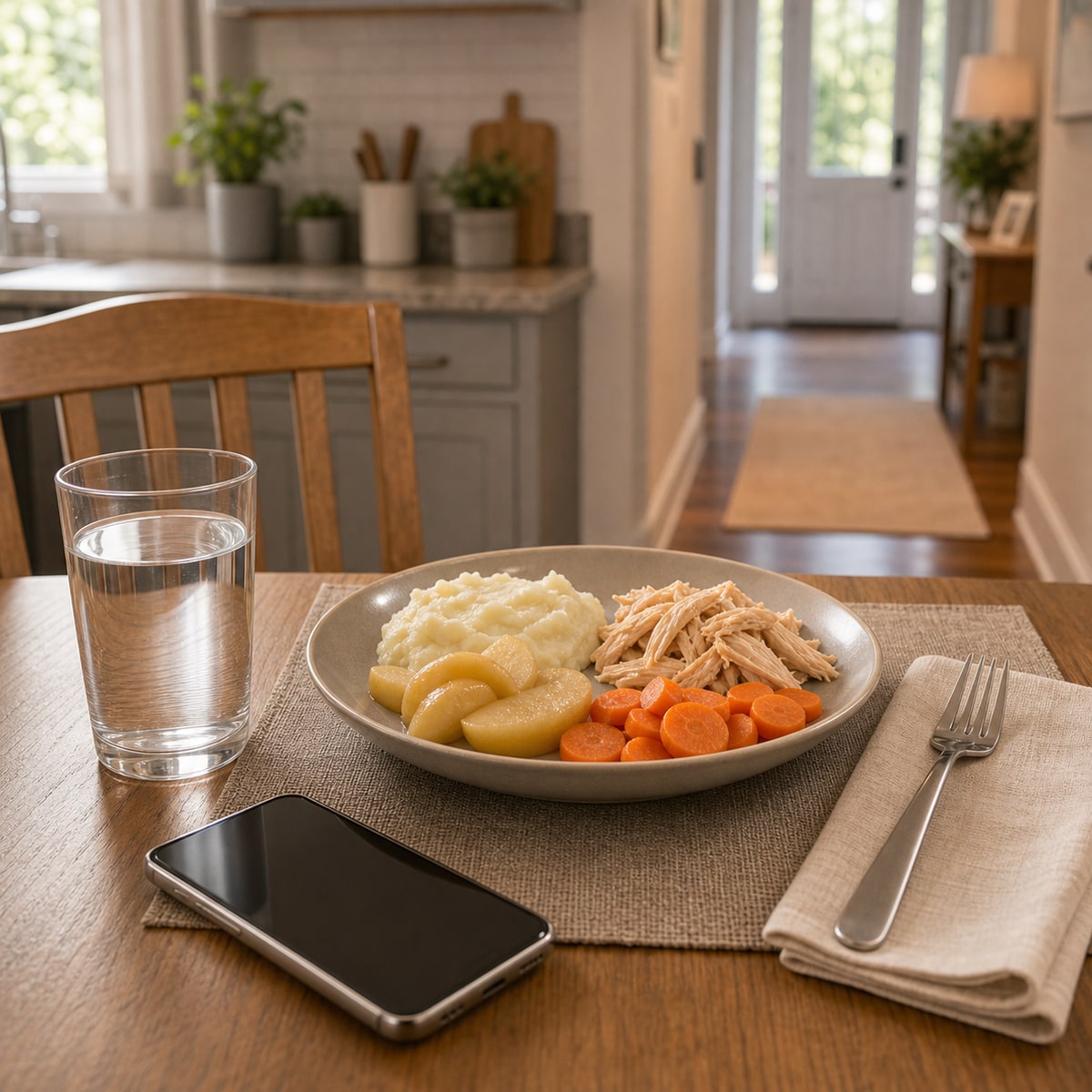
A safer kitchen does not need to look medical. In most homes, the best changes are quiet and practical.
Start with the chair. The person should sit upright for meals, not reclined on a sofa or half-turned in bed. A straight-backed chair, stable table height, and good lighting make eating easier. The plate should be close enough that the person is not reaching awkwardly. Water should be nearby, but water should not be used to force down food that keeps sticking.
Next, look at the phone. If someone lives alone, a phone across the room is too far during a choking emergency. A mobile phone, wearable alert button, or smart speaker should be reachable from the dining spot. This is not paranoia. It is response design.
Then check the food. Dry toast, rice, crackers, tough meat, large salad leaves, raw carrots, nuts, and stringy fruit may all become harder with age. The safer version is usually not bland food; it is better-prepared food. Add moisture. Cut smaller. Shred meat. Cook vegetables longer. Use sauces. Avoid large mixed textures if the person struggles with them.
A home choking readiness checklist for seniors should include:
| Upright seating for meals. | Good lighting. |
| A phone or emergency alert within reach. | Smaller bites and slower pace. |
| Moist foods when dry foods cause coughing. | Denture fit checks. |
| A clear path to the door for EMS. | First-aid knowledge for anyone who visits or provides care. |
| A staged second-line backup only if appropriate and familiar. | |
That list is not complicated. The hard part is getting families to treat it as part of kitchen safety rather than an afterthought.

Many senior choking prevention guides list "dangerous foods." That language can be misleading. A food that is risky for one person may be fine for another. The more useful question is: does this food match this person's current chewing and swallowing ability?
Tough steak may be manageable for one 80-year-old and unsafe for another. Rice may be fine when moist and difficult when dry. Salad may be easy for someone with strong chewing and frustrating for someone with dry mouth or dentures.
Still, some categories deserve extra attention.
Dry bread can form a sticky or doughy mass, especially when saliva is low. Crackers and rice cakes crumble, then dry out the mouth further. If someone often needs water to force down dry foods, the texture may need changing.
Safer approach: use softer breads, add moisture, cut smaller pieces, and avoid rushing.
Steak, pork chops, chicken breast, sausage, and jerky can require more chewing than the person can comfortably manage. A large piece may be swallowed before it is broken down.
Safer approach: cook until tender, slice thinly, shred, mince, add gravy or sauce, and avoid chewy edges.
Raw carrots, celery, apple chunks, and firm pears can break into hard pieces. They are healthy, but the texture may not match the person's swallowing ability.
Safer approach: steam, grate, thinly slice, stew, or soften.
Nuts and seeds are hard and can scatter in the mouth. Mixed snack foods add texture changes that require quick coordination.
Safer approach: avoid whole nuts if chewing is weak; use smoother alternatives under clinician guidance when appropriate.
Thick peanut butter can coat the mouth and become difficult to move. Sticky candies and gummy textures can create a similar problem.
Safer approach: spread thinly, mix into softer foods, avoid spoonfuls.
A soup with thin broth and chunks requires the mouth to manage liquid and solid at the same time. That timing can be difficult for people with dysphagia.
Safer approach: choose consistent textures or follow clinician-recommended texture levels.
For families, the point is not to remove every pleasure from meals. The point is to notice where food has stopped matching the body.

Dysphagia can be obvious, but it can also look ordinary. A person may not say "I have trouble swallowing." They may simply change how they eat.
Watch for:
| Coughing during or after meals. | Wet or gurgly voice after swallowing. |
| Food pocketed in the cheeks. | Avoiding meat, bread, pills, or certain textures. |
| Needing extra water to swallow. | Long mealtimes. |
| Unexplained weight loss. | Repeated chest infections. |
| Fatigue during meals. | Confusion or fever after suspected aspiration. |
A clinician, speech-language pathologist, dentist, or primary care provider may need to evaluate recurring swallowing problems. Families should be careful here: the internet can help recognize patterns, but it cannot diagnose the reason.
For older adults living alone, the most concerning pattern is repeated coughing plus isolation. If nobody is present at meals, small events may go undocumented until a serious choking incident happens.
A home choking safety plan should begin when warning signs appear, not after the first 911 call.
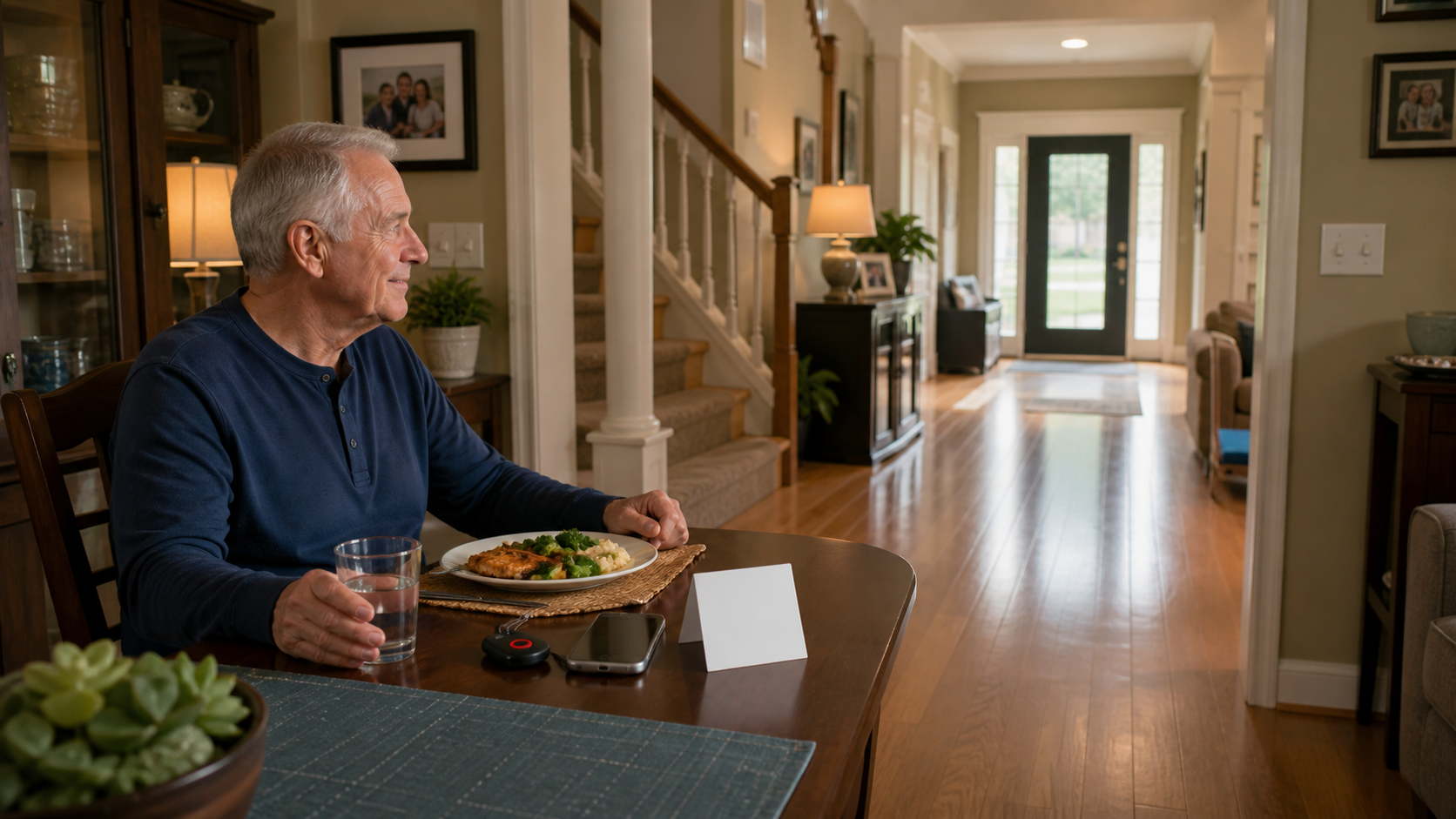
An older adult eating with family has witnesses. Someone hears the cough stop. Someone sees the face change. Someone calls 911. Someone can begin first-line rescue.
Eating alone removes those layers.
A person who is choking may not be able to call out. They may panic, stand up, fall, or lose strength quickly. Even reaching for a phone may be difficult. Self-rescue is possible in some situations, but it should never be treated as reliable. The body is under stress, oxygen is limited, and coordination can deteriorate.
This is why the home setup matters so much.
For seniors living alone, the dining area should have:
| A phone within arm's reach. | Emergency contacts set up. |
| A wearable alert if appropriate. | A clear path to the door. |
| Food prepared to match current swallowing ability. | A visible response card. | Any backup device staged near the eating area, not hidden away. |
If the person uses a second-line anti choking device as part of home readiness, it must be familiar before the emergency. The FDA warns that using an anti-choking device before established choking rescue protocols can delay lifesaving action, and the agency states that established protocols should be followed first; anti-choking devices may be considered as a second option only if standard protocols are unsuccessful. (FDA safety communication)
That warning belongs in every serious article about choking emergency response for elderly adults.
A kitchen safety article for seniors should not become a product-first article. The emergency order has to stay clear.
If an older adult is choking and another person is present, the responder should recognize severe choking, call 911 or send someone to call, and begin established choking rescue protocols. The FDA identifies protocols from the American Red Cross and American Heart Association as the established starting point, and specifically warns against delaying them for a device. (FDA safety communication)
The Red Cross adult and child choking guidance teaches action for someone who cannot cough, speak, or breathe, with back blows and abdominal thrusts used for conscious choking adults and children. (American Red Cross)
For some older adults, standard abdominal thrusts may be harder because of frailty, body size, wheelchair position, pregnancy in other populations, injury risk, or caregiver size mismatch. That does not erase the first-line-first rule. It means families should learn the right variations from a recognized training provider and think through the room before something happens.
The safest sequence is:
| Recognize severe choking. | Call 911. |
| Start trained first-line rescue. | Use a second-line backup only if standard steps are unsuccessful and the device is appropriate. |
| Begin CPR if the person becomes unresponsive. | Continue until EMS arrives. |
That sequence is not just compliance. It is a survival workflow.
A Fitiger device can be part of senior home readiness, but it should not be framed as the whole plan.
For older adults living alone, EasyPumpVac may be more relevant for home, car, bedside, kitchen, and long-term standby placement because its easier-pull mechanical design is intended to reduce handling burden for users with limited hand strength. FoldPumpVac may be useful when portability matters, such as travel, caregiver bags, vehicle kits, or moving between homes.
Both products still belong in the same safety sequence:
| Prevention. | Recognition. |
| 911. | First-line rescue. |
| Second-line backup if standard steps fail. | Post-event medical evaluation. |
This is the language families need because many people searching "choking rescue device for elderly," "anti choking device for home," or "emergency airway suction device for home" are anxious. Anxiety can push people toward a product-first mindset. Fitiger should pull them back into a system-first mindset.
A device in a kitchen drawer is ownership. A device staged near the eating area, with correct masks, instructions, inspection, and first-line training around it, is readiness.
For evidence review, families and care teams can use Fitiger scientific evidence to understand testing context before deciding whether a second-line device belongs in the home plan.
Do this audit at the actual eating spot, not at a desk.
Look at posture. Is the chair stable? Is the table height comfortable? Is the lighting good? Does the person lean back, twist, or eat while standing at the counter?
A safer meal starts with body position.
Do not turn it into a test. Just watch. Are bites large? Is food dry? Does the person cough? Do they avoid certain foods? Do they need water repeatedly? Do they talk while chewing because the meal is social?
The goal is not criticism. The goal is pattern recognition.
Look for foods that are hard, dry, crumbly, sticky, or tough. Ask which foods have become difficult. Families often learn more from what is left uneaten than from what is said.
Can the person reach a phone without standing? Does voice calling work? Are emergency contacts easy to access? Is the phone charged during meals?
A phone in the bedroom does not help much during dinner.
Could EMS enter quickly? Is the door locked with a code nobody knows? Is the hallway clear? Is the address visible? Does a neighbor or family member have access if needed?
For seniors living alone, emergency response begins before the ambulance arrives.
Choose one visible place near meals for a response card and any emergency equipment. Do not bury safety tools in a decorative cabinet.
The best storage location is the place people can reach while frightened.
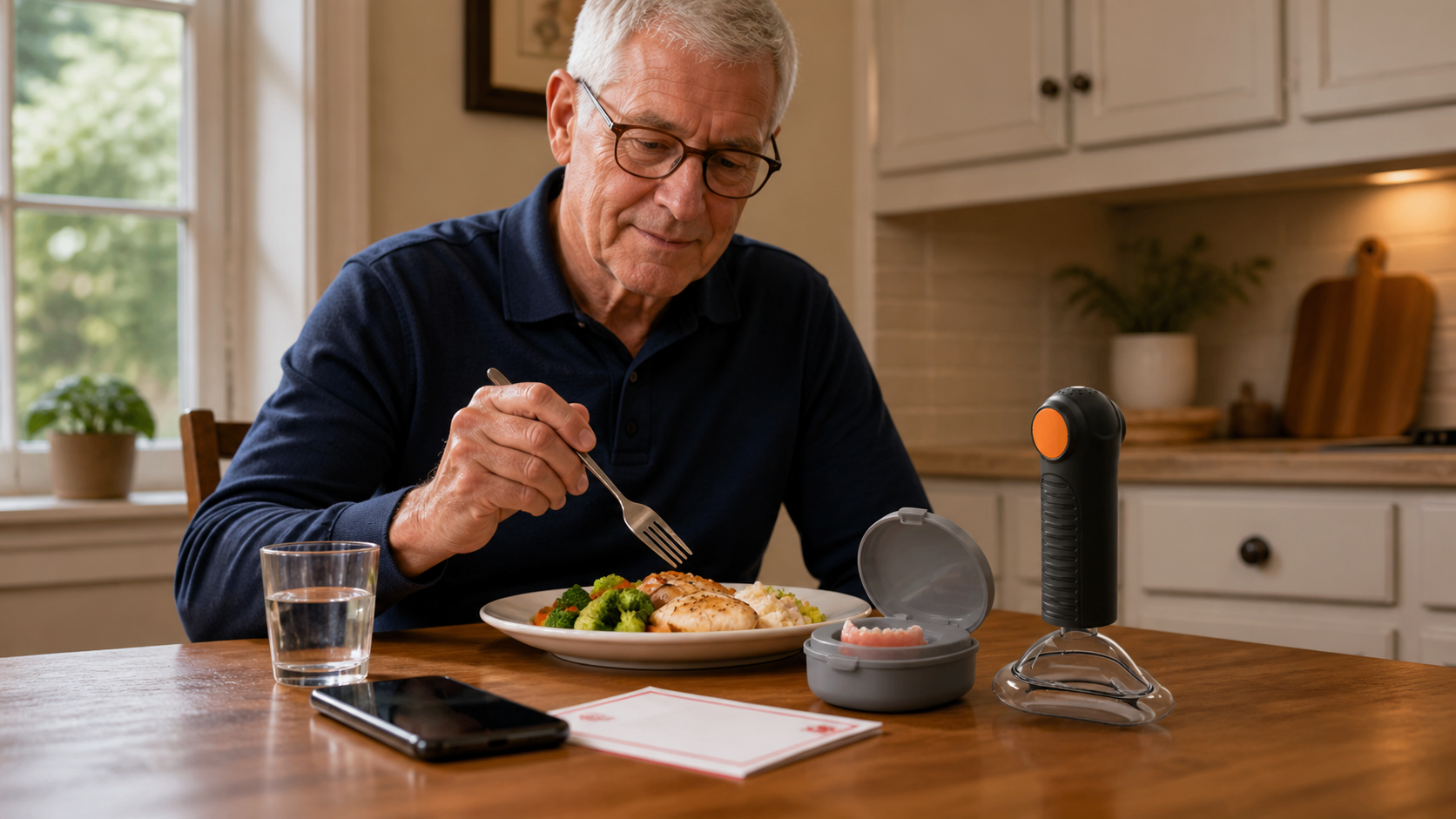
Use this as a family or caregiver checklist.
|
Readiness area |
What to check |
Why it matters |
|---|---|---|
|
Meal position |
Upright chair, stable table, good lighting |
Improves control during eating |
|
Food texture |
Moist, soft, cut small, matched to ability |
Reduces choking and coughing risk |
|
Dentures and teeth |
Fit, pain, chewing strength |
Poor chewing increases risk |
|
Medication effects |
Dry mouth, sedation, swallowing changes |
Can raise choking or aspiration risk |
|
Phone access |
Phone or alert device within reach |
Reduces delay if alone |
|
First aid |
Family and caregivers trained |
Prevents panic and wrong sequence |
|
Backup placement |
Device near meals if chosen |
Reduces retrieval delay |
|
EMS access |
Clear path, visible address, door plan |
Helps responders reach the person |
|
Documentation |
Notes after coughing or choking events |
Helps clinicians see patterns |
A checklist should not make the home feel like a facility. It should make the home easier to live in safely.
This topic can become emotional. Older adults may hear "choking prevention" as "you cannot take care of yourself." Adult children may overcorrect and start policing every bite.
The better approach is practical and respectful.
Try saying:
| "I noticed meat has been harder lately. Should we try softer cuts or more sauce?" | "Would it help to keep your phone right here during meals?" |
| "Can we move the emergency card near the table, just so nobody has to think under stress?" | "Let's ask your doctor about the coughing after meals." |
| "Do you want the backup device in the kitchen instead of the closet?" | |
These sentences protect dignity. They also move the system.
The goal is not to make the person feel watched. The goal is to make the kitchen forgive small failures.
This article focuses on older adults living alone, but the same logic applies to assisted living, home health, adult day programs, and caregiver-supported homes.
In staffed environments, the question changes from "Can the person reach help?" to "Can the staff respond without confusion?"
A choking preparedness plan for assisted living should include:
| Texture and diet notes. | Denture and swallowing-risk observations. | Staff role assignment. |
| 911 activation policy. | First-line rescue training. | Device placement if used. |
| Post-incident documentation. | Family communication. | Inspection schedule for any emergency equipment. |
Choking safety in senior care should not depend on whoever happens to be closest. It should be built into mealtime operations.
For B2B buyers comparing choking safety equipment for nursing homes or choking emergency response elderly tools, the purchase should be tied to training and placement. A product bought without a workflow becomes one more object on a shelf.
The safest kitchen for a senior living alone is not the kitchen with the most devices. It is the kitchen where risk has been noticed early.
The chair is upright. The food is moist enough. The bites are small. The phone is close. The path is clear. The family knows what coughing during meals may mean. Caregivers know when to call 911. If a second-line backup is present, it is visible, complete, and understood before the emergency.
For Fitiger, the right role is narrow but useful: a second-line readiness layer after standard rescue steps have been attempted without success. EasyPumpVac may support home and car standby where easier handling matters. FoldPumpVac may support portable placement when seniors travel or split time between households.
A safer meal often starts quietly. A softer piece of meat. A phone moved six feet closer. A caregiver who notices the cough. A backup plan placed where dinner actually happens.
That is real kitchen safety.
For related planning context, review the child and home choking safety readiness plan.
The biggest risk is the combination of swallowing changes and delayed help. Dry mouth, dentures, dysphagia, tough foods, rushed eating, and eating alone can create a choking emergency with no immediate witness. A safer plan includes food texture changes, phone access, first-aid readiness, and clear emergency steps.
Older adults with swallowing difficulty may need to be careful with tough meats, dry bread, crackers, rice, raw carrots, apple chunks, nuts, seeds, sticky peanut butter, stringy fruit, and mixed-texture soups. The safest choice depends on the person and should follow clinician guidance when dysphagia is suspected.
Possible dysphagia warning signs include coughing during meals, wet or gurgly voice after swallowing, food pocketing in the cheeks, needing extra water to swallow, avoiding certain textures, long mealtimes, weight loss, and repeated chest infections. A clinician should evaluate repeated symptoms.
Seniors can reduce choking risk by sitting upright, eating slowly, taking smaller bites, moistening dry foods, cutting food smaller, checking denture fit, keeping water nearby, avoiding rushed meals, and keeping a phone or emergency alert within reach during meals.
A choking rescue device may be considered as part of a broader home choking readiness plan, but it should not replace prevention, first-line choking rescue, 911, CPR readiness, or EMS. Any anti choking device should be familiar, complete, staged near the eating area, and treated as second-line backup only if standard steps are unsuccessful.
EasyPumpVac may be better for home, car, bedside, and long-term standby because its easier-pull design may reduce handling burden for older adults and users with limited hand strength. FoldPumpVac may be better for portable placement, travel, caregiver bags, and vehicle kits. Both remain second-line backup devices.
If the person cannot speak, cough effectively, or breathe, call 911 or send someone to call immediately and begin trained first-line choking rescue. If the person becomes unresponsive, begin CPR according to training and dispatcher instructions. Use any second-line backup only if standard steps are unsuccessful and the device instructions support use.
Occasional coughing can happen to anyone, but repeated coughing during meals should not be dismissed as normal aging. It may signal swallowing difficulty, dry mouth, poor denture fit, or aspiration risk. Families should discuss repeated symptoms with a clinician.
Emergency equipment should be stored near the area where meals actually happen, such as the kitchen table, dining room, bedside meal area, or caregiver station. It should be visible, complete, and easy to reach. A device hidden in a distant closet may not reduce retrieval delay.
A senior home choking readiness checklist should include upright seating, safer food textures, denture checks, phone access, emergency contacts, first-aid training, clear EMS access, a visible response card, and second-line backup placement if the household chooses a device.
FDA Choking Rescue Protocols Safety Communication - Supports the first-line rescue first, second-line anti-choking device backup only after standard protocols are unsuccessful.
American Red Cross Adult and Child Choking First Aid - Supports first-line choking response education for adults and children.
MedlinePlus Aspiration Pneumonia - Supports symptom awareness around aspiration-related respiratory concerns, including cough, breathing difficulty, fever, fatigue, and confusion patterns.
CDC Choking Hazards - Supports prevention logic around food shape, supervision, and choking risk reduction principles for household safety framing.
This article is for general education and emergency preparedness only. It is not medical advice, diagnosis, or treatment. In a choking emergency, call 911 or your local emergency number immediately and follow dispatcher instructions. Older adults with repeated coughing, swallowing difficulty, suspected dysphagia, aspiration symptoms, weight loss, or recurring chest infections should be evaluated by a qualified clinician. Any anti choking device should be treated as a second-line backup, not a replacement for prevention, first-line rescue, CPR, EMS, or professional medical care.


