The best time to prepare for an infant choking emergency is before the first rushed meal, the first babysitter handoff, or the first moment of panic. Learn infant first aid, decide who calls 911, post the home address, and set up a simple readiness point. Manual rescue comes first. Any suction device remains second-line backup only.
For a household checklist, see Fitiger's child and home choking safety readiness plan.

The crib is assembled. Diapers are stacked. Bottles, burp cloths, and wipes are easy to reach. The stroller is folded near the door.
Emergency planning often waits.
Parents know choking is possible, but it feels distant during pregnancy. Solid food is months away. There is always another appointment, another list, another piece of baby gear to research.
Then the first foods arrive quickly.
A baby sits in the high chair with a soft piece of food. A parent is watching closely but realizes they have never practiced infant choking first aid. The phone is charging in another room. A grandparent is helping with lunch and assumes abdominal thrusts are appropriate for a baby. Nobody has posted the address near the kitchen.
The weakness is not a lack of concern. The weakness is that the household has never converted concern into a usable plan.

A practical family plan does not need to happen all at once.
Break it into three moments:
|
Stage |
What to do |
Why it matters |
|---|---|---|
|
Before the baby arrives |
Complete infant first-aid and CPR training, decide who calls 911, post the home address, and identify the main readiness location. |
These steps are easier to complete before sleep deprivation and feeding routines take over. |
|
Before solids begin |
Review age-appropriate feeding guidance, check the high-chair setup, brief grandparents and babysitters, and revisit infant rescue steps. |
Solid food changes the risk picture because texture, shape, and bite size begin to matter. |
|
During the first weeks of solids |
Stay close during meals, observe how the baby manages texture, avoid feeding on the move, and adjust the setup when real-life problems appear. |
The plan becomes stronger when it reflects the baby and household you actually have. |
Take an infant first-aid and CPR course before you need one
A saved video is not enough.
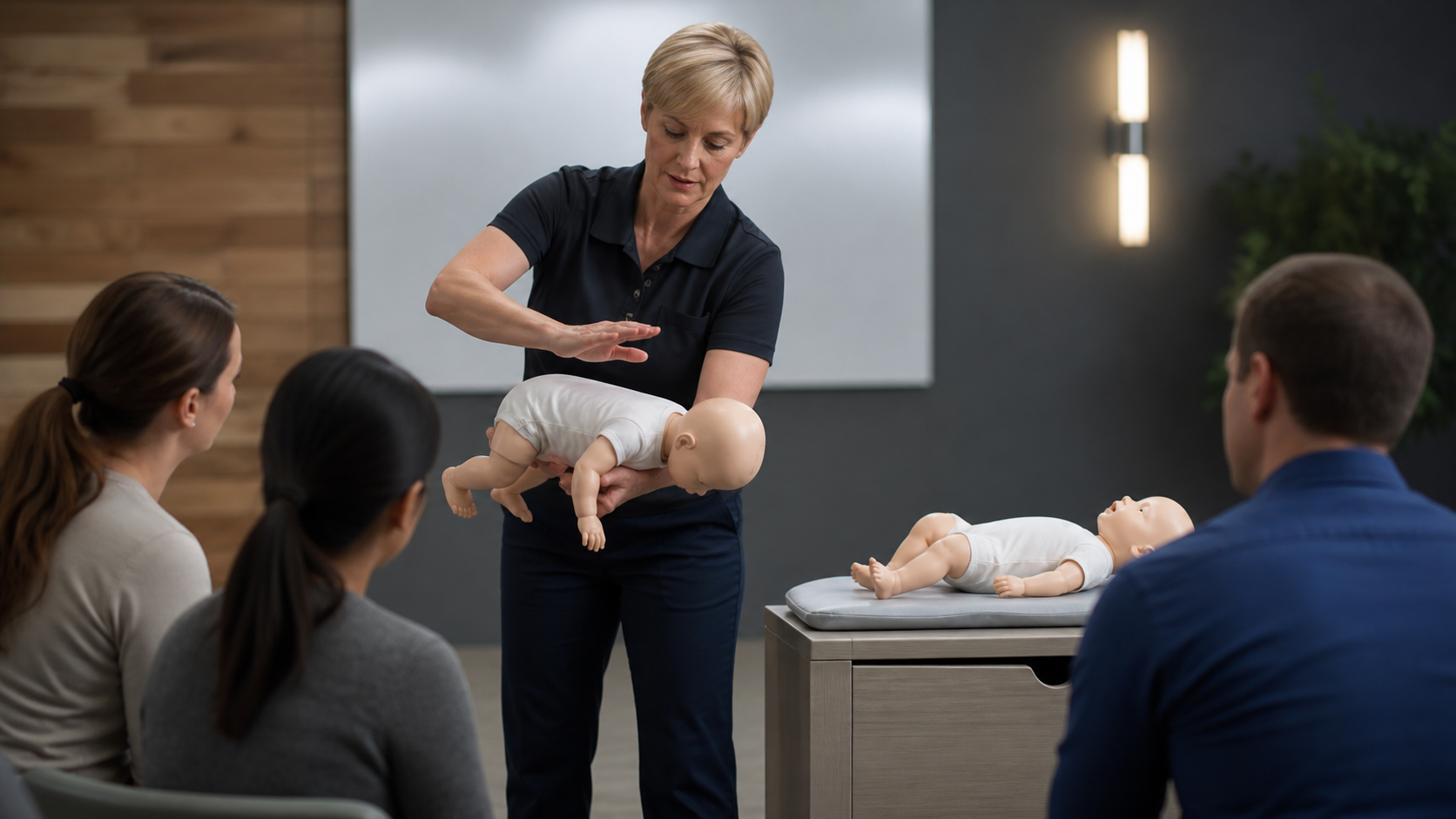
A short clip may help refresh memory, but it cannot replace hands-on practice. Parents need to understand how to hold an infant safely, how to support the head, where back blows land, how chest thrusts differ from abdominal thrusts, and what changes when the infant becomes unresponsive.
For a responsive infant under 1 year old with severe choking, current guidance uses repeated cycles of:
| Give 5 back blows. | Give 5 chest thrusts. |
| Repeat until the object clears or the infant becomes unresponsive. | Do not use abdominal thrusts on an infant. |
| If the infant becomes unresponsive, begin CPR according to your training and follow 911 dispatcher instructions. | |
The technique should feel familiar before the first emergency, not learned from a phone screen while the baby is already in distress.
Parents often expect choking to be loud.
A complete airway obstruction may become much quieter.
A baby who is gagging or coughing forcefully may still be moving air. A baby with severe choking may lose the normal cry, stop making effective sounds, or be unable to breathe.
|
What you observe |
What it may mean |
What to do |
|---|---|---|
|
Loud gagging, crying, or forceful coughing |
Air is still moving |
Stay close and observe carefully |
|
Food pushed forward with the tongue |
The baby may be working through the gag reflex |
Allow space for the baby to clear the food |
|
Cough becomes weak or silent |
The obstruction may be worsening |
Call 911 and prepare to act immediately |
|
Baby cannot cry, cough effectively, or breathe |
Complete airway obstruction |
Begin infant choking rescue immediately |
|
Baby becomes unresponsive |
Life-threatening emergency |
Begin CPR according to training and follow dispatcher instructions |
A phone somewhere in the house is not the same as a phone within reach.
Before solids begin, choose the place where most meals are likely to happen. For many families, that is the kitchen, dining area, or breakfast nook.
Then test the setup:
| Can one adult reach a phone without leaving the baby alone? | Is the full address posted clearly? |
| Can a grandparent or babysitter read the address without searching through contacts? | Is the path to the front door clear? |
| Can EMS enter without someone hunting for keys? | Is speakerphone easy to activate? |
| Does the family know who will meet responders at the door? | |
These questions sound basic until the room becomes loud and confusing.
When two or more adults are present, confusion can still waste time.
One person reaches for the phone. Another runs toward a cabinet. Someone else stands beside the high chair asking what to do.
A simple role plan is easier to remember.
|
Role |
First responsibility |
Practical detail |
|---|---|---|
|
Lead responder |
Stay with the baby and begin age-appropriate care |
Do not leave the baby to search for supplies |
|
Call and control |
Call 911, use speakerphone, read the address, and keep the area workable |
Move siblings, pets, and bystanders back |
|
Retrieve and meet EMS |
Bring the readiness setup, unlock the door, and guide responders inside |
Clear the hallway and entry path |

New parents often explain feeding routines in detail but leave emergency instructions vague.
A grandparent hears, 'Just watch carefully.' A babysitter knows where the bottles are stored but not where the phone is kept during meals. A postpartum helper has not reviewed infant choking steps since their own children were young.
A useful one-page handoff card includes:
| baby's name | age | full home address |
| parent or guardian phone numbers | backup contact | allergies or medical notes |
| main feeding area | phone location | first-aid setup location |
| reminder that infants do not receive abdominal thrusts | reminder to call 911 early during severe choking | reminder not to perform a blind finger sweep |
| instructions for any second-line device stored in the home | ||
The handoff is not complete until the caregiver has seen the actual storage location.
Start in the room where feeding will probably happen.
Sit where the parent or caregiver is likely to sit. Put the phone where it will actually live. Walk to the front door. Check the hallway. Look at the cabinet or shelf that will hold first-aid materials.
Then ask:
| Is anything locked? | Is anything buried behind household supplies? |
| Would a visiting caregiver know where to look? | Does the setup require opening several drawers? |
| Can the address be read in seconds? | Is the phone usually charging somewhere else? |
| Is the front-door path blocked by boxes, a stroller, or baby gear? | |
Fix one weak point before the baby arrives. The house will get busier later.
When solids begin, the chair matters as much as the menu.
Use a stable high chair or another safe feeding seat. Keep the baby upright. Stay within arm's reach. Reduce distractions. Avoid feeding in a stroller or moving vehicle.
Before serving food, check:
| shape | size |
| softness | stickiness |
| whether the piece can break into a hard chunk | whether the baby is tired or overly hungry |
| whether an adult can stay close for the full meal | |
A parent does not need to predict every food the baby will ever try. The household needs a repeatable way to inspect the next tray.
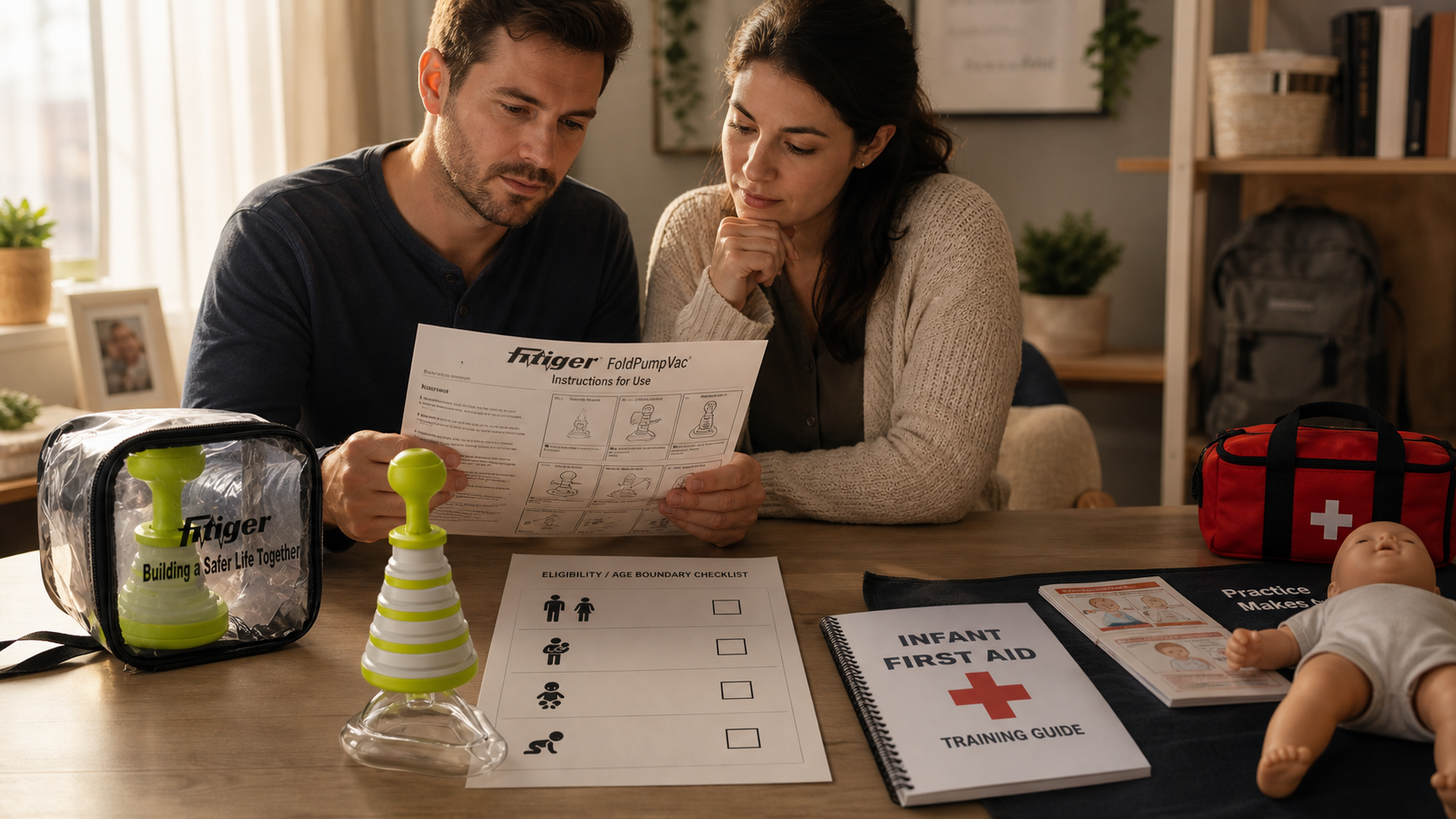
Preparedness products can be useful. They can also create false confidence when they are purchased before the family has practiced the basics.
A box in a cabinet does not replace:
| infant first-aid training | CPR training | safe food preparation |
| seated feeding | close supervision | calling 911 |
| age-appropriate manual rescue | EMS | medical follow-up after a serious choking episode |
A product belongs inside a readiness system. It does not become the readiness system.
Manual rescue first. Backup second.
Some families choose to add a suction anti-choking device as a second-line backup after unsuccessful standard choking rescue for complete airway obstruction.
Infant-related use requires particular caution. Do not assume that any product is appropriate for every baby. Review the current product-specific instructions, warnings, age limits, weight limits, and applicable regulatory status before adding a device to the household plan.
For eligible household members within the current instructions, the FITIGER EasyPumpVac Series may be the more practical option for a fixed kitchen or dining-area readiness point. Its straightforward manual structure supports one clearly marked home location.
The FITIGER FoldPumpVac Series may be the stronger option when compact storage, caregiver bags, travel, or placement near more than one household eating zone matters.
The product recommendation follows the household layout:
|
Household need |
FITIGER series to review |
Why it may fit |
|---|---|---|
|
One fixed kitchen or dining-area readiness point |
EasyPumpVac Series |
Straightforward manual structure and clear fixed-location staging |
|
Caregiver bag or travel kit |
FoldPumpVac Series |
Foldable design and compact storage |
|
Multi-floor home or more than one eating zone |
FoldPumpVac Series |
Easier multi-location staging |
|
Family first-aid area with one adult-accessible station |
EasyPumpVac Series |
Clear storage routine near the main eating zone |
Review the plan again before solids begin
A newborn household changes quickly.
The phone moves. Furniture shifts. Feeding happens in a different room than expected. Grandparents help more often. The diaper bag becomes the family's mobile command center. A storage shelf that seemed perfect during pregnancy becomes buried behind bottles and bibs.
Run the walk-through again before the first solid food.
Preparedness improves when the plan follows real life instead of staying frozen in a checklist made months earlier.
Before the due date, take the course. Post the address. Choose the readiness point. Walk the route to the front door. Show the plan to the adults who will help.
The goal is not to prepare for every imaginable scenario. It is to make the first minute less fragile. Manual rescue first. Backup second. For related planning context, review the child and home choking safety readiness plan.
Before solids begin is the minimum. Learning before the baby arrives gives parents more time to practice infant first aid and CPR without the pressure of a real emergency.
For severe choking in a responsive infant, use repeated cycles of 5 back blows and 5 chest thrusts until the object clears or the infant becomes unresponsive. Do not use abdominal thrusts on an infant.
A baby with complete airway obstruction may be unable to cry, unable to cough effectively, unable to breathe, or suddenly much quieter than expected. The key question is whether air is still moving.
Yes. Every regular caregiver should know the phone location, full home address, infant rescue sequence, blind finger sweep rule, and location of first-aid supplies.
Store readiness materials near the places where they will actually be needed. When solids begin, the main kitchen or dining-area feeding zone is usually more practical than a distant nursery cabinet.
No. Training and prevention come first. Any suction anti-choking device belongs only in a second-line backup role after unsuccessful standard rescue for complete airway obstruction and only within the current product-specific instructions.
EasyPumpVac Series may fit a fixed kitchen or dining-area readiness point. FoldPumpVac Series may be more practical for caregiver bags, travel, compact storage, or multiple eating zones. Review current product-specific instructions, age limits, weight limits, warnings, and applicable regulatory status before choosing any device.
Yes. The household routine may look very different several months after birth. Recheck the phone location, feeding zone, caregiver handoff, storage point, and first-aid training before the first tray.
American Heart Association, Infant Choking Poster - Supports the infant choking sequence of 5 back blows and 5 chest thrusts, plus the CPR transition when the infant becomes unresponsive.
American Red Cross, Child and Baby Choking - Supports recognition of severe choking and the rule against blind finger sweeps unless an object is visible.
U.S. Food and Drug Administration, Update: FDA Encourages the Public to Follow Established Choking Rescue Protocols - Supports the second-line-only positioning for anti-choking devices after unsuccessful standard choking rescue.
Centers for Disease Control and Prevention, Choking Hazards - Supports the food-shape, size, texture, supervision, stroller, and moving-vehicle guidance that becomes relevant once solids begin.
This article is for educational and preparedness-planning purposes only. It does not replace medical advice, legal advice, pediatric guidance, certified first-aid or CPR training, calling 911, EMS, professional medical care, local emergency procedures, or the current product-specific instructions for use. Use any suction anti-choking device only within its current instructions, warnings, contraindications, age limits, weight limits, and applicable regulatory status. Seek emergency medical care whenever a choking incident is serious, symptoms continue, or a child becomes unresponsive.


