Gagging can look dramatic when a baby starts self-feeding, but noise and visible effort often mean air is still moving. Stay close, watch the pattern, and do not reach blindly into the mouth. If the baby cannot cry, cannot cough effectively, or cannot breathe, call 911 and begin infant choking rescue immediately.
For a household checklist, see Fitiger's child and home choking safety readiness plan.
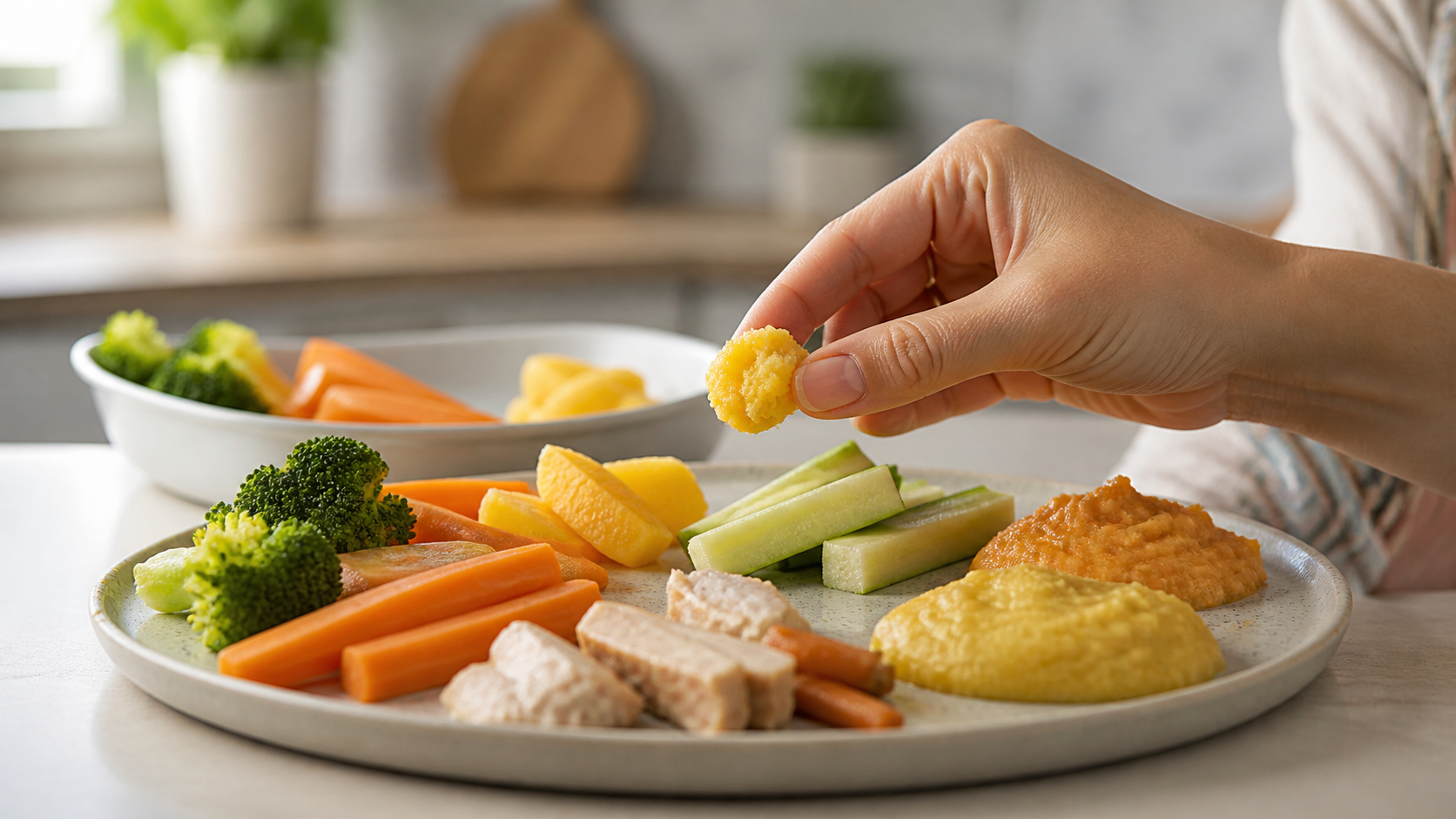
A baby picks up a soft piece of food, brings it to the mouth, and suddenly makes a strained sound.
The tongue pushes forward. The face turns red. The baby coughs, gags, and looks uncomfortable. A parent leans across the table, unsure whether to step in or wait.
That moment is common when babies begin exploring solids, especially in a baby-led weaning routine. It is also one of the moments parents misread most often.
The goal is not to ignore gagging. The goal is to read what is happening, keep the room calm, and know the exact signs that change the plan.

Gagging can look unpleasant. It may include coughing, facial redness, tongue movement, watery eyes, and visible effort. The baby may push food forward or spit it out.
Those actions can be frightening to watch, but they are not the same as complete airway obstruction.
A baby who is gagging may still:
| cough loudly | cry or make sounds |
| breathe between efforts | move the tongue forward |
| push food out of the mouth | recover without rescue actions |
A baby with severe choking may become much quieter because airflow is failing. The baby may:
| lose the normal cry | stop making effective sounds |
| have a weak or silent cough | be unable to breathe |
| show rapidly worsening distress | become blue or dusky |
| lose responsiveness | |
The most useful question at the table is not, "Does this look scary?" It is, "Is air still moving?"

|
What you notice |
What it may mean |
What to do |
|---|---|---|
|
Loud gagging, coughing, or crying |
Air is still moving |
Stay close, remain calm, and observe |
|
Tongue pushes food forward |
The baby may be working through the gag reflex |
Allow space for the baby to clear the food |
|
Baby recovers and returns to normal breathing |
The episode has passed |
Reset the meal calmly |
|
Cough becomes weak or silent |
The blockage may be worsening |
Call 911 and prepare to act immediately |
|
Baby cannot cry, cough effectively, or breathe |
Complete airway obstruction |
Begin infant choking rescue immediately |
|
Baby becomes unresponsive |
Life-threatening emergency |
Begin CPR according to training and follow dispatcher instructions |
A calm table is not a passive table. The adult is still watching closely.
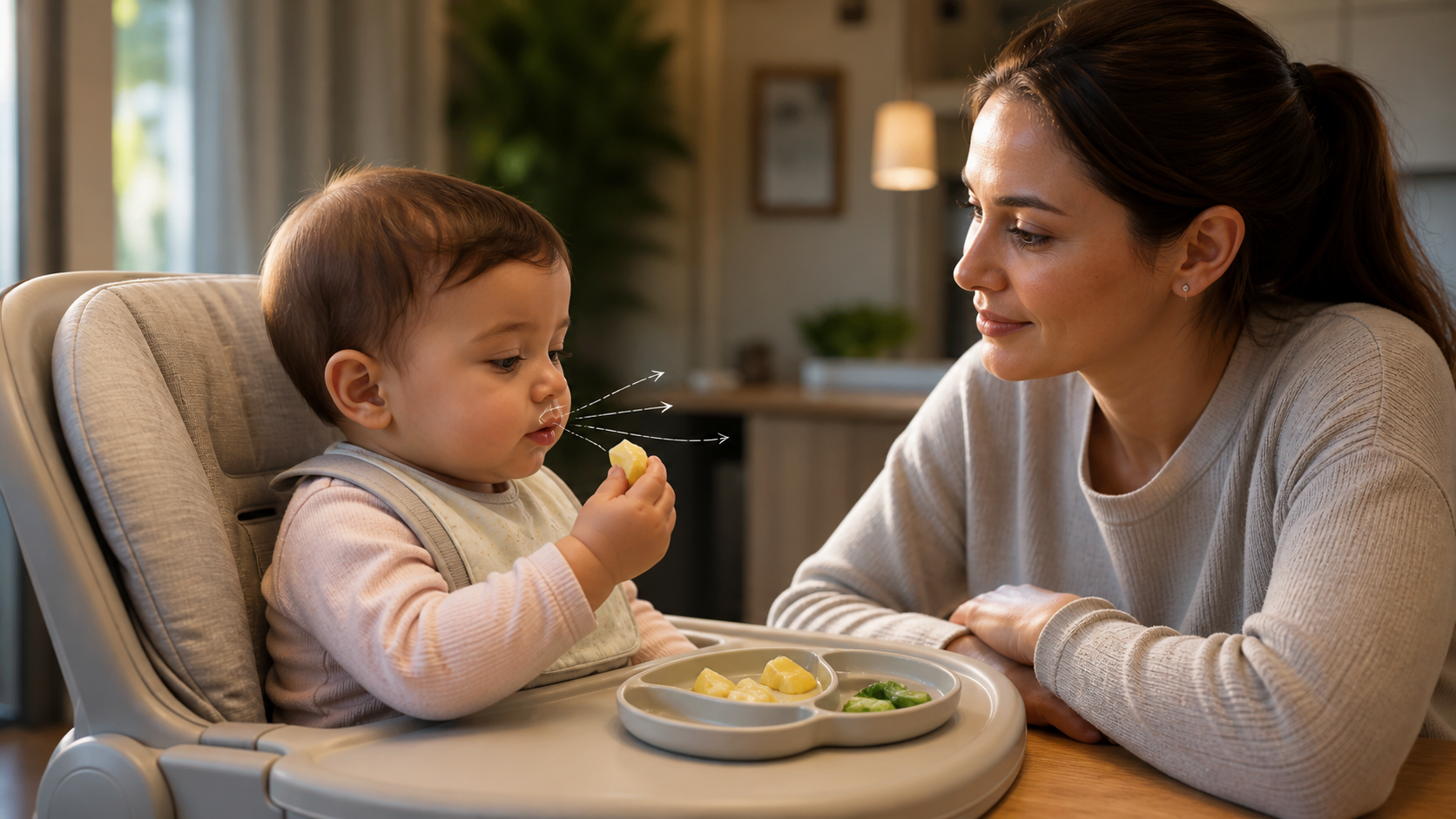
The instinct to put a finger into the baby's mouth is understandable. A parent sees food near the front of the mouth and wants to remove it before the situation gets worse.
The problem is that a blind finger sweep may push food deeper.
Use one rule: If you cannot clearly see the object, do not sweep for it.
If food is visible near the front of the mouth and easy to remove safely, remove it carefully. Do not probe deeper. Do not chase food that has moved out of sight.
A gagging baby often needs room to work through the protective response, not an adult finger moving food backward.
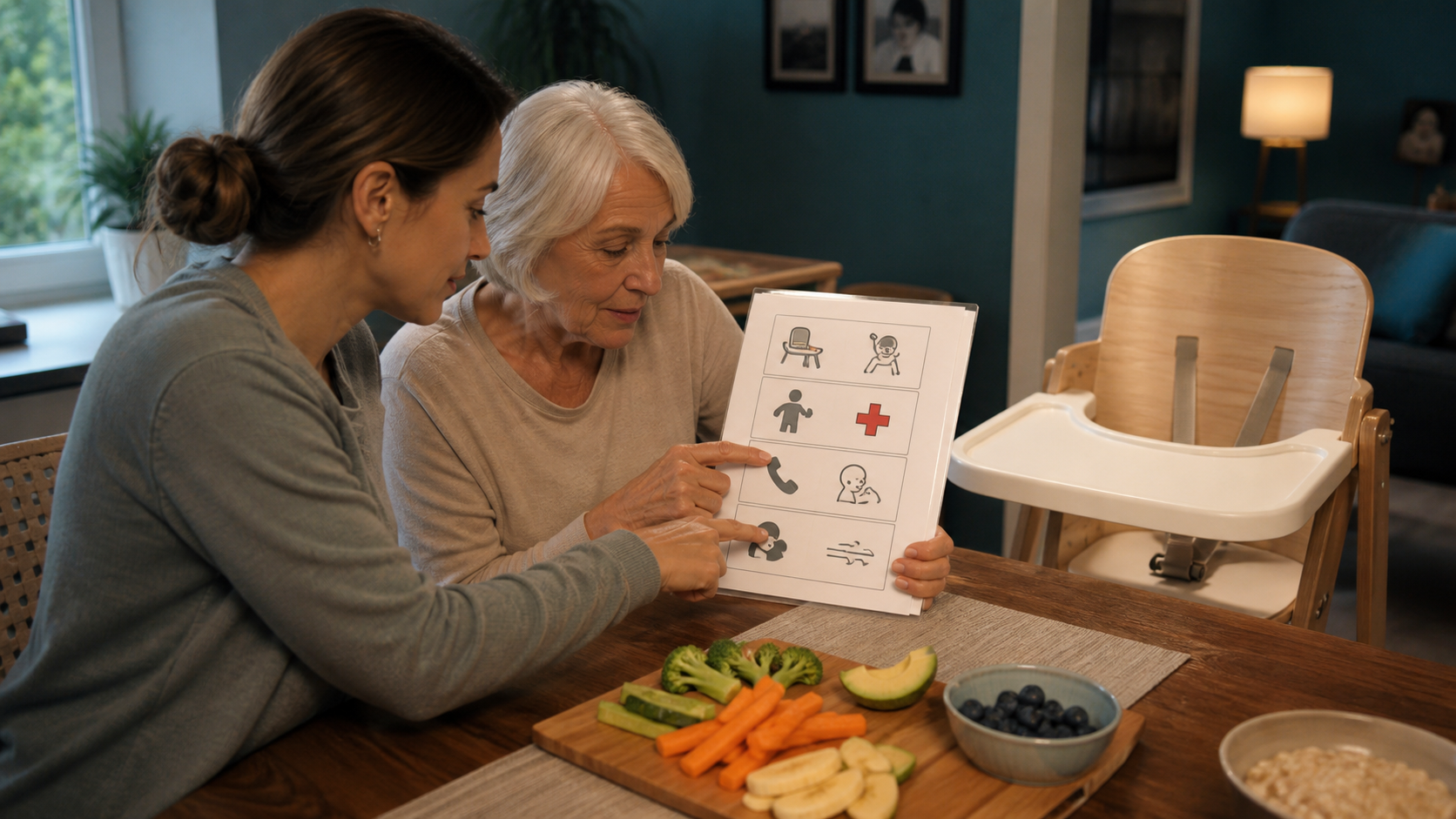
Parents can spend hours researching the perfect BLW food and overlook the eating position. Begin with the basics:
| seat the baby upright | use a stable high chair or another safe feeding seat |
| keep the baby within arm's reach | remove unnecessary distractions |
| slow down the meal | avoid feeding in a stroller |
| avoid feeding in a moving vehicle | do not let older siblings hand over unreviewed food |
A beautifully prepared meal served while the baby is reclined, distracted, or moving around is not a strong setup. The safest meal begins with posture and supervision.

Baby-led weaning is not a contest.
The goal is not to prove that a baby can handle the same food shape another baby handled in a social-media video. The goal is to offer food the baby can explore safely at the current developmental stage.
Before placing food on the tray, ask:
| Is it soft enough for the baby to manage? | Could it break into a hard chunk? |
| Is it round or airway-shaped? | Is it sticky or difficult to clear? |
| Is the piece likely to encourage an oversized bite? | Is the baby tired, hungry, or distracted? |
| Will an adult remain close throughout the meal? | |
|
Food type |
What deserves caution |
Better preparation direction |
|---|---|---|
|
Firm raw apple |
Hard chunks can be difficult to manage |
Cook, soften, grate, or prepare in a developmentally appropriate form |
|
Raw carrot |
Hard sticks and round slices can create risk |
Cook until soft, grate, or shred |
|
Whole grapes and cherry tomatoes |
Round shape can behave like a plug |
Modify carefully before serving |
|
Hot dogs and sausages |
Coin-shaped slices can obstruct a small airway |
Cut lengthwise first, then into smaller pieces |
|
Nut butter |
Thick spoonfuls or sticky globs can be difficult to clear |
Spread thinly |
|
Cheese sticks |
A baby may tear off a dense bite |
Prepare in a smaller or softer form |
|
Popcorn, whole nuts, candy, gum, and marshmallows |
Hard, sticky, or irregular textures can be difficult to manage |
Avoid or delay based on development and pediatric guidance |
No feeding label overrides the mechanics of the food.
A confident eater still needs a close adult
A baby may handle several bites well and then struggle with the next one. Confidence can make the adult look away too soon.
Stay especially close when:
| the baby becomes tired | the meal has lasted longer than usual |
| the baby grabs several pieces at once | siblings become noisy |
| a parent begins cleaning the kitchen | the baby laughs with food in the mouth |
| the family is trying to leave the house quickly | |
The routine should remain calm enough for the adult to notice a change in sound, effort, or breathing.
A noisy gag can unsettle everyone. The baby may cry afterward. The parent may want to clear the tray immediately. The next meal may feel harder because the adult is waiting for the same thing to happen again.
| Confirm that normal breathing has returned. | Let the baby settle. |
| Remove any food that is clearly not working well. | Simplify the tray. |
| Slow the pace. | Continue only when both the baby and caregiver are calm. |
There is no prize for pushing through a meal that is no longer going well. There is also no need to treat every gag as proof that solids must stop completely.
An occasional gag during early solids can happen as babies learn to manage texture. Repeated or worsening difficulty deserves closer attention.
Contact a pediatrician when the pattern includes:
| frequent coughing during feeds | repeated distress with the same textures | poor feeding |
| frequent or forceful vomiting | breathing changes | poor weight gain |
| prolonged meals | food refusal | repeated concern that swallowing is not progressing normally |
Parents do not need to diagnose the reason at the table. A short observation log can make the medical conversation more useful.
|
What to track |
Example |
|---|---|
|
Food texture |
Soft strip, mash, shredded food, lumpy puree |
|
What happened |
Gagging, coughing, vomiting, refusal, fast recovery |
|
Airflow |
Loud cough, crying, normal breathing, weak cough, silence |
|
Timing |
First bite, later in meal, when tired, after bottle or breastfeed |
|
Recovery |
Immediate, slow, needed medical advice, emergency care |
For an infant under 1 year old with severe choking, current first-aid guidance uses repeated cycles of:
| Give 5 back blows. | Give 5 chest thrusts. |
| Repeat until the object is expelled or the infant becomes unresponsive. | Do not use abdominal thrusts on an infant. |
| If another adult is present, one person should begin care while the other calls 911. Use speakerphone when practical. | Do not perform a blind finger sweep. Remove an object only if it is visible. |
| If the baby becomes unresponsive, begin CPR according to your training and follow dispatcher instructions. | A saved video is not the same as hands-on pediatric first-aid and CPR training. |
A baby's feeding routine can change when another adult takes over. A grandparent may offer a food in a different shape. A babysitter may panic when gagging begins. A relative may reach into the mouth because that feels faster than waiting.
| Keep the baby seated upright. | Stay within arm's reach. |
| Watch airflow, not only facial expression. | Loud gagging and forceful coughing usually mean air is still moving. |
| Do not perform a blind finger sweep. | Call 911 if the baby cannot cry, cannot cough effectively, or cannot breathe. |
| Use 5 back blows and 5 chest thrusts for severe choking in an infant. | Begin CPR according to training if the baby becomes unresponsive. |
| A caregiver handoff is not complete until the adult can repeat the plan clearly. | |
Food preparation, upright seated eating, close supervision, pediatric first-aid training, calling 911, manual rescue, EMS, and CPR when unresponsive come first.
Manual rescue first. Backup second.
Some families choose to keep a suction anti-choking device as a second-line backup after unsuccessful standard choking rescue for complete airway obstruction.
Infant-related use requires particular caution. Do not assume that any device is appropriate for every baby. Review the current product-specific instructions, warnings, age limits, weight limits, and applicable regulatory status before adding a device to a household plan.
For eligible household members within the current instructions, the FITIGER EasyPumpVac Series may be the more practical option for a fixed kitchen or dining-area readiness point. Its straightforward manual structure supports one clearly marked household location.
The FITIGER FoldPumpVac Series may be the stronger option when compact storage, caregiver bags, travel, or more than one eating zone matters.
Review how the device works and the scientific evidence before adding any second-line device to the household plan. A second-line backup does not replace back blows, chest thrusts, CPR, calling 911, EMS, or training. For related planning context, review the child and home choking safety readiness plan.
Gagging can happen when babies begin exploring solids and new textures. A gagging baby may cough, make noise, and push food forward. Stay close and watch airflow carefully.
Gagging is often noisy. Complete airway obstruction may become quiet because the baby cannot cry, cannot cough effectively, or cannot breathe. The key question is whether air is still moving.
Do not automatically reach into the mouth. If food is clearly visible near the front and easy to remove safely, careful removal may be reasonable. Do not perform a blind finger sweep.
First confirm that normal breathing has returned and the baby has settled. Simplify the tray or change the food preparation when needed. Continue only when the baby and caregiver are calm.
Avoid casual feeding in a stroller or moving vehicle. Babies are safer when seated upright, supervised closely, and eating in a setting where an adult can respond immediately.
Call 911 and begin the current infant choking rescue protocol immediately: 5 back blows followed by 5 chest thrusts, repeated until the object clears or the infant becomes unresponsive.
No. Abdominal thrusts are not used on infants under 1 year old.
No. Established manual rescue comes first. Any suction anti-choking device belongs only in a second-line backup role after unsuccessful standard rescue for complete airway obstruction and only within the current product-specific instructions.
EasyPumpVac Series may fit a fixed kitchen or dining-area readiness point. FoldPumpVac Series may be more practical for compact storage, caregiver bags, travel, or multiple eating zones. Review current product-specific instructions, age limits, weight limits, warnings, and applicable regulatory status before choosing any device.
Before the next tray
Pull the high chair close. Check the texture. Put the phone within reach. Watch the first bites without hovering over every movement.
A calm adult is not an adult who ignores gagging. It is an adult who knows what to watch for and what changes the plan.
Manual rescue first. Backup second.
CDC: Choking Hazards - Infant and Toddler Nutrition - Supports developmentally appropriate food shape, size, texture, seated eating, supervision, and examples of choking-hazard foods.
American Heart Association: Heartsaver Infant Choking Digital Poster - Supports recognition of severe infant airway blockage and the 5 back slaps / 5 chest thrusts infant response sequence.
FDA Safety Communication: Follow Established Choking Rescue Protocols - Supports manual rescue first, second-option device positioning after unsuccessful standard protocols, complete airway-block boundary, and IFU familiarity before an emergency.
This article is for educational and preparedness-planning purposes only. It does not replace medical advice, legal advice, pediatric guidance, certified first-aid or CPR training, calling 911, EMS, professional medical care, local emergency procedures, or the current product-specific instructions for use.
Use any suction anti-choking device only within its current instructions, warnings, contraindications, age limits, weight limits, and applicable regulatory status. Seek emergency medical care whenever a choking incident is serious, symptoms continue, or a child becomes unresponsive.


