Last updated: October 5, 2026
Authored by George King
Nighttime feeding noises, spit-up, brief coughing, and reflux-related discomfort can sound alarming, but they are not always choking emergencies. The real emergency sign is failing airflow: a baby who cannot cry, cannot cough effectively, or cannot breathe. Watch the pattern, not just the sound. Call 911 and begin infant choking rescue immediately if severe choking is present.
For a household checklist, see Fitiger's child and home choking safety readiness plan.
A baby makes a sudden choking sound at 2 a.m.
The room is dark. The sound monitor crackles. A parent rushes in and finds the baby coughing, sputtering, arching, or spitting up milk. A few seconds can feel much longer at night because there is less visual information and more fear.
Many families remember the sound more vividly than the actual pattern. They describe the moment as "my baby was choking," even when the baby was still coughing forcefully, crying, moving air, and recovering without rescue.
A baby can have a frightening nighttime episode without having complete airway obstruction. Parents need a way to sort normal-but-scary events from a true emergency.
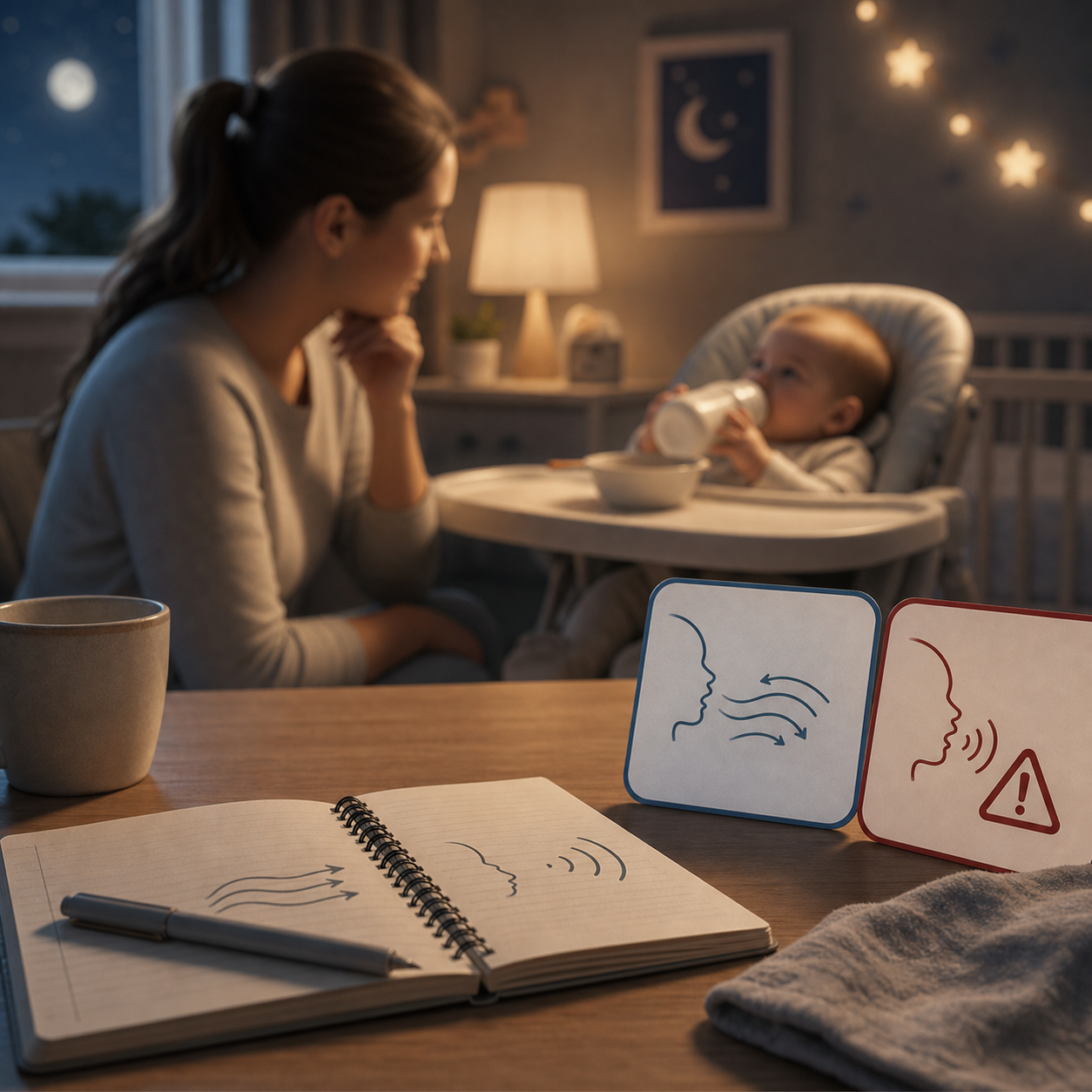
Babies can make sudden feeding and sleep sounds for many reasons:
| spit-up or milk coming back up | reflux-related coughing |
| mucus or congestion | brief gagging |
| swallowing pooled saliva | coughing after a feed |
| temporary sputtering while repositioning | |
These events may look dramatic. They do not automatically mean the airway is fully blocked.
What matters most is whether air is still moving.
A baby who is coughing loudly, crying, making sound, or taking breaths is not showing the same pattern as a baby with complete airway obstruction.
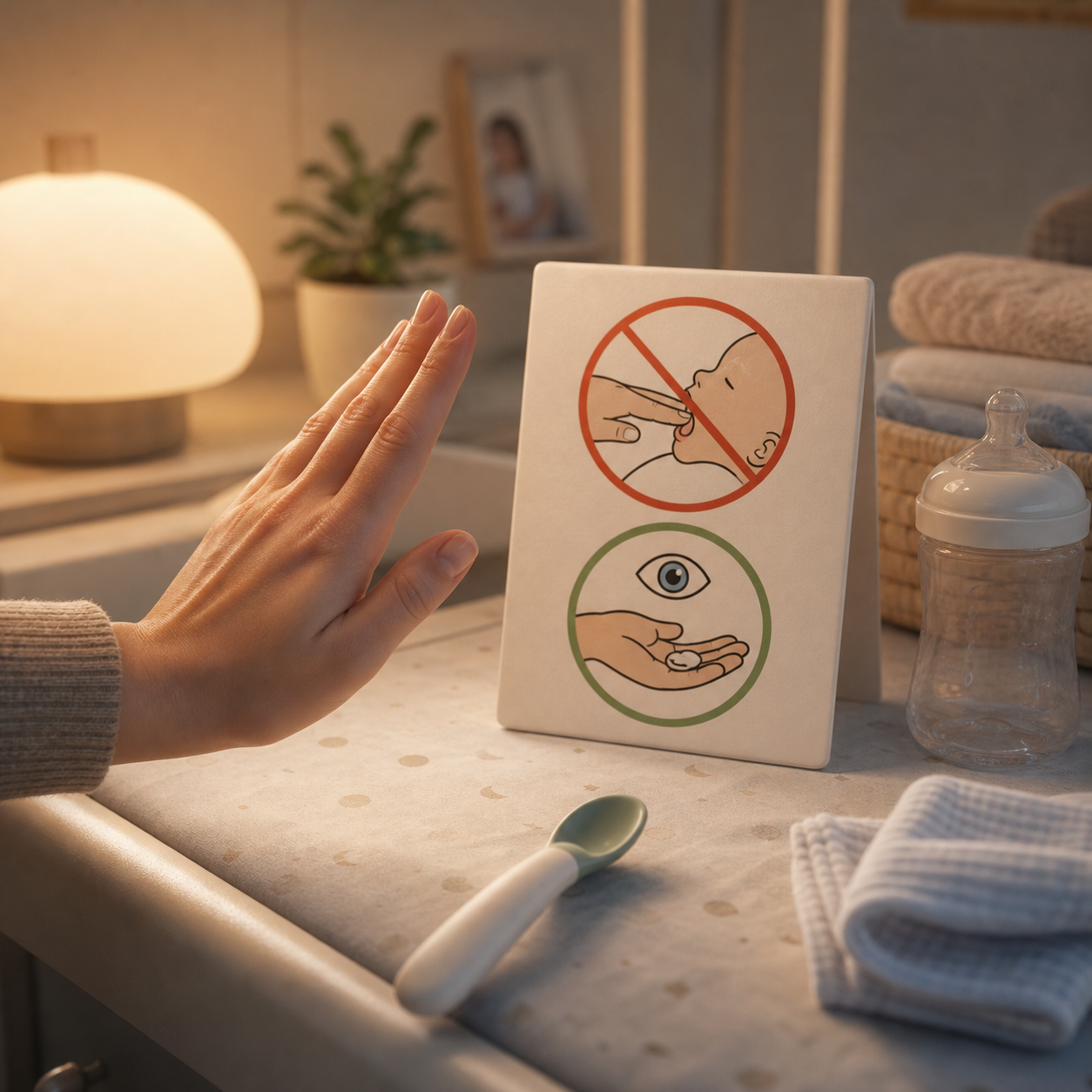
Parents often focus first on color, facial expression, or body movement. Those clues matter, but airflow matters more.
A baby with nighttime reflux or spit-up may:
| cough loudly | cry | gag |
| turn red | arch the back | push milk or saliva out |
| sound wet or congested for a short period | settle after clearing the airway | A baby with complete airway obstruction may: |
| suddenly become quiet | be unable to cry | be unable to cough effectively |
| be unable to breathe | show weak or absent sound | look panicked or distressed without clearing the problem |
| become blue or dusky | lose responsiveness | |
|
What you notice |
What it may mean |
What to do |
|---|---|---|
|
Loud coughing or crying |
Air is still moving |
Stay close and observe carefully |
|
Gagging with sound and visible effort |
The baby may be clearing the airway |
Stay calm and monitor closely |
|
Brief spit-up followed by coughing and recovery |
Likely not complete airway obstruction |
Clean up, observe, and watch for worsening |
|
Weak or ineffective cough |
Airflow may be worsening |
Treat seriously and prepare to act |
|
Unable to cry, cough effectively, or breathe |
Complete airway obstruction |
Call 911 and begin infant choking rescue immediately |
|
Baby becomes unresponsive |
Life-threatening emergency |
Begin CPR according to training and follow dispatcher instructions |
The question is not, "Did the baby make a scary sound?" The question is, "Could the baby still move air?"
Nighttime episodes are often linked to the timing of feeds.
A baby may spit up when laid down after feeding. Milk may pool briefly in the mouth or throat. The baby coughs, sputters, or gags, then settles after clearing it.
That event can frighten a caregiver, especially during the first months. It may still be very different from complete airway obstruction.
Parents should notice:
| Did the baby cough strongly? | Was there crying or sound? |
| Did the baby recover after clearing the spit-up? | Was the episode brief? |
| Did normal breathing return? | |
A baby who quickly returns to normal breathing and color is not showing the same pattern as a baby with severe choking.
This does not mean parents should dismiss repeated nighttime problems. Recurrent episodes, poor feeding, breathing changes, poor weight gain, persistent vomiting, worsening cough, or repeated distress deserve medical follow-up.
Reflux does not change the safe sleep baseline. Place babies on their backs on a firm, flat sleep surface. Do not elevate the crib mattress, use wedges, or rely on sleep positioners. If reflux symptoms are frequent, worsening, or affecting feeding and growth, discuss them with a pediatrician.

Some nighttime scares happen with no food involved.
A baby with congestion may cough after mucus shifts. A teething baby may swallow pooled saliva awkwardly. A baby lying flat may briefly struggle with secretions, then recover with coughing and repositioning.
These events still require observation. They do not automatically mean a solid or liquid has completely blocked the airway.

At night, it helps to avoid reacting only to the sound monitor. Go to the baby, observe breathing, look for effective sound, and assess whether the baby is recovering or deteriorating.

The moment becomes an emergency when the baby cannot move enough air.
That includes:
| no effective cry | no effective cough |
| no breathing | rapidly worsening distress |
| silent struggle | loss of responsiveness |
Parents should not delay because they are trying to decide whether the baby "really" looks blue enough or whether milk might clear on its own.
If the baby cannot cry, cannot cough effectively, or cannot breathe, act as a choking emergency.
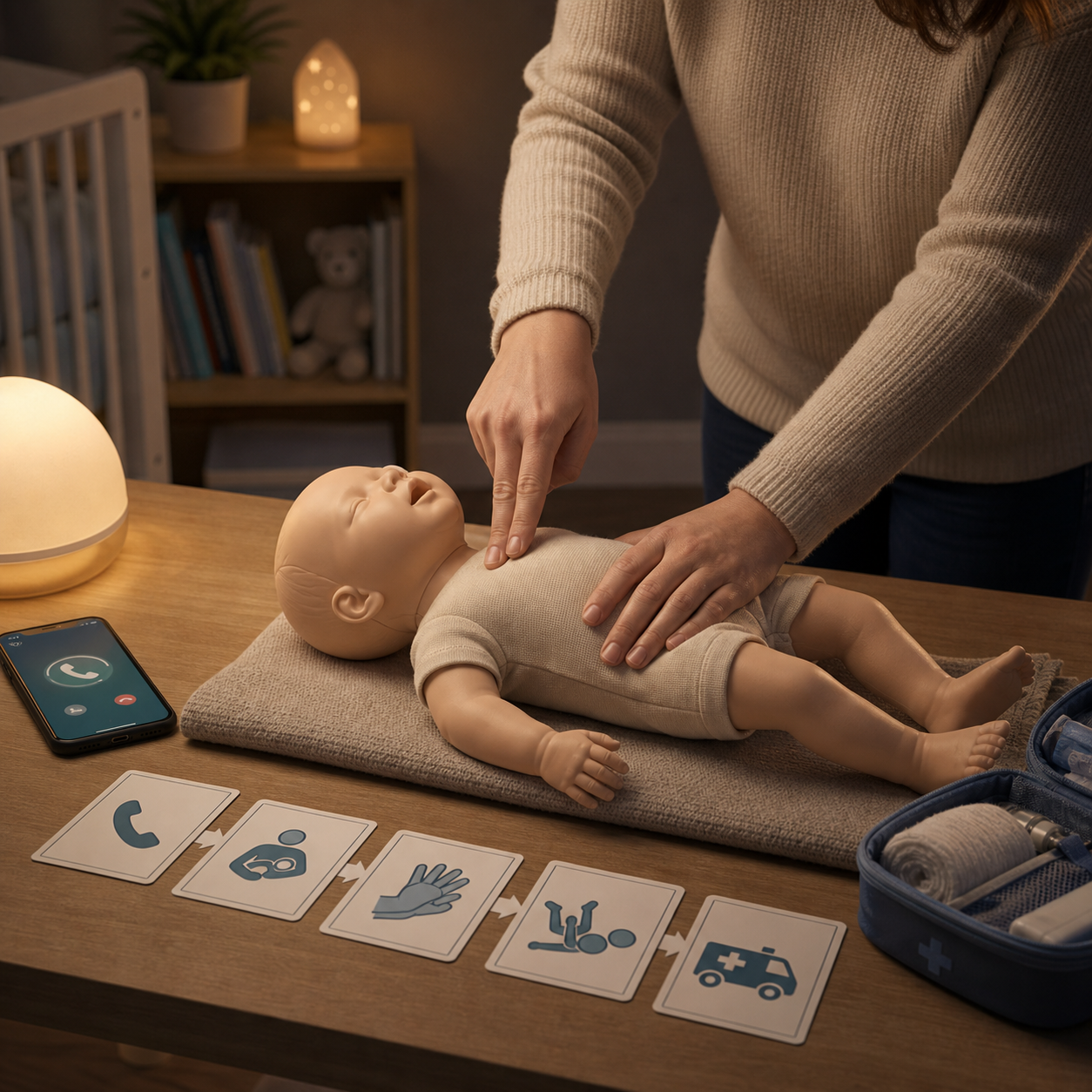
For an infant under 1 year old with severe choking, current first-aid guidance uses repeated cycles of:
| Give 5 back blows. | Give 5 chest thrusts. |
| Repeat until the object is expelled or the infant becomes unresponsive. | Do not use abdominal thrusts on an infant. |
If another adult is present, one person should begin care while the other calls 911. Use speakerphone when practical and give the exact address.
Do not perform a blind finger sweep. Remove an object only if it is clearly visible and easy to remove safely.
If the baby becomes unresponsive:
| begin CPR according to your training | follow 911 dispatcher instructions |
| open the mouth during care | remove an object only if it is visible |
Do not lose time sweeping blindly through the mouth.
A visible object during care is different from searching blindly for one you cannot see.
Parents can overcorrect after one frightening night.
A baby coughs once, and the family starts checking the mouth repeatedly. Every feed feels dangerous. Every noisy swallow sounds like choking. The parent becomes afraid to let the baby sleep after feeding.
That kind of fear can grow quickly when the family has not been shown what true emergency signs look like.
A better approach is to separate three categories:
|
Nighttime event |
Likely category |
Next step |
|---|---|---|
|
Brief spit-up with strong coughing and fast recovery |
Scary but not usually complete airway obstruction |
Observe and discuss with a clinician if repeated |
|
Recurrent nighttime coughing, feeding trouble, or frequent distress |
Ongoing feeding or reflux concern |
Schedule medical follow-up |
|
No effective cry, no effective cough, or inability to breathe |
Emergency |
Call 911 and begin infant choking rescue immediately |
This framework helps families respond without freezing and without overreacting to every ordinary sound.
A nighttime emergency feels worse when the household is disorganized.
Use a short evening readiness check:
| keep a phone charged and reachable | make sure the full home address is easy to state |
| review who will call 911 if two adults are present | keep the sleep and feeding area uncluttered |
| know where first-aid materials are stored | make sure caregivers know infant choking steps |
| know that abdominal thrusts are not used on infants | avoid blind finger sweeps |
A household plan does not eliminate fear, but it reduces delay.
Grandparents, postpartum helpers, babysitters, and overnight caregivers may misread a nighttime feeding scare.
Give them a short, direct rule set:
| Watch airflow first | Loud coughing and crying mean air is still moving. |
| Treat silent obstruction as urgent | No effective cry or cough is an emergency. |
| use 5 back blows and 5 chest thrusts for severe choking in an infant | do not use abdominal thrusts on an infant |
| do not perform a blind finger sweep | call 911 early when severe choking is present |
Nighttime care is harder when someone new is learning the plan during the emergency.
Safe feeding, safe sleep, observation, pediatric first-aid training, manual rescue, calling 911, EMS, and CPR when unresponsive come first.
Manual rescue first. Backup second.
Some families choose to keep a suction anti-choking device as a second-line backup after unsuccessful standard choking rescue for complete airway obstruction.
Do not assume that every device is appropriate for every baby or infant. Infant-related use requires extra caution. Review the current product-specific instructions, warnings, age limits, weight limits, and applicable regulatory status before adding any device to the home.
Families comparing backup options can also review FITIGER's scientific evidence page before making a household readiness decision.
For eligible household members within the current instructions, the FITIGER EasyPumpVac Series may be the more practical option for a fixed kitchen or home readiness point. Its straightforward manual structure supports one clearly marked storage location.
The FITIGER FoldPumpVac Series may be the stronger option when compact staging, caregiver bags, travel, or more than one household readiness point matters.
A second-line backup does not replace back blows, chest thrusts, CPR, calling 911, EMS, or training.
For related planning context, review the child and home choking safety readiness plan.
It can happen. Some babies cough after spit-up, reflux, mucus, or saliva pooling. A baby who coughs strongly, cries, and recovers is showing a different pattern from complete airway obstruction.
The most important question is whether air is still moving. Loud coughing, crying, and visible sound usually mean air is moving. A baby who cannot cry, cannot cough effectively, or cannot breathe should be treated as an emergency.
Yes. Reflux and spit-up can create sudden coughing, gagging, sputtering, and distress that feel frightening. Repeated or worsening episodes should be discussed with a clinician, but they are not always complete airway obstruction.
No. Safe sleep still means placing the baby on the back on a firm, flat surface. Do not elevate the crib mattress or use wedges or sleep positioners.
Call 911 if your baby cannot cry, cannot cough effectively, cannot breathe, shows rapidly worsening distress, or becomes unresponsive.
Do not perform a blind finger sweep. Remove an object only if it is clearly visible and easy to remove safely.
No. Abdominal thrusts are not used on infants under 1 year old. For severe choking in an infant, use 5 back blows and 5 chest thrusts.
Begin CPR according to your training and follow dispatcher instructions. Look for an object during care and remove it only if visible.
No. Manual rescue comes first. Any suction anti-choking device belongs only in a second-line backup role after unsuccessful standard rescue for complete airway obstruction and only within the current product-specific instructions.
Check where the phone is. Make sure regular caregivers know the difference between loud coughing and failing airflow. Review the infant choking steps before the house gets dark and quiet.
The goal is not to fear every nighttime sound. The goal is to recognize the sound that truly changes the plan.
Manual rescue first. Backup second.
U.S. Food and Drug Administration - Established choking rescue protocols come first; anti-choking devices may be used only as a second option after standard protocols are unsuccessful; registration and listing do not equal approval, clearance, or authorization.
American Heart Association - Heartsaver Infant Choking Digital Poster - Recognizing severe airway block in an infant; up to 5 back slaps and up to 5 chest thrusts; CPR and visible-object checks if the infant becomes unresponsive.
HealthyChildren.org - American Academy of Pediatrics - Reflux, spit-up, symptoms that deserve medical follow-up, and supervised upright positioning after feeds when appropriate.
HealthyChildren.org - American Academy of Pediatrics - Safe sleep for babies with reflux: back sleeping on a firm, flat surface; avoid wedges, inclined sleep products, and crib elevation.
This article is for educational and preparedness-planning purposes only. It does not replace medical advice, legal advice, pediatric guidance, certified first-aid or CPR training, calling 911, EMS, professional medical care, local emergency procedures, safe sleep guidance, or the current product-specific instructions for use.
Use any suction anti-choking device only within its current instructions, warnings, contraindications, age limits, weight limits, and applicable regulatory status. Seek emergency medical care whenever a choking incident is serious, symptoms continue, or a child becomes unresponsive.


