
| For children older than 1, choking risk often comes from a risky combination: the wrong food shape, a rushed bite, and a distracted moment. Keep snacks seated, cut higher-risk foods into safer pieces, and act immediately if a child can't speak, cough effectively, or breathe normally. |
| For a household checklist, see Fitiger's child and home choking safety readiness plan. |
| A backyard birthday party is moving at full speed. Someone sets out hot dogs. Children weave around folding chairs with paper plates in their hands. A four-year-old takes a bite, turns toward the yard, and starts running after another child. |
| A few seconds later, the child stops. |
| At first, nobody understands why. One hand moves toward the throat. The cough sounds weak, then disappears. The adults nearby are still smiling for a moment longer than they should be. |
| Child choking at home rarely begins with an obviously dangerous decision. It happens during an ordinary family afternoon, in the back seat after school, or on the couch while a child is watching cartoons. The food matters, but the setting around the bite often decides whether a routine snack stays routine. |
| Once a child is past infancy, adults sometimes relax too quickly. A toddler may be talking clearly, feeding themselves, and eating many of the same foods as the rest of the family. A school-age child may seem old enough to manage snacks independently. |
| Neither assumption removes choking risk. |
| Young children are still learning how to chew thoroughly, judge bite size, and slow down when they are excited. Older children may chew well under normal conditions but eat carelessly when they are laughing, running, gaming, or rushing out the door. |
| The risk changes as children grow. It doesn't disappear. |
| Food preparation should match the child's age, chewing ability, and maturity. A cautious rule for a preschooler may still make sense for an older child who tends to overstuff their mouth or eat while moving. |
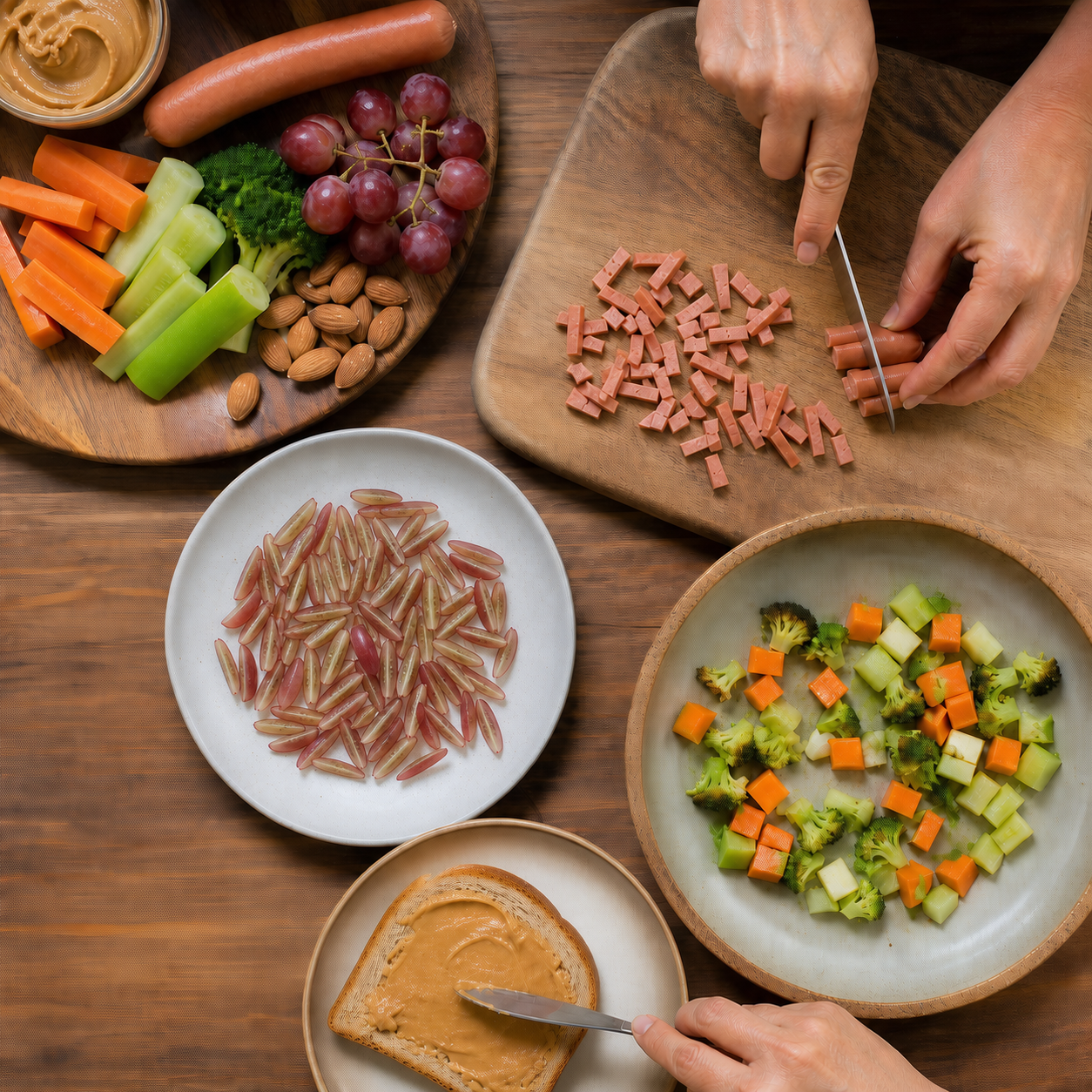
| Whole grapes and hot dogs deserve their reputation as choking hazards. Their shape allows them to obstruct a small airway more easily than many parents expect. Hot dogs should be cut lengthwise and then into small pieces for younger children. Grapes and similar round foods should be cut lengthwise into small pieces rather than served whole. |
| Other foods deserve the same attention: |
| Hard, sticky, or gooey candy | Chewing gum | Popcorn |
| Nuts and seeds | Whole cherry or grape tomatoes | Raw carrot sticks and hard apple chunks |
| Marshmallows | Thick spoonfuls of nut butter | Large chunks of cheese |
| Meat sticks, sausages, and dense pieces of meat |
| A food list only solves part of the problem. A child can choke on a familiar food when the bite is too large, the pace is too fast, or attention is somewhere else. |
| A sandwich eaten slowly at the kitchen table is not the same meal when a child is shouting at a video game. A small piece of hot dog served on a plate is not the same risk when the child grabs it and runs toward the backyard. A chewy candy in the car may become harder to manage when the child laughs suddenly or the driver can't reach the back seat quickly. |

| Parties feel supervised because adults are everywhere. In practice, responsibility gets scattered. |
| One adult is setting out food. Another is greeting guests. Someone is trying to keep younger children away from the stairs. Parents assume another person is watching the snack table. Children eat in motion because the next game has already started. |
| A simple rule prevents many avoidable problems: |
| Food stays at the table. |
| Children don't need to finish every bite before they return to the party. They do need to sit down while food is in their mouths. That includes cake, popcorn, candy, fruit, and the small snacks adults stop noticing once the room becomes busy. |
| For younger children, prepare higher-risk foods before guests arrive. Don't leave whole grapes, hot dog rounds, or large chunks of cheese on a shared buffet and assume every adult will remember to modify them. |
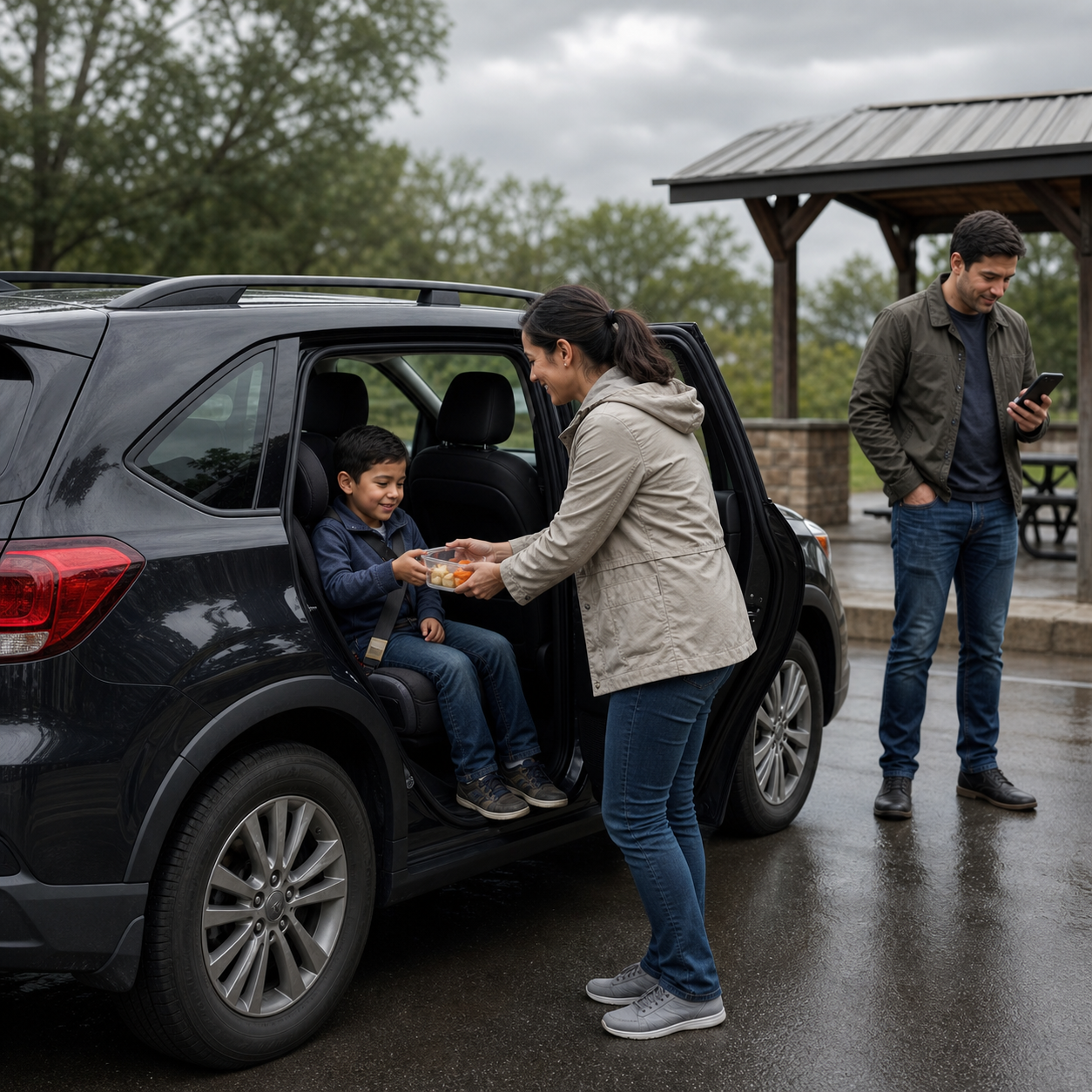
| The back seat is one of the worst places for a choking emergency. |
| A child is strapped into a car seat or seat belt. The driver may be alone. Traffic may make it difficult to pull over immediately. A cough can sound ordinary for a few seconds before it becomes clear that something is wrong. |
| Car snacks should be chosen conservatively. Avoid gum, hard candy, chewy candy, whole grapes, popcorn, nuts, and other foods that become harder to manage when a child is laughing, talking, or bouncing along a rough road. |
| For younger children, the safer option is often to wait until the car stops. |
| A quiet snack may feel like an easy solution during a long drive. It can also create a situation where the only adult is facing forward while the child needs help behind them. |
| A child sitting down isn't always eating safely. |
| On the couch, children lean back, look away from the food, and take bites without noticing their size. During a game, a child may talk through a mouthful of snacks, laugh through a headset, or reach into a bowl repeatedly without slowing down. |
| The household rule needs one extra line: |
| Sit upright and pay attention while eating. |
| Food shouldn't become background activity. A child can pause a show, put down the controller, and finish chewing before speaking. Those habits may feel overly cautious until a close call makes them feel obvious. |
| Not every coughing episode is severe choking. |
| A child who is coughing forcefully is still moving air. Stay close, encourage the child to keep coughing, and watch carefully. Don't give food or water. Don't reach into the mouth unless you can clearly see an object that can be removed safely. |
| The situation changes when the cough becomes weak, ineffective, or silent. |
| Treat it as severe choking if the child: |
| Can't speak | Can't cough effectively |
| Can't breathe normally | Makes weak or high-pitched sounds instead of a strong cough |
| Becomes visibly distressed or unusually still | Shows a color change around the lips or face |
| Clutches the throat or signals that air isn't moving |
Children don't always perform the classic choking gesture. Some freeze. Some look frightened but make very little sound. A sudden loss of an effective cough is enough reason to act.
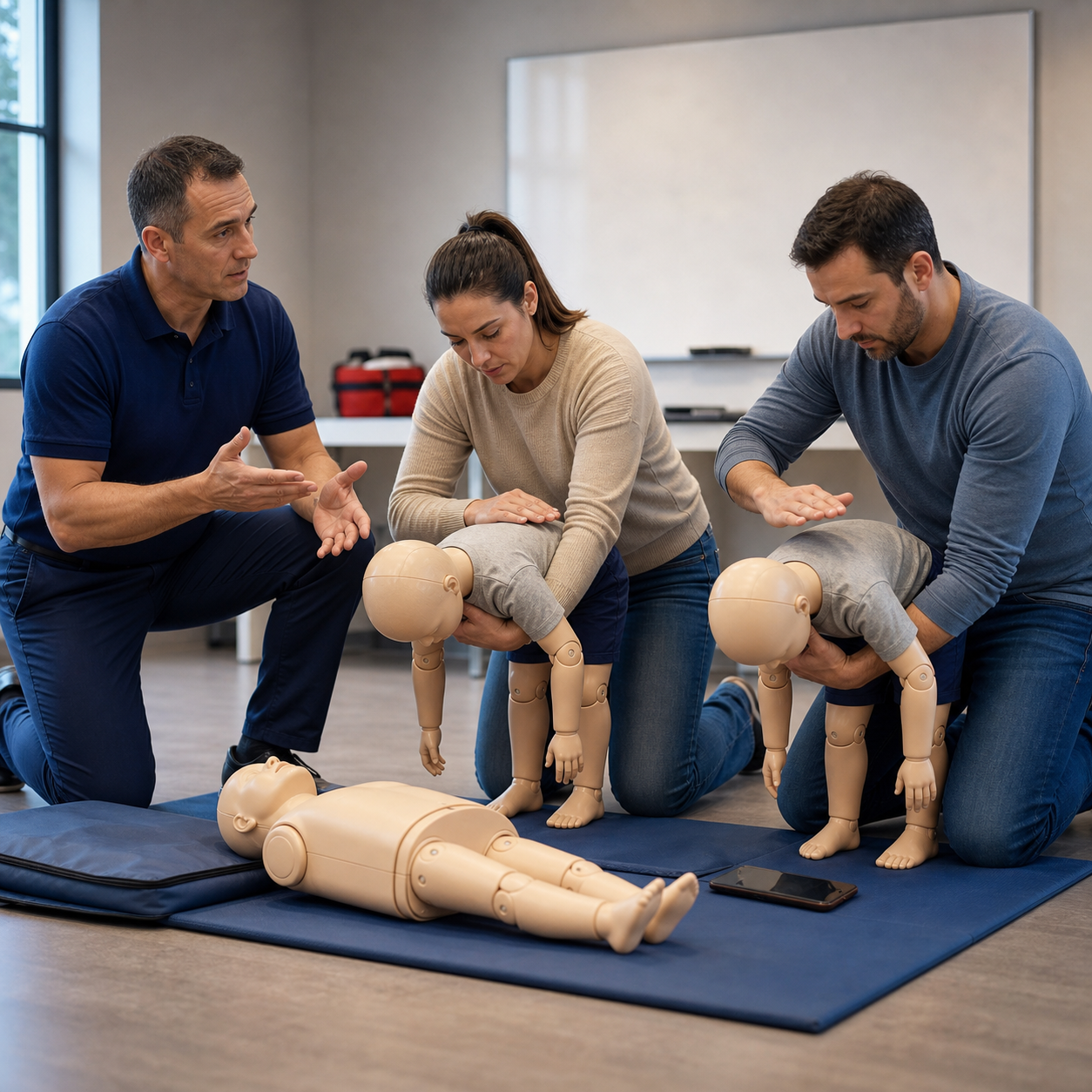
| For a responsive child older than 1 who can't speak, cough effectively, or breathe normally: |
| Call 911 immediately, or tell a specific person to call. |
| Give 5 back blows between the shoulder blades. |
| Give 5 abdominal thrusts. |
| Continue alternating 5 back blows and 5 abdominal thrusts until the object comes out or the child becomes unresponsive. |
| If the child becomes unresponsive, begin CPR based on your training and follow the 911 dispatcher's instructions. |
| Only remove an object from the mouth if you can clearly see it. Don't perform a blind finger sweep. |
| Infants under 1 need a different response. Their choking first aid uses back blows and chest thrusts, not abdominal thrusts. |
| This article is educational. A hands-on pediatric first-aid and CPR course is still the best place to learn the correct technique and practice it before an emergency. |

| A suction anti-choking device does not replace 911, manual choking rescue, CPR, or first-aid training. |
| If a household chooses to keep one as part of its emergency setup, it belongs in a second-line role after established choking rescue steps have been attempted and haven't cleared the obstruction. It should be stored where an adult can retrieve it quickly without delaying the standard response. |
| The sequence needs to stay clear under stress: |
| Call 911. Begin trained choking first aid. Use a suction device only as a backup after standard rescue is unsuccessful. Begin CPR if the child becomes unresponsive. |
| The mistakes that cost time |
| Most delays don't come from a lack of concern. They come from disbelief. |
| An adult offers water because the child was coughing a moment ago. Someone keeps asking, 'Are you okay?' when the child physically can't answer. A relative reaches blindly into the mouth. At a party, people assume another adult has already called 911. |
| Families can remove much of that confusion before it starts. |
Keep the home address easy to find, especially for babysitters and visiting relatives. Make sure grandparents know the same food rules. Review where emergency equipment is stored. Don't let a preparedness tool disappear into a closet that nobody checks.
The strongest food-safety rules are usually the ones children can remember without negotiation:
| Sit down for snacks and meals. | Stay upright while chewing. |
| Take one bite at a time. | Swallow before talking, laughing, or running. |
| Pause games and screens while taking a bite. |
| Avoid gum and chewy candy in the car. |
| Cut round foods into safer pieces for younger children. |
| Keep higher-risk foods away from children who aren't ready for them. |
| Make sure babysitters, grandparents, and relatives follow the same rules. |
| A perfect menu isn't realistic. A steady routine is. |
| Before the next snack |
| Walk through the rooms where children actually eat. |
| Check the kitchen table, the couch, the backyard, and the car. Notice which snacks show up in each place. Decide which foods need different preparation. Ask whether every caregiver knows how to recognize the moment when a strong cough turns weak or silent. |
| Preparedness doesn't need to make the home feel anxious. It should make the next decision easier when an ordinary afternoon suddenly isn't ordinary anymore. |
Yes. A strong cough usually means air is still moving, so encourage coughing and stay close. If the cough becomes weak, ineffective, or silent, or the child can't speak or breathe normally, treat it as severe choking and act immediately.
Call 911 immediately and begin choking first aid. For a responsive child older than 1, current guidance uses cycles of 5 back blows followed by 5 abdominal thrusts until the object is expelled or the child becomes unresponsive.
No. Water doesn't clear a blocked airway and may waste time. Begin the appropriate choking first-aid response instead.
No. Only remove an object if you can clearly see it. A blind finger sweep may push the object deeper into the airway.
For younger children, whole grapes and hot dog rounds create a serious choking risk because of their shape. Cut them lengthwise and into small pieces. Food preparation should match the child's age, chewing ability, and maturity.
They can be. The adult may be driving, the child may be strapped into a seat, and it can take time to pull over safely. Avoid higher-risk foods in the car, especially gum, hard candy, chewy candy, nuts, popcorn, and round foods served whole.
No. A suction anti-choking device belongs in a second-line role after established choking rescue steps haven't worked. It doesn't replace 911, manual choking rescue, CPR, or first-aid training.
No. Infants under 1 need an infant-specific response using back blows and chest thrusts. They should not receive abdominal thrusts.
| American Heart Association: Part 6 - Pediatric Basic Life Support - Supports the 2025 AHA child severe foreign-body airway obstruction sequence: repeated cycles of 5 back blows alternating with 5 abdominal thrusts; CPR if the child becomes unresponsive. |
| American Heart Association: Child Foreign Body Airway Obstruction Algorithm - Provides the current child FBAO algorithm in a concise visual format. |
| American Red Cross: Adult and Child Choking - Symptoms and First Aid - Supports recognition of choking and the use of 5 back blows followed by 5 abdominal thrusts for adults and children. |
| HealthyChildren.org / American Academy of Pediatrics: Choking Prevention for Babies and Children - Supports age-appropriate prevention advice and higher-risk food examples, including hot dogs, grapes, hard or sticky candy, gum, nuts, and seeds. |
| FDA Safety Communication: FDA Encourages the Public to Follow Established Choking Rescue Protocols - Supports the boundary that established choking rescue protocols come first and suction anti-choking devices belong only in a second-line role after unsuccessful standard rescue. |
| FDA De Novo Database: DEN250012 - Supports the 2026 classification terminology for a suction anti-choking device as a second-line treatment under 21 CFR 874.5400. |
This article is for general education and emergency preparedness. It is not medical advice, diagnosis, or treatment. In an emergency, call 911 or the appropriate local emergency number immediately and follow dispatcher instructions. Use choking first aid and CPR techniques appropriate to the person's age and condition, based on certified training. A suction anti-choking device is a second-line backup option after unsuccessful standard choking rescue. It does not replace prevention, first-line rescue, CPR, EMS, or professional medical care.


