If you are choking alone and cannot cough, speak, or breathe effectively, call 911 if possible, then perform self-abdominal thrusts. Use your fist or press your upper abdomen against a firm chair back or countertop. If air stops moving, every second matters. A choking rescue device is backup only if reachable and appropriate.
For a household checklist, see Fitiger's child and home choking safety readiness plan.
Choking alone is different from every other choking scenario because there is no bystander to recognize the danger, call 911, start first aid, or bring a choking emergency kit from another room. The whole response begins with the person who is already losing air.
It can happen over a late dinner, a rushed bite over the sink, a snack in a home office, a piece of steak at a restaurant bar, or a quiet meal after everyone else has gone to bed. You may feel the bite stick, try to cough, and realize the cough is not strong enough. The situation becomes frightening quickly because there is no one else in the room to recognize the change or start the response.
The first decision is still the same one used in every choking emergency: can air move? A strong cough means there is still some airflow. No useful cough, no speech, and no effective sound means the emergency has crossed into severe airway obstruction.
If you can cough forcefully, keep coughing. Do not waste that airflow by trying several small, nervous movements at once. Lean forward, cough hard, and move toward a phone or a place where someone might hear you.
A forceful cough is not failure. It is your body still doing useful work. The danger begins when the cough becomes weak, speech disappears, or you can no longer pull in enough air to keep trying.
At home, this can feel confusing because there may be no one to confirm what is happening. Use the sound test. If you can make a strong cough or call out, air is moving. If you cannot speak, cannot cough effectively, or feel the room narrowing around you, act now.
If severe choking is underway and you are alone, call 911 or your local emergency number as soon as you can. Put the phone on speaker. Even if you cannot talk clearly, an open emergency call may help responders locate you.
Self-rescue differs from helping another adult. In a two-person rescue, one person can call while another starts care. When you are alone, the call is part of the rescue sequence. It creates a second path into the room before you lose consciousness.
If you are in a workplace, restaurant, apartment building, hotel, or public space, also move toward people if you can do so without wasting breath. Bang on a wall, hit a table, or get into a hallway. Do not lock yourself farther away from help.
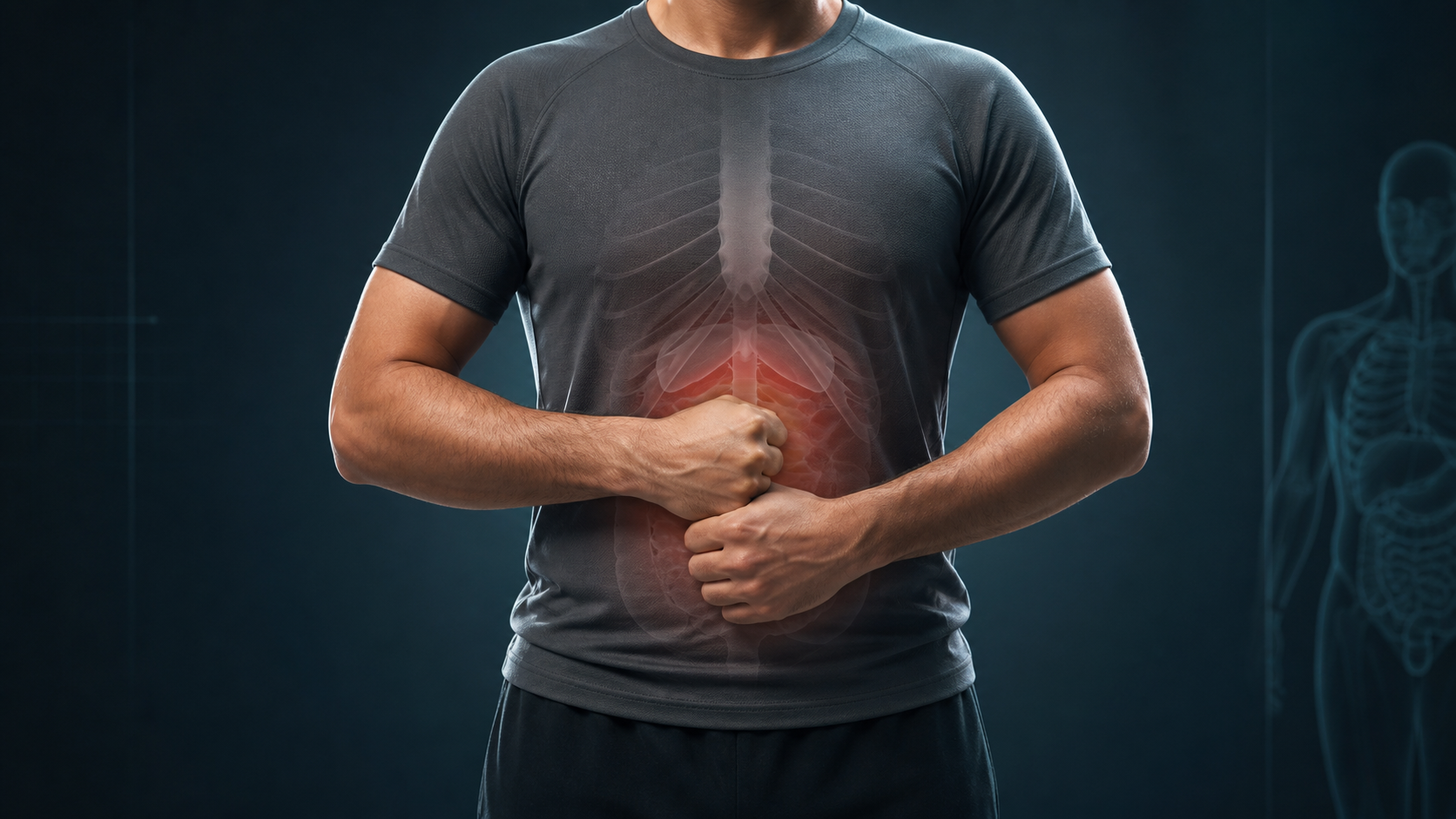
Make a fist and place it slightly above your navel, below the breastbone. Grab that fist with your other hand. Thrust inward and upward, sharply and repeatedly, trying to create pressure that can force air up behind the object.
If your hands are not enough, use a hard surface. Bend over the back of a sturdy chair, the edge of a countertop, a table edge, or a railing that is firm enough to take force. Drive your upper abdomen inward and upward against the edge. Avoid sharp corners when possible.
This is often described as a self Heimlich maneuver. In plain terms, you are trying to create the same pressure a rescuer would create from behind. The movement should be forceful, not timid. Small pushes often do not move a true obstruction.
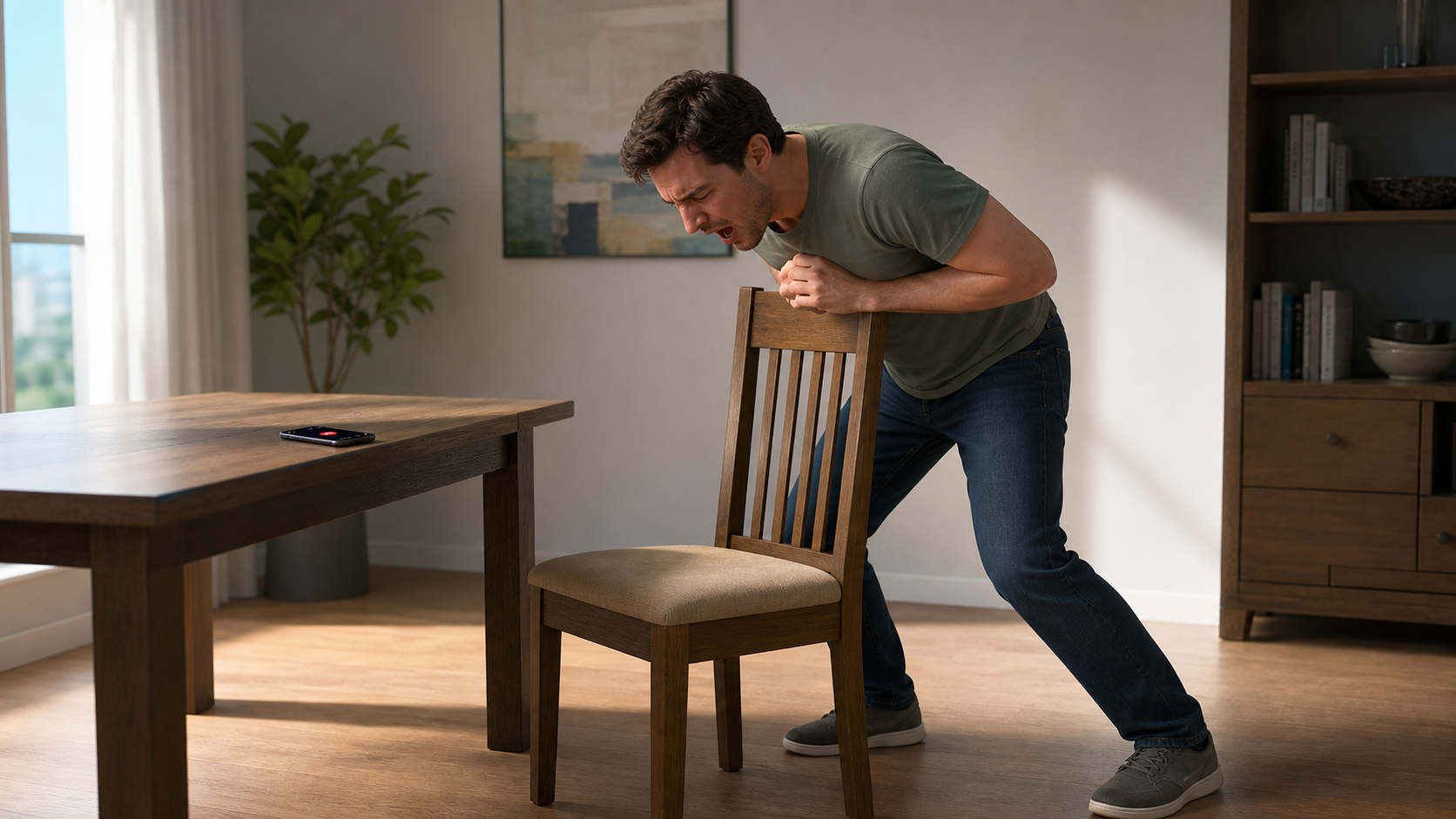
Picture a person alone in a kitchen. A bite catches. The cough fades. The chair next to the table suddenly matters. So does the counter edge. Those surfaces can give you leverage your hands may not create by themselves.
Use the firmest, safest edge nearby. A padded sofa arm may collapse under force. A rolling chair may slide away. A sharp counter corner may injure you. The best surface is stable, about upper-abdomen height, and strong enough to let you drive inward and upward without losing balance.
This is not elegant. It does not need to be. A choking emergency at home alone is a physical problem first: restore airflow or create enough pressure to move the blockage.
If the object comes out and you can breathe, do not simply return to the meal. Choking and strong abdominal thrusts can leave throat irritation, chest discomfort, vomiting, aspiration concern, or abdominal injury. Get medical advice, especially if breathing feels abnormal, pain remains, or you needed repeated forceful thrusts.
If you become weak, dizzy, confused, or collapse, the emergency has moved beyond self-rescue. Call 911 early. The call is not a formality. It is a bridge to EMS if your own actions do not work.
If you are with others when breathing returns, ask them to stay with you and watch for symptoms. Do not drive yourself after a serious choking event unless emergency professionals tell you it is safe.
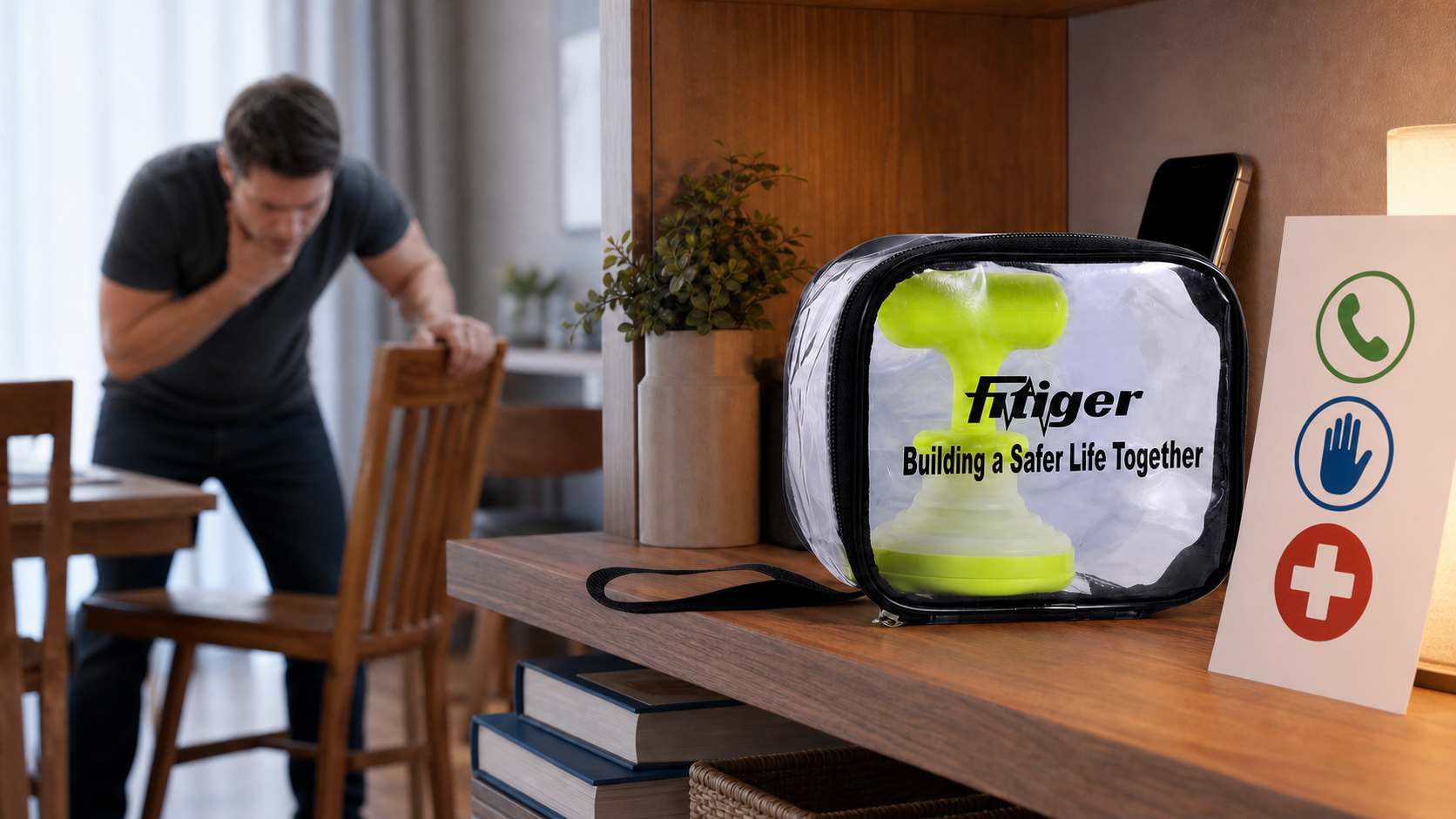
A lot of adults considering a choking rescue device for home are not imagining a crowded dining room. They are thinking about eating alone: a widowed parent, someone living by themselves, a late-night meal after work, or a caregiver who worries no one will be nearby.
That concern is real. The placement question matters more than the product photo. A portable anti choking device stored in a closet, garage, or sealed cabinet is not truly reachable during a one-person emergency. If it is part of a home choking emergency kit, it needs to live near the places where choking risk is most likely: kitchen, dining table, bedside snack area, or eldercare room.
FDA's 2026 QXN framework defines a suction anti-choking device under 21 CFR 874.5400 as a second-line treatment for complete airway obstruction after unsuccessful basic life support choking protocol. For a person choking alone, that boundary is still important. The device is not a reason to skip coughing, self-thrusts, 911, or CPR transition if the person becomes unresponsive. It is a prepared backup layer if it is reachable and used according to instructions.
Most buyers do not only ask, "Does it work?" They ask more honest questions: Will I remember where it is? Can I use it on myself? Will my elderly parent understand it? What happens if I panic? Does this replace the Heimlich maneuver? What if it does not remove the object?
Those questions belong in the purchase decision. A choking rescue device for home should be evaluated as part of a wider choking emergency preparedness plan, not as a magic object. The home plan should include safe eating habits, phone access, family check-ins for high-risk adults, caregiver instructions, and a clear stopping rule if the device attempt fails.
For older adults, the decision often overlaps with choking risk for elderly care. Dentures, swallowing difficulty, dry mouth, stroke history, Parkinson's disease, dementia, and eating alone can all change mealtime safety. A device may add redundancy, but prevention and recognition still sit earlier in the chain.
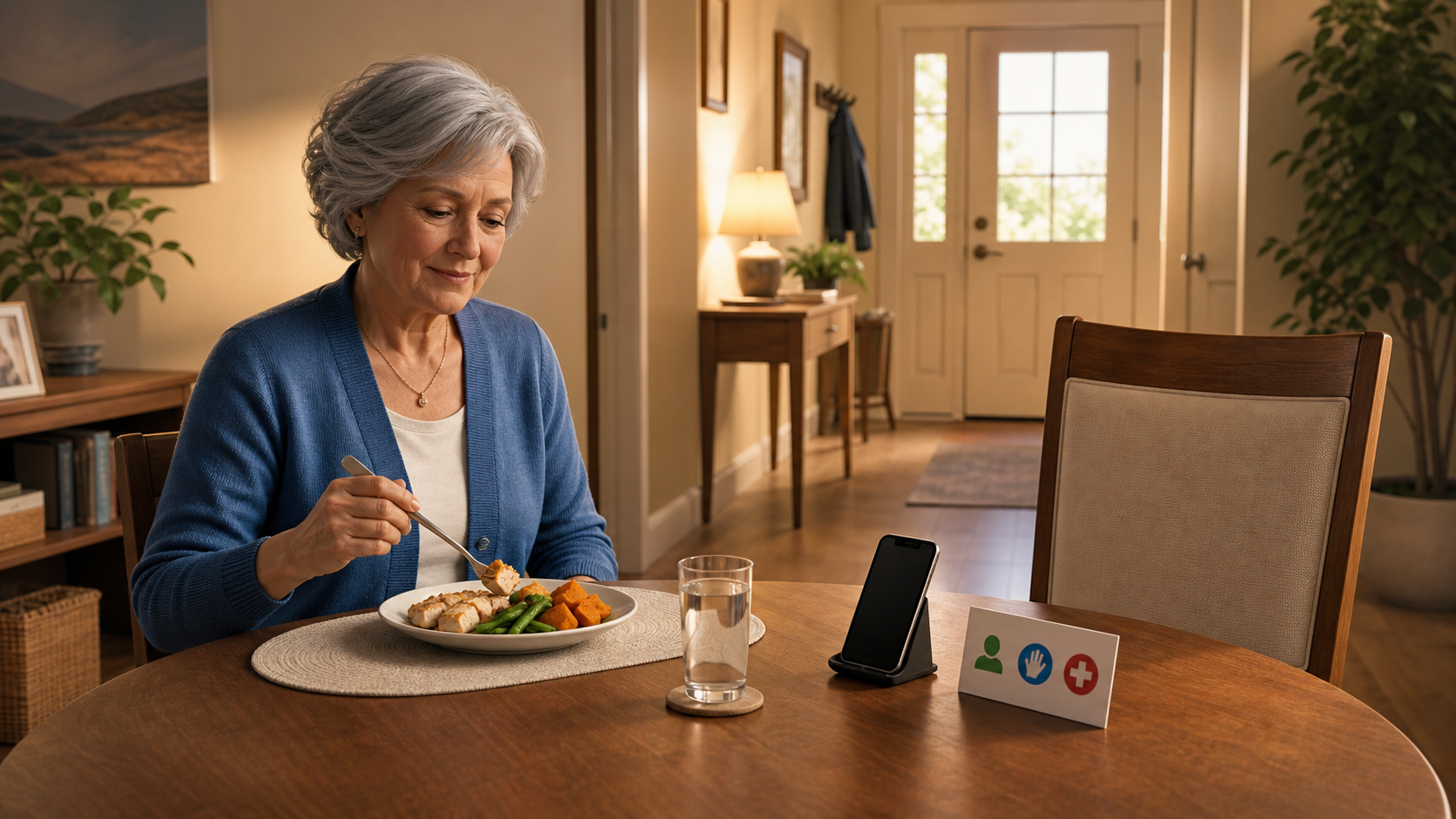
People who often eat alone should design the room before the emergency. Keep a charged phone nearby during meals. Avoid eating while walking around the house. Sit upright. Cut dense foods smaller. Be careful with steak, dry bread, sticky foods, and large bites taken while distracted.
If you are at higher choking risk, consider a daily check-in routine during meals or after dinner. In eldercare and assisted living, staff should not treat independent dining as zero-risk dining. The person may be independent most days and still need a plan for the one bite that goes wrong.
A choking emergency kit for home should be visible and simple. If it includes an airway clearance device, the user and nearby family members should know the age and use limits, the second-line boundary, and what to do if the device does not clear the airway.
Situation | What it suggests | Immediate action | Preparedness note |
|---|---|---|---|
You can cough forcefully | Air is still moving | Keep coughing, lean forward, stay near help | Do not start frantic small interventions that waste airflow |
You cannot speak or cough effectively | Severe choking may be underway | Call 911 if possible; start self-abdominal thrusts | Use speakerphone if available |
Hands do not create enough force | Leverage may be insufficient | Use a chair back, counter, table edge, or railing | Choose a stable, non-sharp surface |
Object clears | Airflow has returned but injury risk remains | Seek medical advice and stay monitored | Do not immediately resume eating |
Backup device is nearby | Second-line tool may be reachable | Use only if appropriate and not delaying emergency response | Keep device visible and train before emergency |
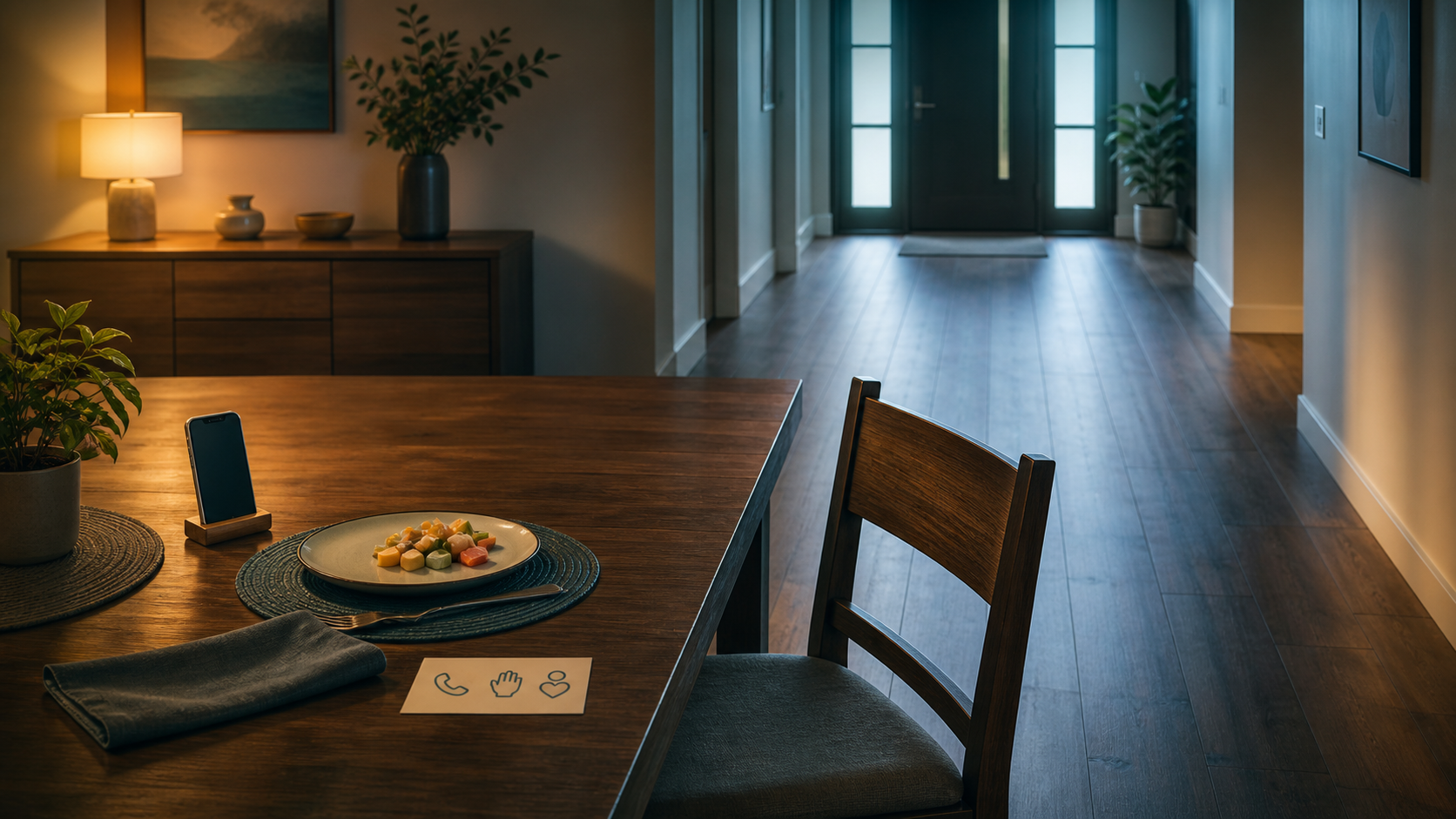
Choking alone is not mainly a knowledge test. It is a room-design test. Can you reach the phone? Is there a sturdy surface nearby? Is the choking rescue device visible? Does someone know to check on you? Did you cut the food smaller before you sat down?
The emergency begins with one question: can air still move? If yes, cough hard and get near help. If no, call 911 if possible and start self-abdominal thrusts. Use a hard surface if your hands are not enough. If a portable airway rescue device is part of your plan, treat it as second-line backup, not as a replacement for immediate self-rescue.
Explore Fitiger choking safety resources, home airway emergency kits, and second-line choking-readiness options for families, older adults, workplaces, and care settings after standard first-line choking response fails.
For related planning context, review the child and home choking safety readiness plan.
If you can cough forcefully, keep coughing and move toward help. If you cannot cough, speak, or breathe effectively, call 911 if possible, put the phone on speaker, and begin self-abdominal thrusts immediately.
Make a fist, place it slightly above your navel, grab it with your other hand, and thrust inward and upward. If your hands are not enough, bend over a firm chair back, counter, table edge, or railing and drive your upper abdomen inward and upward against it.
If severe choking is underway and you can call, call 911 immediately. Use speakerphone if available. The call brings help if your own actions do not work or if you become unresponsive.
A strong cough means air is still moving. Keep coughing hard, lean forward, and stay near a phone or other people. Start self-rescue steps if the cough becomes weak, speech disappears, or breathing becomes ineffective.
A choking rescue device for home may add backup if it is reachable, appropriate for the user, and understood before the emergency. It should not replace self-abdominal thrusts, 911, medical evaluation, or CPR transition if the person becomes unresponsive.
No. Under the FDA QXN framework, a suction anti-choking device is a second-line treatment after unsuccessful basic life support choking protocol for complete airway obstruction. It is a backup layer, not a substitute for first-line response.
Keep it near the places where choking is most likely: the kitchen, dining area, eldercare room, or travel bag. A device locked in a closet or stored far from meals may not be useful during the first minute.
Yes. Older adults with dentures, swallowing difficulty, stroke history, Parkinson's disease, dementia, dry mouth, or frequent coughing during meals should have a more deliberate plan: smaller food pieces, upright eating, phone access, check-ins, and reachable emergency tools.
Get medical advice, especially if you needed repeated thrusts, have throat pain, chest pain, abdominal pain, persistent coughing, vomiting, or abnormal breathing. Choking may clear, but injury or aspiration concern can remain.
American Heart Association 2025 CPR and ECC Guidelines Update - Supports updated choking response recommendations for adults, children, and infants.
Mayo Clinic Choking First Aid - Supports self-administered abdominal thrusts and using a hard surface such as a countertop or chair.
FDA 2026 Safety Communication - Supports following established choking rescue protocols and second-option device positioning.
FDA De Novo DEN250012 - Supports 21 CFR 874.5400, product code QXN, and the second-line suction anti-choking device category.
Red Cross First Aid Resources - Supports public first-aid education and choking recognition guidance.
MedlinePlus Choking First Aid - Supports choking warning signs, response urgency, and emergency care guidance.
This article is for general education and emergency preparedness only. It does not replace professional medical advice, certified CPR or first-aid training, emergency medical services, device instructions for use, or local emergency protocols. In a choking emergency, call 911 or your local emergency number and follow dispatcher instructions.


