If an adult is choking and cannot cough, speak, or breathe effectively, treat it as severe choking. Use 5 back blows followed by 5 abdominal thrusts, call 911, and repeat until the object clears or the adult becomes unresponsive. A choking rescue device belongs only after manual first aid fails.
For a household checklist, see Fitiger's child and home choking safety readiness plan.
Before choosing equipment, review Fitiger's anti-choking device buyer evidence checklist for FDA wording, testing, seller traceability, and kit-selection questions.
Adult choking often looks less dramatic than people expect. A coworker at lunch suddenly stops answering. A parent at the kitchen table reaches for water but cannot speak. A restaurant guest stands halfway up from a booth, eyes wide, one hand near the throat. In an elder-care dining room, a resident coughs once, goes quiet, and the room hesitates.
In those scenes, people don't need a theory lesson. They need a clean sequence they can remember under stress.
Recognize severe choking, begin the appropriate first-aid steps, and ask someone to call 911. Do not pause care to search for equipment.

A strong cough means air is still moving. Stay close, encourage coughing, and watch carefully. Do not start abdominal thrusts while the person is forcefully coughing and able to make sound.
The emergency changes when the cough becomes weak or disappears, speech stops, breathing looks ineffective, color changes, or the person shows panic without useful sound. Severe adult choking can be quiet. A person may look embarrassed at first, then frightened. They may open their mouth and produce almost nothing. In a crowded restaurant, office break room, or family dinner, that silence is easy to misread.
The simple question is still the right one: can the adult cough forcefully or speak? If yes, encourage coughing and stay with them. If no, begin choking first aid immediately and have someone call 911.
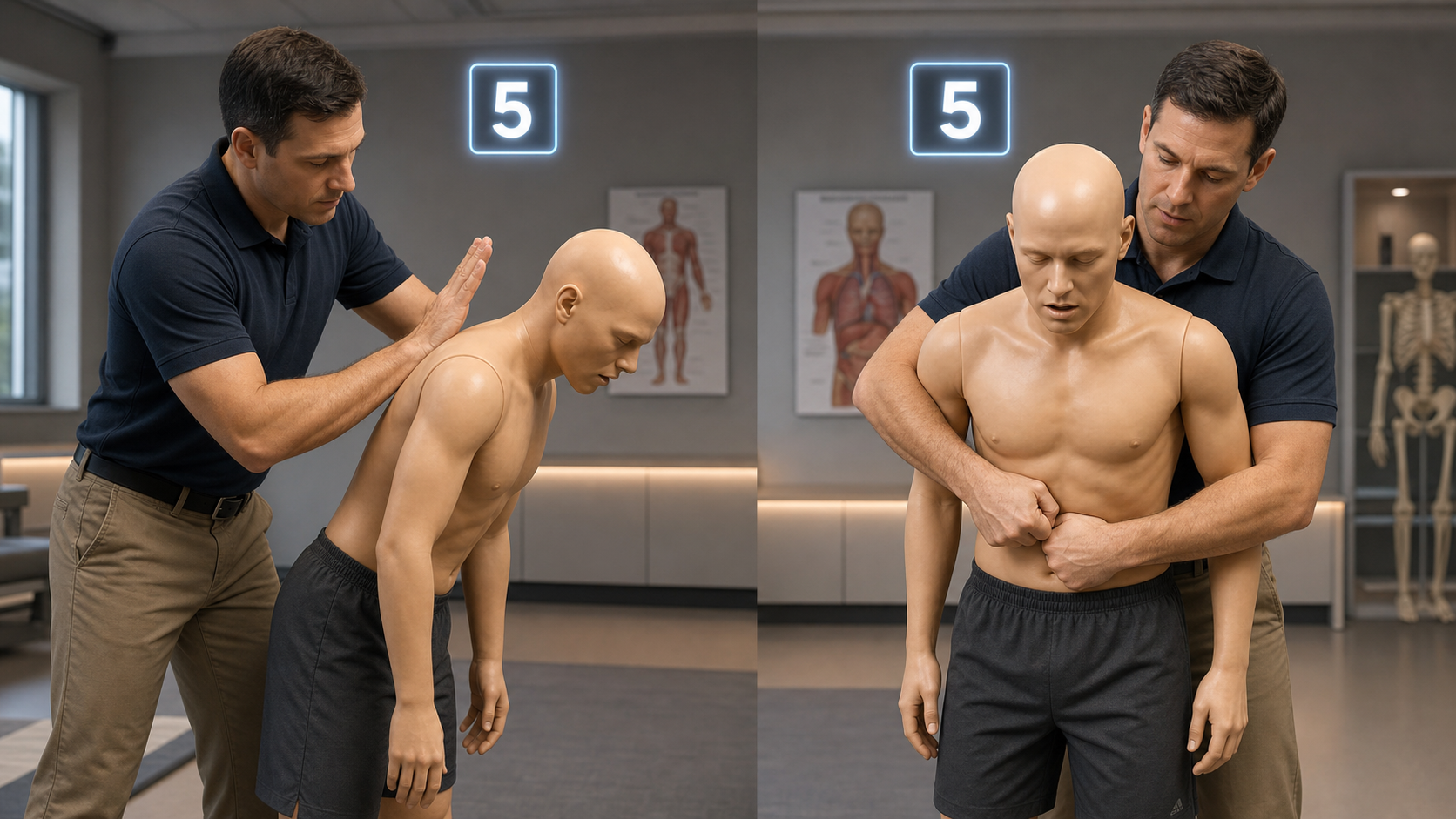
For a responsive adult with severe choking, use repeated cycles of 5 back blows and 5 abdominal thrusts.
Stand slightly behind and to the side of the adult. Support the chest with one hand and lean the person forward so the object has a path out of the airway.
Give 5 firm back blows between the shoulder blades with the heel of your hand. Make each blow separate and deliberate.
If the object does not come out, move behind the person. Place a fist just above the navel, below the breastbone. Grasp the fist with your other hand and give 5 quick inward-and-upward abdominal thrusts.
Keep alternating 5 back blows and 5 abdominal thrusts until the object is expelled, the adult can breathe or cough again, or the person becomes unresponsive.
Many people still call the abdominal-thrust portion the Heimlich maneuver. Whatever name you learned, respond promptly when the adult cannot cough, speak, or breathe effectively.
| Do not give water. A blocked airway is not solved by swallowing more liquid. | Do not slap the person on the back while they are coughing forcefully and moving air. |
| Do not perform a blind finger sweep. If you cannot see the object, reaching into the mouth can push it deeper. | Do not leave the person alone to search for equipment. |
| Do not keep repeating standing maneuvers after the person becomes unresponsive. Move to CPR. | Do not treat a choking rescue device as the first step. Manual first-line care comes first. |
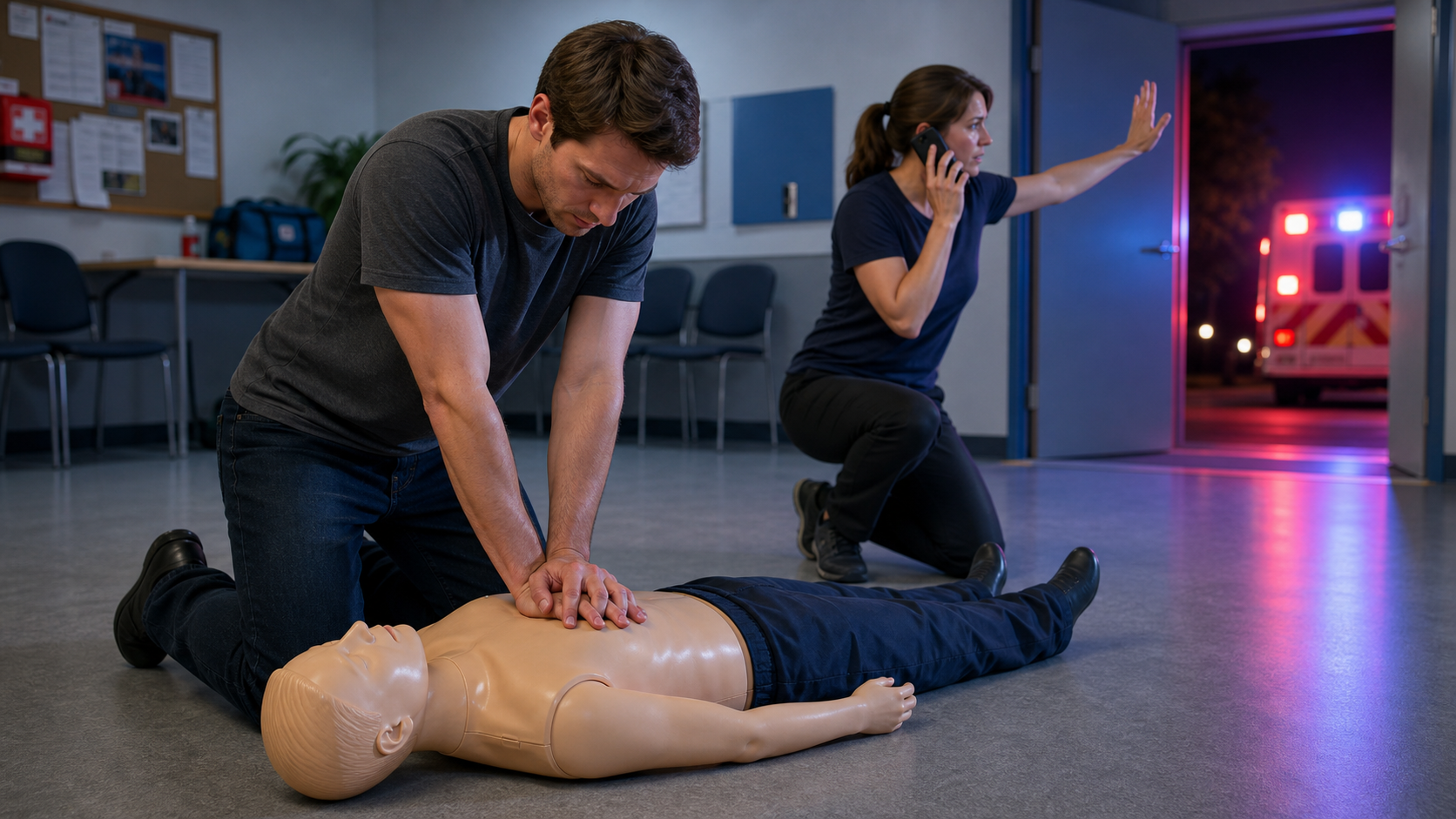
If the adult becomes unresponsive, lower the person carefully to a firm, flat surface. Call 911 immediately if that has not already happened. Begin CPR with chest compressions according to your training.
After compressions, open the airway and look in the mouth before giving breaths. Remove an object only if you can clearly see it. Do not sweep blindly.
This transition matters in homes, offices, restaurants, senior living communities, and public spaces. Once the person collapses, the emergency has changed. Standing abdominal thrusts are no longer the response. CPR and EMS handoff become the priority.
At home, the first problem is usually confusion. One person asks if the choking adult is okay. Another reaches for a phone. A child starts crying nearby. The choking person is standing in the kitchen, unable to answer.
A home choking emergency plan does not need to be complicated. One adult starts care. One calls 911. One clears space, unlocks the front door, and keeps children or pets away from the scene. If only one helper is present, start first aid immediately and call 911 as soon as possible, using speakerphone if available.
Families shopping for a choking rescue device for home often ask a practical question: will I remember what to do when the room panics? That concern is real. If a family considers a device, it should first check that exact product's regulatory status, labeling, and instructions. A device does not replace first-aid training, quick access to 911, or immediate manual care.
A restaurant guest may stop speaking while seated at a table or booth. Someone nearby may initially mistake a weak cough for ordinary throat clearing. Clear the space, identify who is providing care, and have another person call 911.
A restaurant choking emergency plan should name roles before the event: who starts care, who calls 911, who clears space, and where a choking first aid kit or second-line device is stored if the business keeps one on site.
Workplaces have a similar problem. Break rooms, conference lunches, factory cafeterias, office kitchens, and holiday meals all create eating areas without medical staff nearby. A workplace choking emergency plan should be short enough for employees to remember: recognize, call, care, clear space, and escalate if the person becomes unresponsive.
Adult choking risk is not evenly distributed. Older adults may face higher risk because of swallowing problems, dentures, dry mouth, neurologic disease, medication effects, fatigue while eating, cognitive decline, or eating alone.
In a nursing home or assisted-living dining room, the first warning may not be dramatic. A resident may cough once, stop chewing, reach for water, or go quiet. Staff may wonder whether this is ordinary throat clearing or a true airway obstruction. The same recognition rule still applies: a forceful cough means monitor; weak or absent cough, silence, color change, or inability to speak means act.
For elder-care settings, choking preparedness is not only about rescue. It includes food texture, supervision, denture checks, dysphagia plans, dining-room visibility, and a clear escalation path if manual rescue fails.

Some adult choking emergencies do not fit the clean training-room picture. A pregnant adult may not be able to receive abdominal thrusts safely. A person with severe obesity may be hard to encircle. A wheelchair user may have a backrest, armrest, belt, or seated angle blocking normal positioning.
For late pregnancy or when the rescuer cannot encircle the abdomen, the 2025 AHA guideline calls for cycles of 5 back blows followed by 5 chest thrusts until the object is expelled or the person becomes unresponsive. Train for these adjustments before an emergency rather than improvising from a device illustration.
Facilities that serve adults should think about this before the emergency. A plan that works only for a standing, average-sized person in an open room is not a full adult choking response plan.
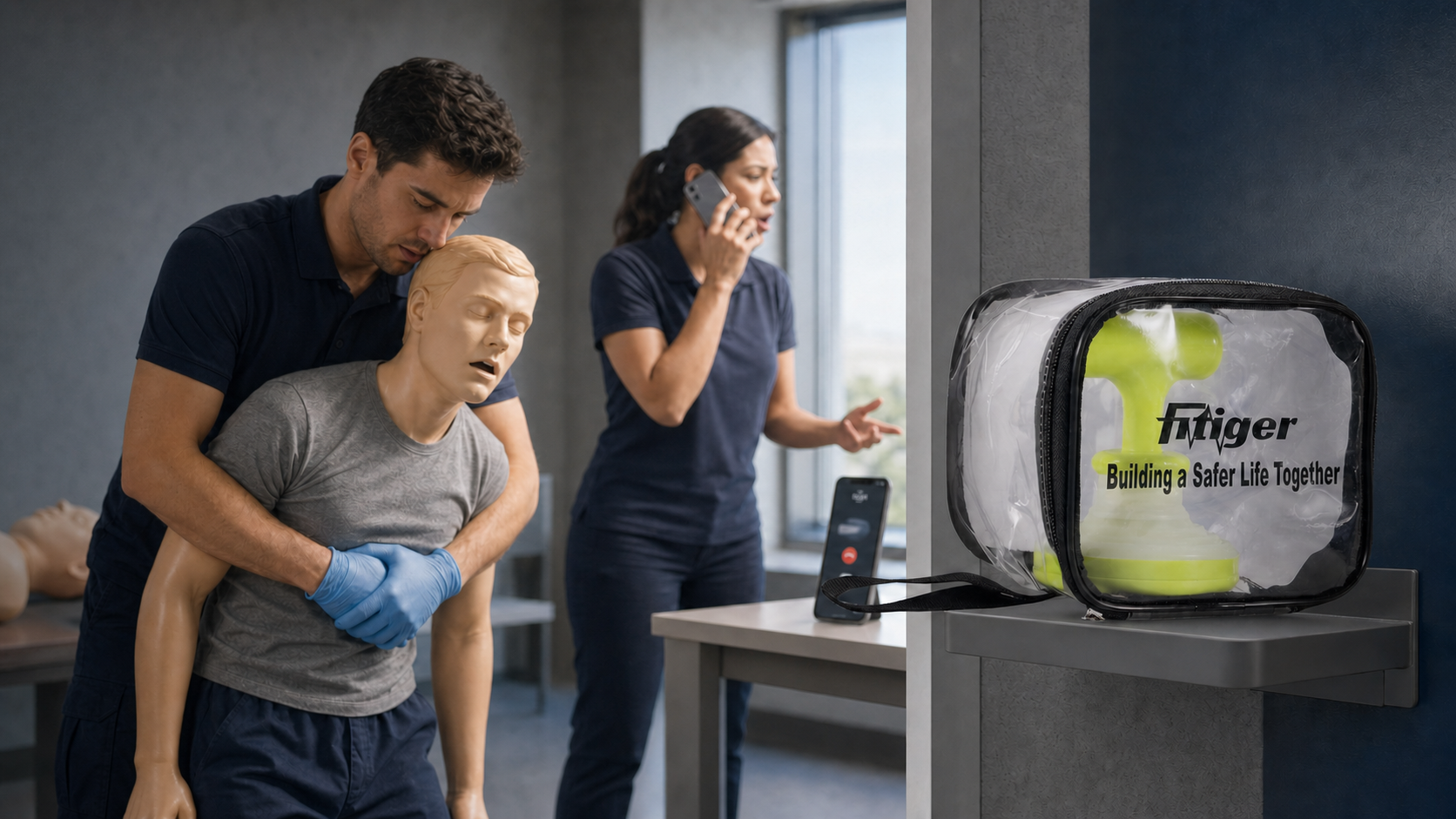
A device is a separate purchasing decision, not a substitute for choking first aid. The FDA says established rescue protocols come first and describes anti-choking devices as a possible second option only when those protocols are unsuccessful. Retrieving or assembling a device must not delay the response.
The regulatory boundary is product-specific. FDA's March 2026 De Novo decision DEN250012 names LifeVac, not Fitiger, as the authorized device. That decision established the QXN classification under 21 CFR 874.5400; it does not itself authorize every device in the category or any Fitiger product. Check the exact product's FDA record and instructions rather than transferring another brand's authorization.
The 2025 AHA adult basic life support guideline states that the effectiveness and safety of suction-based airway-clearance devices for adults have not been established and that evidence is insufficient to recommend them. This uncertainty applies even when a device is marketed as emergency backup. Follow established first aid, activate EMS promptly, and begin CPR if the adult becomes unresponsive.
A family, restaurant, workplace, or elder-care facility should not buy a choking rescue device as a panic purchase. The better purchase questions are practical.
| Who is most likely to be the first responder? | Where will the device be stored? |
| Can someone reach it without leaving the choking person alone? | Does everyone know manual first aid comes first? |
| Is the device clearly labeled for adult use and complete airway obstruction? | What happens if the device does not clear the object? |
A device stored far from an eating area may take time to retrieve. That practical concern does not establish that the device works or justify delaying established rescue steps.
A choking emergency kit for adults should support the rescue chain, not replace it. Training, 911 access, food-risk awareness, CPR readiness, and second-line backup all need to fit together.
|
Situation |
What it may mean |
First action |
Backup planning |
|---|---|---|---|
|
Adult can cough forcefully |
Partial obstruction; air is still moving |
Encourage coughing and stay close |
Keep phone nearby and watch for worsening |
|
Adult cannot speak, cough, or breathe effectively |
Severe choking |
Start 5 back blows + 5 abdominal thrusts |
Assign someone to call 911 |
|
Adult is pregnant or abdomen cannot be reached |
Standard abdominal thrusts may be unsafe or impractical |
Use back blows + chest thrusts |
Train staff on special-situation adjustments |
|
Adult becomes unresponsive |
Emergency has escalated |
Start CPR and call 911 |
Check mouth only for visible object |
|
Manual first aid fails |
Second-line backup may be considered |
Continue emergency response |
Do not delay EMS or CPR; check any exact device's status and instructions in advance |
Adult choking first aid starts with one decision: is the person still moving air? A strong cough means monitor closely. Silence, weak cough, no speech, color change, or panic means severe obstruction may already be underway.
Use 5 back blows and 5 abdominal thrusts for a responsive adult. Call 911. Move to CPR if the person becomes unresponsive. If your home, workplace, restaurant, or care facility keeps an anti choking device or airway clearance device nearby, do not treat it as evidence-backed replacement care or a shortcut around first aid. AHA says adult suction-device evidence is insufficient for a recommendation.
Fitiger Life LLC sells anti-choking devices and publishes this guide, so it has a commercial interest in the topic. Explore Fitiger airway safety resources separately from the medical guidance above. A Fitiger product page is not evidence that its device has the same FDA authorization as LifeVac or that suction-device effectiveness has been established for adults.
For related planning context, review the child and home choking safety readiness plan.
For related planning context, review the anti-choking device buyer evidence checklist.
First, decide whether the adult can cough forcefully or speak. If yes, encourage coughing and stay close. If the adult cannot cough, speak, or breathe effectively, start 5 back blows and 5 abdominal thrusts and have someone call 911.
Severe choking signs include weak or absent cough, inability to speak, little or no useful sound, pale or bluish skin, panicked expression, hands near the throat, and worsening breathing trouble. Silent choking can be easy to miss in restaurants, offices, and elder-care dining rooms.
For a responsive adult with severe choking, abdominal thrusts are part of the standard response after back blows. Many people still call this the Heimlich maneuver. Current guidance supports alternating 5 back blows with 5 abdominal thrusts until the object clears or the person becomes unresponsive.
If the adult is coughing forcefully, do not interfere with choking maneuvers yet. Encourage coughing, stay close, and watch carefully. Start first aid if the cough becomes weak, speech stops, or breathing worsens.
Call 911 if that has not already happened. Lower the person to a firm, flat surface and begin CPR with chest compressions according to your training. Look for a visible object before breaths, but do not perform a blind finger sweep.
For late pregnancy or when the rescuer cannot encircle the abdomen, the 2025 AHA guideline recommends cycles of 5 back blows followed by 5 chest thrusts until the object is expelled or the adult becomes unresponsive.
Follow established choking first aid and call 911. The FDA describes anti-choking devices as a possible second option only after standard protocols fail; the exact product must be checked for its own status and instructions. The AHA says adult suction-device evidence is insufficient for a recommendation. LifeVac's FDA decision does not authorize Fitiger devices.
Restaurants and workplaces may choose to keep choking rescue equipment as part of a broader emergency plan. Placement matters: equipment should be near eating areas, accessible, and paired with staff training so it does not create retrieval delay.
Learn standard choking first aid and CPR, plan quick 911 access, and check any exact product's regulatory status and instructions before buying. The AHA says effectiveness and safety of suction devices for adult choking have not been established. Never delay established rescue or EMS to look for a device.
American Heart Association 2025 Adult Basic Life Support Guideline - Supports the adult 5-back-blow/5-abdominal-thrust sequence, special-circumstance chest thrusts, CPR transition, and the stated uncertainty about suction devices.
American Red Cross First Aid Resources - Supports public-facing choking recognition and response steps.
MedlinePlus Choking First Aid - Supports choking warning signs, the cough distinction, no blind finger sweep, and emergency response guidance.
21 CFR 874.5400 Suction Anti-Choking Device - Supports the second-line regulatory category for suction anti-choking devices.
FDA De Novo DEN250012 - Identifies the LifeVac-specific De Novo authorization and QXN classification; it does not authorize Fitiger devices.
FDA 2026 Safety Communication - Supports established rescue protocols first and possible device consideration only when standard protocols are unsuccessful, without delaying first aid.
This article is for general education and emergency preparedness only. It does not replace professional medical advice, certified CPR or first-aid training, emergency medical services, workplace policy, facility policy, or device instructions for use. In a choking emergency, call 911 or your local emergency number and follow dispatcher instructions.


