School nurse shortages turn emergency response into a workflow problem. In many buildings, the nurse is not the first adult at the cafeteria table, hallway corner, or gym doorway where a choking event begins. The first minute belongs to the nearest adult. The system has to make that minute usable.
Before choosing equipment, review Fitiger's anti-choking device buyer evidence checklist for FDA wording, testing, seller traceability, and kit-selection questions.
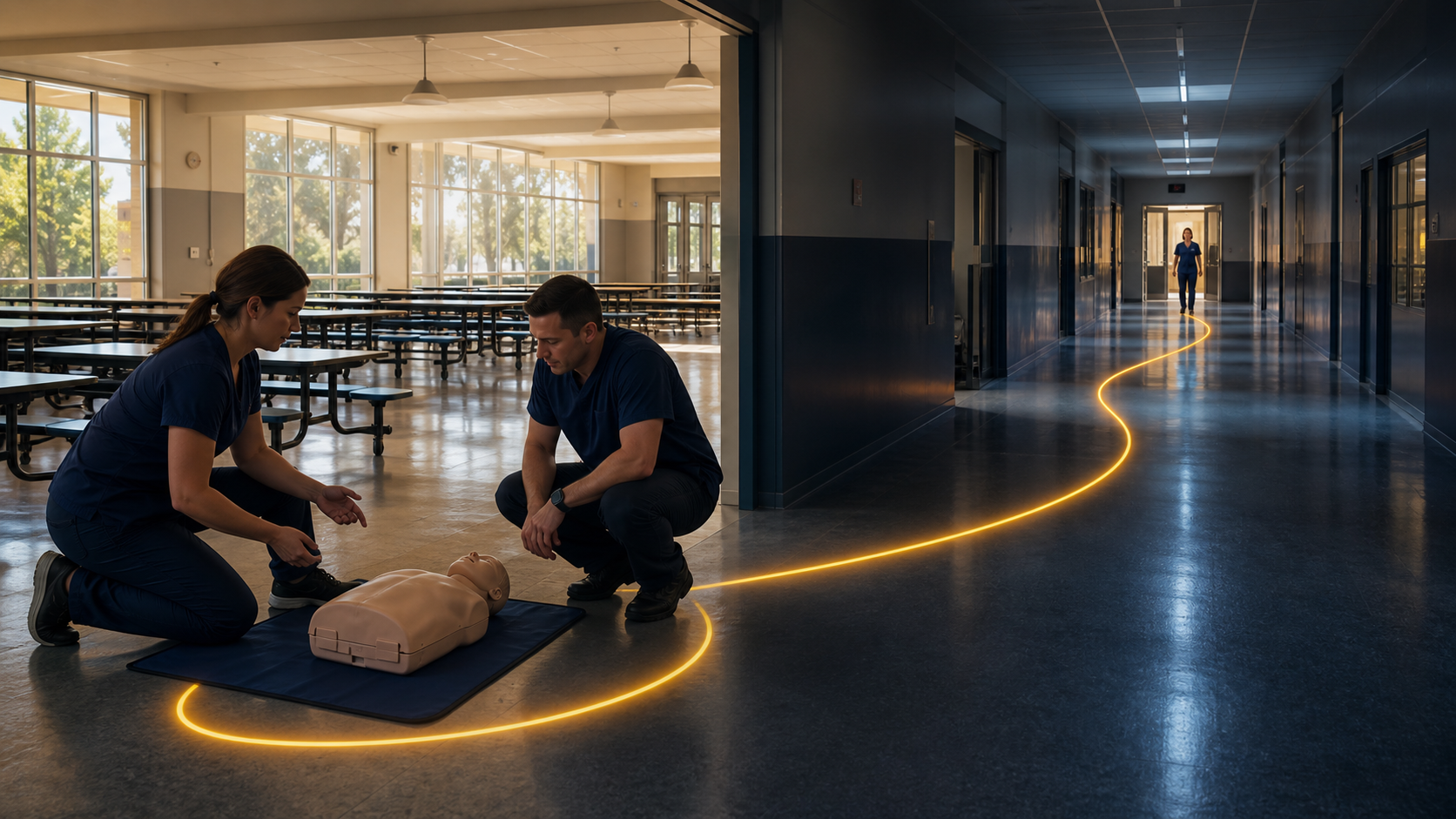
A safer school response model starts by accepting one fact: coverage on paper does not equal proximity in the room. Schools need a structure that lets the nearest adult begin first-line care, trigger location-aware help without leaving the student, and retrieve compliant second-line backup only after unsuccessful BLS under 21 CFR 874.5400.
A student can choke in a cafeteria, hallway, bus area, recess zone, or after-school program. The nurse may be in another wing, covering another building, or managing several students at once. Recent school nursing literature continues to describe high caseloads, often in the 750 to 1,000 range, and uneven access to full-time school nurse coverage across schools. Workload is a safety constraint. Once one clinician is stretched across too many rooms and too many students, proximity becomes the only biological defense left.
Emergency outcomes reflect reality: a choking event does not wait for a nurse to return from another wing. The nearest adult is usually the real first responder.
Schools often confuse staffing assignment with actual response capacity. A nurse may be assigned to the building and still be too far away to affect the first minute. That gap matters more in airway emergencies than in many routine health events because support has to arrive while first-line rescue is already happening.
The building either helps the first responder or it leaves that responder alone. Once the teacher, aide, coach, or cafeteria worker has to choose between staying hands-on and running to find help, the system has already created a dangerous delay.
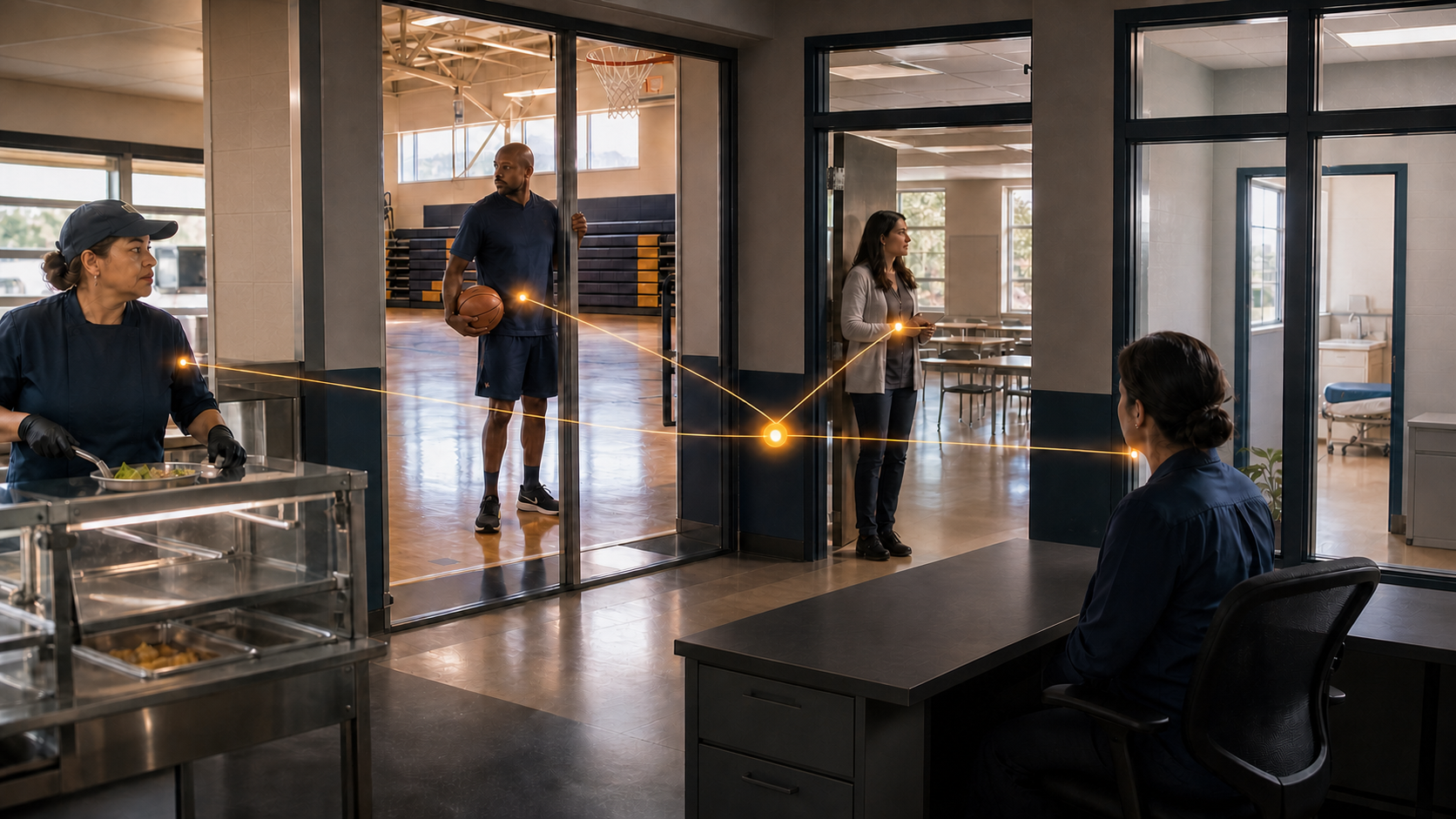
The staffing picture helps explain why workflow design matters so much. Public data and recent reviews point to the same operational problem: many schools still lack immediate, room-level clinical proximity, while school nurses often carry very large student loads. Rural EMS data makes the gap even starker. When outside response is slow, schools need stronger independent on-site backup layers.
Staffing Variable | Current Industry Baseline | Rescue System Impact |
|---|---|---|
Nurse Coverage | 60.2% of public schools reported a full-time nurse in NCES 2020-21 data | Creates response vacuums in distal wings and shared-use spaces |
Median Caseload | 750-1,000 students per nurse in recent school nursing literature | Forces triage delay during concurrent events |
Rural EMS Gap | 97.1 min average total call time in high-acuity rural EMS analysis | Demands stronger independent on-site backup layers |
Biological Limit | Brain injury risk rises within about 4-6 minutes of oxygen deprivation | Proximity must override administrative titles |
A nurse assigned to the school is not the same thing as a nurse close enough to shape the first minute.
Current AHA guidance for a conscious child with severe foreign-body airway obstruction is repeated cycles of 5 back blows followed by 5 abdominal thrusts until the object is expelled or the child becomes unresponsive. That sequence is deliberately simple. The surrounding workflow is not.
The problem is not uncertainty about the first-line rescue steps. The problem is whether the next layer of help can move quickly enough to support them.
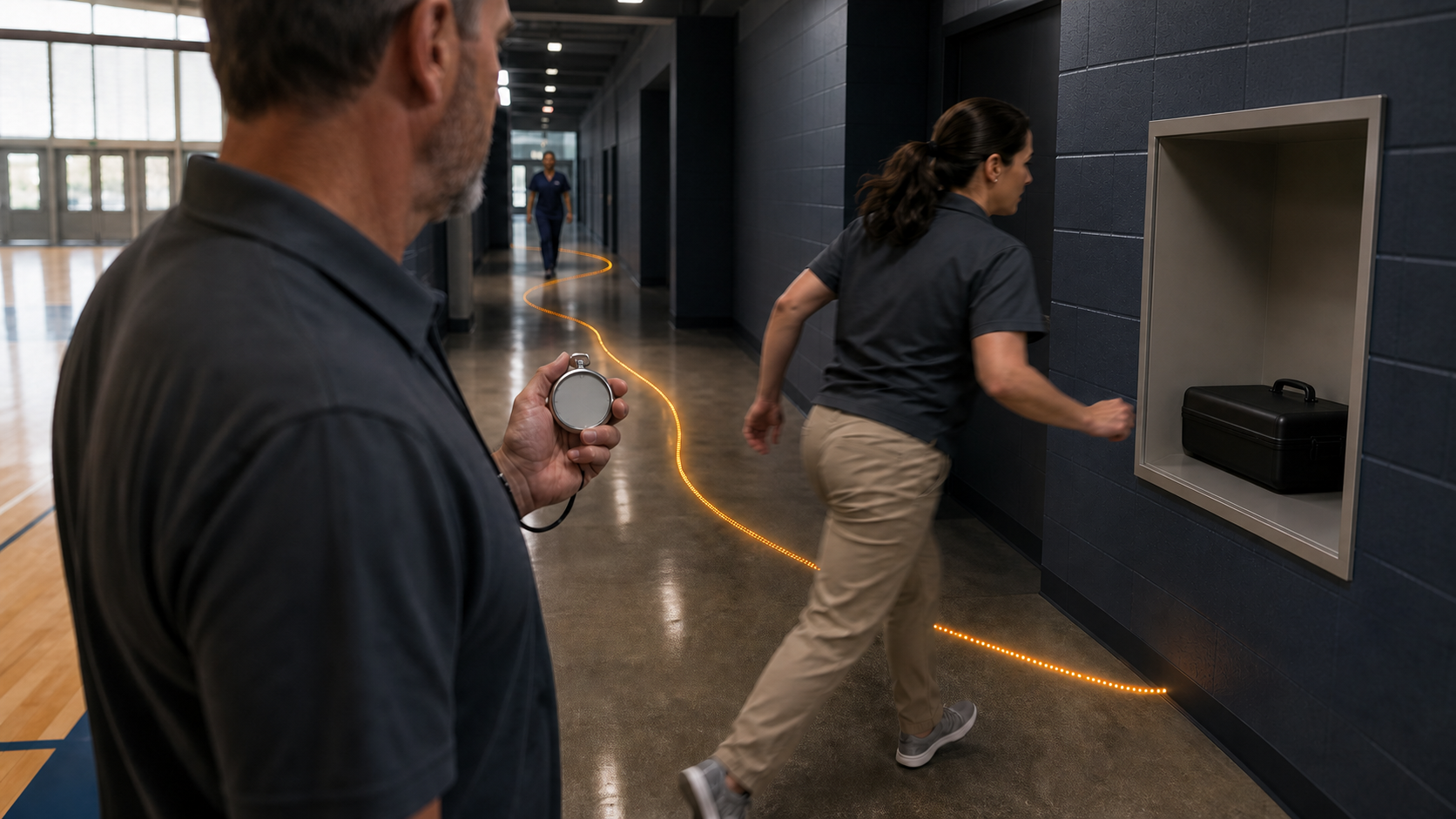
Fitiger's engineering view is simple: equipment that exists but cannot be reached inside the oxygen window is functionally absent. Retrieval latency starts when the need for backup is recognized and ends when the compliant second-line device arrives in the room. Response radius is the physical distance and time between the incident point and whoever can actually bring support.
A school may have a nurse, an AED, and a second-line airway device on campus. If all of them sit behind a locked health office door at the wrong end of the building, the system has built false reassurance instead of usable redundancy.
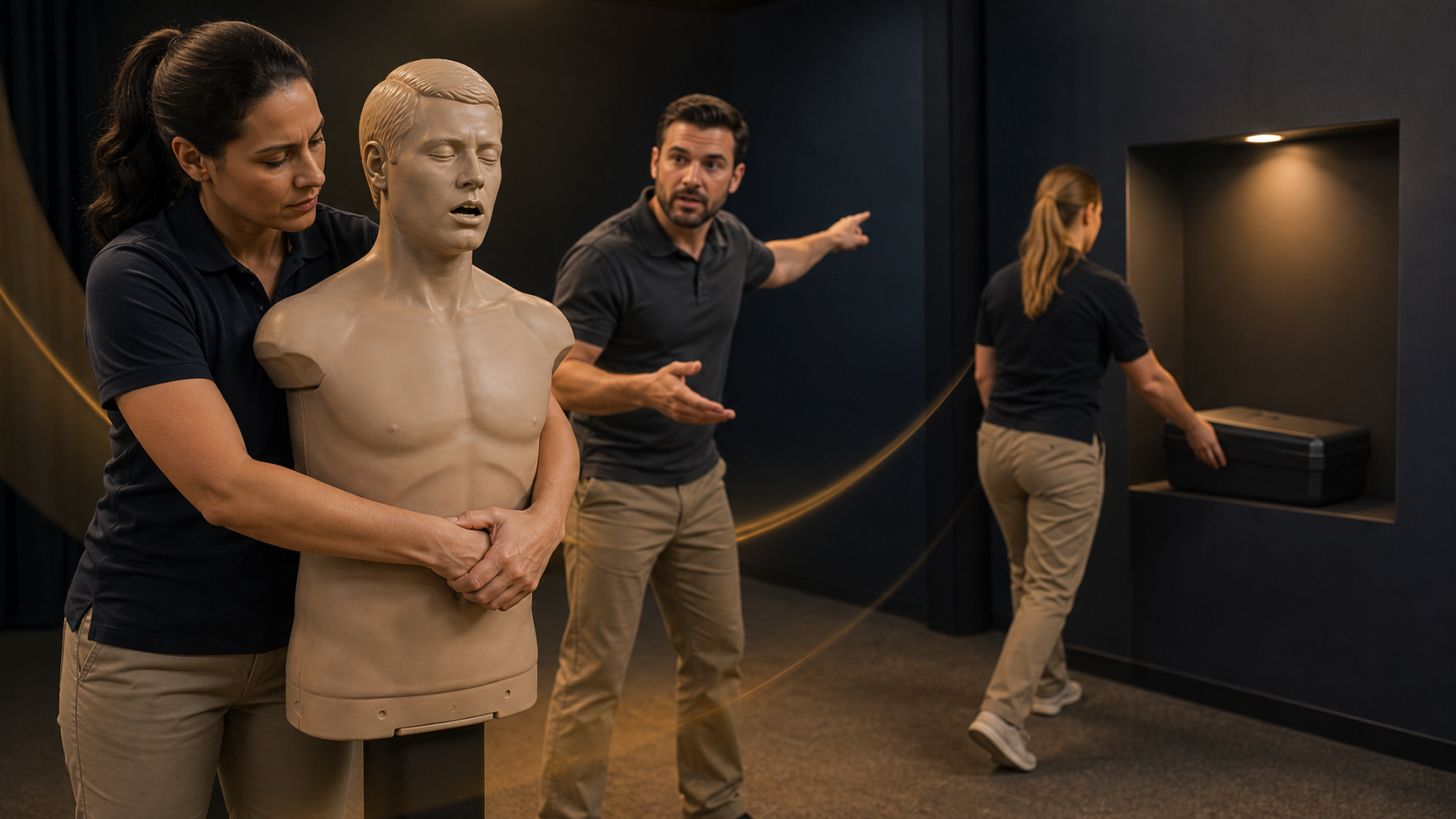
Manual rescue remains first-line. The nearest adult begins the 5-and-5 sequence immediately. The alert layer routes help to the exact location. The nurse, trained backup staff, and emergency equipment move toward the room. If standard basic life support measures fail, compliant second-line suction devices may enter the chain after unsuccessful BLS.
FDA's March 4, 2026 De Novo classification established QXN under 21 CFR 874.5400 as a Class II category for suction anti-choking devices used as a second-line treatment after unsuccessful use of a BLS choking protocol. That boundary matters operationally. Schools should not build workflows that reach for second-line equipment first. They should build workflows that make first-line rescue immediate and second-line retrieval fast, traceable, and realistic.
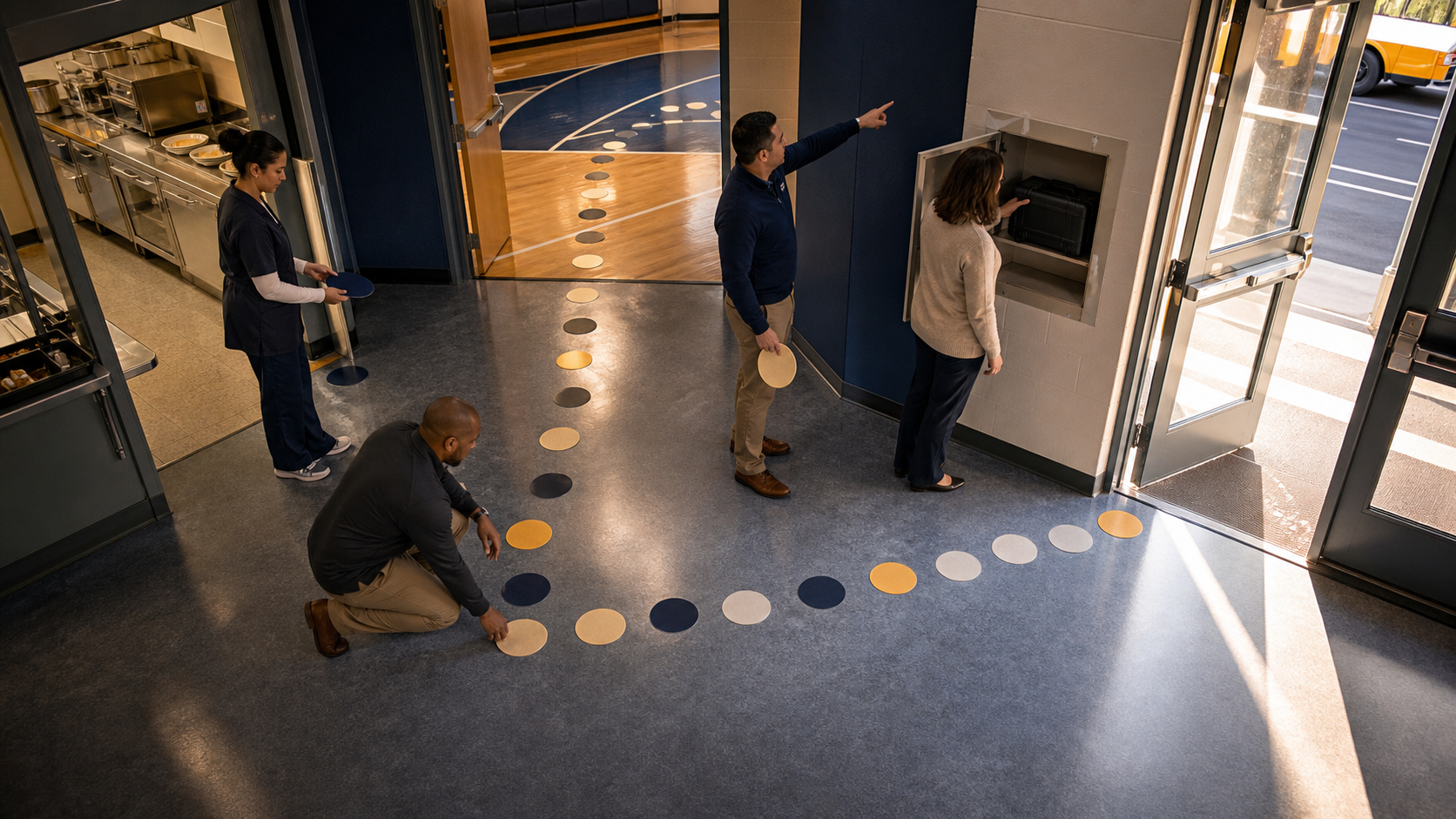
Run a proximity test this week. Time how long it takes the nurse to reach the farthest cafeteria table, the gym doorway, the bus lane, and the end of the longest hallway. Then time the retrieval path for backup equipment from those same points.
If the nurse cannot reach those spaces in about 90 seconds, or if second-line equipment cannot enter the room quickly after unsuccessful BLS, your instant-responder layer needs redundant staging today. Coverage titles do not rescue students. Proximity, routing, and retrieval do.
For related planning context, review the anti-choking device buyer evidence checklist.
For a product-specific backup option, review the second-line backup.
Because choking punishes delay. The nurse may not be the first adult in the room, so the workflow has to let the nearest adult begin first-line rescue immediately while backup starts moving.
Begin the current first-line rescue sequence for severe choking, trigger help without leaving the student, and keep the room usable for incoming support.
After unsuccessful BLS. FDA's 2026 De Novo classification places QXN devices in a Class II second-line role, not as a replacement for first-line rescue.
Measure proximity and retrieval. Time the nurse's path and the backup equipment path from the farthest real incident locations, not just from the health office.
AHA Child FBAO Algorithm - Supports 5 back blows + 5 abdominal thrusts for conscious child with severe FBAO
American Red Cross Choking Guidance - Supports Public 5-and-5 guidance for adults and children
FDA De Novo DEN250012 - Supports QXN / 21 CFR 874.5400 as Class II second-line suction anti-choking category after unsuccessful BLS
Integrative Review on School Nurse Prioritization - Supports Median caseload of 750-1,000 clients per school nurse
ACS Rural EMS Analysis - Supports 97.1-minute average total call time for high-acuity rural EMS cases
This article is for educational and emergency-preparedness purposes only. It is not medical advice. In a choking emergency, follow current accredited first-aid guidance, call 911 or local emergency services immediately, and treat any suction anti-choking device only as a second-line option after unsuccessful standard BLS measures.


