A practical guide for recognizing severe choking, assigning roles, calling 911 early, clearing the dining area, and staging second-line backup equipment without delaying first aid.
For meal-service teams, Fitiger's restaurant choking readiness plan gives practical guidance for staff roles, kit placement, and service-area response.
A restaurant choking emergency turns serious fast when the diner cannot cough effectively, cannot speak, or cannot breathe. Call 911 early. Begin standard manual rescue immediately when severe choking is present. In a restaurant, the biggest failures are usually delay, crowding, and confusion about who is doing what.
A plate lands on the table. Someone takes a bite, laughs, and suddenly stops talking.
At first, the table may not understand what is happening. A friend offers water. Another person asks, "Are you okay?" A server notices that something looks wrong but has not yet decided whether this is ordinary coughing or a true airway emergency.
That is how time slips away in a restaurant.
The room may be full of people, but the response often depends on one or two adults noticing the right signs and acting without hesitation. A crowded dining room does not automatically mean help arrives faster. Too many people watching, and too few people taking clear responsibility, can make the first minute worse.
Not every coughing fit is severe choking.
A diner who can cough forcefully, speak, or make clear sounds is still moving air. Encourage coughing. Stay close. Watch carefully for deterioration.
Severe choking looks different. The cough becomes weak or disappears. Speech stops. The diner may clutch the throat, stand abruptly, or panic without making useful sound.
|
What you see |
What it may mean |
What to do |
|---|---|---|
|
Forceful coughing and clear speech |
Air is still moving |
Encourage coughing and monitor closely |
|
Weak or ineffective coughing |
The obstruction may be worsening |
Call 911 and prepare to act immediately |
|
Unable to speak, cough effectively, or breathe |
Severe choking |
Begin standard manual rescue immediately |
|
Sudden silent distress |
Airflow may be failing |
Treat it as an emergency |
|
Loss of responsiveness |
Life-threatening emergency |
Begin CPR according to training and follow dispatcher instructions |
The practical question is simple: can this person still move enough air?
When the answer is no, the restaurant no longer has a table problem. It has a medical emergency.
People often wait too long to call 911 because they hope the obstruction will clear on its own. That delay can cost valuable time.
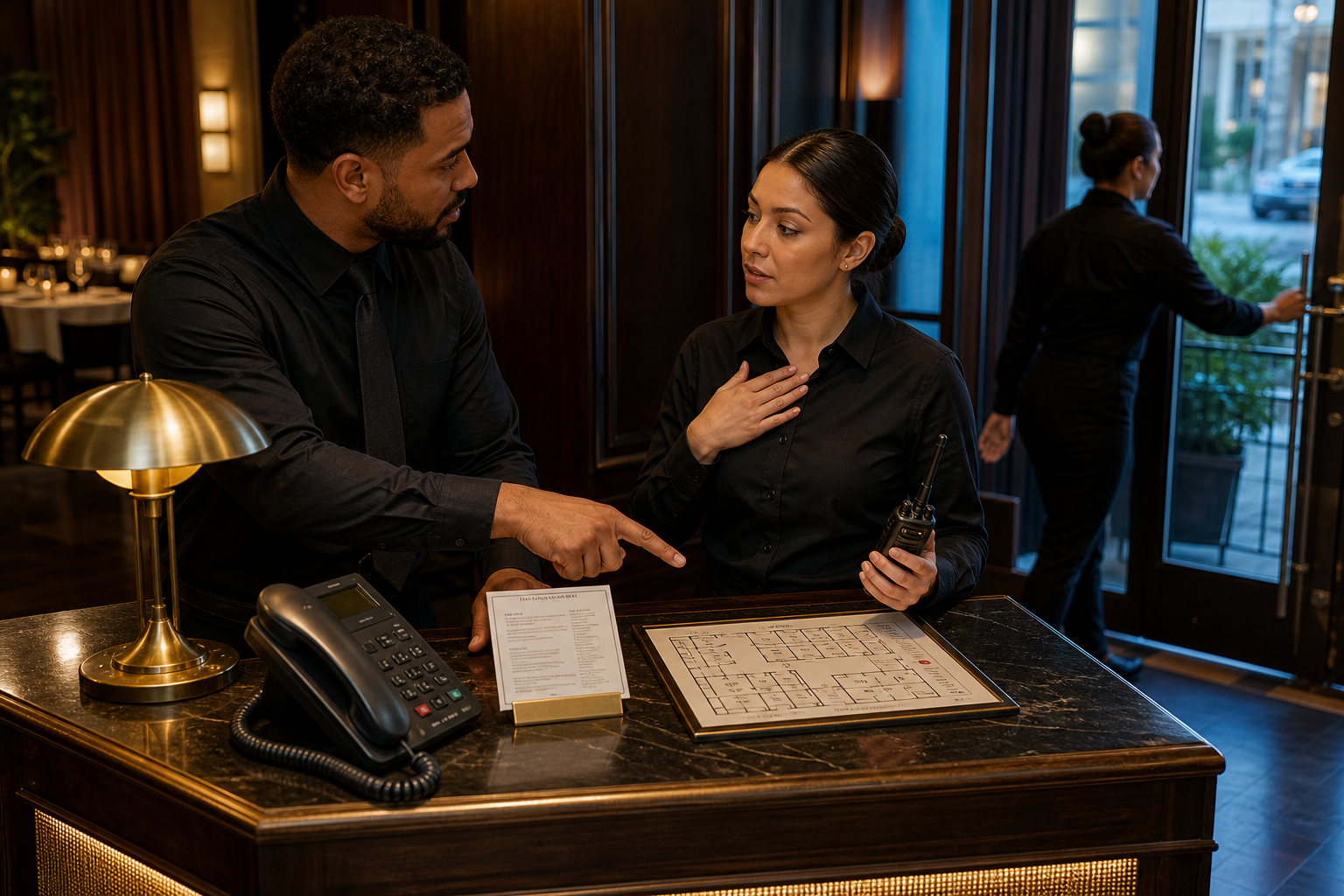
Use a direct sequence:
| Recognize severe choking. | Direct one specific person to call 911. |
| Begin manual rescue immediately. | Clear the area around the diner. |
| Prepare for CPR if the person becomes unresponsive. | |
Do not shout, "Someone call 911," into a crowded room and assume it will happen. Point to one person and say, "You, call 911 now."
Specific instructions reduce confusion. The caller should state that a person is choking, whether the person is responsive, the restaurant name, the exact address, the best entrance for EMS, and whether rescue efforts are already underway.
The restaurant team should be able to state the address without searching for it.
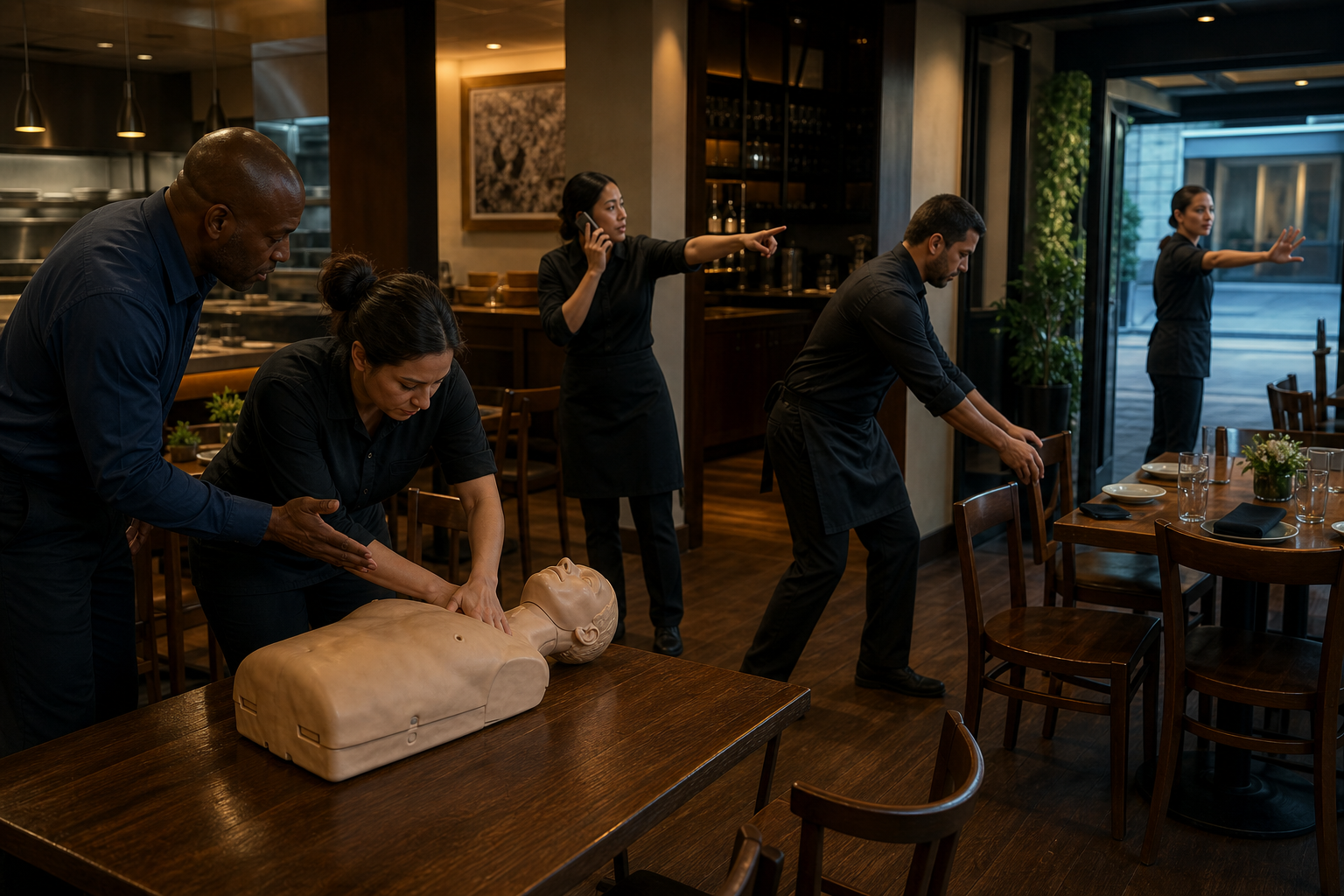
Restaurant teams do better when the response becomes visible. The roles do not need to be complicated.
|
Role |
First responsibility |
What that means in practice |
|---|---|---|
|
Lead responder |
Stay with the diner and begin care |
Focus on the airway emergency. Do not leave to search for supplies. |
|
Caller and floor control |
Call 911 and manage the surrounding space |
Use speakerphone, move chairs back, clear bystanders, and communicate the exact location. |
|
Runner and EMS guide |
Bring the readiness setup and meet responders |
Retrieve supplies, open the entrance path, and guide EMS to the table. |
In a small restaurant, one person may need to combine roles. That is still better than having no structure at all.
What slows the response is often not a lack of concern. It is several people trying to do the same thing while nobody handles the missing job.
A restaurant table can become cramped in seconds.
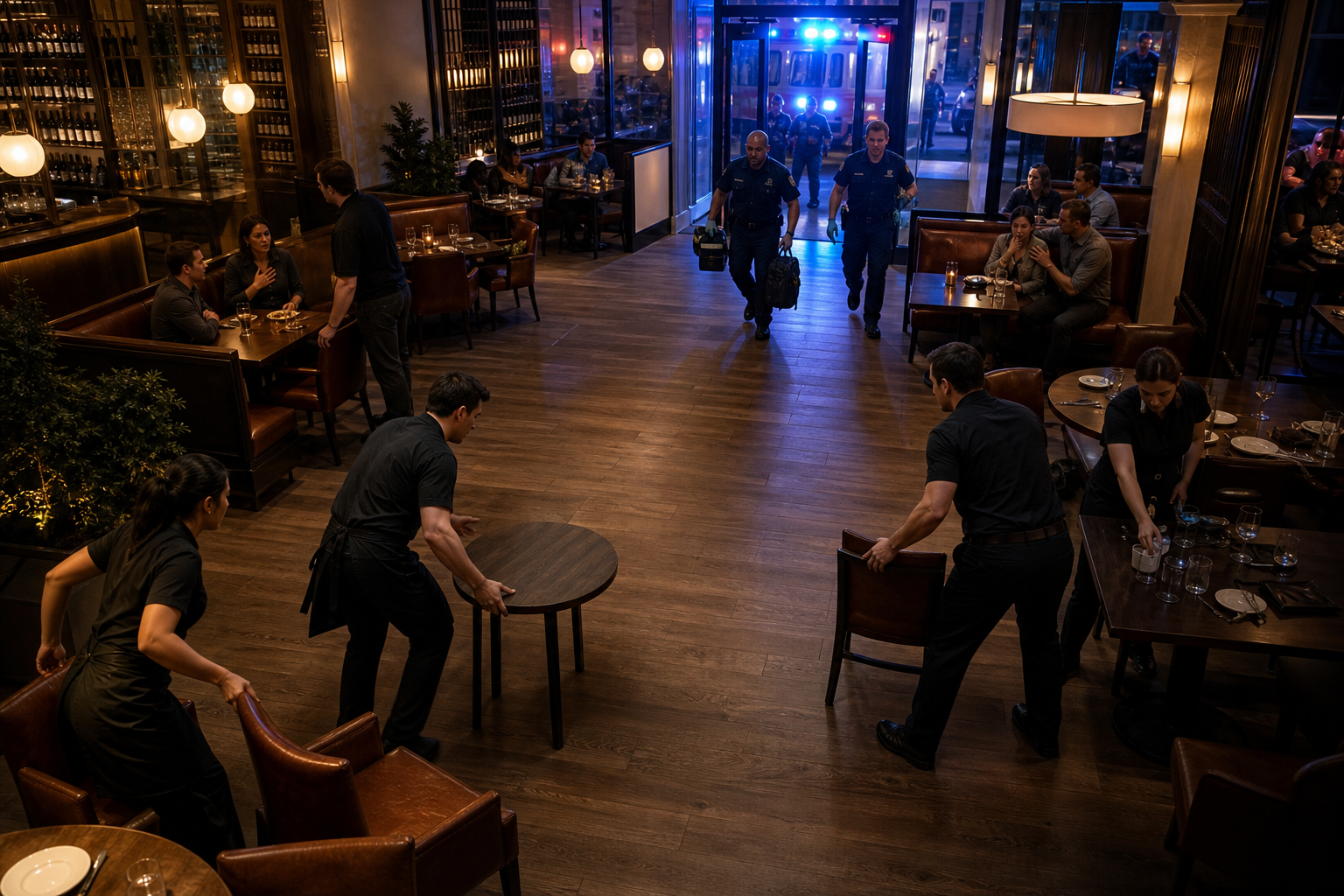
Chairs block access. Bags are under the table. Another guest stands up to help but ends up in the way. Plates and glassware turn a narrow aisle into an obstacle course.
The lead responder needs room to work safely.
| Move chairs back. | Clear food, glassware, and bags. |
| Create a workable area around the diner. | Move bystanders away from the table. |
| Stop conflicting advice from turning into crowding. | |
If the diner becomes unresponsive, the team may need enough floor space to lower the person safely and begin CPR. The floor plan is part of the emergency plan. Restaurants should not discover that for the first time during a collapse.
For a responsive adult with severe foreign-body airway obstruction, the 2025 American Heart Association algorithm uses repeated cycles of:
| 5 back blows. | 5 abdominal thrusts. |
| Repeat until the object is expelled or the adult becomes unresponsive. | |
If the diner becomes unresponsive, begin CPR according to training and follow dispatcher instructions. Check for a visible object in the mouth before giving breaths.
For a diner in the late stages of pregnancy, or when the rescuer cannot encircle the abdomen, use 5 chest thrusts instead of abdominal thrusts.
Do not lose time offering water, searching online for instructions, or waiting for a manager to arrive. Severe choking needs immediate first aid.
A bystander can make the response better. A bystander can also make the room more chaotic.
The most useful bystander chooses one clear job:
| Call 911. | Move chairs and clear the aisle. |
| Guide staff to the exact table. | Meet EMS at the entrance. |
Help move children or family members away from the immediate response area. The least useful bystander crowds the responder, offers conflicting instructions, or turns the emergency into a debate. A restaurant choking emergency is not the moment for six people to become directors.
Many restaurants say they "have first aid." That phrase does not tell you whether the team can act during a busy service.
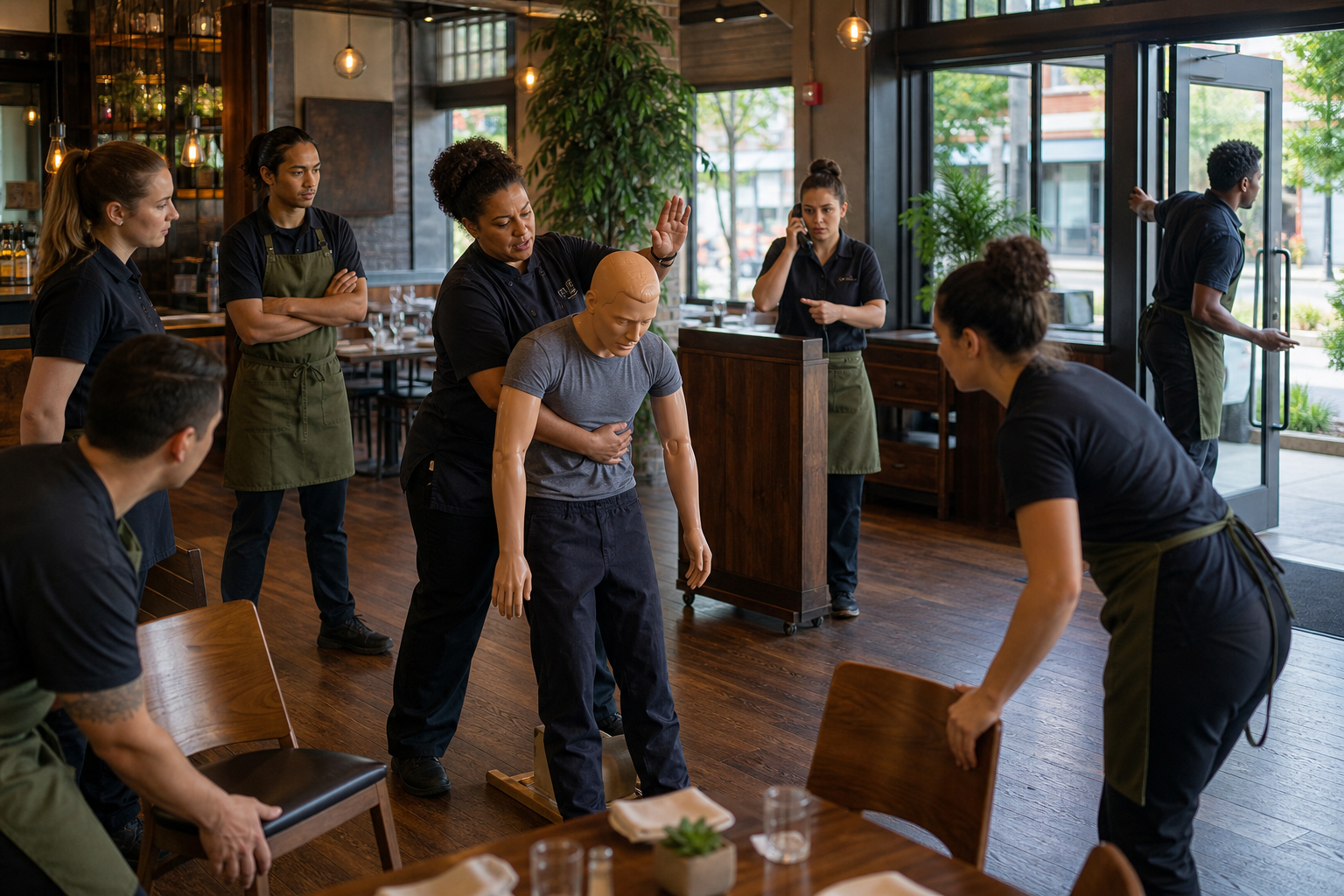
Useful readiness is specific:
| Staff can recognize severe choking. | The address is posted and easy to state. |
| One person calls 911 while another stays with the diner. | Someone knows which entrance EMS should use. |
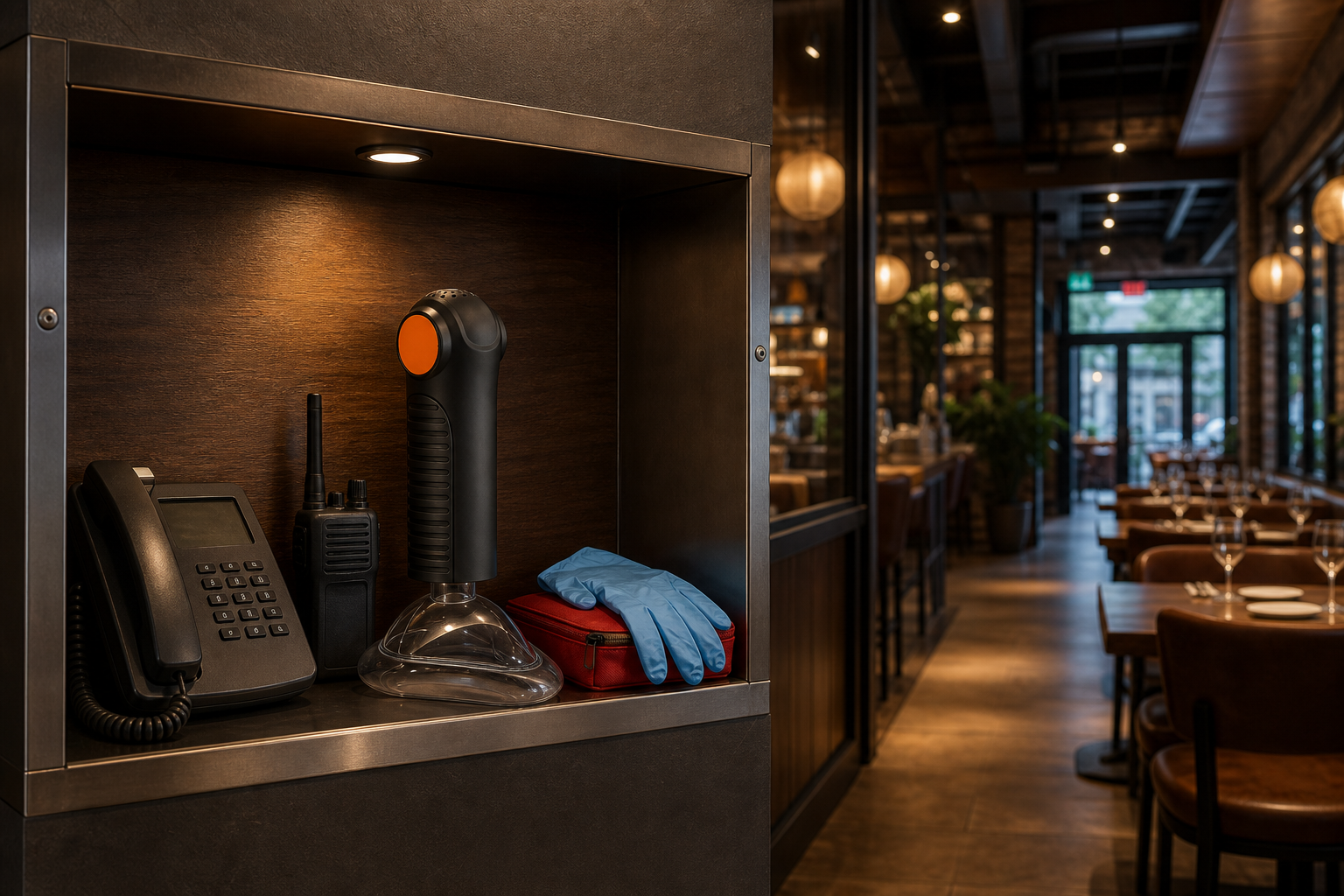
| The first-aid setup is stored where staff can retrieve it quickly. | The team can clear a table area without blocking the aisle. |
| Drills happen during non-service hours. | |
Practice where the problem would really happen: tight tables, patio seating, bar stools, banquet rooms, private events, crowded weekend service, and takeout counters with limited staffing.
The plan needs to survive a busy Saturday night, not just look good in a training binder.
Staff should not hover over diners or turn hospitality into surveillance. They should notice when an ordinary meal starts to change.
Situations that deserve closer attention include:
| An older adult eating alone. | A guest coughing repeatedly while eating. |
| A diner rushing through food before an event. | A person who appears to have difficulty swallowing. |
| A guest who stands up abruptly and cannot explain what is wrong. | A banquet or buffet where people are talking and eating quickly. |
A weak cough at a crowded table is easier to miss than most teams expect.
A near-miss is not a reason to move on unchanged. It is a chance to find the delay before the next emergency.
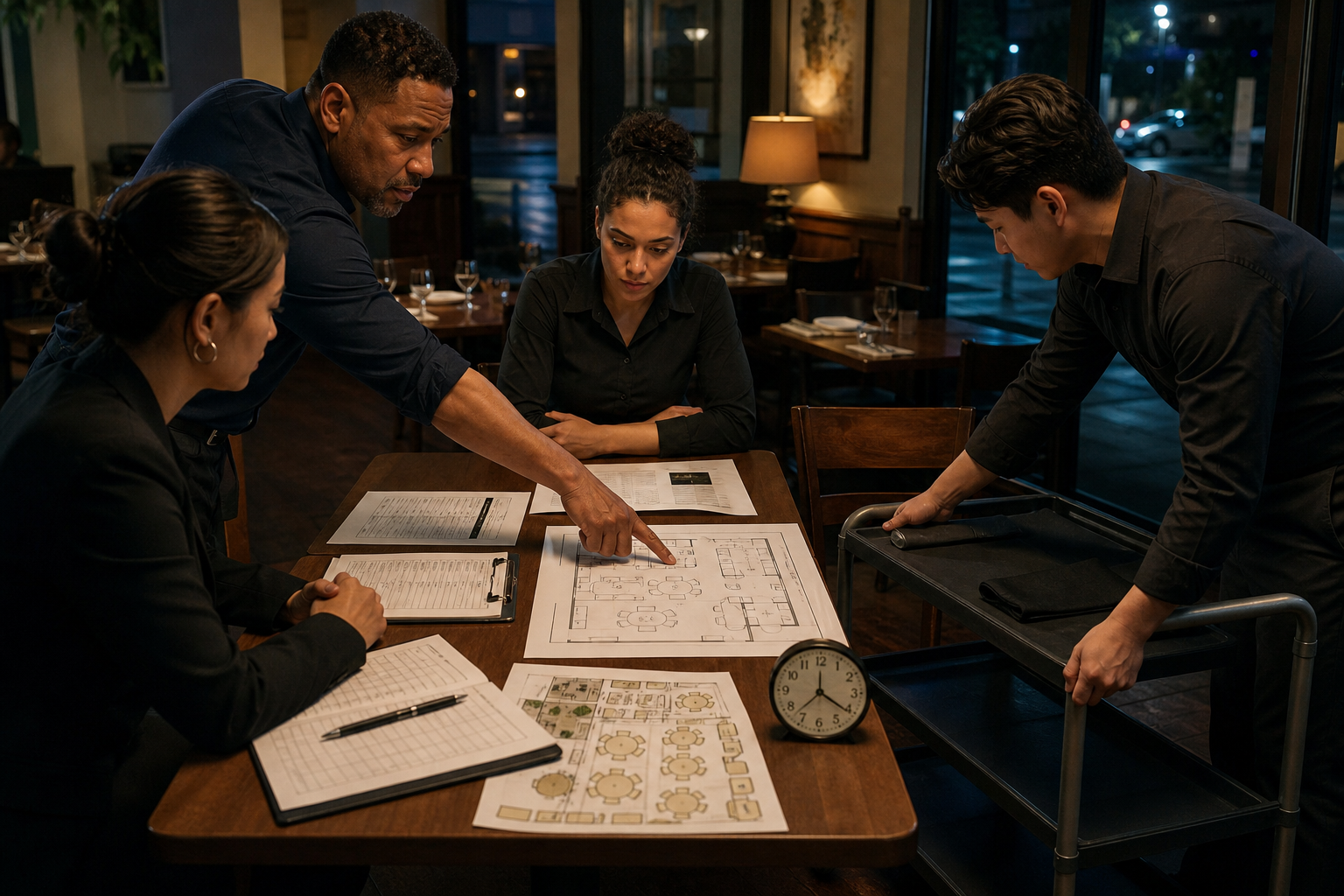
After the incident, ask:
| Did anyone hesitate to call 911? | Did staff recognize severe choking quickly enough? |
| Was the address easy to provide? | Did the right person meet EMS? |
| Was the table area too crowded to work safely? | Could the first-aid setup be reached without delay? |
| Did bystanders help or interfere? | Did the team know who was leading the response? |
One messy real event can teach more than a page of vague safety slogans.
Where a FITIGER second-line backup fits
Restaurant prevention, staff awareness, calling 911, manual rescue, EMS, and CPR when the person becomes unresponsive come first.
Manual rescue first. Backup second.
Some restaurants choose to keep a suction anti-choking device as a second-line backup after unsuccessful standard choking rescue for complete airway obstruction.
For a fixed dining-area readiness station, the FITIGER EasyPumpVac Series may be the more practical option to review as part of a choking first aid kit or choking emergency kit. Its straightforward manual structure supports one clearly staged adult-accessible location near the service area.
For catering teams, event staff, or operations that move between service points, the FITIGER FoldPumpVac Series may be the stronger option when compact staging matters.
A backup product belongs inside a restaurant emergency system. It does not replace back blows, abdominal thrusts, chest thrusts when indicated, CPR, calling 911, EMS, or staff training.
|
Readiness point |
What to check |
|---|---|
|
Emergency address |
Can any shift lead state it immediately? |
|
Dining room access |
Can staff clear space around a table fast? |
|
911 plan |
Does the team know who calls and what to say? |
|
EMS entry route |
Can someone guide responders inside without delay? |
|
First-aid setup |
Is it complete, visible, protected, and adult-accessible? |
|
Team roles |
Does each shift know who leads, calls, and guides? |
|
Training refresh |
Has the team reviewed choking response recently? |
|
Event setups |
Does the plan still work for patios, banquets, and crowded nights? |
Restaurants do not need a perfect safety program to improve. They need a real one.
For related planning context, review the standard manual rescue.
First decide whether the person can still cough forcefully, speak, or breathe. If severe choking is present, direct one specific person to call 911 and begin standard manual rescue immediately.
Yes. In severe choking, activate emergency response early. Waiting until the person becomes unresponsive creates avoidable delay.
Signs include a weak or absent cough, inability to speak, color change, altered mental status, apnea, or rapidly worsening distress.
Use repeated cycles of 5 back blows followed by 5 abdominal thrusts until the object clears or the adult becomes unresponsive.
Use 5 chest thrusts instead of abdominal thrusts when the person is in the late stages of pregnancy or the rescuer cannot encircle the abdomen.
Begin CPR according to training and follow dispatcher instructions. Check for a visible object in the mouth before giving breaths.
A restaurant may choose to keep a suction anti-choking device as a second-line backup after unsuccessful standard choking rescue for complete airway obstruction. It should never replace manual rescue, 911, EMS, CPR, or staff training.
EasyPumpVac Series may fit a fixed service-area station. FoldPumpVac Series may be more practical for catering, events, or mobile multi-location staging.
The best response is the one the team has already rehearsed
The room will still be noisy. The aisle may still be narrow. The emergency will still feel abrupt.
What changes the response is whether the adults nearby can recognize severe choking, create space, call 911 early, and act without drifting into confusion.
Manual rescue first. Backup second.
American Heart Association, Adult Foreign-Body Airway Obstruction Algorithm (2025) - Supports severe FBAO recognition, emergency response activation, repeated cycles of 5 back blows and 5 abdominal thrusts, the CPR transition, and 5 chest thrusts for late pregnancy or when the rescuer cannot encircle the abdomen.
American Red Cross, Adult and Child Choking - Supports recognition of choking signs, first-aid training, and practical adult and child choking response education.
U.S. Food and Drug Administration, Update: FDA Encourages the Public to Follow Established Choking Rescue Protocols - Supports keeping suction anti-choking devices in a second-line role after unsuccessful established rescue protocols and avoiding claims that registration or listing equals authorization.
This article is for educational and preparedness-planning purposes only. It does not replace medical advice, legal advice, certified first-aid or CPR training, calling 911, EMS, professional medical care, workplace policies, local emergency procedures, or the current product-specific instructions for use.
Use any suction anti-choking device only within its current instructions, warnings, contraindications, and applicable regulatory status. Seek emergency medical care whenever a choking incident is serious, symptoms continue, or the person becomes unresponsive.


