A practical, evidence-based guide to how food geometry, moisture, particle size, and cohesion affect choking risk. It explains IDDSI home testing, warning signs of swallowing difficulty, safer meal preparation, and the limited second-line role of suction anti-choking devices.
Authored by George KingR&D Manager & Emergency Preparedness Specialist at Fitiger Life LLC.Medically Reviewed by Michael J. Bullock, DNP, MSN, RN
What matters first

| Food texture modification for choking prevention is not simply about making meals softer. Shape, particle size, moisture, stickiness, and cohesion all affect how food moves through the mouth and throat. |
| For a household checklist, see Fitiger's child and home choking safety readiness plan. |
| Before choosing equipment, review Fitiger's anti-choking device buyer evidence checklist for FDA wording, testing, seller traceability, and kit-selection questions. |
| Round or cylindrical foods can form a tight airway plug. Sticky foods may cling to tissue and resist clearance. Dry or crumbly foods can break apart before the swallow is properly organized. These risks become more important when chewing strength, saliva, dentition, or swallowing coordination begins to decline. |
| For families caring for an older adult, the most useful question is not just, "Is this food soft?" It is, "How will this food behave when it is chewed, gathered into a bolus, and moved toward the throat?" |
Choking risk begins with food behavior

| A choking hazard is often described by the name of the food: grapes, hot dogs, peanut butter, meat, bread, or raw vegetables. |
| The name alone does not explain the risk. |
| From a material science perspective, foods become dangerous because of their geometry and physical behavior. A round piece can match the diameter of the airway. A sticky mass can spread across a surface and increase friction. A fibrous strip may resist breaking into smaller pieces. A compressible food can deform and wedge more tightly when pressure is applied. |
| This explains why the same food can present very different risks depending on how it is prepared. |
| A hot dog cut into round coins retains a cylindrical shape that can seal an airway. Cutting it lengthwise first, then into smaller irregular pieces, changes that geometry. |
| A thick spoonful of peanut butter behaves differently from a thin layer spread across moist food. The problem is not simply that peanut butter is dense. Its adhesiveness can make it difficult to control and harder to clear if it becomes lodged. |
| Bread can also be deceptive. A soft slice may seem safe in the hand, yet become sticky, compressible, or clumped after mixing with saliva. Dry bread may fragment, while moist bread can form a cohesive mass that is difficult for someone with reduced tongue strength or saliva to manage. |
| Food safety depends on what happens in the mouth, not how harmless the food looks on the plate. |
Shape can turn an ordinary bite into a mechanical plug
| Round and cylindrical foods deserve particular attention because they can closely match the shape of the upper airway. |
| Whole grapes. |
| Cherry tomatoes. |
| Hot dog rounds. |
| Sausage slices. |
| Large pieces of carrot. |
| Hard round candy. |
| Large meat chunks. |
| Cutting these foods into smaller pieces helps, but size alone is not enough. Shape still matters. |
| A small round piece may remain capable of forming a seal. Lengthwise cutting creates a less symmetrical shape, making it less likely that the food will sit neatly across the airway opening. |
| For grapes and cherry tomatoes, quartering lengthwise is generally safer than slicing across the middle. For hot dogs and sausages, cut lengthwise into narrow strips before cutting the strips into smaller pieces. |
| The goal is not visual neatness. Irregular food geometry is often safer because it is less able to form a complete mechanical plug. |
Stickiness increases resistance to movement
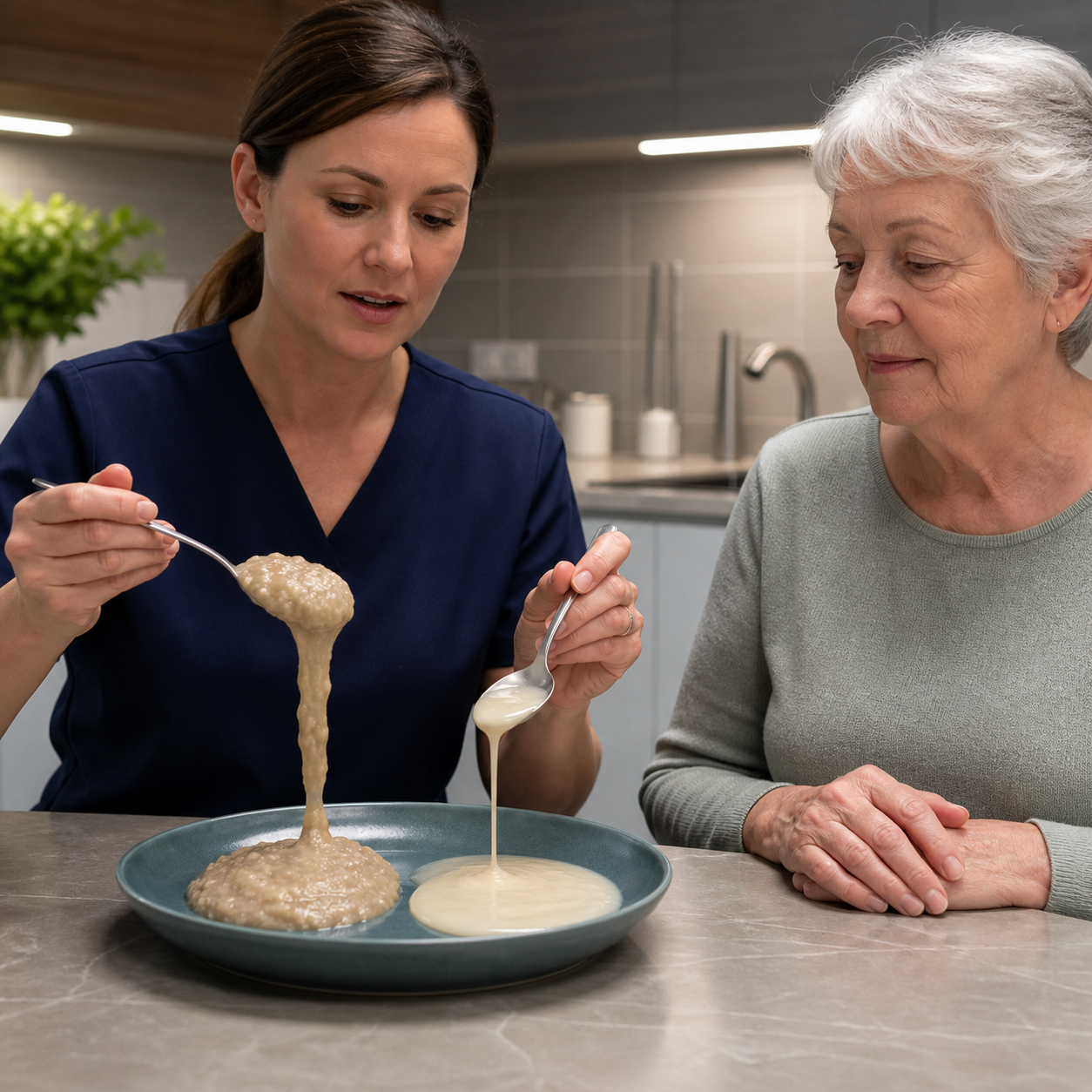
| Sticky foods create a different problem. Instead of sealing the airway because of their shape, they can adhere to oral or throat surfaces and resist movement. |
| Examples include: |
| Thick peanut butter. | Sticky candy. |
| Marshmallows. | Dense mashed foods without enough moisture. |
| Glutinous rice products. |
| Some dry cakes or compressed snack bars. |
| Stickiness becomes especially important when saliva production is reduced. An older adult with dry mouth may have difficulty lubricating food, gathering it into a manageable bolus, and moving it cleanly through the mouth. |
| Medication can contribute to dry mouth. So can dehydration, illness, mouth breathing, and age-related changes in salivary function. |
| Adding moisture may reduce risk, but simply pouring liquid over a difficult food does not automatically make it safe. Thin liquid can separate from solid particles, creating a mixed texture that may be harder to control for someone with dysphagia. |
| The food needs to remain moist and cohesive without becoming gummy, stringy, or separated into liquid and solid components. |
Dry and crumbly foods can fail before the swallow begins

| Dry food requires enough saliva, chewing strength, tongue control, and time to form a stable bolus. |
| When any of those functions are reduced, the food may remain scattered in the mouth or break into loose particles. Pieces can move backward before the person is ready to swallow. |
| Foods that may become difficult include: |
| Dry bread. | Crackers. |
| Cookies. | Dry rice. |
| Tough meat. | Crumbly cake. |
| Dry cereal. | Foods with hard crusts. |
| Families often respond by encouraging the person to drink water after every bite. That may help some people, but it is not a universal solution. Someone with swallowing difficulty may also have trouble controlling thin liquids. |
| A safer approach may involve changing the food itself: adding an appropriate sauce, choosing a more cohesive preparation, reducing particle size, removing hard crusts, or replacing the food with a texture that has been assessed as safer. |
| When coughing, throat clearing, wet voice, food pocketing, or repeated difficulty appears during meals, texture changes should not be improvised indefinitely. A qualified speech-language pathologist or other swallowing specialist should evaluate the pattern. |
Why older adults have less margin for error
| Aging does not automatically cause choking. Many older adults continue to eat a regular diet safely. |
| Risk rises when normal age-related changes combine with illness, dental problems, medication effects, weakness, cognitive decline, or a diagnosed swallowing disorder. |
| Several functions may change: |
| Chewing may become less efficient. | Tongue strength may decline. |
| Saliva production may decrease. | Dentures may shift or fit poorly. |
| Sensation in the mouth and throat may become less reliable. |
| Swallow initiation may take longer. |
| Food or liquid may remain in the throat after swallowing. |
| Fatigue may reduce performance near the end of a meal. |
| These changes are sometimes grouped under terms such as presbyphagia, oral frailty, or dysphagia. The terms are not interchangeable, but they all point to the same practical issue: a meal that was once easy may gradually become harder to manage. |
| Warning signs can be subtle: |
| Meals take much longer than before. |
| Meat, bread, or raw vegetables are regularly avoided. |
| Food remains in one cheek. |
| The person needs repeated sips to finish a bite. |
| Coughing or throat clearing occurs during meals. |
| The voice sounds wet or gurgly after swallowing. |
| Pills become difficult to take. |
| Dentures move during chewing. |
| Unexplained weight loss or recurrent chest infections develop. |
| A single cough does not prove dysphagia. A repeated pattern deserves professional attention. |
Using the IDDSI framework at home

| The International Dysphagia Diet Standardisation Initiative, or IDDSI, provides a common framework for describing food textures and drink thickness. |
| The framework is valuable because words such as "soft," "mashed," or "easy to chew" can mean different things to different people. IDDSI adds measurable characteristics and simple testing methods. |
| For adults, Level 5 Minced & Moist food uses small, soft particles. Current guidance specifies a particle width of no more than 4 mm, with a maximum adult particle length of 15 mm. The food should remain moist, hold together on a spoon, and contain no hard, sharp, fibrous, or separate thin-liquid components. |
| The Spoon Tilt Test helps assess whether food is cohesive enough to hold its shape but not so sticky that it remains attached to the spoon. |
| The Fork Drip Test helps assess how food holds together across the spaces between fork tines. |
| The Fork Pressure Test helps determine whether particles are soft enough to squash easily with limited pressure. |
| Level 4 Pureed food is smoother and requires no chewing. It should be cohesive, free of lumps, and able to hold together without becoming sticky. It should not separate into liquid and solid portions. |
| These tests are useful, but they do not replace an individualized swallowing assessment. A person may need a particular texture because of reduced chewing, weak tongue control, delayed swallowing, or another specific problem. The appropriate level should be selected with clinical guidance whenever dysphagia is suspected or diagnosed. |
Bread deserves special caution
| Bread is often treated as a soft food, but the way it behaves after chewing makes it difficult to classify safely. |
| IDDSI generally does not permit standard bread products at Levels 5 or 6. Bread can become dry and crumbly, or it can absorb moisture and form a sticky mass. Either behavior may create problems for someone who needs a texture-modified diet. |
| Removing the crust does not necessarily solve the problem. Dipping bread into liquid may also create an inconsistent mixed texture. |
| Families should not assume that sandwiches, toast, soft rolls, or bread soaked in soup are automatically suitable for a minced-and-moist or soft-and-bite-sized diet. Follow the individual's care plan and current professional guidance. |
A practical food texture review for families
| A home meal review does not need laboratory equipment. It does need consistency. |
| Before serving food to someone with reduced chewing or swallowing reliability, check five characteristics. |
| 1. Shape |
| Could the piece form a round or cylindrical plug? |
| Cut grapes, tomatoes, sausages, and similar foods lengthwise. Avoid smooth, symmetrical pieces that can match the airway opening. |
| 2. Particle size |
| Are the pieces appropriate for the person's prescribed texture level? |
| Do not rely on visual estimates alone. Use a fork, ruler, or IDDSI testing guide when a clinical texture level has been recommended. |
| 3. Moisture |
| Can the food be gathered and moved without falling apart? |
| Add an appropriate sauce or moisture when recommended, but avoid loose liquid separating from solid particles. |
| 4. Cohesion |
| Does the food hold together without becoming sticky? |
| A safe modified texture should not scatter into dry fragments or cling heavily to the spoon, mouth, or palate. |
| 5. Effort |
| Can the person chew and swallow the food comfortably throughout the meal? |
| Meal fatigue matters. Food that is manageable during the first few bites may become harder to control later. |
Texture modification is not the same as blending everything
| Overprocessing food can create new problems. |
| A puree that is too thin may flow too quickly. A minced meal that is too dry may scatter. A thick food that is too sticky may remain attached to the mouth or spoon. Mixed textures, such as thin soup with solid pieces, may require the person to manage liquid and solids at different speeds. |
| Good texture modification aims for predictable behavior. |
| The food should match the person's swallowing ability, remain appetizing, and be prepared consistently. Color, temperature, flavor, and presentation still matter. A safer meal that the person refuses to eat does not support nutrition or quality of life. |
| The best plans combine clinical guidance with practical food preparation that the household can repeat. |
Prevention still comes before emergency equipment
| Food texture modification can reduce risk, but it cannot remove every possibility of choking. |
| A complete airway obstruction can still occur. When a responsive adult cannot cough, speak, or breathe effectively, current American Heart Association guidance calls for repeated cycles of 5 back blows followed by 5 abdominal thrusts. If the person becomes unresponsive, begin CPR with chest compressions, check for a visible object when opening the airway, and do not perform a blind finger sweep. |
| Call 911 as early as possible. |
| A suction anti-choking device is not the first response. FDA's 21 CFR 874.5400 category defines this type of device as a second-line treatment for complete airway obstruction after an unsuccessful basic life support choking protocol. |
| That category does not mean every anti-choking device sold online is FDA-authorized. Registration, listing, marketplace availability, and advertising claims do not establish marketing authorization. Product status, labeling, intended users, age limitations, and instructions must be verified for the specific device. |
Where a second-line FITIGER option may fit

| For many families caring for an older adult, the larger safety problem is not a lack of products. It is a lack of a complete plan. |
| The household should know: |
| Who recognizes the signs of complete airway obstruction. |
| Who calls 911. |
| Who begins standard choking rescue. |
| Where any second-line equipment is stored. |
| Whether the package and mask are complete. |
| Whether the device can be reached without leaving the person unattended. |
| Whether caregivers have reviewed the current instructions. |
| What must be replaced after use or after packaging damage. |
| In a fixed home dining area or caregiver station, a compact device that can be stored visibly and retrieved quickly may be easier to integrate into a readiness plan than a kit kept in a distant closet. |
| Families considering the FITIGER EasyPumpVac Series can review it as a possible fixed-location second-line preparedness option, but only after confirming its current labeling, instructions for use, age range, and applicable regulatory status in their market. |
| The product should never displace food modification, swallowing assessment, certified first-aid training, 911 activation, hands-on rescue, or CPR. |
| The sequence remains clear: safer meals first, manual rescue first, second-line backup only after standard rescue has failed. |
What families should remember
| Food texture is not a cosmetic detail. It affects whether a bite can be chewed, organized, moved, and cleared safely. |
| Round foods can seal. Sticky foods can adhere. Dry foods can scatter. Fibrous foods can resist breakdown. Compressible foods can deform into the airway. |
| For an older adult with dry mouth, denture problems, fatigue, oral frailty, or swallowing changes, small preparation decisions can reduce avoidable risk: |
| Change round shapes. | Control particle size. |
| Add appropriate moisture. | Avoid sticky or inconsistent textures. |
| Slow the pace of eating. | Keep the person upright and attentive. |
| Follow a clinically recommended texture level. |
FAQ
What food textures are most likely to cause choking?
Round, cylindrical, hard, sticky, fibrous, dry, and compressible foods can be difficult to manage. Risk depends on the person's chewing and swallowing ability as well as the food's shape, moisture, particle size, and cohesion.
Is peanut butter a choking risk for older adults?
Thick peanut butter can be difficult because it is adhesive and may resist movement. The risk may increase when saliva is reduced or oral control is impaired. A thin layer may be easier to manage than a thick spoonful, but individual swallowing guidance should still be followed.
Is ground meat always safer than steak?
No. Smaller particle size may help, but moisture, softness, and cohesion also matter. Ground meat that is dry, crumbly, tough, or poorly bound may still be difficult to control. A prescribed IDDSI texture should be prepared and tested consistently.
What is the correct particle size for IDDSI Level 5 food for adults?
Current IDDSI guidance uses an adult particle width of no more than 4 mm, with a maximum particle length of 15 mm. The food must also be moist, soft, and cohesive. Particle size alone does not make a food compliant.
Can someone on a Level 5 Minced & Moist diet eat bread?
Standard bread products are generally not permitted at IDDSI Levels 5 or 6 because bread can become sticky, clumped, dry, or difficult to manage safely. Follow the person's clinical care plan rather than assuming soft bread is acceptable.
Why should hot dogs and grapes be cut lengthwise?
Lengthwise cutting changes the food from a smooth round or cylindrical shape into smaller, less symmetrical pieces. That reduces the chance that one piece can match and seal the airway.
When should an older adult receive a swallowing assessment?
Seek professional evaluation when coughing, throat clearing, food pocketing, prolonged meals, wet voice, difficulty with pills, unexplained weight loss, repeated chest infections, or avoidance of certain foods becomes a pattern.
Does texture modification eliminate choking risk?
No. Texture modification can reduce avoidable risk, but no meal plan can guarantee that choking will not occur. Families and caregivers still need current first-aid training, access to 911, and a clear emergency response plan.
Should an anti-choking device be used before back blows and abdominal thrusts?
No. Standard choking rescue comes first. FDA defines suction anti-choking devices under 21 CFR 874.5400 as second-line treatment for complete airway obstruction after an unsuccessful basic life support choking protocol.
Resources
| Peer-reviewed choking-hazard review - Supports the role of round, cylindrical, sticky, fibrous, and compressible foods in airway obstruction risk. |
| Peer-reviewed swallowing and aging review - Supports presbyphagia, oral frailty, poor dentition, dry mouth, and reduced chewing efficiency as older-adult risk factors. |
| International Dysphagia Diet Standardisation Initiative, Adult Consumer Handouts - Supports Level 4 and Level 5 definitions, adult particle dimensions, Spoon Tilt, Fork Drip, Fork Pressure testing, and bread restrictions. |
| American Heart Association, Adult Basic Life Support - Supports severe adult FBAO recognition, 5 back blows followed by 5 abdominal thrusts, and CPR transition if unresponsive. |
| U.S. Food and Drug Administration, DEN250012 - Supports the 21 CFR 874.5400 second-line category after unsuccessful BLS choking protocol. |
| American Speech-Language-Hearing Association, Adult Dysphagia - Supports professional assessment for recurring swallowing symptoms and individualized care planning. |
Medical and regulatory disclaimer
This article is for educational and preparedness-planning purposes only. It does not replace medical advice, diagnosis, treatment, a professional swallowing assessment, certified first-aid or CPR training, EMS activation, calling 911, standard choking rescue protocols, or current product-specific instructions for use.
Texture modification for suspected or diagnosed dysphagia should be guided by a qualified clinician, such as a speech-language pathologist or another trained swallowing specialist. Any anti-choking device should be considered only within its current labeling, instructions, contraindications, age limitations, and applicable regulatory status.


