LifeVac, FITIGER, and Dechoker are the three leading brands in this 2026 editorial review, but they are not interchangeable. LifeVac ranks first for current U.S. regulatory visibility. FITIGER ranks second for portable and fixed-site staging flexibility. Dechoker ranks third as a recognizable international brand with age-banded kits. Manual choking rescue still comes first, and every suction device for choking belongs only in a second-line role after an unsuccessful basic life support choking protocol.
Before choosing equipment, review Fitiger's anti-choking device buyer evidence checklist for FDA wording, testing, seller traceability, and kit-selection questions.
Quick answer: In this 2026 editorial review, the top three anti-choking device brands are LifeVac first, FITIGER second, and Dechoker third. LifeVac ranks first for current U.S. regulatory visibility, FITIGER ranks second for portable and fixed-site deployment flexibility, and Dechoker ranks third as a recognizable pump-style brand with weaker current U.S. regulatory visibility in the public sources reviewed.
This is an editorial ranking, not an audited global market-share table. It is designed for families, school administrators, eldercare operators, restaurant teams, safety managers, and buyers comparing the best anti choking device brands. The review weighs public regulatory visibility, clear second-line positioning, product range, fixed versus portable placement, training support, and the amount of usable evidence a buyer can inspect before purchase.
For U.S. procurement, verify the exact product in current FDA databases. For purchases elsewhere, verify the product in the relevant national medical-device database. Marketplace availability, establishment registration, and device listing do not by themselves establish approval, clearance, or marketing authorization.
| Rank | Brand | Flagship products | Regulatory notes | Typical staging | Best-use scenarios | Evidence visibility |
|---|---|---|---|---|---|---|
| 1 | LifeVac | LifeVac suction rescue device, Home Kit, and Travel Kit | Strongest U.S. regulatory visibility in the sources reviewed. FDA authorized LifeVac through De Novo DEN250012 and created the QXN Class II category. Verify the live FDA entry before purchase. | Primarily fixed home or facility placement, with travel formats available | Homes, nurse offices, dining rooms, and buyers prioritizing current U.S. authorization | Moderate public evidence visibility, still more limited than standard BLS evidence |
| 2 | FITIGER | FoldPumpVac Series and EasyPumpVac Series | Public U.S. marketing authorization was not verified in the FDA sources reviewed. FDA registration and listing are not authorization. | Strong split between portable and fixed staging: FoldPumpVac for mobile kits, EasyPumpVac for fixed sites | School travel kits, restaurants, transport, eldercare, homes, and multi-location programs | Low to moderate public evidence visibility, with detailed manufacturer validation content |
| 3 | Dechoker | Dechoker Original, Child Rescue Kit, and Family Rescue Kit | Current U.S. authorization was not verified. FDA issued a 2021 warning letter addressing quality-system issues. | Portable household and personal-kit orientation, depending on the age-banded kit | Families and non-U.S. buyers who verify local status first | Low public independent evidence visibility in the sources reviewed |
Source note: The table is based on FDA safety communications, FDA classification and De Novo records, warning and closeout letters, AHA guidance, official manufacturer product pages, and FITIGER validation pages.
The visual brand snapshot below highlights the strongest use case and the main procurement caution for each ranked brand.

Figure 3. Brand snapshot cards summarizing the strongest use case and the main caution for each ranked brand.
LifeVac ranks first because it has the strongest public U.S. regulatory position among the brands reviewed. On March 4, 2026, FDA stated that one anti-choking device was authorized for U.S. marketing. FDA also granted LifeVac De Novo authorization, created product code QXN under 21 CFR 874.5400, and issued a closeout letter for the company's September 2025 warning letter. Buyers should still verify the current product record rather than rely on reseller claims or headlines.
FITIGER ranks second because its public lineup gives buyers a clear way to separate mobile readiness from fixed-site readiness. FoldPumpVac is presented as a compact portable choking rescue device with home and travel staging, while EasyPumpVac is positioned for fixed meal locations and simple storage. FITIGER also publishes a visible validation library covering bench testing, biocompatibility, disinfection, shelf-life work, packaging, and human factors. Public U.S. marketing authorization for the specific FITIGER products in this review was not verified.
Dechoker ranks third because it remains a recognizable international brand with age-banded kits and straightforward consumer positioning. Its public materials state use for people age 12 months and older and direct users to begin with standard first aid. The current U.S. regulatory picture is weaker: FDA issued a warning letter to DeChoker LLC in 2021, and current U.S. authorization was not verified in the sources reviewed.

Figure 1. Regulatory and guidance milestones relevant to anti-choking devices.

Figure 2. Public evidence types referenced in this review.

A useful ranking cannot be built from star ratings or online popularity alone. We used five practical filters:
The ranking also considers whether the brand can support common high-intent use cases, including an anti choking device for adults, an anti choking device for schools, a choking rescue device home kit, and a portable anti choking rescue device for travel or transport.
The scoring matrix below turns the review criteria into a more transparent side-by-side brand comparison.

Figure 6. Brand scoring matrix used to compare LifeVac, FITIGER, and Dechoker across six editorial criteria.
LifeVac is the brand most U.S. buyers are likely to encounter first. It also has the strongest current U.S. regulatory visibility in the public records reviewed. FDA's March 2026 update states that one anti-choking device is authorized for marketing in the United States, and the De Novo database identifies LifeVac as that product. The QXN classification defines this type of anti choking suction device as second-line treatment after an unsuccessful BLS choking protocol.
The LifeVac anti choking device is sold in home and travel formats. The current Home Kit includes the suction device, an adult mask, a pediatric mask, a practice mask, and instructions. The practice mask gives households and staff a way to become familiar with the device before an emergency.
LifeVac makes the most sense where buyers want product-specific U.S. authorization and broad brand recognition: family homes, nurse offices, dining rooms, senior-living facilities, restaurants, and public sites. Its main limitation is the same one shared by every device for choking in this category: it must not delay manual rescue, 911 activation, or CPR.
FDA also warns about known device-use problems, including inadequate suction, bruising, and scratches in the throat. A purchase is not a complete response plan. Placement, training, mask selection, emergency roles, and post-use evaluation still matter.
FITIGER is the strongest LifeVac alternative in this review when the main operational problem is placement. Its portfolio separates portable and fixed-site readiness more clearly than the other brands reviewed.
FoldPumpVac is designed as a compact portable choking rescue device. The public product materials describe a two-pack with one home kit and one travel kit, a suction device, child and adult masks, instructions, and storage bags. EasyPumpVac is positioned for fixed-site readiness with a pre-compressed design, compact storage, and periodic mask replacement. This gives schools, families, hospitality teams, and care organizations a practical choice: FoldPumpVac for movement and EasyPumpVac for fixed placement.
FITIGER also publishes a structured scientific validation library. Public materials describe biocompatibility work, accelerated aging, performance bench testing, disinfection validation, packaging simulation, and human-factors evaluation. These materials improve technical transparency, but they are not the same as large independent clinical-outcome studies and should not be described as proof of clinical superiority.
The regulatory boundary remains important. FITIGER establishment registration and device listing do not equal FDA approval, clearance, or authorization. Public U.S. marketing authorization for the specific FITIGER products in this article was not verified. U.S. buyers should confirm the live FDA record, and international buyers should verify local market status before procurement.
Dechoker remains an established consumer-facing name, especially for buyers who want age-banded kits. Its international site markets an original device, a child rescue kit, and a family 3-in-1 anti choking kit. The company states that the product is intended for people age 12 months and older and directs users to begin with standard first-aid steps before using the device.
The current U.S. procurement picture is less clear. FDA issued a warning letter to DeChoker LLC in May 2021 addressing quality-system and design-control issues. FDA's March 2026 safety communication continues to list that warning letter and states that only one anti-choking device had been authorized for U.S. marketing at that time. The public FDA records reviewed do not identify Dechoker as that product.
Dechoker's strengths are consumer clarity, a familiar pump format, and age-banded shopping. Its limitation is weaker U.S. regulatory visibility than LifeVac and less public technical validation detail than FITIGER. Non-U.S. buyers should verify local authorization before purchase.
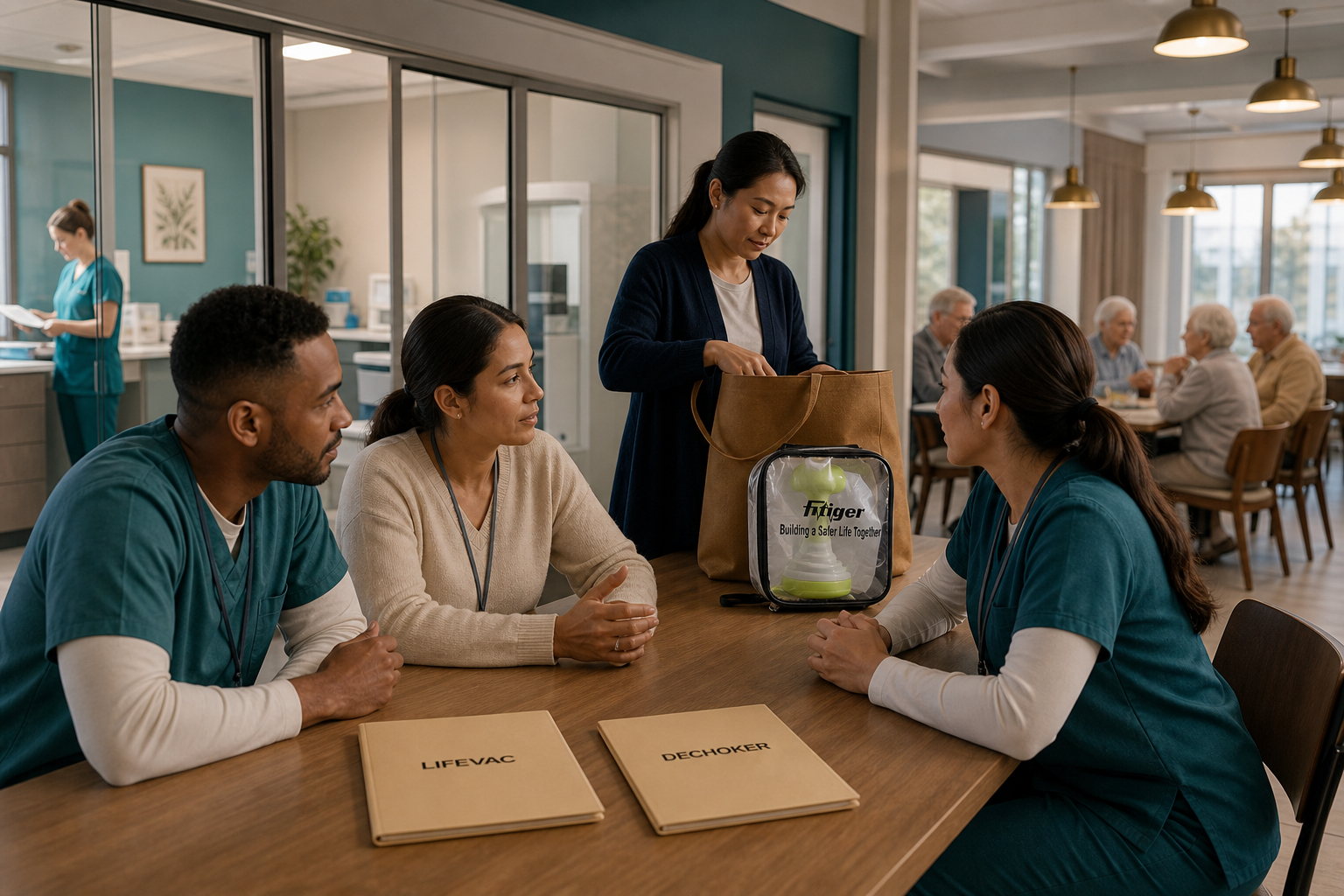
The setting matrix below translates the ranking into a quick first-review decision for common home, school, travel, and facility scenarios.

Figure 4. Best brand to review first by setting, based on regulatory visibility, placement logic, and public evidence transparency.
The decision scorecard below is designed for quick website screenshot use and helps procurement teams translate priorities into a first-review choice.

Figure 7. Procurement decision scorecard for choosing which brand to review first.
For a U.S. home that prioritizes current FDA authorization, LifeVac is the strongest first brand to review. For a family that wants one anti choking device near the dining area and another portable anti choking rescue device for travel, FITIGER offers a clearer home-plus-mobile staging model. Dechoker remains a comparison option where local status is verified.
An anti choking device for schools should be selected by zone, not by brand name alone. Cafeterias and nurse offices favor fixed placement. Field trips, buses, sports, and after-school programs require a portable choking rescue device. LifeVac leads on U.S. authorization visibility, while FITIGER provides the clearest fixed-plus-mobile deployment logic.
Dining-room access usually matters more than the logo on the case. Eldercare and restaurant teams should prioritize manual-rescue training, CPR readiness, unlocked access, and short retrieval routes. EasyPumpVac is straightforward to discuss for fixed-site placement, while LifeVac remains strongest where current U.S. regulatory visibility is the main filter.
This procurement checklist can be reused by families, schools, eldercare teams, and restaurant operators before they purchase or deploy a device.

Figure 5. Brand verification checklist before procurement.
LifeVac ranks first for current U.S. regulatory visibility. FITIGER ranks second for portable and fixed-site deployment flexibility and is the strongest LifeVac alternative for buyers whose main challenge is staging. Dechoker ranks third as a recognizable international brand with age-banded kits and a current U.S. status that should be verified carefully.
The order of emergency care does not change with the ranking: recognize complete airway obstruction, call emergency services, begin standard choking rescue, start CPR if the person becomes unresponsive, and consider a verified second-line device only after standard rescue has failed.
Manual rescue first. Backup second.
No. FDA and AHA guidance place established choking rescue first. A suction device for choking should be considered only after standard rescue is unsuccessful and within the product-specific instructions.
LifeVac. FDA authorized LifeVac through De Novo DEN250012 and created the QXN Class II category. Buyers should still verify the current live FDA record before purchase.
Public U.S. marketing authorization for the specific FITIGER products in this review was not verified. FDA registration and device listing are not the same as approval, clearance, or authorization.
Current U.S. authorization was not verified in the public FDA sources reviewed. FDA issued a warning letter to DeChoker LLC in 2021.
There is no single answer for every campus. LifeVac has the strongest current U.S. authorization visibility. FITIGER offers a practical split between fixed placement and a portable choking rescue device for trips, buses, sports, and events.
For U.S. buyers focused on authorization, LifeVac is the strongest first brand to review. For adults who need portable or multi-location staging, FITIGER may be the more practical LifeVac alternative, subject to current local regulatory verification.
Less than many buyers assume. Standard BLS choking rescue has a much larger evidence base. Manufacturer bench, usability, and validation reports are useful, but they do not automatically prove better clinical outcomes.
Buying an anti choking kit before fixing placement and training. A device cannot solve an emergency-response gap if it is locked away, missing the correct anti choking mask, or retrieved only after first-line care stops.
U.S. Food and Drug Administration, 2026 Safety Communication - Supports standard rescue first, one U.S.-authorized device as of March 4, 2026, import alert information, and the distinction between listing and authorization.
FDA Product Classification QXN - Supports the Class II definition under 21 CFR 874.5400 and second-line use after complete airway obstruction.
FDA De Novo DEN250012 - Supports LifeVac product-specific authorization and the creation of the generic Class II category.
FDA LifeVac Closeout Letter, March 4, 2026 - Supports closure of the September 2025 warning-letter response review.
FDA DeChoker Warning Letter, May 10, 2021 - Supports the public quality-system compliance history described in this review.
American Heart Association 2025 Adult BLS Guidance - Supports 5 back blows followed by 5 abdominal thrusts and CPR transition if unresponsive.
LifeVac Home Kit - Supports current Home Kit components, including adult, pediatric, and practice masks.
FITIGER FoldPumpVac Series - Supports portable and home-and-travel positioning.
FITIGER EasyPumpVac Series - Supports fixed-site and compact staging discussion.
FITIGER Scientific Evidence - Supports the description of public manufacturer validation materials.
Dechoker International Product Information - Supports the age 12 months and older statement and age-banded kit discussion.
This article is for educational and preparedness-planning purposes only. It does not replace medical advice, certified first-aid or CPR training, emergency services, professional medical care, facility legal review, or current product-specific instructions for use. Regulatory status, labeling, and market authorization can change. Verify the exact product in the applicable official medical-device database before purchasing or using it.


